

Hello! This is your Daily Hangul Editor.
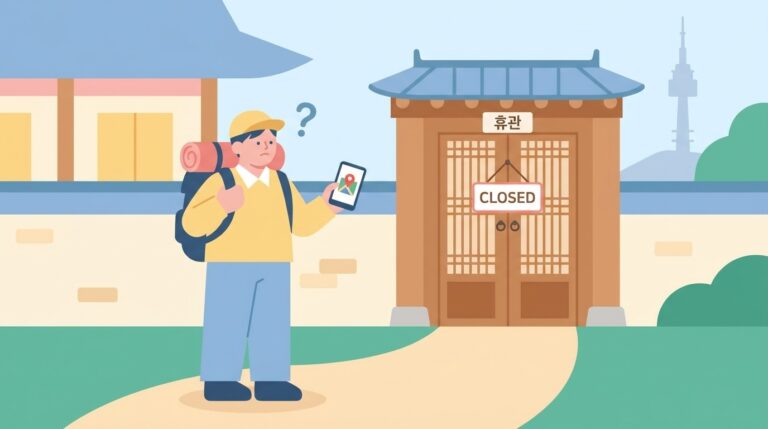
Imagine this: You are exploring Seoul, inspired by a K-Drama where the main characters have a romantic encounter at a stunning art gallery. You finally arrive at the museum you have been dying to see, maybe a trendy pop-up exhibition in Seongsu-dong or the grand National Museum of Korea. You walk up to the door, but it is dark inside. The sign is in Korean, and you realize you have no idea if they are closed for the day, on a break, or closed on Mondays!
This happens to so many travelers. In Korea, things move fast, but museums and galleries have strict schedules. Knowing how to ask for operating hours will not only save your itinerary but also make you sound like a local who knows how to navigate the city. Let us dive into the easiest and most natural ways to check viewing hours!
Core Expressions: Checking the Time
1. 몇 시까지 해요? (Until what time are you open?)
- Pronunciation: myeot sikkaji haeyo? (myut shee-kkah-jee hae-yo?)
- Meaning: Literal: Until what time do you do? / Real nuance: Until what time are you open?
- K-Culture Moment: You will hear this everywhere! From a cozy late-night cafe in Hongdae to a ticket booth at an art gallery. Koreans love using the verb 하다 (to do) for operating a business.
- Editor’s Insight: This is your golden survival phrase. It sounds friendly, natural, and not too formal. It is exactly what a Korean would say when calling a restaurant or asking a museum staff member.
- Situation Spectrum:
- Casual (Friends): ✅
- Semi-formal (Staff, Strangers): ✅
- Formal (Boss, Elders): 🚫
- 🤔 Think About It: Why do Koreans use the word do instead of open? In Korean culture, running a business or service is seen as an active action (doing work). Does your native language focus on the state (being open) or the action?
2. 입장 마감이 몇 시예요? (What time is the last entry?)
- Pronunciation: ipjang magami myeot siyeyo? (eep-jahng mah-gah-mee myut shee-yeh-yo?)
- Meaning: Literal: When is the entrance deadline? / Real nuance: What time is the last entry?
- K-Culture Moment: K-Pop pop-up stores and popular exhibitions are famous for this. Even if the store closes at 8 PM, they might stop letting people in at 7 PM. If you miss the entrance deadline, even your cutest puppy eyes will not get you in!
- Editor’s Insight: The word 마감 (magam, deadline/closing) is a word you will see a lot in Korea. It is the crucial difference between arriving on time and getting turned away at the door.
- Situation Spectrum:
- Casual (Friends): 🚫
- Semi-formal (Staff, Strangers): ✅
- Formal (Boss, Elders): ✅
- 🤔 Think About It: Korea has a very fast-paced palli-palli (hurry) culture, but rules like last entry are strictly followed to ensure staff can leave exactly on time.
3. 오늘 쉬어요? (Are you closed today?)
- Pronunciation: oneul swieoyo? (oh-neul shwi-uh-yo?)
- Meaning: Literal: Do you rest today? / Real nuance: Are you closed today?
- K-Culture Moment: Imagine checking a map app for a famous K-Food restaurant or a local gallery, but the door is locked. You can ask a neighboring shop owner, 오늘 쉬어요? (Are you closed today?).
- Editor’s Insight: We use the verb 쉬다 (to rest) for businesses being closed. It humanizes the shop or museum, implying that the place (or the people running it) needs a well-deserved day off.
- Situation Spectrum:
- Casual (Friends): ✅
- Semi-formal (Staff, Strangers): ✅
- Formal (Boss, Elders): 🚫
- 🤔 Think About It: Personifying a business by saying it rests shows a subtle cultural empathy towards labor. What do you think about this perspective?
Textbook vs. Real Korean
Checking the Closing Time
* 📖 Textbook Korean: 관람 시간이 어떻게 됩니까? (How are the viewing hours?)
* 🗣️ Real Korean: 몇 시까지 해요? (Until what time do you do?)
* 💡 Why is it different?: The textbook phrase is perfectly polite but sounds like a formal news reporter. The real phrase is short, efficient, and used by 99% of locals.
Asking if it is Closed
* 📖 Textbook Korean: 오늘 영업 안 합니까? (Are you not doing business today?)
* 🗣️ Real Korean: 오늘 쉬어요? (Do you rest today?)
* 💡 Why is it different?: Using the word rest instead of business is much softer and more natural for everyday conversations.
Cultural Context — K-Culture Deep Dive
Non-Verbal Cues
When asking a staff member about hours, slightly bow your head (just a gentle nod) and start with 저기요 (Excuse me). Eye contact is good, but do not stare too intensely. A soft, polite tone goes a long way in Korea.
K-Travel Connection: The Monday Trap
If you are planning to visit the grand museums or royal palaces featured in historical K-Dramas, beware of the Monday Trap! Most national museums and public art galleries in Korea are closed on Mondays. If Monday is a national holiday, they might open and close on Tuesday instead. Always check the operating hours before you travel. Koreans heavily rely on apps like Naver Map or KakaoMap because foreign map apps are not fully optimized in Korea. The app will clearly show 영업 종료 (Closed) or 휴무 (Day off).
Real-Life Roleplay Scenario
Setting: Wednesday afternoon, 4:30 PM. You are standing in front of the Dongdaemun Design Plaza (DDP), wanting to see a special K-Culture design exhibition. You see a staff member sorting out line dividers.
Characters:
* YOU: An enthusiastic traveler who really wants to see this exhibition before dinner.
* STAFF: A polite but busy Korean staff member managing the entrance.
YOU: 저기요, 안녕하세요!
(juh-gee-yo, an-nyeong-ha-se-yo!)
(Excuse me, hello!)
STAFF: 네, 안녕하세요. 어떻게 오셨어요?
(ne, an-nyeong-ha-se-yo. uh-ttuh-keh oh-syuh-ssuh-yo?)
(Yes, hello. How can I help you?)
YOU: 이 전시… 지금 볼 수 있어요?
(ee jeon-shi… jee-geum bol soo ee-ssuh-yo?)
(This exhibition… can I see it now?)
STAFF: 아, 죄송합니다. 오늘 현장 발권은 끝났어요.
(ah, joe-song-ham-ni-da. oh-neul hyun-jang bal-gwon-eun kkeut-na-ssuh-yo.)
(Ah, I am sorry. On-site ticketing is finished for today.)
🔀 Your Turn! How should you respond to check the closing time?
A) 왜 끝났어요?! (Why is it finished?!)
B) 그럼 내일은 몇 시까지 해요? (Then until what time are you open tomorrow?)
C) 관람 시간이 어떻게 됩니까? (How are the viewing hours?)✅ Best Choice: B — It is natural, practical, and shows you want to come back.
⚠️ Choice A Analysis: Too aggressive! Never ask why it is finished unless you want to sound angry.
⚠️ Choice C Analysis: Too stiff and robotic for a casual staff interaction.
STAFF (If you chose B): 내일은 오전 10시부터 오후 8시까지 해요. 입장 마감은 7시입니다.
(nae-il-eun oh-jeon yul-shi-boo-tuh oh-hoo yuh-deol-shi-kka-jee hae-yo. ip-jang ma-gam-eun eel-gop-shi-im-ni-da.)
(Tomorrow we are open from 10 AM to 8 PM. Last entry is at 7 PM.)
YOU: 아, 네! 감사합니다. 내일 다시 올게요!
(ah, ne! gam-sa-ham-ni-da. nae-il da-shi ol-ggeh-yo!)
(Ah, okay! Thank you. I will come back tomorrow!)
Bonus K-Culture Roleplay: The Pop-up Store
You are at a K-Pop idol pop-up store in Seongsu.
YOU: 저기요, 오늘 문 열어요? (Excuse me, are you open today?)
FAN: 아뇨, 오늘은 쉬는 날이에요. 내일 오픈런 하셔야 돼요! (No, today is a rest day. You have to do an open-run tomorrow!)
YOU: 헉, 진짜요? 감사합니다! (Gasp, really? Thank you!)
10-Second Shadowing Drill
Let us practice with feeling! Follow the slashes for pauses and match the emotion.
- 😊 Polite & Curious: 저기요, / 오늘 / 몇 시까지 해요? (juh-gee-yo / oh-neul / myut shee-kkah-jee hae-yo?)
- 🥺 Slightly Anxious: 혹시 / 입장 마감이 / 몇 시예요? (hok-shee / eep-jahng mah-gah-mee / myut shee-yeh-yo?)
- 😢 Disappointed: 아… / 오늘 / 쉬어요? (Ah… / oh-neul / shwi-uh-yo?)
K-Culture Mini Dictionary
1. 팝업
* Romanization: pab-eop
* English: Pop-up (store/exhibition)
* Context: Short-term themed spaces, incredibly popular in Korea for K-Pop, K-Beauty, and food. They often have unpredictable hours!
2. 오픈런
* Romanization: o-peun-reon
* English: Open-run
* Context: Waiting in line before a store or exhibition opens to be the first to enter. A massive trend in modern Korean consumer culture.
3. 휴관일
* Romanization: hyu-gwan-il
* English: Closed day
* Context: Literally resting building day. Usually Mondays for most public museums and galleries in Korea.
4. 핫플
* Romanization: hat-peul
* English: Hot place
* Context: A trendy, popular spot. Art galleries and museums in Seoul often become hot places if they have aesthetic photo zones!
Traveler’s Survival Kit
🆘 Survival Phrase #1
* 🇰🇷 이거 얼마예요? (igeo eolmayeyo?)
* 🗣️ English Guide: (ee-guh ul-mah-yeh-yo?)
* 📍 Where to use: Gift shops at the museum, buying tickets.
* 💡 Pro Tip: If you cannot catch the numbers, just hand them your phone with the calculator app open!🆘 Survival Phrase #2
* 🇰🇷 화장실 어딨어요? (hwajangsil eodisseoyo?)
* 🗣️ English Guide: (hwa-jang-shil uh-dee-ssuh-yo?)
* 📍 Where to use: Finding the restroom in a large museum.
* 💡 Pro Tip: Look for signs that say 화장실 or just follow the universally recognized icons.🆘 Survival Phrase #3
* 🇰🇷 사진 찍어도 돼요? (sajin jjigeodo dwaeyo?)
* 🗣️ English Guide: (sah-jeen jjee-guh-doh dwae-yo?)
* 📍 Where to use: Asking if photography is allowed inside the gallery.
* 💡 Pro Tip: Many Korean exhibitions encourage photos, but some strictly forbid it. Always ask first!📌 Editor’s Travel Note
* Useful Apps: Naver Map or KakaoMap. Search for the museum and look for the red text 영업 종료 (Closed) or green text 영업 중 (Open).
* Payment: Korea is a cashless society. Most museum ticket booths prefer or only accept credit cards.
* Tipping: There is no tipping culture in Korea! Do not tip the gallery guides or ticket staff; they will politely decline.
Critical Thinking Corner — One Step Deeper
🧠 Media vs Reality: The Palli-Palli Paradox
In K-Dramas, characters seem to wander into art galleries at all hours, often having dramatic late-night conversations among paintings. However, the reality of Korean museum hours is quite strict. Despite Korea’s famous palli-palli (hurry-hurry) culture and 24-hour convenience stores, the art and cultural sectors heavily protect their operating and resting hours. This strictness ensures that employees can leave exactly on time, reflecting a modern shift in Korean society that values work-life balance over endless service hours.💬 Your Turn: Does your country have late-night museums, or do they close early? Share in the comments!
FAQ & Avoiding Misunderstandings
- Q: Can I use 몇 시까지 해요? to someone older than me?
- Yes! As long as you add the 요 (yo) at the end, it is polite enough for staff members, taxi drivers, and shop owners regardless of their age.
- Q: What if the sign says 18:00 but they will not let me in at 17:30?
- This is the 입장 마감 (Last entry) rule! Always assume the last entry is 30 to 60 minutes before the actual closing time.
❌ Common Mistake 1: Trying to negotiate the closing time. If they say it is closed, it is closed. Korean staff cannot bend system rules.
✅ Do This Instead: Smile, say 알겠습니다 (I understand), and come back the next day.❌ Common Mistake 2: Relying entirely on foreign map apps for museum hours in Korea.
✅ Do This Instead: Always cross-check with Naver Map or the official Korean website!
Summary & Action Items
One-Liner Summary: To check if you can still enjoy the art, simply ask 몇 시까지 해요? (Until what time are you open?) or check the 입장 마감 (Last entry).
Action Mission
* 🥉 Bronze (Solo): Say 몇 시까지 해요? aloud 3 times while looking at your watch.
* 🥈 Silver (Online): Find a Korean museum you want to visit online and check if they are open on Mondays.
* 🥇 Gold (Real Life): Download Naver Map, search for National Museum of Korea, and find their operating hours today!
K-Culture Mission: Go to Instagram or YouTube and search for Seoul Pop-up Store. Listen closely to the videos and see if you can spot anyone doing an 오픈런 (open-run)!
Engagement: What is the number one museum or gallery you want to visit in Korea? Let me know below!
Interactive Challenge Quiz
1. Situational Judgment
You arrive at a gallery at 5:45 PM. The sign says they close at 6:00 PM. The staff blocks the door. What is the most likely reason?
* A) The staff is angry.
* B) The 입장 마감 (last entry) has passed.
* C) They do not like tourists.
(Answer: B. Galleries usually have a strict last entry time 30-60 minutes before closing.)
2. Fill in the Blank
To ask Until what time are you open?, you say: _____ 시까지 해요?
* A) 언제 (When)
* B) 몇 (How many/What)
* C) 오늘 (Today)
(Answer: B. 몇)
3. True or False – K-Culture Edition
Most national museums in Korea are open every day of the week.
(Answer: False! Beware the Monday Trap. Most public museums close on Mondays.)
Frequently Asked Questions (FAQ)
Q: What does "몇 시까지 해요? (Until what time are you open?)" mean in Korean and how do you pronounce it?
A: In Korean, "몇 시까지 해요? (Until what time are you open?)" is pronounced [myeot sikkaji haeyo? (myut shee-kkah-jee hae-yo?] and means: Literal: Until what time do you do? / Real nuance: Until what time are you open?
Q: What does "입장 마감이 몇 시예요? (What time is the last entry?)" mean in Korean and how do you pronounce it?
A: In Korean, "입장 마감이 몇 시예요? (What time is the last entry?)" is pronounced [ipjang magami myeot siyeyo? (eep-jahng mah-gah-mee myut shee-yeh-yo?] and means: Literal: When is the entrance deadline? / Real nuance: What time is the last entry?
Q: What does "오늘 쉬어요? (Are you closed today?)" mean in Korean and how do you pronounce it?
A: In Korean, "오늘 쉬어요? (Are you closed today?)" is pronounced [oneul swieoyo? (oh-neul shwi-uh-yo?] and means: Literal: Do you rest today? / Real nuance: Are you closed today?







