

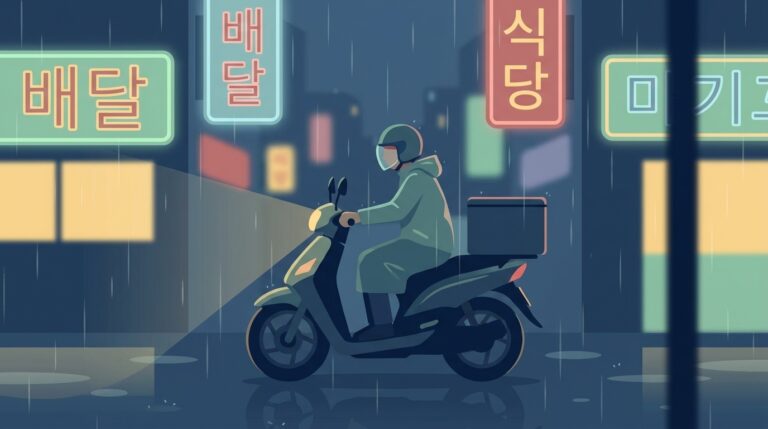
Phase 1: Empathy & The Rain-Soaked Delivery Rider
Hello! This is your Daily Hangul Editor.
Imagine this: It is a torrential downpour in Seoul. You are craving something warm and spicy, so you open your food delivery app and order a piping hot bowl of Jjamppong (spicy seafood noodle soup). The app says your food will arrive in 30 minutes, but 50 minutes pass. You are starting to get annoyed. Finally, the doorbell rings. You open the door, ready to sigh, but you are met with a rider completely drenched in rain, bowing apologetically and handing over your food.
Suddenly, that slight annoyance transforms into a heavy, complex feeling. The subtitle in your brain says ‘Thank you,’ but is that really enough?
Welcome to C2 Advanced Korean. Today, we are moving beyond ordering coffee and asking for directions. We are diving deep into one of the most hotly debated social issues in modern South Korea: Guaranteeing Labor Rights for Platform Workers. If you want to hold your own in a debate with Korean university students, or truly understand the socioeconomic undertones of the latest K-Drama about startup companies, you need to know these words. We are going to look at the hidden humans behind the hyper-convenient ‘Bbali-bbali’ (hurry up) K-Food delivery culture.
This article is built from the deep, thought-provoking questions asked by our advanced learners who noticed the cracks in the shiny facade of Korea’s gig economy.
Phase 2: Core Expressions Deep Dive
To discuss this social issue like a true intellectual, you need to master these three advanced expressions.
1. 특수고용직 (Specially Employed Workers)
- Pronunciation: teuk-su-go-yong-jik (Sounds like: ‘Tsook-soo-go-yong-jik’. Emphasize the ‘teuk’ like a sharp tap.)
- Meaning: Literal: Special employment type. Real nuance: Independent contractors who work essentially like regular employees but are legally classified outside standard labor law protections (gig workers, delivery riders, etc.).
- K-Culture Moment: You will hear this term constantly on Korean news programs like ‘PD Note’ or in socially conscious K-Dramas where the protagonist is fighting a massive corporate entity for basic rights.
- Editor’s Insight: This is a heavy, academic-yet-common word. When you use this, Koreans will instantly know your language skills are top-tier. It highlights the gray area of the platform economy.
- Situation Spectrum:
- Chatting with close friends (Casual): ⚠️ (A bit too academic for casual banter, unless discussing news)
- Debating with colleagues (Semi-formal): ✅
- Formal presentations (Formal): ✅
- 🤔 Think About It: Why does the Korean legal system use the word ‘special’ (특수) for these workers? Does the word ‘special’ actually mask their vulnerability?
2. 별점 테러 (Review Terrorism)
- Pronunciation: byeol-jeom te-reo (Sounds like: ‘Byul-jum teh-ro’. ‘Byul’ sounds like the start of ‘beautiful’ without the ‘ti-ful’, but with a ‘y’.)
- Meaning: Literal: Star-point terror. Real nuance: Review bombing. Maliciously leaving 1-star reviews on delivery apps to ruin a restaurant’s or rider’s reputation, often for absurd reasons.
- K-Culture Moment: You order a pizza, and you see a 1-star review because ‘the delivery rider didn’t smile.’ This phrase is everywhere on Korean internet forums and YouTube commentary videos.
- Editor’s Insight: This phrase perfectly captures the dramatic flair of Korean internet slang. The word ‘terror’ shows just how economically devastating a bad review can be in Korea’s highly competitive delivery market.
- Situation Spectrum:
- Chatting with close friends (Casual): ✅
- Debating with colleagues (Semi-formal): ✅
- Formal presentations (Formal): ⚠️ (Use ‘악의적 리뷰’ – malicious reviews – in extremely formal settings)
- 🤔 Think About It: The customer is king, but at what cost? How does the rating system in apps shift the power dynamic unfairly against the platform worker?
3. 알고리즘의 노예 (Slave to the Algorithm)
- Pronunciation: al-go-ri-jeum-ui no-ye (Sounds like: ‘Al-go-ri-jum-eh no-yeh’.)
- Meaning: Literal: Slave to the algorithm. Real nuance: A sharp critique of how AI dispatch systems control delivery riders’ routes, speeds, and incomes without human empathy.
- K-Culture Moment: In documentaries about platform workers, you will see riders staring at their phones, desperately chasing the high-paying routes dictated by an invisible AI.
- Editor’s Insight: This is a highly evocative, slightly cynical phrase. It is the perfect term to use when criticizing tech companies that hide behind technology to avoid employer responsibilities.
- Situation Spectrum:
- Chatting with close friends (Casual): ✅
- Debating with colleagues (Semi-formal): ✅
- Formal presentations (Formal): 🚫 (Too emotional. Use ‘알고리즘 종속성’ – algorithmic subordination – instead.)
- 🤔 Think About It: Does technology create freedom (gig work) or a new form of invisible control?
Phase 3: Textbook vs Real Korean
Let us see how textbook Korean compares to what is actually spoken in debates and everyday life regarding this issue.
Discussing Delivery Delays
* 📖 Textbook Korean: 배달이 늦어서 플랫폼 노동자의 환경이 걱정됩니다. (I am worried about the platform worker’s environment because the delivery is late.)
* 🗣️ Real Korean: 비 오는데 라이더분들 묶음 배달 하느라 고생하시네. (It’s raining, the riders must be suffering doing bundled deliveries.)
* 💡 Why the difference?: Koreans use specific industry terms like ‘묶음 배달’ (bundled deliveries) naturally, showing empathy through understanding their actual work process.
Reacting to Unfair App Policies
* 📖 Textbook Korean: 플랫폼 회사는 노동법을 준수해야 합니다. (Platform companies must obey labor laws.)
* 🗣️ Real Korean: 앱 수수료 떼가는 거 보면 진짜 갑질이 따로 없어요. (Seeing the app take those commission fees, it’s pure ‘Gapjil’ – abuse of power.)
* 💡 Why the difference?: ‘갑질’ (Gapjil) is the ultimate Korean buzzword for power abuse. It injects a strong cultural and emotional critique into the sentence that formal terms lack.
Phase 4: Cultural Context — K-Culture Deep Dive
4-1. Non-verbal Nuances & Nunchi
When discussing heavy social issues like this in Korea, Nunchi (the ability to read the room) is vital. If you are having a beer with Korean friends and the topic of delivery strikes comes up, leaning in and lowering your voice slightly shows you are treating the topic with the gravity it deserves.
Furthermore, when receiving food from a delivery rider, the non-verbal Korean way is a quick, slight nod of the head while taking the bag with two hands (or at least one hand supporting the other arm). Even if it is a rapid, 2-second interaction, that physical gesture of respect bridges the gap between consumer and laborer.
4-2. The K-Food Connection: The Bbali-Bbali Paradox
Korean food culture is world-renowned for its hyper-efficiency. You can get a full Korean BBQ meal, complete with side dishes, delivered to a park by the Han River in 40 minutes. But this K-Food miracle relies on a paradox.
We love ‘Bbali-Bbali’ (hurry up) culture, but society is increasingly feeling guilty about the human cost. Recently, delivery apps added an option: ‘천천히 안전하게 와주세요’ (Please come slowly and safely). This check-box on an app is a fascinating cultural shift. It is society trying to use technology to buy back the human empathy that the algorithm stripped away.
Phase 5: Real-Life Roleplay Scenario
Setting: It is 8:00 PM on a Friday. You and two Korean coworkers are at a noisy Chimaek (Chicken and Beer) pub in Gangnam. You just read a news article about delivery riders going on strike for better base pay.
Characters:
* YOU (Reader): An expat working in Seoul, highly observant of Korean society.
* Jiwon (30): Your Korean coworker. Practical, a bit tired from work, uses delivery apps daily.
Dialogue:
Jiwon: 아, 배달비 또 올랐어. 이제 치킨 한 마리 시켜 먹기도 무섭다니까.
(Ah, baedal-bi tto ollasseo. Ije chikin han mari sikyeo meokgido museopdanikka.)
[Translation: Ugh, delivery fees went up again. It’s scary to even order a whole chicken now.]
YOU: 맞아요. 근데 뉴스 보니까 라이더분들 기본 배달료는 몇 년째 그대로라고 파업하시더라고요.
(Majayo. Geunde nyuseu bonikka raideo-bundeul gibon baedallyoneun myeot nyeon-jjae geudaerorago pa-eop-hasideoragoyo.)
[Translation: That’s true. But I saw on the news that riders are striking because their base delivery fee hasn’t changed in years.]
Jiwon: 진짜요? 플랫폼 회사가 수수료를 다 가져가는 건가?
(Jinjjayo? Peullaet-pom hoesaga susu-ryoreul da gajyeoganeun geonga?)
[Translation: Really? Is the platform company taking all the commission?]
YOU: 네, 그래서 특수고용직 노동권 보장 문제가 요즘 뜨거운 이슈잖아요.
(Ne, geuraeseo teuk-su-go-yong-jik nodong-gwon bojang munjega yojeum tteugeo-un isyu-janayo.)
[Translation: Yes, that’s why the issue of guaranteeing labor rights for specially employed workers is a hot topic lately.]
Jiwon: 하긴, 비 오는 날 위험하게 운전하시는 거 보면 안쓰럽긴 해요.
(Hagin, bi oneun nal wiheomhage unjeon-hasineun geo bomyeon ansseureopgin haeyo.)
[Translation: I guess so. When I see them driving dangerously on rainy days, I do feel bad for them.]
🔀 Your Turn! How will you respond?
– A) 플랫폼 기업 규제가 필요해요. (We need regulations on platform companies.)
– B) 우리라도 리뷰 좋게 남겨드려요! (At the very least, let’s leave them good reviews!)
– C) 그래도 배달비는 너무 비싸요. (Still, delivery fees are too expensive.)✅ Best Choice: B — Why? It acknowledges the systemic issue but brings it back to a warm, actionable human level (‘Jeong’ / 정 culture). It keeps the pub conversation friendly while staying socially conscious.
⚠️ Choice A Analysis: Grammatically perfect, but a bit too academic for a Friday night pub conversation. It might kill the mood.
Phase 6: 10-Second Shadowing Drill
Practice your intonation to sound like a native Korean debating a social issue.
😤 단호하게 (Firmly, discussing regulations):
플랫폼 회사는 / 알고리즘 뒤에 숨지 말고 / 노동자를 보호해야 합니다.
(Peullaet-pom hoesaneun / al-go-ri-jeum dwi-e sumji malgo / nodong-jareul bohohaeya hamnida.)
[Platform companies must not hide behind algorithms and must protect workers.]
😊 따뜻하게 (Warmly, to a delivery worker):
비 오는데 / 고생 많으셨습니다. / 안전 운전하세요!
(Bi oneun-de / gosaeng maneuseot-seumnida. / anjeon unjeon-haseyo!)
[You’ve worked hard in the rain. Please drive safely!]
Phase 7: K-Culture Mini Dictionary
1. 배달앱 (Baedal-app)
* English: Delivery App
* Context: The giants of the Korean food industry (e.g., Baedal Minjok, Yogiyo, Coupang Eats). They control the market and the algorithms.
2. 갑질 (Gapjil)
* English: Abuse of power
* Context: The overarching social issue where the ‘Gap’ (the one with power, e.g., the platform or the angry customer) abuses the ‘Eul’ (the subordinate, e.g., the delivery rider).
3. 상생 (Sang-saeng)
* English: Mutual growth / Coexistence
* Context: A highly favored corporate buzzword in Korea. When platform companies are criticized for exploiting workers, they always release statements promising ‘Sang-saeng’.
4. 콜 (Call)
* English: A delivery order/dispatch
* Context: Riders do not say ‘I got an order,’ they say ‘콜 잡았다’ (I caught a call). It reflects the gig economy’s piece-rate nature.
Phase 8: Traveler’s Survival Kit
Even if you are just visiting Korea, you will likely use a delivery app. Understanding the labor context helps you become a more respectful traveler.
🆘 Survival Phrases for Delivery Apps
– 🇰🇷 문 앞에 두고 벨 눌러주세요. (Mun ap-e dugo bel nulleo-juseyo.)
– 🗣️ Guide: Moon ah-peh doo-go bell nool-luh-joo-seh-yo.
– 📍 Where to use: In the ‘Delivery Request’ box on the app.
– 💡 Pro Tip: This is the most common delivery instruction in Korea. It saves the rider time and provides contactless delivery!📌 Editor’s Travel Note
– Tipping: Korea DOES NOT have a tipping culture. Recently, a major app tried to introduce a tipping feature for riders, and Korean society completely rejected it. The consensus was: ‘The platform should pay them properly, don’t pass the burden to the consumer!’
– Weather: If there is a typhoon or heavy snow, delivery apps will temporarily shut down to protect the riders’ safety. Do not get angry; it is a sign of social protection.
Phase 9: Critical Thinking Corner — ‘One Step Deeper’
Language & Power (언어와 권력)
The platform economy strips away the rich, context-heavy power dynamics of traditional Korean speech. In standard Korean society, respect (존댓말) is established through age, status, and face-to-face interaction. However, on a delivery app, the rider is just a moving dot on a map, and the customer is just an address. This digital anonymity allows for a brutal power imbalance, leading to phenomena like ‘Review Terrorism’ (별점 테러). The app interface creates a false reality where the laborer’s human dignity is invisible. By learning terms like 특수고용직, we are using language to pull these invisible workers back into the light of social consciousness.
💬 Your Turn: Does the gig economy in your home country have specific slang or terminology that masks the harsh realities of the workers? Share it in the comments!
Phase 10: FAQ & Avoiding Mistakes
Q: Should I hand the delivery driver a cash tip if it is raining heavily?
Maybe. While standard tipping is a strict ‘No’, handing a rider a warm canned coffee (캔커피) or a small 1,000 won bill in terrible weather with the words ‘고생하십니다’ (You are working hard) is seen as ‘Jeong’ (정 – Korean warm-heartedness), not a capitalist tip.
Q: Is it okay to complain to the rider if the food is cold?
No. In Korea’s platform system, the rider is usually just a third-party contractor. Complaining to them does nothing. You must process refunds or complaints through the app’s customer service.
❌ Common Mistake #1: Saying ‘수고하셨습니다’ (You worked hard) to a delivery rider who is older than you.
✅ Do this instead: While ‘수고하세요’ is widely used, technically, saying it to someone significantly older can be seen as slightly condescending. A safer, universally polite phrase is ‘감사합니다. 안전 운전하세요!’ (Thank you. Drive safely!).
Phase 11: Summary & Action Items
One-Liner Summary: Understanding the vocabulary around platform workers (like 특수고용직 and 알고리즘) elevates your Korean from a tourist level to a socially conscious, advanced speaker.
Action Mission 3 Steps:
* 🥉 Bronze (Solo): Read a Korean news headline containing the word ‘특수고용직’ or ‘플랫폼 노동자’ and translate it.
* 🥈 Silver (Online): Go to a Korean YouTube video about delivery riders and leave a supportive comment: ‘라이더분들 항상 안전 운전하세요!’
* 🥇 Gold (Real Life): The next time you order delivery in Korea, type ‘천천히 안전하게 와주세요’ (Please come slowly and safely) in the request box.
K-Culture Mission:
Watch an episode of the K-Drama ‘Strongest Deliveryman’ or search for ‘배달 라이더 다큐’ (Delivery Rider Documentary) on YouTube. Try to spot how many times they mention ‘콜’ (calls) and ‘수수료’ (commission fees).
Did you learn something new about the reality behind your late-night K-Chicken? Let me know in the comments below!
Frequently Asked Questions (FAQ)
Q: What does "특수고용직 (Specially Employed Workers)" mean in Korean and how do you pronounce it?
A: In Korean, "특수고용직 (Specially Employed Workers)" is pronounced [teuk-su-go-yong-jik (Sounds like: 'Tsook-soo-go-yong-jik'. Emphasize the 'teuk' like a sharp tap.] and means: Literal: Special employment type. Real nuance: Independent contractors who work essentially like regular employees but are legally classified outside standard labor law protections (gig workers, delivery riders, etc.).
Q: What does "별점 테러 (Review Terrorism)" mean in Korean and how do you pronounce it?
A: In Korean, "별점 테러 (Review Terrorism)" is pronounced [byeol-jeom te-reo (Sounds like: 'Byul-jum teh-ro'. 'Byul' sounds like the start of 'beautiful' without the 'ti-ful', but with a 'y'.] and means: Literal: Star-point terror. Real nuance: Review bombing. Maliciously leaving 1-star reviews on delivery apps to ruin a restaurant's or rider's reputation, often for absurd reasons.
Q: What does "알고리즘의 노예 (Slave to the Algorithm)" mean in Korean and how do you pronounce it?
A: In Korean, "알고리즘의 노예 (Slave to the Algorithm)" is pronounced [al-go-ri-jeum-ui no-ye (Sounds like: 'Al-go-ri-jum-eh no-yeh'.] and means: Literal: Slave to the algorithm. Real nuance: A sharp critique of how AI dispatch systems control delivery riders' routes, speeds, and incomes without human empathy.







