

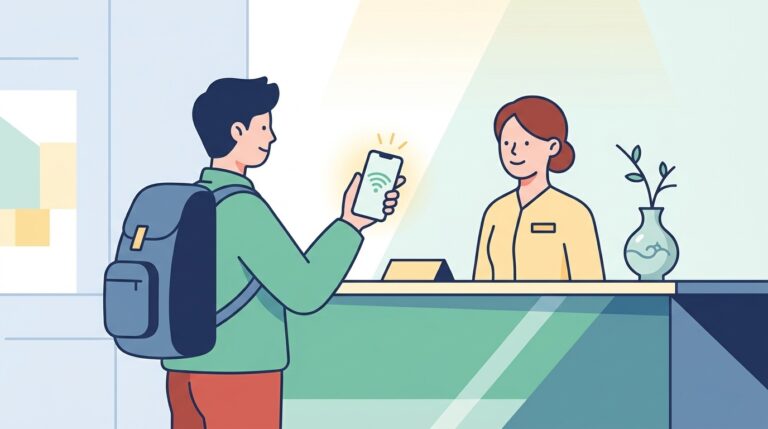
Phase 1: Empathy (Immersive Open)
Hello! I’m your Daily Hangul Editor. Picture this: You’ve just arrived in Seoul after a long 12-hour flight. You check into a gorgeous hotel, drop your bags, and flop onto the bed. You want to text your family that you arrived safely, check your travel itinerary, or maybe watch that new K-Drama episode. But wait… you don’t have internet! You head down to the lobby. You know the word Wi-Fi, but how do you actually ask for the password without freezing up or sounding like a translation app?
Today, we are going to learn how to ask for Wi-Fi naturally, just like a local. By the end of this post, you’ll sound so natural that the hotel staff might mistake you for a Seoulite! This guide is based on real questions from my beginner students who panicked at the front desk. Let’s dive in!
Phase 2: Core Expressions Deep Dive
1. 와이파이 비밀번호가 뭐예요?
- Pronunciation: wa-i-pa-i bi-mil-beon-ho-ga mwo-ye-yo? (wa-ee-pa-ee bee-meel-beon-ho-ga mwo-yeh-yo?)
- Meaning: Literal: What is the Wi-Fi secret number? / Real nuance: What’s the Wi-Fi password?
- K-Culture Moment: You will hear this everywhere in Korea! In a cafe, a restaurant, or a hotel lobby. Koreans love staying connected, so asking for the password is the most normal thing in the world.
- Editor’s Insight: The word 비밀 (bi-mil) means secret, and 번호 (beon-ho) means number. It feels like you are asking for a secret code, but it’s just the standard word for password! Don’t overthink it, just let it flow.
- Situation Spectrum:
- 친구 사이(Casual): ✅ (Change it slightly to: 와이파이 비밀번호 뭐야?)
- 직장 동료(Semi-formal): ✅
- 직장 상사·어른(Formal): ✅ (Perfectly polite for hotel staff)
- 🤔 Think About It: Why does Korean use the English word Wi-Fi but a Korean word for password? How does your native language handle new internet terms?
2. 와이파이 비번 알려주세요.
- Pronunciation: wa-i-pa-i bi-beon al-lyeo-ju-se-yo. (bee-beon ahl-lyeo-joo-seh-yo)
- Meaning: Literal: Please let me know the Wi-Fi password. / Real nuance: Can I get the Wi-Fi password, please?
- K-Culture Moment: If you watch a K-Drama where friends meet at a cafe, you might hear them say 비번 (bi-beon). It is the shortened, slightly more casual version of 비밀번호.
- Editor’s Insight: This is a fantastic survival phrase! 알려주세요 (al-lyeo-ju-se-yo) means please let me know. You can attach it to anything you want to find out!
- Situation Spectrum:
- 친구 사이(Casual): ✅ (Change to 알려줘)
- 직장 동료(Semi-formal): ✅
- 직장 상사·어른(Formal): ⚠️ (A bit too direct for a very formal setting, but completely fine for friendly hotel or cafe staff)
- 🤔 Think About It: Koreans love shortening words to save time. This culture is called 줄임말 (ju-rim-mal). Does your culture value efficiency in language too?
Phase 3: Textbook vs Real Korean
Asking for the password
* 📖 Textbook Korean: 와이파이 암호가 무엇입니까? (wa-i-pa-i am-ho-ga mu-eo-sim-ni-kka?)
* 🗣️ Real Korean: 와이파이 비번 뭐예요? (wa-i-pa-i bi-beon mwo-ye-yo?)
* 💡 Why is it different?: Textbook Korean often uses very formal, news-anchor style endings (입니까). In real life, the polite 요 (yo) ending with the shortened word 비번 (bi-beon) sounds much friendlier and natural.
Asking if there is internet
* 📖 Textbook Korean: 무선 인터넷이 됩니까? (mu-seon in-teo-ne-si doem-ni-kka?)
* 🗣️ Real Korean: 여기 와이파이 돼요? (yeo-gi wa-i-pa-i dwae-yo?)
* 💡 Why is it different?: Nobody really says wireless internet (무선 인터넷) in daily life. Everyone just says Wi-Fi, and 돼요? (Does it work?) is the ultimate casual-polite question for checking availability.
Phase 4: Cultural Context — K-Culture Deep Dive
4-1. Non-verbal Elements
When asking the hotel staff for the password, you don’t need to make intense eye contact. Simply holding up your smartphone or pointing to the Wi-Fi network screen while asking is a very natural gesture. Also, remember to receive any written password slips or room keys with two hands! It shows respect in Korean culture.
4-2. The K-Travel Connection: The Kingdom of Fast Internet
Korea is famous for its 빨리빨리 (ppalli-ppalli / hurry-hurry) culture. This directly translates to their internet infrastructure. Korea has some of the fastest, most accessible Wi-Fi in the world. You will find free Wi-Fi on subways, buses, and even in random public parks! When you are at a hotel, the Wi-Fi is almost always free, and the password is often written right on your key card sleeve. But if you can’t find it, don’t hesitate to ask.
Phase 5: Real-Life Roleplay Scenario
Setting: 3:00 PM. The front desk of a modern business hotel in Gangnam. You’ve just received your room key after a long journey.
Characters:
* YOU: An excited traveler ready to explore Seoul, but you need your map app to work.
* Min-ji: A friendly hotel receptionist.
Dialogue:
Min-ji: 객실 키 여기 있습니다. 편안한 시간 되세요.
(gaek-sil ki yeo-gi it-seum-ni-da. pyeon-an-han si-gan doe-se-yo.)
[Here is your room key. Have a comfortable stay.]
(Stage Direction: Min-ji hands you the key card with both hands)
YOU: 감사합니다. 그런데…
(gam-sa-ham-ni-da. geu-reon-de…)
[Thank you. By the way…]
Min-ji: 네, 고객님. 더 필요하신 게 있으신가요?
(ne, go-gaeng-nim. deo pi-ryo-ha-sin ge it-seu-sin-ga-yo?)
[Yes, guest. Do you need anything else?]
🔀 Your Turn! How should you respond?
* A) 와이파이 비밀번호가 뭐예요? (wa-i-pa-i bi-mil-beon-ho-ga mwo-ye-yo?)
* B) 인터넷 내놔! (in-teo-net nae-nwa!)
* C) 무선 인터넷 암호가 무엇입니까? (mu-seon in-teo-net am-ho-ga mu-eo-sim-ni-kka?)✅ Best Choice: A — It is polite, natural, and exactly what a local would say.
⚠️ Choice B Analysis: This means Give me the internet! Very rude and aggressive. Never use this!
⚠️ Choice C Analysis: You sound like a time-traveler or a robot. It is too formal and unnatural for a simple question.
Min-ji: 아, 와이파이 비밀번호는 객실 카드 키 봉투 뒷면에 적혀 있습니다!
(a, wa-i-pa-i bi-mil-beon-ho-neun gaek-sil ka-deu ki bong-tu dwin-myeon-e jeo-kyeo it-seum-ni-da!)
[Ah, the Wi-Fi password is written on the back of your room key envelope!]
(Stage Direction: Min-ji smiles and points to the small numbers on your key holder.)
Phase 6: 10-Second Shadowing Drill
Let’s practice the most important sentence. Pay attention to the pauses and the intonation!
😊 저기요, / 와이파이 비번이 / 뭐예요?
(jeo-gi-yo, / wa-i-pa-i bi-beon-i / mwo-ye-yo?)
[Excuse me, what is the Wi-Fi password?]
Editor’s tip: Keep your tone bright and polite, slightly raising your pitch at the very end on 요 (yo)!
Phase 7: K-Culture Mini Dictionary
1. 비번
* Romanization: bi-beon
* English: Password (short for 비밀번호)
* Context: Used heavily by young people and in casual daily life. If you use this, you sound like a true insider.
2. 호캉스
* Romanization: ho-kang-seu
* English: Staycation (Hotel + Vacance)
* Context: A popular trend in Korea where people spend their vacation relaxing inside a luxury hotel rather than traveling far.
3. 프론트 / 로비
* Romanization: peu-ron-teu / ro-bi
* English: Front desk / Lobby
* Context: Konglish (Korean-English) terms widely used in Korean hotels. Everyone understands them!
4. 빨리빨리
* Romanization: ppal-li-ppal-li
* English: Hurry hurry / fast
* Context: The driving force behind Korea’s incredibly fast internet speeds and highly efficient service culture.
Phase 8: Traveler’s Survival Kit
🆘 Survival Expression #1
* 🇰🇷 여기 와이파이 돼요? (yeo-gi wa-i-pa-i dwae-yo?)
* 🗣️ English pronunciation: yeo-gee wa-ee-pa-ee dweh-yo?
* 📍 Where to use: Cafes, restaurants, small hotels.
* 💡 Pro Tip: 돼요 (dwae-yo) means Does it work? or Is it available? It’s a magic word you can use for almost anything!📌 Editor’s Travel Note
* Passwords everywhere: In cafes and hotels, the Wi-Fi password is very often the establishment’s phone number! Look for numbers on the receipt or near the counter.
* Connecting: Sometimes the Wi-Fi network name in a hotel is just your room number, like Room_204.
* Public Wi-Fi: Look for networks named Public WiFi Free in public spaces. You usually just need to click the big blue button on a pop-up screen to connect!
Phase 9: Critical Thinking Corner — A Step Deeper
Language in the Global Era (Konglish)
🧠 Think Deeper:
Have you noticed that Koreans say 와이파이 (Wa-i-pa-i) and 로비 (Ro-bi)? As Korea rapidly modernized and became a global tech hub, many English words were absorbed directly into the Korean language. These are called 외래어 (loan words). While some purists argue we should invent native Korean words for everything, using global terms like Wi-Fi makes life incredibly easy for both locals and travelers. It shows how a language gracefully adapts to technology and global connectivity.💬 Your Turn: Does your native language use English tech words, or do you invent your own unique words for things like Wi-Fi and the Internet? Share your thoughts in the comments!
Phase 10: FAQ & Avoiding Misunderstandings
- Q: Can I just say ‘Password’ in English?
A: Yes! Most hotel staff will understand the English word Password, but taking the effort to say 비밀번호 (bi-mil-beon-ho) guarantees a big, appreciative smile! -
Q: Is it okay to ask for the Wi-Fi before I even check in?
A: Absolutely! If you need to check your booking details on your email, just ask the lobby staff politely. They are happy to help.
❌ Common Mistake #1: Asking 와이파이 있어? (wa-i-pa-i it-seo?)
✅ Do this instead: 있어 (it-seo) is very informal (banmal). You should never use it with staff or strangers. Always add 요 (yo) at the end to be polite: 와이파이 있어요? (wa-i-pa-i it-seo-yo?)
Phase 11: Summary & Action Items
One-Liner Summary: To connect to the internet in Korea, just remember the magic phrase: 와이파이 비밀번호가 뭐예요? (What is the Wi-Fi password?)
Action Mission 3 Steps:
* 🥉 Bronze (Solo): Say 와이파이 비밀번호 3 times out loud while looking in the mirror.
* 🥈 Silver (Online): Write down the Korean phrase for Wi-Fi password in your travel notebook or phone’s notes app.
* 🥇 Gold (Real Life): Use this exact phrase at your hotel or a Korean cafe on your next trip to Seoul!
K-Culture Mission:
Watch an episode of a modern K-Drama today and look closely at the cafe or hotel scenes. Can you spot a small sign on the counter that says 와이파이? (Hint: It usually has the password right under it!)
Phase 12: Interactive Quiz
1. Situational Judgment: You are at a fancy hotel lobby and need the password to message a friend. What is the most natural way to ask the staff?
* A) 인터넷 암호! (in-teo-net am-ho!)
* B) 와이파이 비밀번호가 뭐예요? (wa-i-pa-i bi-mil-beon-ho-ga mwo-ye-yo?)
(Answer: B. Option A is way too abrupt and rude! B is perfectly polite and natural.)
2. True or False – K-Culture Edition: You always have to pay extra to use the Wi-Fi in Korean hotels.
(Answer: False! Korea is a hyper-connected society. Wi-Fi is almost universally free, especially in hotels, cafes, and even on public transport.)
Great job today! You are now officially ready to navigate the Korean internet landscape. I’ll see you in the next lesson!
Frequently Asked Questions (FAQ)
Q: What does "와이파이 비밀번호가 뭐예요?" mean in Korean and how do you pronounce it?
A: In Korean, "와이파이 비밀번호가 뭐예요?" is pronounced [wa-i-pa-i bi-mil-beon-ho-ga mwo-ye-yo? (wa-ee-pa-ee bee-meel-beon-ho-ga mwo-yeh-yo?] and means: Literal: What is the Wi-Fi secret number? / Real nuance: What's the Wi-Fi password?
Q: What does "와이파이 비번 알려주세요." mean in Korean and how do you pronounce it?
A: In Korean, "와이파이 비번 알려주세요." is pronounced [wa-i-pa-i bi-beon al-lyeo-ju-se-yo. (bee-beon ahl-lyeo-joo-seh-yo] and means: Literal: Please let me know the Wi-Fi password. / Real nuance: Can I get the Wi-Fi password, please?







