

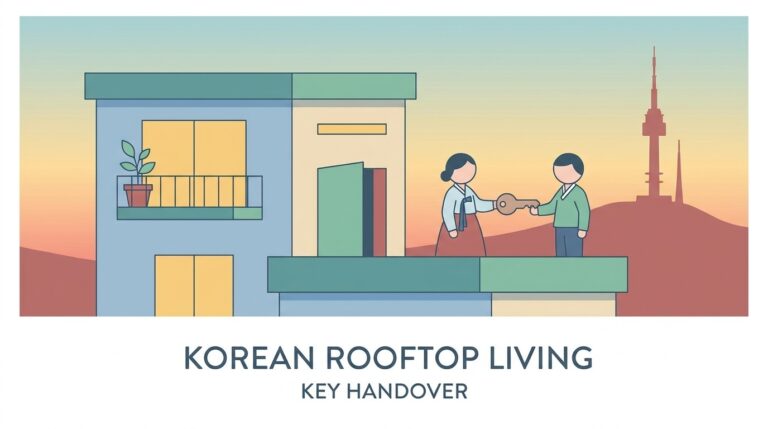
Greeting & K-Culture Cold Open
Hello! I’m the lead editor of Daily Hangul.
Picture this: You’re in Seoul. You’ve finally found that perfect, cozy rooftop apartment (Oktapbang) just like the one from your favorite K-Drama. The night view of N Seoul Tower is stunning. You are ready to move in! The real estate agent smiles and says something about Bokbi.
Bokbi? Is it a type of Korean BBQ? A hidden tax?
If you don’t know this word, you might end up very confused when signing your lease! Today, we are diving into the world of Korean real estate (Budongsan) and the secret language of brokerage fees.
Note: This guide is based on real struggles from my expat students who survived the wild Seoul housing market!
Phase 2: Core Expressions Deep Dive
1. 복비가 얼마예요?
- Pronunciation: bokbi-ga eolmayeyo? [bohk-bee-gah uhl-mah-yeh-yo?]
- Meaning: How much is the brokerage fee? (Literal: How much is the good luck fee?)
- K-Culture Moment: In K-Dramas, when the main character is flat broke and looking for a tiny room, they always ask this with a nervous voice. Bokbi literally translates to good luck fee. In the old days, people believed paying the agent generously would bring good fortune to their new home!
- Editor’s Insight: This is the most natural way to ask about the agent’s commission. It sounds much more native than the textbook version.
- Situation Spectrum:
- Casual (Friends): ✅
- Semi-formal (Agent): ✅
- Formal (Boss): 🚫
- 🤔 Think About It: Why do Koreans call a business transaction fee a good luck fee? Does your culture have any financial terms wrapped in positive, lucky meanings?
2. 조금만 깎아주세요.
- Pronunciation: jogeum-man ggakka-juseyo. [joh-geum-mahn gkah-gkah-joo-seh-yo]
- Meaning: Please give me a little discount.
- K-Culture Moment: You’ll see grandmas doing this at traditional markets, but you can also try this with the real estate agent for the Bokbi! Sometimes, if you ask nicely with a smile, they might round down the fee.
- Editor’s Insight: The word 깎다 means to peel (like an apple) or cut down. You are asking them to shave off a bit of the price.
- Situation Spectrum:
- Casual: ✅
- Semi-formal: ✅ (Use politely with agents)
- Formal: 🚫
- 🤔 Think About It: Haggling is a dying art in modern Korean malls, but it survives in real estate and local markets. How common is haggling in your home country?
3. 여기로 계약할게요.
- Pronunciation: yeogi-ro gyeyakalgeyo. [yuh-gee-roh gyeh-yahk-hahl-geh-yo]
- Meaning: I will sign the contract for this place.
- K-Culture Moment: The triumphant moment! The agent hands you a mix of instant coffee (the legendary Korean Maxim coffee), and you confidently declare you’ll take the room.
- Editor’s Insight: 여기 means here, and 계약 means contract. It’s a very decisive and clear phrase perfect for A1 learners.
- Situation Spectrum:
- Casual: ✅
- Semi-formal: ✅
- Formal: ✅
- 🤔 Think About It: Sealing a deal in Korea usually involves a physical stamp (Dojang) rather than just a signature. Have you ever used a personal stamp?
Phase 3: Textbook vs Real Korean
[Asking about the commission fee]
* 📖 Textbook Korean: 중개 수수료는 얼마입니까? (junggae susuryoneun eolmaimnikka? / How much is the brokerage commission?)
* 🗣️ Real Korean: 복비 얼마예요? (bokbi eolmayeyo? / How much is the Bokbi?)
* 💡 Why the difference?: 중개 수수료 is the legal, official term. 복비 is the historical, cultural term everyone actually uses in daily life because it’s shorter and carries a warm good luck vibe.
[Agreeing to the price]
* 📖 Textbook Korean: 이 가격에 동의합니다. (i gagyeoge donguihamnida. / I agree to this price.)
* 🗣️ Real Korean: 네, 좋아요. 진행할게요. (ne, joayo. jinhaenghalgeyo. / Yes, sounds good. Let’s proceed.)
* 💡 Why the difference?: Koreans prefer soft, action-oriented verbs like proceed (진행하다) over robotic declarations like agree (동의하다) in everyday business.
Phase 4: Cultural Context — K-Culture Deep Dive
4-1. Non-verbal Communication
When negotiating or discussing money like Bokbi, Koreans often use a soft, slightly hesitant voice rather than being overly aggressive. Direct eye contact is okay, but a polite smile and a slight bow of the head when asking for a discount (깎아주세요~) work like magic. Remember the concept of Nunchi? Read the room—if the agent worked super hard to find you 10 different rooms, asking for a discount might be considered rude!
4-2. K-Drama Connection: The Reality of ‘Oktapbang’
You’ve seen it in classic K-Dramas—the romantic rooftop room (Oktapbang). In dramas, these rooms are spacious, have amazing city views, and the leads throw BBQ parties every night.
Critical View: In reality? They can be freezing in winter, boiling in summer, and the Bokbi for these cheap rooms is usually paid in cash. When you visit a Korean Budongsan (Real Estate), the agent will often drive you around in their own car to show you these hidden spots. It is much more practical than the romanticized TV version!
Phase 5: Real-Life Roleplay Scenarios
Scenario A: Main Roleplay
Setting: A small, busy real estate office (Budongsan) in Hongdae. The walls are covered in maps. The agent, Mr. Kim, just handed you a sweet cup of instant coffee.
Characters:
* YOU: An expat who just found a great one-room studio.
* Mr. Kim (50s): The friendly but fast-talking real estate agent.
Mr. Kim: 이 방이 제일 싸고 좋아요! 계약할까요?
(i bang-i jeil ssago joayo! gyeyahalkkayo?)
[This room is the cheapest and best! Shall we sign the contract?]
(Stage Direction: Mr. Kim taps the desk with his pen enthusiastically)
YOU: 네, 너무 마음에 들어요. 여기로 계약할게요.
(ne, neomu maeume deureoyo. yeogiro gyeyakalgeyo.)
[Yes, I really like it. I will sign the contract for this place.]
Mr. Kim: 탁월한 선택이에요! 그럼 보증금 준비해 주세요.
(tagwolhan seontaegieyo! geureom bojeunggeum junbihae juseyo.)
[Excellent choice! Then please prepare the deposit.]
YOU: 네, 알겠습니다. 그런데 혹시… 복비가 얼마예요?
(ne, algetseumnida. geureonde hoksi… bokbiga eolmayeyo?)
[Yes, understood. By the way… how much is the brokerage fee?]
Mr. Kim: 아, 중개 수수료는 30만 원입니다.
(a, junggae susuryoneun 30man wonimnida.)
[Ah, the commission fee is 300,000 won.]
🔀 Your Turn! How do you reply?
* A) 너무 비싸요! 안 할래요! (Too expensive! I won’t do it!)
* B) 사장님, 조금만 깎아주세요~ (Boss, please give me a little discount~)
* C) 대박! 돈 없어요. (Awesome! I have no money.)
✅ Best Choice: B — Reason: It’s polite but playful. Calling him Sajangnim (Boss) shows respect, and adding ~ softens the request.
⚠️ Choice C Analysis: 대박 is great for friends, but completely inappropriate for a business transaction!
Scenario B: Bonus Roleplay (Moving Day Tradition)
Setting: You just moved into your new place. You want to order Jajangmyeon (Black bean noodles), the ultimate Korean moving-day tradition!
YOU: 짜장면 하나 배달해 주세요!
(jjajangmyeon hana baedalhae juseyo! / Please deliver one Jajangmyeon!)
Restaurant: 주소가 어디예요?
(jusoga eodiyeyo? / What is the address?)
YOU: 홍대 오피스텔 302호입니다!
(hongdae opiseutel 302ho-imnida! / It’s Hongdae Officetel, Room 302!)
Phase 6: 10-Second Shadowing Drill
Follow the intonation and pause markers ( / ) to sound like a native!
* 😊 사장님, / 복비가 / 얼마예요? (sajangnim, / bokbi-ga / eolmayeyo?)
* 🥺 조금만 / 깎아주세요~ (jogeum-man / ggakka-juseyo~)
* 😤 여기로 / 계약할게요! (yeogi-ro / gyeyakalgeyo!)
Phase 7: K-Culture Mini Dictionary
1. 부동산
* Romanization: budongsan
* English: Real estate agency / Real estate
* Context: Literally immovable property. You will see these signs everywhere in Korea, usually with big phone numbers on the window.
2. 보증금
* Romanization: bojeunggeum
* English: Security Deposit
* Context: Korean housing deposits are famously high! Often starting from 5 million to 10 million KRW even for small studios.
3. 월세
* Romanization: wolse
* English: Monthly rent
* Context: Literally month tax. The most common rental system for expats and young Koreans.
4. 눈치
* Romanization: nunchi
* English: Situational awareness / The subtle art of gauging others’ moods
* Context: You need good nunchi to know if the real estate agent is giving you a fair Bokbi or if they are open to a discount!
Phase 8: Traveler Survival Kit
Even if you are just traveling and using Airbnb, these phrases will save you!
🆘 Survival Expression TOP 3
* 🇰🇷 1. 이거 얼마예요? (igeo eolmayeyo?)
* 🗣️ Sound-alike: [ee-guh uhl-mah-yeh-yo?]
* 📍 Meaning: How much is this? (Use it anywhere!)
* 🇰🇷 2. 여기 주소가 뭐예요? (yeogi jusoga mwoyeyo?)
* 🗣️ Sound-alike: [yuh-gee joo-soh-gah mwoh-yeh-yo?]
* 📍 Meaning: What is the address here? (Great for taxis and deliveries)
* 🇰🇷 3. 너무 비싸요. (neomu bissayo.)
* 🗣️ Sound-alike: [nuh-moo bee-ssah-yo]
* 📍 Meaning: It’s too expensive.
📌 Editor’s Travel Note
* Useful Apps: Naver Map (to find locations) and Papago (for translating contracts or menus!). Google Maps doesn’t work well for walking directions in Korea.
* Cash vs Card: While Korea is a cashless society, Bokbi or traditional market discounts often require a direct bank transfer or cash!
* Tipping Culture: There is NO tipping in Korea! Do not tip your real estate agent, taxi driver, or waiter. It will just confuse them.
Phase 9: Critical Thinking — “One Step Deeper”
🧠 Think Deeper: Media vs Reality
K-Dramas often romanticize the struggle of living in cheap housing. A poor protagonist lives in a beautiful rooftop room, magically affording rent while working part-time. In reality, the Korean housing system (with its massive Jeonse or high Bojeunggeum deposits) is a major social issue for young people. Understanding terms like Bokbi and Wolse gives you a glimpse into the real economic survival of young adults in Seoul, far beyond the glamorous K-Pop stages and drama sets.
💬 Your Turn: Does your country have a high deposit system for renting an apartment? How do young people usually find their first homes? Let us know in the comments!
Phase 10: FAQ & Avoiding Common Mistakes
- Can I use 깎아주세요 (Discount please) with a boss or elder?
- No! It is strictly for business transactions (markets, real estate). Asking an elder for a discount in a non-business setting is nonsensical and slightly rude.
- Is it okay to ask the agent to lower the Bokbi?
- Maybe. By law, there is a maximum limit for Bokbi. If they charge the maximum, you can politely ask for a small reduction (조금만 깎아주세요), but they are not obligated to say yes.
Common Mistakes
* ❌ Common Mistake #1: Paying the Bokbi before signing the contract!
* ✅ Do this instead: The Bokbi is always paid after the contract is fully signed and you have paid your deposit. Don’t pay it upfront!
* ❌ Common Mistake #2: Tipping the agent on top of the Bokbi.
* ✅ Do this instead: A simple 감사합니다 (Thank you) or a small bottle of a health drink (like Bacchus) is more than enough!
Phase 11: Summary & Action Items
- One-Liner Summary: Bokbi is the magical cultural word for brokerage fee—learn it, and you’ll survive the Korean housing market like a pro!
- Action Mission 3 Steps:
- 🥉 Bronze (Solo): Stand in front of a mirror and ask “복비가 얼마예요?” 3 times.
- 🥈 Silver (Online): Share a picture of a Korean room you found online in our community and write “여기로 계약할게요!”
- 🥇 Gold (Real World): Visit a traditional market and try using “조금만 깎아주세요~” (Just for practice!).
- K-Culture Mission: Watch an episode of a K-Drama where someone moves into a new house. Notice if they eat Jajangmyeon or talk about the deposit!
- Engagement: What was the hardest part about finding a home in your city? Tell me below!
Phase 12: Quiz — Interactive Challenge
1. Situational Judgment: You are at the real estate agency. You want to know the agent’s fee. What is the most natural, native-sounding phrase?
* A) 에이전트 돈 얼마예요? (Agent money how much?)
* B) 복비가 얼마예요? (How much is Bokbi?)
* C) 공인중개사 수수료 부탁합니다. (Realtor fee please.)
2. True or False – K-Culture Edition: You should tip your Korean real estate agent 15% on top of the Bokbi.
3. Fill in the Blank: Please give me a little discount! -> 조금만 ___ 주세요~
Answers:
* 1. B! A is grammatically weird. C is too robotic and formal.
* 2. False! There is no tipping culture in Korea. Paying the exact Bokbi is the rule.
* 3. 깎아 (ggakka)
Frequently Asked Questions (FAQ)
Q: What does "복비가 얼마예요?" mean in Korean and how do you pronounce it?
A: In Korean, "복비가 얼마예요?" is pronounced [bokbi-ga eolmayeyo? [bohk-bee-gah uhl-mah-yeh-yo?] and means: How much is the brokerage fee? (Literal: How much is the good luck fee?)
Q: What does "조금만 깎아주세요." mean in Korean and how do you pronounce it?
A: In Korean, "조금만 깎아주세요." is pronounced [jogeum-man ggakka-juseyo. [joh-geum-mahn gkah-gkah-joo-seh-yo] and means: Please give me a little discount.
Q: What does "여기로 계약할게요." mean in Korean and how do you pronounce it?
A: In Korean, "여기로 계약할게요." is pronounced [yeogi-ro gyeyakalgeyo. [yuh-gee-roh gyeh-yahk-hahl-geh-yo] and means: I will sign the contract for this place.







