

Phase 1: Empathy (Immersive Opening)
Hello! I’m the Daily Hangul Editor.
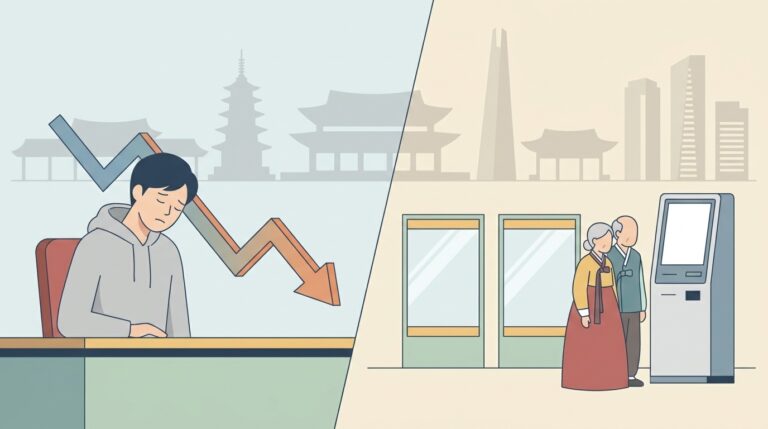
Picture this: You are riding a taxi in Seoul at 11 PM after a long day of exploring. You look at the driver, and you notice he’s an elderly gentleman, perhaps in his late 70s. The next morning, you visit a local fast-food restaurant, but there is no one at the counter. Instead, three glowing kiosks are waiting for your order. If you’ve watched K-Dramas like My Liberation Notes or Misaeng, you’ve likely felt the heavy, exhausting atmosphere surrounding young adults struggling to find jobs and survive in a fiercely competitive society.
Why does modern Korea look like this? Behind the glittering K-Pop stages and the mouth-watering K-Food scenes lies a profound societal shift. As an advanced (C2) learner of Korean, moving beyond everyday pleasantries means understanding the structural heartbeat of the society. Today, we are diving deep into the Demographic Cliff—specifically, the decline in the working-age population and the drop in the economic growth rate.
If you want to have a truly deep, intellectual conversation with a Korean friend over a glass of Soju, understanding these concepts is your golden ticket. This guide is built on real discussions I’ve had with my advanced students who wanted to read Korean newspapers and understand the real Korea behind the media facade.
Phase 2: Deep Dive into Core Expressions
1. 생산 연령 인구 감소
- Pronunciation: [saengsan yeollyeong ingu gamso] + [sang-san yull-young in-goo gahm-so]
- Meaning: Literal: Decrease in the production age population / Real nuance: Shrinking workforce
- K-Culture Moment: You will hear this phrase constantly on the 8 PM News (SBS 8 Nyuseu) or when Korean CEOs discuss the future in business dramas. It refers to the shrinking pool of people aged 15 to 64.
- Editor’s Insight: This isn’t just an economic term; it’s a societal anxiety. When Koreans say this, there’s an underlying sigh of “Who is going to support the country in the future?”
- Situation Spectrum:
- Friends (Casual): ⚠️ (Too formal for a pub chat, unless debating politics)
- Co-workers (Semi-formal): ✅
- Boss/Elders (Formal): ✅
- 🤔 Think About It: Why does a shrinking workforce impact the cultural mindset? How does the intense pressure on the remaining young workforce manifest in Korean pop culture?
2. 경제 성장률 하락
- Pronunciation: [gyeongje seongjangnyul harak] + [gyung-jeh sung-jang-nyool ha-rak]
- Meaning: Literal: Economic growth rate drop / Real nuance: Economic stagnation or slowdown
- K-Culture Moment: Think of family gathering scenes during Chuseok (Korean Thanksgiving) in dramas. The uncle sighs, pours a drink, and laments how tough running a business has become because the economy just isn’t growing like it used to in the 80s and 90s.
- Editor’s Insight: While the term is academic, the feeling is visceral. It translates to “getting a good job is harder than ever” for the youth.
- Situation Spectrum:
- Friends (Casual): ⚠️
- Co-workers (Semi-formal): ✅
- Boss/Elders (Formal): ✅
- 🤔 Think About It: Korea experienced explosive growth (The Miracle on the Han River). How does a sudden “drop in growth” affect the psychological expectations of parents versus their children?
3. 먹고 살기 팍팍하다
- Pronunciation: [meokgo salgi pakpakada] + [muck-go sal-gi pak-pak-ha-da]
- Meaning: Literal: Eating and living is dry/stiff / Real nuance: Making a living is incredibly tough/tight
- K-Culture Moment: This is the street-level equivalent of the terms above. You’ll hear this in a Pojangmacha (street tent bar) when characters are venting about their low salaries and high living costs.
- Editor’s Insight: Pakpakada originally means dry, like eating a sweet potato without water. It perfectly captures the suffocating, frustrating feeling of economic stagnation.
- Situation Spectrum:
- Friends (Casual): ✅
- Co-workers (Semi-formal): ✅
- Boss/Elders (Formal): 🚫 (Too colloquial for a boardroom)
- 🤔 Think About It: English speakers might say “money is tight.” Why do Koreans use a texture word (dry/stiff) to describe financial and emotional hardship?
Phase 3: Textbook vs. Real Korean
Here is how you bridge the gap between your C2 TOPIK textbook and a real conversation in Seoul.
[Situation 1: Discussing the lack of young people in society]
* 📖 Textbook Korean: 요즘은 저출산으로 인해 생산 연령 인구가 감소하고 있습니다. (Due to the low birth rate, the working-age population is decreasing these days.)
* 🗣️ Real Korean: 요즘 어딜 가나 젊은 사람이 없어요. 알바생 구하기가 하늘의 별 따기예요. (These days, there are no young people anywhere. Finding a part-timer is like plucking a star from the sky.)
* 💡 Why the difference?: Koreans use vivid metaphors (“plucking a star”) and focus on the direct, daily impact (lack of part-timers) rather than macro-economic terms in daily life.
[Situation 2: Talking about the bad economy]
* 📖 Textbook Korean: 경제 성장률이 하락하여 취업이 어렵습니다. (Because the economic growth rate has dropped, employment is difficult.)
* 🗣️ Real Korean: 요즘 경기 진짜 바닥이잖아요. 취업문이 꽉 막혔어요. (The economy has hit rock bottom lately. The door to employment is completely shut.)
* 💡 Why the difference?: Visual imagery (“rock bottom”, “shut door”) emphasizes the collective frustration of the job market.
Bottom Note: At the C2 level, weaving sophisticated idioms like “하늘의 별 따기” (plucking a star from the sky) into your sentences makes you sound incredibly fluent and culturally tuned in.
Phase 4: Cultural Context — K-Culture Deep Dive
4-1. Non-verbal Elements & Nunchi (눈치)
When discussing economic hardship or the lack of workforce, Nunchi is paramount. Because the younger generation bears the brunt of the shrinking economy (fewer jobs, intense competition, high housing prices), older generations must exercise Nunchi by avoiding questions like “Why aren’t you getting married?” or “Why don’t you have kids?” For a C2 learner, showing empathy with a slow nod and a quiet “에휴, 요즘 다들 힘들죠” (Sigh, everyone is having a hard time these days) goes a long way.
4-2. K-Culture Connection
K-Travel & The Extinction of Regional Towns (지방 소멸):
If you travel outside of Seoul to beautiful coastal towns (like the setting of Hometown Cha-Cha-Cha), you will witness the demographic cliff firsthand. You’ll notice many beautiful, aesthetic cafes are actually remodeled abandoned schools (폐교). Because the working-age population has migrated to Seoul for better economic opportunities, rural areas are rapidly aging. When traveling, if you strike up a conversation with a local senior, expressing polite admiration for their town while acknowledging the quietness is a high-level cultural interaction.
K-Drama & The N-Po Generation:
Dramas have shifted from Cinderella stories to gritty realism. The youth facing the drop in economic growth are called the N-po Generation (giving up on N-number of things, like dating, marriage, homeownership). Understanding this demographic reality adds a profound layer of depth when you watch characters staring blankly out of subway windows after a long day of work.
Phase 5: Real-World Roleplay Scenario
Setting: Friday night, 8 PM. A smoky Gogi-jib (Korean BBQ restaurant) in Yeouido, the financial district of Seoul. You are having dinner with your Korean co-workers. Empty Soju bottles line the table.
Characters:
* YOU: A foreign expat working in Seoul, highly fluent in Korean (C2), keenly observing the societal shifts.
* Minsu: 38 years old, your team manager. Exhausted but friendly, currently grilling the pork belly.
Dialogue:
Minsu: 아, 요즘 우리 팀에 신입사원 안 들어온 지 벌써 2년째네요.
(a, yojeum uri time sinipsawon an deuroon ji beolsseo inyeonjjaeneyo.)
[Ah, it’s already been two years since a new junior employee joined our team.]
(Stage Direction: Minsu flips the meat with a sigh)
YOU: 그러게요. 인사팀 말로는 지원자 수 자체가 확 줄었대요.
(geureogeyo. insatim malloneun jiwonja su jachega hwak jureotdaeyo.)
[I know, right? HR says the number of applicants itself has dropped drastically.]
Minsu: 이게 다 생산 연령 인구가 감소해서 그래요. 일할 젊은 친구들이 없어요.
(ige da saengsan yeollyeong inguga gamsohaeseo geuraeyo. ilhal jeolmeun chingudeuri eopseoyo.)
[This is all because the working-age population is decreasing. There are no young friends to work.]
YOU: 맞아요. 경제 성장률도 계속 떨어지니까 회사도 사람 뽑기가 부담스럽겠죠.
(majayo. gyeongje seongjangnyuldo gyesok tteoreojinikka hoesado saram ppopgiga budamseureopgetjyo.)
[Right. And since the economic growth rate keeps dropping, the company probably feels burdened to hire people too.]
Minsu: 진짜 먹고 살기 팍팍한 시대예요. 우리 땐 그래도 취업이 이렇게까지 어렵진 않았는데.
(jinjja meokgo salgi pakpakan sidaeyeyo. uri ttaen geuraedo chwieobi ireokekkaji eoryeopjin ananneunde.)
[It’s truly a tough era to make a living. In our time, getting a job wasn’t this hard, at least.]
🔀 Your Turn! How do you respond?
* A) “그래도 노력하면 다 되지 않을까요?” (But wouldn’t everything work out if they just try hard?)
* B) “요즘 청년들이 N포 세대라고 불리는 이유가 있네요. 정말 안타까워요.” (There’s a reason the youth today are called the N-po generation. It’s really unfortunate.)
* C) “매니저님은 월급 많이 받으시잖아요!” (But you get paid a lot of money, manager!)
Best Choice: B — Reason: As an advanced speaker, using the socio-cultural term “N포 세대” shows deep empathy and profound understanding of the macroeconomic situation.
Choice A Analysis: This sounds like ‘Kkondae’ (꼰대 – condescending older person) mindset and ignores the structural demographic issues.
Phase 6: 10-Second Shadowing Drill
Master the rhythm of this advanced socio-economic sentence!
😤 심각하게 / 진지하게 (Seriously / Earnestly)
생산 연령 인구가 / 줄어들면서 // 경제 성장률도 / 지속적으로 / 하락하고 있습니다.
(saengsan yeollyeong inguga / jureodeulmyeonseo // gyeongje seongjangnyuldo / jisokjeogeuro / harakago itseumnida.)
[As the working-age population shrinks, the economic growth rate is also continuously dropping.]
Pronunciation Tip: Pause slightly at the ‘//’ to sound like a professional news anchor!
Phase 7: K-Culture Mini Dictionary
Here are 4 essential C2-level cultural keywords to understand Korea’s demographic and economic landscape.
1. N포 세대
* Romanization: N-po sedae
* English: The generation that gave up ‘N’ things
* Context: Originally the 3-po generation (gave up dating, marriage, kids), it expanded to N-po (giving up homeownership, career, hope) due to low economic growth.
2. 지방 소멸
* Romanization: jibang somyeol
* English: Regional extinction
* Context: The phenomenon where rural towns are literally dying out because the youth migrate to Seoul, leaving only the elderly behind.
3. 헬조선
* Romanization: heljoseon
* English: Hell Joseon (Hell Korea)
* Context: A cynical slang term used by the youth to describe the hyper-competitive, low-growth reality of modern Korea, where socioeconomic mobility feels impossible.
4. 소확행
* Romanization: sohwakhaeng
* English: Small but certain happiness
* Context: A lifestyle trend born from low economic growth. Since buying a house is impossible, people seek happiness in small, achievable things, like buying a premium cup of coffee.
Phase 8: Traveler’s Survival Kit
Because of the shrinking working-age population, human labor in Korea is rapidly being replaced by technology. As a traveler, you will encounter Kiosks (키오스크) everywhere, from fast-food chains to tiny mom-and-pop restaurants.
Survival Expressions for the Kiosk Era TOP 3
1. 주문은 기계로 해야 하나요?
* (jumuneun gigyero haeya hanayo?)
* English: Do I have to order through the machine?
* Where to use: Small restaurants where you aren’t sure if you should talk to the staff or use the screen.
2. 영수증은 버려주세요.
* (yeongsujeungeun beoryeojuseyo.)
* English: Please throw away the receipt.
* Where to use: A very common phrase to use at counters to save paper, often an option on the kiosk screen too!
3. 카드를 어디에 꽂아요?
* (kadeureul eodie kkojayo?)
* English: Where do I insert the card?
* Where to use: When fumbling with a new kiosk interface.
Editor’s Travel Note
* Demographic Impact: Because of the lack of young part-timers, many stores are becoming unstaffed (무인 점포 – mu-in jeompo), operating 24/7 with only CCTVs and self-checkout kiosks.
* Card is King: Korea is virtually cashless. Ensure you have a physical credit/debit card, as many kiosks do not accept cash.
Phase 9: Critical Thinking Corner — “One Step Deeper”
Media vs Reality (미디어와 현실)
When global fans watch K-Dramas, they often see chaebol heirs in sparkling penthouses or trendy young adults partying in Gangnam. However, the reality of the “Demographic Cliff” tells a completely different story. The staggering youth unemployment rate and the drop in economic growth have birthed a culture of intense burnout. The aesthetic, minimalist cafes you see in Seoul are sometimes a reflection of Sohwakhaeng—young people spending their limited income on a beautiful slice of cake because saving up for a million-dollar apartment in a stagnant economy is mathematically impossible. Recognizing this gap between the glitzy media exports and the heavy societal reality allows you to appreciate the resilience and true everyday lives of Korean people.
Your Turn: In your culture, how is the younger generation dealing with economic shifts and demographic changes? Are there similar slang terms like the N-po Generation? Share your thoughts below!
Phase 10: FAQ & Avoiding Misunderstandings
Q: “Can I ask my Korean friends if they plan to have children to practice these words?”
* NO. The low birth rate is a highly sensitive, personal, and economically stressful topic. Unless you are very close or discussing politics objectively, avoid asking personal family planning questions.
Q: “Is it okay to use terms like ‘헬조선’ (Hell Joseon) as a foreigner?”
* Maybe, but be careful. While Koreans use it self-deprecatingly, hearing a foreigner call Korea “Hell” can trigger defensiveness. It is better to show empathy by saying “요즘 취업이 참 힘들다면서요” (I hear getting a job is really tough these days).
Common Mistakes Warning!
❌ Mistake: Saying “한국은 늙은 나라예요” (Korea is an old country) to mean an aging society. This sounds rude and grammatically awkward.
✅ Do This: Use the proper socio-economic term: “한국은 고령화 사회가 되고 있어요” (Korea is becoming an aging society).
Phase 11: Summary & Action Items
One-Liner Summary: The decline in Korea’s working-age population (생산 연령 인구 감소) and the drop in economic growth (경제 성장률 하락) are deeply reshaping the youth culture and the daily landscape of Korea.
Action Mission 3 Steps:
* Bronze (Solo): Read a Korean news headline today related to the economy and spot the word 인구 (population) or 경제 (economy).
* Silver (Online): Go to a Korean learning forum and write a short paragraph explaining the term N포 세대 (N-po generation) in your own words.
* Gold (Real-world): Next time you talk to a Korean language partner, ask them about the rise of unstaffed stores (무인 점포) in their neighborhood!
K-Culture Mission:
Watch an episode of My Liberation Notes or Misaeng. Pay attention to the scenes showing the characters’ commutes or office dinners. Can you feel the weight of the economic stagnation they are portraying?
Phase 12: Quiz — Interactive Challenge
1. Situational Judgment:
You are at a business dinner, and the CEO mentions that finding new talent is getting harder. Which response shows C2-level proficiency and empathy?
* A) “돈을 더 많이 주시면 됩니다!” (Just pay them more money!)
* B) “생산 연령 인구가 감소해서 기업들도 고민이 많으시겠어요.”
* C) “한국인들은 일을 너무 많이 해요.”
(Answer: B. It acknowledges the macro-economic reality respectfully. A is too direct, and C is irrelevant to the hiring pool issue.)
2. True or False — K-Culture Edition:
“Because the youth population is shrinking, Korea still relies purely on human labor for simple tasks like taking orders at fast-food restaurants.”
(Answer: False. Korea has aggressively adopted Kiosks and unstaffed stores to combat the lack of working-age population.)
3. Fill in the Blank:
요즘 젊은이들은 취업과 결혼을 포기한 ____ 세대라고 불립니다.
(Answer: N포 / N-po)
Frequently Asked Questions (FAQ)
Q: What does "생산 연령 인구 감소" mean in Korean and how do you pronounce it?
A: In Korean, "생산 연령 인구 감소" is pronounced [saengsan yeollyeong ingu gamso] and means: Literal: Decrease in the production age population / Real nuance: Shrinking workforce
Q: What does "경제 성장률 하락" mean in Korean and how do you pronounce it?
A: In Korean, "경제 성장률 하락" is pronounced [gyeongje seongjangnyul harak] and means: Literal: Economic growth rate drop / Real nuance: Economic stagnation or slowdown
Q: What does "먹고 살기 팍팍하다" mean in Korean and how do you pronounce it?
A: In Korean, "먹고 살기 팍팍하다" is pronounced [meokgo salgi pakpakada] and means: Literal: Eating and living is dry/stiff / Real nuance: Making a living is incredibly tough/tight







