

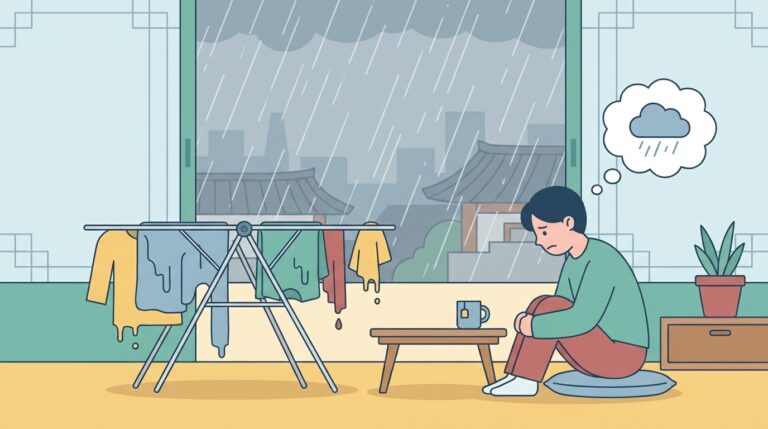
Hello! Editor of Daily Hangul here.
Have you ever watched a K-Drama where the main characters share a bright yellow umbrella under a sudden romantic downpour? The music swells, their shoulders touch… it is beautiful, right?
But let me tell you the reality of the Korean rainy season, known as 장마 (Jangma). When July hits, the romance fades, and the real struggle begins: your clothes simply refuse to dry! If you only learn textbook Korean, you will politely say, “It rains a lot.” But if you want to sound like a local who is truly surviving the Korean summer, you need to know how to express that sticky, damp frustration. Let’s dive in!
Core Expressions: Surviving the Monsoon
1. 장마철이라서 빨래가 안 말라요.
- Pronunciation: jang-ma-cheo-ri-ra-seo ppal-lae-ga an mal-la-yo.
- Meaning: Literal: Because it is the rainy season, the laundry does not dry. / Real nuance: The monsoon is ruining my laundry day!
- K-Culture Moment: You will hear this everywhere in July. Coworkers sighing in the breakroom, roommates staring at a drying rack that has had the same wet towels on it for three days.
- Editor’s Insight: The ending ‘~아/어서’ (because) mixed with ‘안 말라요’ (does not dry) is the ultimate B1 grammar combo. It is the perfect polite yet frustrated excuse when someone asks why you are wearing a slightly wrinkled shirt!
- Situation Spectrum:
- Casual with friends: ✅
- Semi-formal with coworkers: ✅
- Formal with elders: ✅ (It is a great small-talk icebreaker!)
- 🤔 Think About It: Why is laundry such a big topic of small talk in Korea during summer? Does your home country have weather-specific household struggles that everyone bonds over?
2. 날씨가 너무 꿉꿉해요.
- Pronunciation: nal-ssi-ga neo-mu kkup-kku-pae-yo. (Tip: ‘kkup-kkup’ sounds like the heavy, sticky sound your shoes make on a wet floor!)
- Meaning: Literal: The weather is very damp. / Real nuance: It is so sticky, humid, and muggy that I want to take three showers today.
- K-Culture Moment: Someone walks into the office, wipes sweat from their forehead, shakes their umbrella, and immediately says this before even saying hello.
- Editor’s Insight: Forget the textbook word ‘습해요’ (humid). ‘꿉꿉하다’ is the vivid, sensory word that Koreans actually use. It describes not just the weather, but how your sticky skin feels.
- Situation Spectrum:
- Casual with friends: ✅
- Semi-formal with coworkers: ✅
- Formal with elders: ⚠️ (Use ‘습도가 높네요’ – humidity is high – for very formal situations).
- 🤔 Think About It: Korean has many sensory words. How does describing the ‘feeling’ of the air rather than just the scientific ‘humidity’ change the emotional tone of the conversation?
Textbook vs. Real Korean
Complaining about the rain
* 📖 Textbook Korean: 비가 많이 옵니다. (It rains a lot.)
* 🗣️ Real Korean: 하늘에 구멍이 뚫렸나 봐요. (Looks like a hole was punched in the sky!)
* 💡 Why is it different?: Koreans love dramatic, visual exaggerations to build empathy and bond over shared struggles.
Expressing the humidity
* 📖 Textbook Korean: 습도가 높습니다. (The humidity is high.)
* 🗣️ Real Korean: 완전 꿉꿉해요. (It’s totally muggy.)
* 💡 Why is it different?: ‘꿉꿉하다’ conveys shared physical discomfort, making it a better bonding phrase than a clinical weather report.
Cultural Context — K-Culture Deep Dive
Non-Verbal Cues
When saying ‘꿉꿉해요’, slightly fan your face with your hand or gently pull your shirt collar away from your neck. This physical action is universally understood in Korea and immediately tells the listener exactly how you feel!
K-Food Connection
When the Jangma rain pours, laundry is forgotten, and Koreans immediately crave 파전 (Pajeon – green onion pancake) and 막걸리 (Makgeolli – rice wine). Why? Because the sizzling sound of the pancake batter hitting the hot oil sounds exactly like heavy rain hitting the pavement! If your laundry will not dry, you might as well go to a local pub, point outside, and say, “비도 오는데 파전 어때요?” (It’s raining, how about Pajeon?)
Real-Life Roleplay Scenario
Setting: A Friday evening in July. The office breakroom. You and your coworker Minsu are looking out the window. It has been pouring for three days straight.
Characters:
* YOU: A foreign professional working in Seoul, frustrated with your damp apartment.
* Minsu (32): Your friendly Korean coworker who always knows the best local spots.
Minsu: 비가 또 오네요. 이번 주말에도 계속 온대요.
(bi-ga tto o-ne-yo. i-beon ju-ma-re-do gye-sok on-dae-yo.)
[Translation] It’s raining again. They say it’ll keep raining this weekend too.
(🎭 Stage Direction: Minsu sighs and takes a sip of his iced americano)
YOU: 진짜요? 아… 장마철이라서 빨래가 안 말라요.
(jin-jja-yo? a… jang-ma-cheo-ri-ra-seo ppal-lae-ga an mal-la-yo.)
[Translation] Really? Ah… because of the monsoon, my laundry won’t dry.
Minsu: 맞아요. 날씨가 너무 꿉꿉하죠? 제습기 없으면 큰일 나요.
(ma-ja-yo. nal-ssi-ga neo-mu kkup-kku-pa-jyo? je-seup-gi eop-seu-myeon keu-nil na-yo.)
[Translation] Right. The weather is so muggy, isn’t it? If you don’t have a dehumidifier, it’s a big disaster.
🔀 Your Turn! How should you reply?
Option A: 저는 제습기가 없습니다. (I do not have a dehumidifier.)
Option B: 맞아요. 혹시 코인 세탁소 근처에 알아요? (Right. Do you happen to know a coin laundromat nearby?)
Option C: 꿉꿉해요! 대박! (Muggy! Awesome!)✅ Best Choice: Option B — Why? It agrees with Minsu (‘맞아요’) and naturally shifts to a practical B1 level question, asking for local advice. Minsu will happily help!
⚠️ Option C Analysis: ‘대박’ (Awesome/Crazy) is casual slang and does not fit the frustrating context of humid weather.
Minsu: 네, 우리 회사 뒤에 하나 있어요. 이따 퇴근하고 같이 갈래요? 비도 오는데 파전도 먹고요!
(ne, u-ri hoe-sa dwi-e ha-na i-sseo-yo. i-tta toe-geun-ha-go ga-chi gal-lae-yo? bi-do o-neun-de pa-jeon-do meok-go-yo!)
[Translation] Yes, there’s one behind our company. Wanna go together after work? And eat Pajeon since it’s raining!
10-Second Shadowing Drill
Practice speaking like a local by focusing on the pauses (/) and the emotion!
- 😢 Frustrated: 아휴, / 장마철이라서 / 빨래가 / 안 말라요. (a-hyu / jang-ma-cheo-ri-ra-seo / ppal-lae-ga / an mal-la-yo)
- 😤 Sticky & Annoyed: 날씨가 / 너~~~무 / 꿉꿉해요. (nal-ssi-ga / neo~~~mu / kkup-kku-pae-yo)
K-Culture Mini Dictionary
1. 장마
* Romanization: jang-ma
* English: The Korean summer monsoon season.
* Context: Usually lasting from late June to late July, characterized by high humidity and endless rain.
2. 눈치
* Romanization: nun-chi
* English: The subtle art of reading the room.
* Context: During Jangma, having ‘nunchi’ means offering your umbrella space to someone who forgot theirs without them having to ask.
3. 파전
* Romanization: pa-jeon
* English: Green onion pancake.
* Context: The absolute soul food of rainy days in Korea, best paired with Makgeolli.
4. 제습기
* Romanization: je-seup-gi
* English: Dehumidifier.
* Context: The most important home appliance for any Korean living through the summer.
Traveler Survival Kit
Stuck in the rain while visiting Korea? Here are your must-know phrases:
🆘 Survival Expressions
* 🇰🇷 “우산 하나 주세요.” (u-san ha-na ju-se-yo)
* 🗣️ Pronunciation: oo-san ha-na joo-se-yo
* 📍 Where to use: Convenience stores when caught in a sudden downpour.
* 💡 Pro Tip: Convenience stores sell transparent umbrellas (비닐우산) very cheaply. They are a traveler’s lifesaver!📌 Editor’s Travel Note
* Useful Apps: Use KakaoMap or Naver Map to search for ‘코인 세탁소’ (Coin laundry) when your hotel clothes won’t dry.
* Etiquette: When entering stores or buses during the rain, always look for umbrella covers (비닐 우산 커버) or umbrella dryers at the entrance to prevent dripping water everywhere. It is basic manners!
Think Deeper: Media vs Reality
In K-Dramas, rain is often a plot device for romance—a male lead suddenly appearing with an umbrella to shelter the female lead. But the reality of Korea’s Jangma is intensely practical: battling mold, tracking humidity levels on smart home apps, and escaping to air-conditioned cafes. This gap reminds us that media often glosses over the mundane struggles of daily life. However, even in reality, Koreans have created a sort of ‘everyday romance’ out of the rain through the shared cultural ritual of eating Pajeon and Makgeolli together.
💬 Your Turn: How is rain portrayed in the media of your home culture? Is it romantic, gloomy, or something else entirely? Tell us in the comments!
FAQ & Avoiding Mistakes
Q: Can I use ‘꿉꿉해요’ with my boss?
A: Maybe! It is a bit casual. If you are close with your boss, it is totally fine as a relatable complaint. If not, stick to “오늘 많이 습하네요” (It is very humid today).
Q: Is it okay to dry laundry indoors during Jangma?
A: It is common, but it will smell bad without a dehumidifier (제습기) or good ventilation. Koreans often turn on the air conditioner or a fan to help.
❌ Common Mistake: Saying “빨래가 안 건조해요” (using the formal, scientific word for dry, 건조).
✅ Do this instead: Always use ‘말라요’ (from 마르다) for clothes. “빨래가 안 말라요.”
Summary & Action Items
One-Liner Summary: Ditch the textbook weather reports and bond with Koreans over damp laundry and muggy air using “빨래가 안 말라요” and “꿉꿉해요”.
Your Action Missions:
* 🥉 Bronze (Solo): Stand in your room and dramatically sigh, “날씨가 너무 꿉꿉해요!” 3 times to practice the feeling.
* 🥈 Silver (Online): Comment on a Daily Hangul post using today’s expressions.
* 🥇 Gold (Real Life): Next time it rains, ask a Korean friend or coworker, “비도 오는데 파전 어때요?”
K-Culture Mission:
Check your favorite K-Pop idol’s past livestream during the summer. I guarantee you will hear them complain about “장마” (Jangma) or “꿉꿉한 날씨”!
Quiz: Interactive Challenge
1. Situational Judgment: You walk into a cafe sweating profusely in July. The barista looks at you with sympathy. What is the most natural thing to say?
Option A: 비가 옵니다. (It rains.)
Option B: 날씨가 정말 꿉꿉하네요. (The weather is really muggy.)
Option C: 빨래가 말라요. (The laundry dries.)
(Answer: B. Option A is too robotic, and C makes no sense here.)
2. Fill in the Blank: 비도 오는데, 오늘 저녁은 ____ 먹을까요? (Since it’s raining, should we eat ____ tonight?)
(Answer: 파전 – Pajeon)
3. True or False – K-Culture Edition: In Korea, you must leave your dripping wet umbrella at the door or use a provided plastic cover before entering a nice store.
(Answer: True. It is basic etiquette (nunchi) to not make the indoor floors slippery!)
Frequently Asked Questions (FAQ)
Q: What does "장마철이라서 빨래가 안 말라요." mean in Korean and how do you pronounce it?
A: In Korean, "장마철이라서 빨래가 안 말라요." is pronounced [jang-ma-cheo-ri-ra-seo ppal-lae-ga an mal-la-yo.] and means: Literal: Because it is the rainy season, the laundry does not dry. / Real nuance: The monsoon is ruining my laundry day!
Q: What does "날씨가 너무 꿉꿉해요." mean in Korean and how do you pronounce it?
A: In Korean, "날씨가 너무 꿉꿉해요." is pronounced [nal-ssi-ga neo-mu kkup-kku-pae-yo. (Tip: 'kkup-kkup' sounds like the heavy, sticky sound your shoes make on a wet floor!] and means: Literal: The weather is very damp. / Real nuance: It is so sticky, humid, and muggy that I want to take three showers today.







