

Phase 1: Empathy (Immersive Opening)
안녕하세요! I am your Daily Hangul Editor, your personal guide to the real Korea.
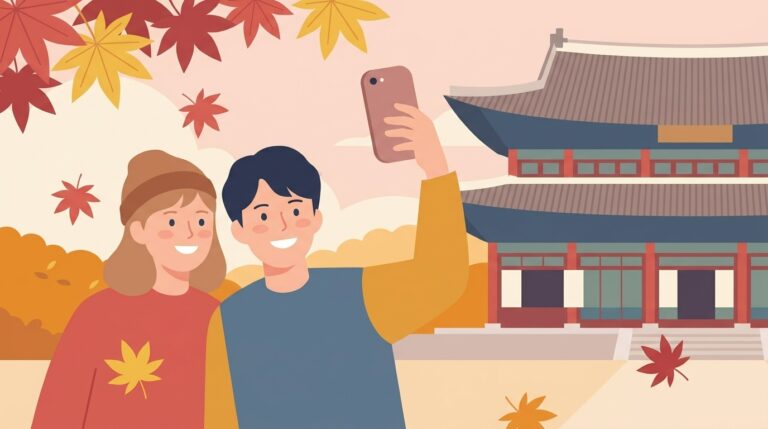
Picture this: It is late October in Seoul. You are walking along the famous Deoksugung Stonewall Walkway, or perhaps you have decided to bravely hike Bukhansan. The yellow ginkgo leaves and red maple leaves are falling around you, creating a scene straight out of your favorite K-Drama (Yes, just like that famous scene in ‘Goblin’!).
Everywhere you look, groups of Korean ‘Ahjummas’ and ‘Ahjussis’ in their brightest, neon-colored hiking jackets are enthusiastically taking photos. You find the perfect spot for a photo, but your arms are too short for a good selfie. You need to ask a stranger for help. Or maybe you want to suggest grabbing some traditional food after enjoying the views with your Korean friends. But… your mind goes blank.
Don’t worry! Textbooks teach you how to talk about the weather, but they rarely teach you the real survival skills for Korea’s massive autumn culture. This guide is built from the real experiences of my students who wanted to sound less like a textbook and more like a local. Let’s dive in!
Phase 2: Core Expressions Deep Dive
1. 단풍 구경 가요
- Pronunciation: dan-poong goo-gyeong ga-yo (Say ‘dan’ like in ‘Dan’, ‘poong’ like ‘pool’ but ending with ‘ng’. ‘goo-gyeong’ rhymes with ‘young’.)
- Meaning: Let’s go see the autumn leaves! (Literal: Let’s go do autumn foliage sightseeing.)
- K-Culture Moment: In October, this phrase is practically a seasonal greeting. If you work in a Korean office or have Korean friends, someone will inevitably say this to you. It is the ultimate invitation to bond.
- Editor’s Insight: This phrase feels warm and inviting. It is not just about looking at trees; it is an invitation to spend quality time together, take photos, and eat good food.
- Situation Spectrum:
- Casual (Friends): ✅ (단풍 구경 가자! – dan-poong goo-gyeong ga-ja!)
- Semi-formal (Colleagues): ✅ (단풍 구경 가요 – dan-poong goo-gyeong ga-yo)
- Formal (Boss/Elders): ⚠️ (단풍 구경 가시는 거 어떠세요? – dan-poong goo-gyeong ga-si-neun geo eo-tteo-se-yo?)
- 🤔 Think About It: Koreans often use the word ‘구경’ (sightseeing/looking around) for many activities. Market sightseeing (시장 구경), house sightseeing (집 구경). Why do you think looking around together is such an important social activity in Korea?
2. 사진 좀 찍어 주실래요?
- Pronunciation: sa-jin jom jji-geo ju-sil-lae-yo? (The ‘jj’ in ‘jjigeo’ is a tense, strong ‘j’ sound, like you are slightly annoyed when saying ‘jeez’.)
- Meaning: Could you please take a picture of me?
- K-Culture Moment: Hand your smartphone to a Korean stranger at a tourist spot, say this phrase, and witness magic. They will squat, tilt the phone, and take 30 rapid-fire photos to ensure you look tall and flawless.
- Editor’s Insight: The magic word here is ‘좀’ (a little). It softens the request. Without it, you sound like a military commander ordering someone to take a photo.
- Situation Spectrum:
- Casual: ✅ (사진 좀 찍어 줄래? – sa-jin jom jji-geo jul-lae?)
- Semi-formal/Strangers: ✅ (사진 좀 찍어 주실래요?)
- Formal: 🚫 (For absolute elders, say: 사진 한 장만 부탁드려도 될까요?)
- 🤔 Think About It: Is it common in your country to hand your expensive smartphone to a complete stranger? In Korea, high trust and low petty crime make this completely normal!
3. 파전에 막걸리 어때요?
- Pronunciation: pa-jeon-e mak-geol-li eo-ttae-yo? (‘eo-ttae-yo’ sounds like ‘uh-tay-yo’)
- Meaning: How about Pajeon (green onion pancake) and Makgeolli (rice wine)?
- K-Culture Moment: You just finished a 2-hour hike. Your legs hurt. What is the reward? Sitting at a noisy restaurant at the base of the mountain, tearing into crispy Pajeon and drinking sweet, milky Makgeolli from golden aluminum bowls.
- Editor’s Insight: Saying this phrase will instantly upgrade your status to ‘Honorary Korean’. It proves you understand the soul of Korean outdoor culture.
- Situation Spectrum:
- Casual: ✅
- Semi-formal: ✅
- Formal: 🚫 (Wait for the boss to suggest alcohol first!)
- 🤔 Think About It: Why do Koreans pair specific foods with specific weather or activities (like Pajeon on rainy days or after hiking)?
Phase 3: Textbook vs Real Korean
[Asking for a Photo]
* 📖 Textbook Korean: 저의 사진을 찍어 주세요. (Take my picture.)
* 🗣️ Real Korean: 여기 사진 좀 부탁드릴게요. (I would like to request a photo here.)
* 💡 Why the difference?: Using ‘저의’ (my) sounds translated and robotic. ‘부탁드릴게요’ (I will request) is the golden standard for politely asking strangers for a favor in modern Korea.
[Expressing Amazement at the View]
* 📖 Textbook Korean: 단풍이 참 아름답습니다. (The autumn foliage is truly beautiful.)
* 🗣️ Real Korean: 와, 뷰 대박이다! / 단풍 미쳤다! (Wow, the view is daebak! / The autumn leaves are crazy!)
* 💡 Why the difference?: Young Koreans express strong positive emotions using slightly dramatic slang like ‘대박’ (jackpot) or ‘미쳤다’ (crazy/insane), making the reaction feel much more genuine and energetic.
Bottom Note: For A2 learners, sticking to ‘대박이에요!’ (It is daebak!) is a safe, perfectly balanced way to sound native but polite.
Phase 4: Cultural Context — K-Culture Deep Dive
4-1. Non-verbal Communication: The Art of Handing Over the Phone
When asking a stranger to take your photo, language is only half the battle.
* Two Hands: Always hand your smartphone over using both hands. This is a universal sign of respect in Korea.
* The Bow: Give a slight head bow when saying ‘감사합니다’ (Thank you) after they return your phone.
* Nunchi (눈치) in Action: Read the room! If the person is rushing to catch a bus, do not ask them. Look for couples or groups of young people taking photos of each other—they are usually the most willing and have the best camera skills!
4-2. The K-Travel Link: The ‘Insaeng-syat’ Culture
Koreans take their travel photography incredibly seriously. There is a term called 인생샷 (insaeng-syat), which means ‘the shot of a lifetime’. When you visit palaces or mountains during autumn, you will see friends directing each other like professional fashion photographers.
If a Korean takes your photo, do not be surprised if they say, ‘다리 길어 보이게 찍어줄게요!’ (I will take it so your legs look long!). If you want to impress them, say ‘인생샷 건졌어요!’ (I got the shot of a lifetime!) when they hand the phone back.
Phase 5: Real-world Roleplay Scenario
Setting: A crisp Friday afternoon at Namsan Park. The ground is covered in a carpet of red and yellow leaves. You are taking a walk with your friendly Korean colleague, Minsoo (32, energetic, loves food).
Characters:
* YOU: An expat in Korea who wants to experience the local autumn vibes.
* Minsoo: Your helpful Korean friend.
Dialogue:
Minsoo: 와, 오늘 날씨 진짜 좋죠? 단풍도 너무 예뻐요.
(wa, oneul nalssi jinjja jojyo? danpungdo neomu yeppeoyo.)
Wow, the weather is really nice today, right? The autumn leaves are so pretty too.
YOU: 맞아요! 오길 잘한 것 같아요.
(majayo! ogil jalhan geot gatayo.)
That is right! I think it is a good thing we came.
Minsoo: 저기 나무 밑에 서 봐요. 사진 찍어 줄게요.
(jeogi namu mite seo bwayo. sajin jjigeo julgeyo.)
Stand under that tree over there. I will take a picture of you.
YOU: 아, 진짜요? 고마워요!
(a, jinjjayo? gomawoyo!)
Oh, really? Thank you!
Minsoo: 자, 찍습니다! 하나, 둘, 셋!
(ja, jjipseumnida! hana, dul, set!)
Okay, taking it! One, two, three!
YOU: 어떻게 나왔어요? 잘 나왔어요?
(eotteoke nawasseoyo? jal nawasseoyo?)
How did it come out? Did it come out well?
Minsoo: 네, 완전 인생샷이에요! 우리 같이도 한 장 찍어요.
(ne, wanjeon insaengsyasieyo! uri gachido han jang jjigeoyo.)
Yes, it is a total shot of a lifetime! Let’s take one together too.
YOU: 제가 지나가는 분한테 부탁해 볼게요.
(jega jinaganeun bunhante butakae bolgeyo.)
I will ask someone walking by.
(Stage Direction: You approach a friendly-looking Korean couple)
YOU: 저기요, 죄송하지만 사진 좀 찍어 주실래요?
(jeogiyo, joesonghajiman sajin jom jjigeo jusillaeyo?)
Excuse me, I am sorry but could you take a picture for us?
Stranger: 네, 핸드폰 주세요. 자, 웃으세요~
(ne, haendeupon juseyo. ja, useuseyo~)
Yes, give me your phone. Okay, smile~
🔀 Your Turn! The stranger says ‘smile’. What pose should you strike?
* A) Just stand completely straight with a polite smile.
* B) Hold up a ‘V’ (Peace) sign with your fingers.
* C) Cross your thumb and index finger to make a ‘K-Heart’ (손가락 하트).
✅ Best Choice: B or C!
* Reason: Koreans love active poses! A ‘V’ sign is the classic, safe go-to for everyone. The ‘K-Heart’ is trendy, cute, and shows you really embrace K-Culture. Standing completely stiff (A) might make the photographer tell you to relax!
Phase 6: 10-Second Shadowing Drill
Practice this sentence out loud. Pay attention to the pauses (/) and the emotion tags!
😊 와! / 단풍이 / 진~~~짜 / 예뻐요!
(wa! / dan-poong-i / jin~~~jja / ye-ppeo-yo!)
Wow! / The autumn leaves / are real~~~ly / pretty!
Phase 7: K-Culture Mini Dictionary
1. 단풍
* Romanization: danpung
* English: Autumn foliage / Fall colors
* Context: The main event of Korean autumn. The whole country tracks the ‘danpung map’ on the news to see when the leaves will change in each region.
2. 인생샷
* Romanization: insaeng-syat
* English: Shot of a lifetime
* Context: A combination of ‘인생’ (life) and ‘샷’ (shot/photo). It means a photo so good it is the best of your life. Often used as a compliment.
3. 등산복
* Romanization: deungsanbok
* English: Hiking clothes / Outdoor gear
* Context: Older Koreans love wearing expensive, brightly colored hiking gear not just on mountains, but everywhere—on the subway, at the mall, or just walking in the park.
4. 막걸리
* Romanization: makgeolli
* English: Korean traditional rice wine
* Context: A milky, lightly sparkling alcoholic drink. It is the absolute mandatory drink to have with a savory pancake (Pajeon) after finishing a hike.
Phase 8: Traveler Survival Kit
If you are traveling in Korea during autumn, memorize these!
🆘 Survival Expression #1: Asking for a photo
* 🇰🇷 “여기 사진 좀 부탁드릴게요.”
* 🗣️ Pronunciation: yeogi sajin jom butakdeurilgeyo.
* 📍 Where to use: Palaces, Namsan Tower, Parks.
🆘 Survival Expression #2: Finding the restroom (Crucial for parks!)
* 🇰🇷 “가까운 화장실이 어디예요?”
* 🗣️ Pronunciation: gakkaun hwajangsiri eodiyeyo?
* 📍 Where to use: Hiking trails, large outdoor areas.
🆘 Survival Expression #3: Ordering after the hike
* 🇰🇷 “파전 하나랑 막걸리 한 병 주세요.”
* 🗣️ Pronunciation: pajeon hanarang makgeolli han byeong juseyo.
* 📍 Where to use: Traditional restaurants near the mountain entrance.
📌 Editor’s Travel Note:
* Useful Apps: Google Maps does not work well for walking directions in Korea! Download Naver Map or KakaoMap to find the best hiking trails or walking paths.
* Safety: If you leave your bag on a bench to take a photo, no one will touch it. Korea is incredibly safe. Just do not lose your actual friends in the crowd!
Phase 9: Critical Thinking Corner — “A Step Deeper”
Food & Identity: Why Do We Eat Together After Sweating Together?
In Korea, hiking is rarely a solitary activity. It is a group event. But the real peak of the mountain is not the summit—it is the restaurant at the bottom. Eating ‘Pajeon’ (pancakes) and drinking ‘Makgeolli’ from the same bowl is deeply tied to the Korean concept of 정 (Jeong)—a unique feeling of affection, solidarity, and community attachment. Sharing food from a central plate after a shared physical struggle breaks down formal boundaries and builds lasting bonds.
💬 Your Turn: Do you have a specific food in your culture that you must eat after a certain outdoor activity? Share it in the comments below!
Phase 10: FAQ & Avoiding Mistakes
Q: “Can I say ‘당신’ (dangsin – you) to the stranger when asking for a photo?”
* Absolutely NO. ‘당신’ translates to ‘you’ in the dictionary, but in real life, it is either used affectionately between married couples or aggressively when picking a fight! Just omit the word ‘you’ entirely or say ‘저기요’ (Excuse me) to get their attention.
Q: “Do I need professional hiking gear to see autumn leaves?”
* Maybe. For a simple walk in Namsan Park or Nami Island, sneakers are fine. But if you plan to hike Bukhansan, wear proper shoes. Korean mountains are very rocky!
❌ Common Mistake #1: Saying ‘사진 줘’ (sajin jwo – Give me photo) to a stranger. This is extremely rude and uses informal language (banmal).
✅ Do this instead: Always use the polite ‘-요’ (-yo) ending. ‘사진 좀 찍어 주실래요?’
Phase 11: Summary & Action Items
One-Liner Summary: To survive Korean autumn, remember to ask politely for photos using ‘좀’ (jom), strike a fun pose, and finish your day with some Pajeon and Makgeolli!
Your Action Missions:
* 🥉 Bronze (Solo): Stand in front of a mirror and practice saying ‘사진 좀 찍어 주실래요?’ three times with a polite smile.
* 🥈 Silver (Online): Go to your favorite K-Pop idol’s Instagram. Find an autumn photo and comment: ‘와, 단풍 예뻐요! 인생샷이다!’ (Wow, the leaves are pretty! It is the shot of a lifetime!)
* 🥇 Gold (Real Life): Next time you are out, try taking a photo with the ‘K-Heart’ pose, or visit a Korean restaurant and order Pajeon!
Phase 12: Interactive Challenge (Quiz)
Test your new K-Culture knowledge!
1. Situational Judgment: You are at Gyeongbokgung Palace. You want a stranger to take a photo of you and your friend. What is the BEST phrase to say?
* A) 사진 찍어.
* B) 사진 좀 부탁드릴게요.
* C) 내 핸드폰 가져가요.
2. True or False – K-Culture Edition:
* It is considered rude to hand your phone to someone with two hands. (T / F)
3. Fill in the Blank:
* After a long autumn walk, Koreans love to eat _________ and drink _________.
* A) Pizza / Cola
* B) Kimchi / Soju
* C) Pajeon / Makgeolli
Answers:
1. B (A is rude, C means ‘Take my phone’ and sounds like a robbery!)
2. False (Handing things with two hands is the MOST polite way!)
3. C (The ultimate post-hike combo!)
Frequently Asked Questions (FAQ)
Q: What does "단풍 구경 가요" mean in Korean and how do you pronounce it?
A: In Korean, "단풍 구경 가요" is pronounced [dan-poong goo-gyeong ga-yo (Say 'dan' like in 'Dan', 'poong' like 'pool' but ending with 'ng'. 'goo-gyeong' rhymes with 'young'.] and means: Let's go see the autumn leaves! (Literal: Let's go do autumn foliage sightseeing.)
Q: What does "사진 좀 찍어 주실래요?" mean in Korean and how do you pronounce it?
A: In Korean, "사진 좀 찍어 주실래요?" is pronounced [sa-jin jom jji-geo ju-sil-lae-yo? (The 'jj' in 'jjigeo' is a tense, strong 'j' sound, like you are slightly annoyed when saying 'jeez'.] and means: Could you please take a picture of me?
Q: What does "파전에 막걸리 어때요?" mean in Korean and how do you pronounce it?
A: In Korean, "파전에 막걸리 어때요?" is pronounced [pa-jeon-e mak-geol-li eo-ttae-yo? ('eo-ttae-yo' sounds like 'uh-tay-yo'] and means: How about Pajeon (green onion pancake) and Makgeolli (rice wine)?






