Phase 1: Empathy (Welcome to the Moment!)
Hello! I am your Daily Hangul Editor.
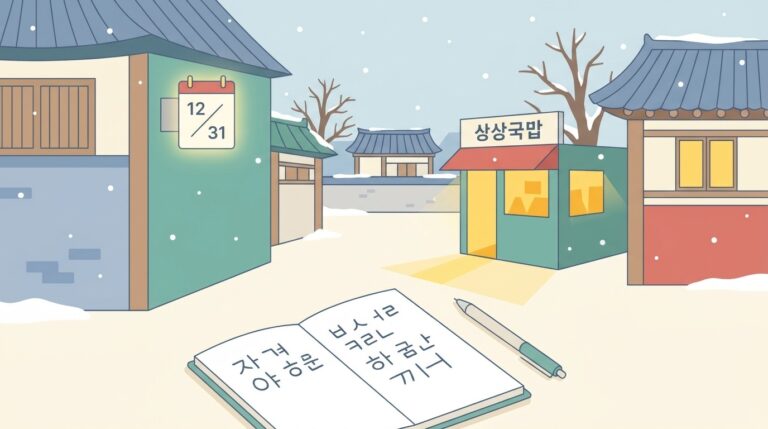
Picture this: You are watching a classic K-Drama. The first snow is falling, and the main characters are sitting in a cozy pojangmacha (tent bar), clinking green Soju glasses. The clock strikes midnight. The screen flashes to fireworks, and everyone shouts a long phrase that definitely does not sound like “Happy New Year.”
Or maybe you are watching your favorite K-Pop idol’s end-of-the-year livestream. They keep saying a specific word—연말 (yeonmal)—and writing numbers in the chat. You want to reply, you want to join the celebration, but all those Korean numbers look like a math test!
Don’t worry. Counting dates in Korean can be intimidating because Korea uses two different number systems. But today, we are going to focus on the absolute basics you need to survive the Korean Year-End. By the end of this guide, you will know exactly how to read the calendar, impress your Korean friends, and drop the perfect New Year’s greeting like a true insider.
This guide is based on real struggles my beginner students face every December. Let’s dive in!
Phase 2: Core Expressions Deep Dive
1. 12월 (December)
- Pronunciation: sib-i-weol [sounds like: sheep-ee-wall]
- Meaning: Literal: 10-2-month. Real nuance: December.
- K-Culture Moment: In Korea, months don’t have special names like “December” or “March.” We simply attach the word for month (월, weol) to the Sino-Korean numbers (1, 2, 3…). 10 is 십 (sib) and 2 is 이 (i). So, 12 + month = 12월! You will hear this constantly on Korean music shows announcing the “December Chart.”
- Editor’s Insight: The pronunciation of 월 (weol) can be tricky. Make your lips round like you are saying “woo,” then quickly say “all.”
- Situation Spectrum:
- Casual (Friends): ✅
- Semi-formal (Coworkers): ✅
- Formal (Boss/Elders): ✅ (Numbers are universal!)
- 🤔 Think About It: Why do you think Korean uses numbers for months instead of names? Doesn’t it make things much easier to memorize?
2. 31일 (The 31st Day)
- Pronunciation: sam-sib-il-il [sounds like: sahm-sheep-eel-eel]
- Meaning: Literal: 3-10-1-day. Real nuance: The 31st.
- K-Culture Moment: Fans waiting for December 31st for the grand K-Pop year-end festivals (Gayo Daejeon).
- Editor’s Insight: For dates, Korea strictly uses Sino-Korean numbers. 3 is 삼 (sam), 10 is 십 (sib), and 1 is 일 (il). The word for “day” is also 일 (il). So it literally translates to 3-10-1-day. It sounds like a tongue twister, but if you say it slowly, it’s just pure logic!
- Situation Spectrum:
- Casual: ✅
- Semi-formal: ✅
- Formal: ✅
- 🤔 Think About It: Is there a tongue-twister date or number in your native language?
3. 새해 복 많이 받으세요 (Happy New Year)
- Pronunciation: saehae bok mani badeuseyo [sounds like: seh-heh bohk mahn-ee bah-deu-seh-yo]
- Meaning: Literal: Please receive a lot of New Year luck. Real nuance: Happy New Year.
- K-Culture Moment: This is the ultimate phrase you will see on every Korean TV show, banner, and KakaoTalk message during the holidays.
- Editor’s Insight: Koreans do not say “Happy” New Year. Instead, we wish that you “receive a lot of luck/blessings” (복). It feels much warmer and more generous, like we are literally handing you good vibes for the year.
- Situation Spectrum:
- Casual (Friends): ⚠️ (Friends usually drop the polite ‘yo’ at the end: 새해 복 많이 받아!)
- Semi-formal (Coworkers): ✅
- Formal (Boss/Elders): ✅
- 🤔 Think About It: “Luck” (복) is a huge concept in Korean culture. Do you have a similar concept of wishing “luck” rather than “happiness” in your country?
Phase 3: Textbook vs. Real Korean
[Asking the Date]
* 📖 Textbook Korean: 오늘은 십이월 삼십일일 입니까? (Is today December 31st?)
* 🗣️ Real Korean: 오늘 며칠이에요? (What date is it today?)
* 💡 Why the difference?: Koreans love efficiency. Instead of guessing the long date, we use the simple question word “며칠” (myeochil – what date) in daily life.
[End of the Year Greetings]
* 📖 Textbook Korean: 훌륭한 연말이 되기를 바랍니다. (I hope it becomes an excellent year-end.)
* 🗣️ Real Korean: 연말 잘 보내세요~ (Spend the year-end well~)
* 💡 Why the difference?: Textbook phrases are often translated directly from English letters. In real life, “잘 보내세요” (spend it well) is the universal, natural way to wish someone a good time.
Bottom Note: At the A1 level, focus on memorizing 연말 잘 보내세요! It is easy, polite, and makes you sound like a local.
Phase 4: Cultural Context — K-Culture Deep Dive
4-1. Non-verbal Cues: The Bow of Respect
Language is only half the battle! When you say “새해 복 많이 받으세요” (Happy New Year) to an older person or a boss, you must pair it with a bow. Not just a slight head nod, but a respectful bend from the waist. In Korea, bowing is a physical manifestation of “Nunchi” (reading the room)—it shows you understand the social hierarchy and respect the recipient of your greeting.
4-2. The K-Drama Connection: Bosingak Bell
If you have watched K-Dramas set in winter, you might have seen scenes where huge crowds gather in the freezing cold in Seoul. They are waiting for the Bosingak Bell ringing ceremony. Just like the ball drop in Times Square, Koreans count down to midnight on 12월 31일.
Critical View: Dramas often show couples romantically kissing when the bell rings. In reality? You are usually freezing, squeezed between thousands of people, trying not to spill your hot fish cake soup (Odeng-guk)!
Phase 5: Real-Life Roleplay Scenario
Setting: Friday, December 31st, 7 PM. A bustling Korean BBQ restaurant near Gangnam Station. The air is thick with the smell of grilling pork belly, and green Soju bottles line the tables. You are here with your Korean coworkers for a year-end party.
Characters:
* YOU: A beginner in Korean, experiencing your first Korean company dinner.
* Minsu: (32, your Korean coworker, very friendly and loves to cheers.)
Dialogue:
Minsu: 와, 벌써 연말이네요!
(wa, beolsseo yeonmarineyo!)
[Wow, it’s already the year-end!]
(Stage Direction: Minsu pours Soju into your glass with two hands)
YOU: 네! 오늘이 12월 31일이에요.
(ne! oneuri sib-i-weol sam-sib-il-il-ieyo.)
[Yes! Today is December 31st.]
Minsu: 시간 진짜 빠르다. 한 해 동안 수고 많았어요!
(sigan jinjja ppareuda. han hae dongan sugo manasseoyo!)
[Time flies so fast. You worked hard this past year!]
YOU: 민수 씨도 수고하셨습니다!
(Minsu ssido sugohasyeotseumnida!)
[You worked hard too, Minsu!]
Minsu: 자, 다 같이 건배할까요? 제가 먼저 할게요!
(ja, da gachi geonbae-halkkayo? jaega meonjeo halgeyo!)
[Alright, shall we all toast together? I’ll go first!]
(Stage Direction: Minsu raises his glass high)
Minsu: 여러분, 새해 복…
(yeoreobun, saehae bok…)
[Everyone, New Year luck…]
🔀 Your Turn! How should you respond to finish Minsu’s toast?
* A) 많이 받으세요! (mani badeuseyo!)
* B) 해피 뉴 이어! (haepi nyu ieo!)
* C) 건배! (geonbae!)
✅ Best Choice: A — Reason: When someone starts the toast with “새해 복” (New Year luck), the whole table enthusiastically finishes the sentence by shouting “많이 받으세요!” (receive a lot!). It’s a fantastic bonding moment.
⚠️ Choice C Analysis: “Geonbae” (Cheers) is perfectly fine, but finishing the traditional Korean greeting together shows you truly understand the culture!
Phase 6: 10-Second Shadowing Drill
Let’s practice speaking like a local! Read aloud, following the pauses (/) and the emotion tags.
😊 오늘은 / 12월 / 31일이에요!
(oneureun / sib-i-weol / sam-sib-il-il-ieyo!)
Smile and say it brightly: Today is December 31st!
🥺 올 한 해 / 정말 / 수고하셨습니다.
(ol han hae / jeongmal / sugohasyeotseumnida.)
Say it with deep appreciation: You worked really hard this year.
🎉 새해 복 / 많~이 / 받으세요!
(saehae bok / man~i / badeuseyo!)
Say it loud and enthusiastically: Happy New Year!
Phase 7: K-Culture Mini Dictionary
Here are 4 essential keywords for the Korean year-end:
1. 연말
* Romanization: yeonmal
* English: Year-end
* Context: The entire month of December is basically “yeonmal.” It’s the season of drinking, gathering, and reflecting.
2. 회식
* Romanization: hoesik
* English: Company dinner
* Context: A crucial part of Korean work culture. At year-end, it’s often called “Songnyeonhoe” (Year-end party) to bid farewell to the old year.
3. 건배
* Romanization: geonbae
* English: Cheers / Bottoms up
* Context: Literally means “dry glass.” Used when clinking glasses at parties.
4. 떡국
* Romanization: tteokguk
* English: Rice cake soup
* Context: A traditional soup eaten on New Year’s Day. Eating a bowl of this soup culturally means you have grown one year older!
Phase 8: Traveler Survival Kit
Traveling to Korea in December? You will need these survival phrases when booking tickets, making reservations, or asking for event dates!
🆘 Survival Phrases TOP 3
* 🇰🇷 “오늘 며칠이에요?” (oneul myeochilieyo?)
* 🗣️ Pronunciation: oh-neul myeoh-chil-ee-eh-yo?
* 📍 Where to use: Hotels, ticket booths, or just asking a friend.
- 🇰🇷 “12월 31일 예약할 수 있어요?”
- 🗣️ Pronunciation: sib-i-weol sam-sib-il-il yeyak-hal su isseoyo?
- 📍 Where to use: Booking a restaurant or hotel for New Year’s Eve.
-
🇰🇷 “새해 복 많이 받으세요!”
- 🗣️ Pronunciation: saehae bok mani badeuseyo!
- 📍 Where to use: Literally to anyone on January 1st—taxi drivers, convenience store clerks, cafe baristas. They will love it!
📌 Editor’s Travel Note
* Useful Apps: Naver Map is essential. Google Maps does not work perfectly for walking directions in Korea!
* Payment: Korea is a card-centric country. You can pay for almost anything with a credit card, even a $1 coffee.
* Tipping: There is NO tipping culture in Korea! Do not leave cash on the table; it will confuse the staff, and they might run after you to give your money back.
Phase 9: Critical Thinking — “One Step Deeper”
🧠 Think Deeper: Food & Identity (The Magic of Tteokguk)
In Western cultures, you get older on your specific birthday. But traditionally in Korea, everyone turns a year older together on January 1st. How? By eating a bowl of 떡국 (Tteokguk – Rice cake soup)! The white rice cakes symbolize purity and a fresh start. This shared experience of “aging together” by eating the same food strongly reflects Korea’s deep-rooted community mindset (Jeong). You aren’t just an individual celebrating a birthday; you are part of a society moving forward together.
💬 Your Turn: Does your culture have a specific food you MUST eat on New Year’s Eve or New Year’s Day? Let me know in the comments!
Phase 10: FAQ & Mistake Prevention
Q: Can I use “새해 복 많이 받으세요” to my boss?
Yes! Absolutely. This phrase is universally polite. Just remember to add a respectful bow!
Q: I want to leave a comment for my favorite idol. Can I drop the “요” (yo) at the end?
If you want to sound cute and casual like a close fan, yes! You can type: “새해 복 많이 받아!” (saehae bok mani bada!). But if you want to be respectful, keep the “요”.
❌ Common Mistake #1: Mixing up the number systems!
For dates, never use the Native Korean numbers (Hana, Dul, Set). Always use the Sino-Korean numbers (Il, I, Sam). December 31st is NOT 열둘월 서른하나일 (yeol-dul-weol seoreun-hana-il). It is 12월 31일 (sib-i-weol sam-sib-il-il)!
Phase 11: Summary & Action Items
One-Liner Summary: To survive the Korean year-end, remember that dates use Sino-Korean numbers (12월 31일), and we wish “New Year luck” instead of “New Year happiness” (새해 복 많이 받으세요).
Action Mission 3 Steps:
* 🥉 Bronze (Solo): Look at your phone calendar and say “12월 31일” out loud 3 times.
* 🥈 Silver (Online): Go to a Korean YouTube video or your favorite idol’s social media and comment “새해 복 많이 받으세요!”
* 🥇 Gold (Real Life): Visit a local Korean restaurant or cafe in late December and say “연말 잘 보내세요~” to the staff when you leave!
Special K-Culture Mission:
Search “보신각 타종행사” (Bosingak Bell Ringing) on YouTube and watch how Koreans count down to the New Year!
Phase 12: Quiz — Interactive Challenge
1. Fill in the Blank:
The Korean word for December is [ _____ ]월 (weol).
(Hint: Number 10 + Number 2)
2. Situational Judgment:
You are leaving a cafe on December 30th. What is the most natural thing to say to the barista?
A) 훌륭한 연말이 되기를 바랍니다.
B) 연말 잘 보내세요~
C) 해피 뉴 이어!
3. True or False — K-Culture Edition:
If you want to give a generous tip to a Korean restaurant owner on New Year’s Eve to show appreciation, they will gladly accept it with a smile. (True / False)
(Answers: 1. 십이 (sib-i) or 12, 2. B, 3. False – Korea does not have a tipping culture and it will cause confusion!)
Frequently Asked Questions (FAQ)
Q: What does "12월 (December)" mean in Korean and how do you pronounce it?
A: In Korean, "12월 (December)" is pronounced [sib-i-weol [sounds like: sheep-ee-wall] and means: Literal: 10-2-month. Real nuance: December.
Q: What does "31일 (The 31st Day)" mean in Korean and how do you pronounce it?
A: In Korean, "31일 (The 31st Day)" is pronounced [sam-sib-il-il [sounds like: sahm-sheep-eel-eel] and means: Literal: 3-10-1-day. Real nuance: The 31st.
Q: What does "새해 복 많이 받으세요 (Happy New Year)" mean in Korean and how do you pronounce it?
A: In Korean, "새해 복 많이 받으세요 (Happy New Year)" is pronounced [saehae bok mani badeuseyo [sounds like: seh-heh bohk mahn-ee bah-deu-seh-yo] and means: Literal: Please receive a lot of New Year luck. Real nuance: Happy New Year.