

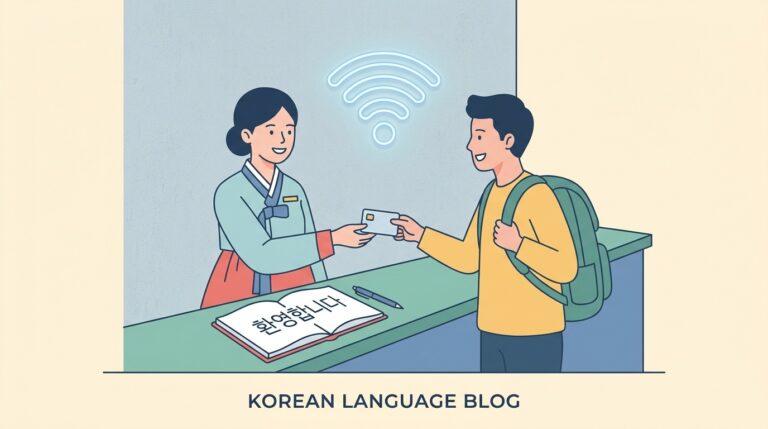
Phase 1: Empathy & K-Culture Cold Open
Hello! I am the Senior Editor of Daily Hangul, your local culture navigator and veteran Korean tutor.
Picture this K-Drama moment: You have just arrived in Seoul after a long flight. You check into a stunning, sleek hotel that looks straight out of King the Land or Crash Landing on You. You fall onto the crisp, white bed, ready to video call your family or post a room tour on Instagram. You check your phone: No Service. Panic sets in. You run down to the front desk, but suddenly, your mind goes blank. You end up pointing at your phone, making weird hand gestures, and saying, Wi-Fi? Wi-Fi please?
If you have ever felt this frustration, you are not alone. Asking for the Wi-Fi password is the ultimate survival skill in Korea, the land of ultra-fast internet. But did you know that knowing how to ask naturally, rather than sounding like a translating app, will immediately earn you that insider respect?
This guide is built from the real experiences of B1 learners who wanted to move past basic textbook sentences and speak like a true local. Let’s dive in!
Phase 2: Core Expressions Deep Dive
Here are the most essential ways to ask about Wi-Fi in Korea, analyzing both the meaning and the vibe.
1. 와이파이 비밀번호가 뭐예요?
* Pronunciation: wa-i-pa-i bi-mil-beon-ho-ga mwo-ye-yo? (Sound-alike: why-pie bee-meal-bun-ho-gah mwo-yay-yo?)
* Meaning: Literal: Wi-Fi secret number is what? / Real: What is the Wi-Fi password?
* K-Culture Moment: You will hear this in literally every cafe, restaurant, and hotel lobby in Korea. It is the golden question.
* Editor’s Insight: Notice the word 비밀번호 (bi-mil-beon-ho). It translates directly to secret number. While some Koreans understand password, using 비밀번호 instantly makes your Korean sound much more authentic.
* Situation Spectrum:
* Casual with friends: ✅ (Drop the 요: 뭐야?)
* Semi-formal (Staff): ⚠️ (Acceptable, but you must say 저기요 first)
* Formal (Elders/Boss): 🚫
* 🤔 Think About It: Why do you think Koreans say secret number instead of adopting the English word password directly, even though they adopted the word Wi-Fi? How does your native language express this concept?
2. 와이파이 어떻게 연결해요?
* Pronunciation: wa-i-pa-i eo-tteo-ke yeon-gyeol-hae-yo? (Sound-alike: uh-ttuh-keh yun-gyul-hae-yo?)
* Meaning: Literal: Wi-Fi how connect? / Real: How do I connect to the Wi-Fi?
* K-Culture Moment: Some Korean hotels have tricky captive portals where you need to input your room number and last name. When just the password isn’t enough, you need to ask how to connect.
* Editor’s Insight: This is a fantastic B1-level phrase. It shows you know how to use question words (어떻게) and dynamic verbs (연결하다), moving beyond simple what is sentences.
* Situation Spectrum:
* Casual with friends: ✅
* Semi-formal (Staff): ✅
* Formal (Elders/Boss): ⚠️
* 🤔 Think About It: Notice what is missing in the sentence? There is no I or you. Korean is a high-context language where the subject is usually dropped if the context is clear. Does dropping the subject feel unnatural to you?
Phase 3: Textbook vs. Real Korean
Let’s compare what you studied with what you will actually hear on the bustling streets of Myeongdong.
Situation 1: Approaching the hotel front desk
* 📖 Textbook Korean: 실례합니다. 와이파이 비밀번호를 가르쳐 주시겠습니까? (Excuse me. Could you please teach me the Wi-Fi password?)
* 🗣️ Real Korean: 저기요, 혹시 와이파이 비밀번호가 어떻게 돼요? (Excuse me, by any chance, how does the Wi-Fi password become?)
* 💡 Why is it different?: Koreans love softening requests. Asking 어떻게 돼요? (How does it become?) is a beautifully indirect and polite way to ask for information compared to a direct 무엇입니까? (What is it?).
Situation 2: A quick question at an artsy cafe in Hongdae
* 📖 Textbook Korean: 와이파이 비밀번호가 무엇입니까?
* 🗣️ Real Korean: 여기 와이파이 비번 뭐예요?
* 💡 Why is it different?: Bibeon (비번) is the ultimate abbreviation for Bimil-beonho. In Korea’s fast-paced Ppalli-ppalli (hurry up) culture, long words are often chopped in half!
Bottom Note: At the B1 level, you want to sound polite but fluent. Using 혹시 (by any chance) and 어떻게 돼요? (how does it become?) strikes the perfect balance of respect and natural fluency.
Phase 4: Cultural Context — K-Culture Deep Dive
4-1. Non-Verbal Nunchi (눈치)
In Korea, it’s all about reading the room, or Nunchi. When asking for the Wi-Fi, don’t just shout from afar. Make slight eye contact, offer a polite head nod (a mini bow), and hold up your phone slightly. This visual cue tells the busy hotel staff exactly what you need before you even speak.
4-2. The K-Travel Connection: Where to Look First
Before you even use your Korean, use your travel Nunchi! In Korean hotels and cafes, the Wi-Fi password is rarely a closely guarded secret.
* At a Hotel: It is almost always printed directly on the paper sleeve that holds your key card.
* At a Cafe: Look at the bottom of your receipt (영수증). If you see a long string of numbers (like 1234567890) or the cafe’s phone number, 99% of the time, that is the Wi-Fi password!
* Pro Tip: In K-Dramas, you rarely see characters asking for Wi-Fi because public internet in Korea is so widely available, even on subway trains and buses!
Phase 5: Real-Life Roleplay Scenario
Setting: 10:00 PM at a sleek boutique hotel in Gangnam. The lobby smells like expensive cedarwood. You just checked in and are trying to join a Zoom meeting, but your laptop won’t connect.
Characters:
* YOU: A B1 Korean learner, on day one of a business trip, feeling slightly jet-lagged.
* Jihun (25): The night auditor. Polite, professional, and currently typing away at his computer.
Dialogue:
YOU: 저기요.
(Jeo-gi-yo.)
[Excuse me.]
Jihun: 네, 고객님. 무엇을 도와드릴까요?
(Ne, gogaengnim. Mueoseul dowadeurilkkayo?)
[Yes, sir/ma’am. How can I help you?]
YOU: 제가 302호에 체크인했는데요, 방에서 와이파이가 안 터져요.
(Jega sam-baek-i-ho-e chekeu-inhaenneundeyo, bang-eseo wa-i-pa-i-ga an teojeoyo.)
[I checked into room 302, but the Wi-Fi isn’t working/connecting in the room.]
(🎭 Stage Direction: You show him your laptop screen with a slightly worried look)
Jihun: 아, ‘Hotel_302’ 네트워크에 연결하셨나요?
(A, Hotel_302 neteuwokeue yeongyeolhasyeonnayo?)
[Ah, did you connect to the ‘Hotel_302’ network?]
YOU: 네, 그런데 비밀번호를 입력하라고 하네요. 혹시 와이파이 비밀번호가 어떻게 돼요?
(Ne, geureonde bimilbeonhoreul imnyeokharago haneyo. Hoksi wa-i-pa-i bimilbeonhoga eotteoke dwaeyo?)
[Yes, but it’s telling me to enter a password. By any chance, what is the Wi-Fi password?]
Jihun: 아, 비밀번호는 고객님 카드키 케이스 뒷면에 적혀 있습니다.
(A, bimilbeonhoneun gogaengnim kadeuki keiseu dwinmyeone jeokhyeo itseumnida.)
[Ah, the password is written on the back of your key card case.]
🔀 Your Turn! How do you reply?
* A) 아이고, 제가 못 봤네요. 감사합니다! (Oh my, I didn’t see it. Thank you!)
* B) 왜 안 알려줘요? (Why aren’t you telling me?)
* C) 진짜요? 대박! (Really? Daebak!)
✅ Best Choice: A — It acknowledges the slight misunderstanding with a polite, humble tone.
⚠️ Choice C Analysis: Daebak is great for friends, but too casual for hotel staff you just met.
YOU: 아이고, 제가 못 봤네요. 한번 볼게요.
(Aigo, jega mot bwanneyo. Hanbeon bolgeyo.)
[Oh my, I didn’t see it. Let me take a look.]
Jihun: 네, 아래쪽에 있는 숫자 8자리입니다.
(Ne, araejjoge inneun sutja yeodeol-jari-imnida.)
[Yes, it’s the 8-digit number at the bottom.]
YOU: 아, 찾았어요! 정말 감사합니다.
(A, chajasseoyo! Jeongmal gamsahamnida.)
[Ah, I found it! Thank you so much.]
Jihun: 별말씀을요. 편안한 밤 되세요!
(Byeolmalsseumeullyo. Pyeonanhan bam doeseyo!)
[Don’t mention it. Have a comfortable night!]
Phase 6: 10-Second Shadowing Drill
Let’s practice the most natural way to ask. Pay attention to the pauses (/) and the intonation.
- 😊 밝고 친절하게 (Bright and polite):
저기요, / 혹시 / 와이파이 비밀번호가 / 어떻게 돼요?
(jeo-gi-yo, / hok-si / wa-i-pa-i bi-mil-beon-ho-ga / eo-tteo-ke dwae-yo?)
Phase 7: K-Culture Mini Dictionary
1. 비번
* Romanization: bi-beon
* English: Password (Abbreviation)
* Context: Short for Bimil-beonho. Used mostly among friends or in casual text messages. You wouldn’t use this at a 5-star hotel front desk, but you will definitely use it with your Korean friends!
2. 안 터져요
* Romanization: an teo-jyeo-yo
* English: (The connection) isn’t working/bursting.
* Context: Literal translation is it doesn’t burst, but Koreans use this to describe poor signal, bad Wi-Fi, or no cell service. It’s incredibly native-sounding!
3. 영수증
* Romanization: yeong-su-jeung
* English: Receipt
* Context: The holy grail of passwords in cafes and restaurants. Always check the bottom of this paper before bothering the barista!
4. 프론트
* Romanization: peu-ron-teu
* English: Front desk / Reception
* Context: In Korean hotels, locals rarely say reception. They use the Konglish word peuronteu.
Phase 8: Traveler Survival Kit
When staying at a hotel in Korea, Wi-Fi is just one piece of the puzzle. Here are the top survival phrases you need for a smooth stay.
🆘 Survival Expression #1: Checkout time
* 🇰🇷 체크아웃 몇 시예요? (che-keu-a-ut myeot si-ye-yo?)
* 📍 Context: Calling the front desk to confirm when you need to leave.
🆘 Survival Expression #2: Requesting amenities
* 🇰🇷 수건 좀 더 주실 수 있어요? (su-geon jom deo ju-sil su i-sseo-yo?)
* 📍 Context: When you need extra towels. You can replace 수건 (towel) with 물 (water).
🆘 Survival Expression #3: Reporting an issue
* 🇰🇷 에어컨이 안 켜져요. (e-eo-keo-ni an kyeo-jyeo-yo.)
* 📍 Context: The AC won’t turn on. A lifesaver during the humid Korean summer!
📌 Editor’s Travel Note
* Tipping Culture: There is NO tipping culture in Korea! If you try to leave a tip on your hotel pillow or hand cash to the front desk, they will likely chase you down the street thinking you forgot your money.
* Useful Apps: Google Maps can be glitchy for walking directions in Korea. Download Naver Map or KakaoMap before your trip.
Phase 9: Critical Thinking Corner — “One Step Deeper”
🧠 Think Deeper: Language & Power (The Art of Indirectness)
As we discussed, Koreans prefer asking 어떻게 돼요? (How does it become?) instead of 뭐예요? (What is it?) when speaking to strangers. This reflects a core pillar of Korean social psychology: preserving harmony and avoiding confrontation. Direct questions can sometimes sound like an interrogation or a demand. By using passive or indirect phrasing, you soften the burden on the listener, showing respect for their space and position. It is an act of linguistic empathy.
💬 Your Turn: Does your culture have indirect ways of asking for information? Do you think being direct is rude, or just efficient? Share your thoughts in the comments!
Phase 10: FAQ & Avoiding Misunderstandings
Q: Can I just point at my phone and say ‘Wi-Fi?’ like I do in Europe?
A: You can, and they will understand, but it comes off as a bit blunt or impatient. Adding a simple 저기요 (Excuse me) and 요 at the end of your words goes a long way in showing respect.
Q: Can I ask another guest in the lobby for the password?
A: Koreans generally avoid bothering strangers unless necessary. It is always better to ask the staff (프론트 직원) directly.
❌ Common Mistake #1: Saying 당신 (Dang-sin / You) to the hotel staff.
✅ Do This Instead: Never use 당신! It can sound confrontational. Just drop the word you entirely, or refer to them by their title if you know it. (e.g., just say 와이파이 비밀번호가 뭐예요?)
Phase 11: Summary & Action Items
One-Liner Summary: To sound like a polite local, ask 혹시 와이파이 비밀번호가 어떻게 돼요? and remember to check your receipt or key card first!
Action Mission 3 Steps:
* 🥉 Bronze: Say 와이파이 비밀번호가 어떻게 돼요? out loud 3 times right now.
* 🥈 Silver: Change your phone’s Wi-Fi network name to a Korean word for fun.
* 🥇 Gold: On your next trip to a Korean restaurant or your local K-Town, use this exact phrase to ask for the Wi-Fi!
K-Culture Mission:
The next time you watch a K-Drama, look closely at the cafe scenes. Can you spot the small Wi-Fi password signs usually taped near the cash register?
Let me know your results in the comments! What expression should we cover next?
Phase 12: Quiz — Interactive Challenge
1. Situational Judgment: You are at a trendy cafe in Seoul. You want to ask the barista for the Wi-Fi password quickly but politely. Which is the best choice?
* A) 너, 비번 뭐야? (Hey you, what’s the password?)
* B) 저기요, 와이파이 비밀번호가 어떻게 돼요? (Excuse me, how does the Wi-Fi password become?)
* C) 와이파이 내놔. (Hand over the Wi-Fi.)
2. Fill in the Blank:
방에서 와이파이가 안 _____. (The Wi-Fi isn’t working/bursting in the room.)
Hint: It starts with 터 (teo)
3. True or False — K-Culture Edition:
If a hotel staff gives you a great room and excellent Wi-Fi service, you should tip them 10% of your room rate. (T/F)
(Answers: 1. B – A is rude, C is a robbery! / 2. 터져요 (teo-jyeo-yo) / 3. False. Tipping is not practiced in Korea and can cause confusion!)







