

Phase 1: Empathy & The K-Culture Cold Open
Hello, hikers and culture explorers! I am your Daily Hangul Editor, your local guide to everything from the bustling streets of Seoul to the serene peaks of Korea’s majestic mountains.
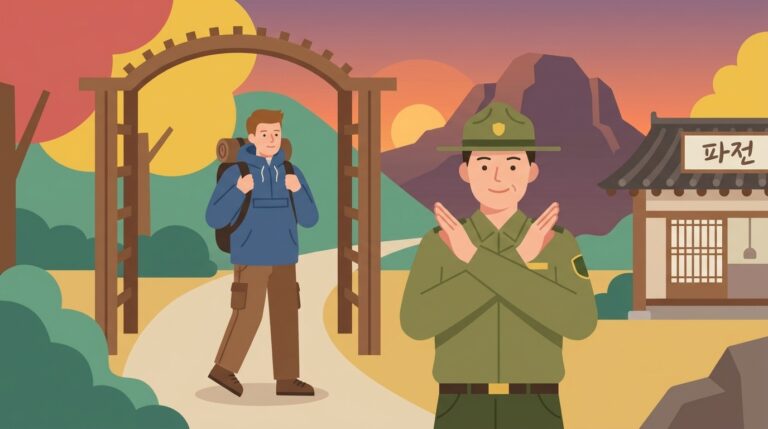
Picture this: You are starring in your very own K-Drama. You’ve bought those trendy colorful hiking leggings you saw on Instagram, packed your favorite cup noodles, and arrived at the entrance of Seoraksan National Park. The autumn leaves are glowing. It is 3:00 PM, a perfect time for a sunset hike, right? You march confidently toward the trail, but suddenly, a park ranger in a neat uniform steps in front of you, crosses their arms into a giant ‘X’, and says something that sounds like “Tong-je!”
Wait, what? You traveled all the way here, and you cannot go up?
If you do not know about 입산 통제 시간 (Mountain Entry Restriction Time), your epic Korean hiking adventure might end at the parking lot. Unlike many Western trails where you hike at your own risk, Korean national parks strictly control entry times to prevent night hiking accidents. Knowing these expressions won’t just save your trip; it will earn you a respectful nod from the local Ahjummas and Ajeossis who practically live on these mountains. Let us dive in!
Phase 2: Core Expressions Deep Dive
1. 입산 통제 시간이 언제예요?
- Pronunciation: ipsan tongje sigani eonjeyeyo? (ip sounds like ‘deep’ without the d, san like ‘sun’, tong like ‘tongs’, je like ‘jelly’)
- Meaning: When is the mountain entry restriction time?
- K-Culture Moment: You will see this phrase printed on huge red banners at the entrance of every national park in Korea. If you arrive a bit late, you can ask other hikers coming down this question. They will usually look at your shoes, assess your speed, and tell you if you can make it!
- Editor’s Insight: The word 통제 (tongje) means control or restriction. It sounds very strict, but in Korea, it is a word deeply connected to public safety. You will also hear it during traffic control or emergency drills.
- Situation Spectrum:
- Casual: ✅ (Asking fellow hikers)
- Semi-formal: ✅ (Asking a park ranger)
- Formal: ✅
- 🤔 Think About It: Why does Korea have such strict cut-off times for mountains instead of letting people take their own risks? How does this reflect the Korean concept of community responsibility?
2. 지금 올라가면 못 내려와요.
- Pronunciation: jigeum ollagamyeon mot naeryeowayo. (eu sounds like the disgusted sound you make when stepping in gum)
- Meaning: If you go up now, you won’t be able to come down (before dark).
- K-Culture Moment: This is the ultimate phrase of Jeong (정 – deep affection/attachment). A random middle-aged hiker passing by might grab your arm, look at you with genuine worry, and say this. They aren’t trying to boss you around; they are protecting you like their own family.
- Editor’s Insight: Koreans rarely sugarcoat safety warnings. Instead of saying “It might be dark soon,” they jump straight to the consequence: “You cannot come down!”
- Situation Spectrum:
- Casual: ✅
- Semi-formal: ⚠️ (Rangers might use more formal vocabulary)
- Formal: 🚫
- 🤔 Think About It: Have you ever experienced a stranger intervening in your plans for your own good in your home country?
3. 하산하셔야 합니다.
- Pronunciation: hasanhasyeoya hamnida. (ha like ‘ha-ha’, san like ‘sun’)
- Meaning: You must descend the mountain.
- K-Culture Moment: It is 5:00 PM near the peak. The sun is dipping. A park ranger approaches you with a flashlight and politely but firmly drops this sentence. It means playtime is over!
- Editor’s Insight: 하산 (hasan) literally means “descend mountain.” The suffix ~하셔야 합니다 makes it a polite but non-negotiable command. It is the respectful way of saying, “Get out now.”
- Situation Spectrum:
- Casual: 🚫
- Semi-formal: ⚠️
- Formal: ✅ (Standard broadcast/ranger announcement)
- 🤔 Think About It: Notice how formal language in Korean is often used to soften authoritative commands. Do you have a similar mechanism in your native language?
Phase 3: Textbook vs. Real Korean
Asking about closing time
* 📖 Textbook Korean: 국립공원은 언제 문을 닫습니까? (When does the national park close its doors?)
* 🗣️ Real Korean: 몇 시까지 올라갈 수 있어요? (Until what time can we go up?)
* 💡 Why the difference?: Mountains do not have physical “doors.” Koreans focus on the action of ascending (올라가다) rather than the abstract concept of a park closing.
Being denied entry
* 📖 Textbook Korean: 입산이 금지되었습니다. (Entry is prohibited.)
* 🗣️ Real Korean: 오늘 통제 끝났어요. 내일 오세요~ (Control is over for today. Come tomorrow~)
* 💡 Why the difference?: Everyday Korean strips away passive, formal vocabulary for direct, friendly, and practical instructions.
Bottom Note: As a B2 learner, try to shift from passive textbook phrases (is prohibited) to active, verb-focused phrases (cannot go up) for a much more natural flow!
Phase 4: Cultural Context — K-Culture Deep Dive
4-1. Non-verbal Communication: The Big ‘X’
When a park ranger or a local hiker wants to tell you that entry is restricted, they will often cross their forearms in front of their chest or face to make an ‘X’ shape. Do not take this aggressively! It is a very common Korean gesture meaning “No,” “Stop,” or “Prohibited.” If you see the ‘X’, smile, nod, and ask about tomorrow’s schedule.
4-2. The K-Food Connection: Post-Hike Rituals
What happens when you are restricted from entering the mountain? You skip straight to the best part: the post-hike meal! At the base of every major Korean mountain, there is a vibrant village of restaurants. Even if you didn’t hike, you can still enjoy 파전 (Pajeon – green onion pancake) and 막걸리 (Makgeolli – traditional rice wine).
In Korea, hiking is just as much a culinary and social event as it is an athletic one. If a ranger turns you away, they might even point to a restaurant and say, “Just go eat some Pajeon!”
Phase 5: Real-Life Roleplay Scenario
Setting: It is 2:30 PM on a brisk November afternoon at the entrance of Bukhansan National Park. You want to hike to Baegundae Peak. You approach the trail gate, but Ranger Kim is standing there, shaking his head.
Characters:
* YOU: An intermediate Korean learner who really wanted an epic sunset photo.
* Ranger Kim (45): A kind but strictly rule-abiding park ranger.
Dialogue:
YOU: 안녕하세요! 지금 백운대 올라갈 수 있나요?
(annyeonghaseyo! jigeum baegundae ollagal su innayo?)
[Hello! Can I go up to Baegundae Peak now?]
Ranger Kim: 아이고, 외국인분이시네. 지금은 늦어서 못 가요. 통제 시간이에요.
(aigo, oeguginbunisine. jigeumeun neujeoseo mot gayo. tongje siganieyo.)
[Oh, you are a foreigner. It is too late to go now. It’s the restriction time.]
YOU: 네? 아직 2시 반인데요?
(ne? ajik dusi banindeyo?)
[Excuse me? It’s only 2:30 PM though?]
Ranger Kim: 겨울에는 해가 빨리 져서 2시부터 입산 통제예요. 지금 올라가면 못 내려와요.
(gyeoureneun haega ppalli jyeoseo dusibuteo ipsan tongjeyeyo. jigeum ollagamyeon mot naeryeowayo.)
[In winter, the sun sets early, so entry is restricted from 2 PM. If you go up now, you can’t come down.]
🔀 Your Turn! How do you respond?
* A) 아, 그렇군요. 그럼 내일 다시 올게요. (Oh, I see. Then I will come back tomorrow.)
* B) 저 진짜 빨리 걸을 수 있어요! 제발요! (I can walk really fast! Please!)
* C) 그럼 중간까지만 갔다가 내려와도 돼요? (Then can I just go halfway and come back down?)
✅ Best Choice: C — This is the ultimate Korean compromise (Nunchi in action). Often, rangers will restrict the peak but allow you to hike a shorter 1-hour loop trail.
⚠️ Choice B Analysis: Arguing with “Pali-pali” (fast) logic won’t work on safety rules in Korea. They will just cross their arms into a harder ‘X’!
Ranger Kim: 중간에 절까지만 가는 건 괜찮아요. 어두워지기 전에 꼭 하산하셔야 합니다!
(junggane jeolkkajiman ganeun geon gwaenchanayo. eoduwojigi jeone kkok hasanhasyeoya hamnida!)
[Going halfway up to the temple is fine. You must descend before it gets dark!]
YOU: 네, 감사합니다! 안전하게 다녀오겠습니다!
(ne, gamsahamnida! anjeonhage danyeoogetseumnida!)
[Yes, thank you! I will have a safe trip!]
Phase 6: 10-Second Shadowing Drill
Listen to the rhythm, pause where the slashes are, and express the emotion!
- 🥺 아쉽게 (With regret): 지금은 / 입산 통제 시간이라서 / 못 올라가요.
- Romanization: jigeumeun / ipsan tongje siganiraseo / mot ollagayo.
- Meaning: Because it is the entry restriction time now, we cannot go up.
Phase 7: K-Culture Mini Dictionary
1. 등린이 (deung-rin-i)
* Meaning: Hiking beginner.
* Context: A cute portmanteau of 등산 (hiking) and 어린이 (child). The MZ generation loves using this on Instagram when showing off their first mountain hike.
2. 정상석 (jeongsang-seok)
* Meaning: Peak stone.
* Context: The heavy stone monument at the top of a Korean mountain. Taking a photo hugging this stone is the ultimate proof you survived the hike!
3. 파전과 막걸리 (pajeon-gwa makgeolli)
* Meaning: Green onion pancake and rice wine.
* Context: The holy grail of post-hike food. Eating this together builds teamwork and friendship.
4. 야간 산행 (yagan sanhaeng)
* Meaning: Night hiking.
* Context: Strictly regulated. You usually can only do this legally on New Year’s Eve to see the first sunrise, or by booking a mountain shelter months in advance.
Phase 8: Traveler’s Survival Kit
Here is your survival pack for navigating Korean mountain trails!
🆘 Survival Expression #1
* 🇰🇷 “어디로 가야 덜 가팔라요?” (eodiro gaya deol gapallayo?)
* 🗣️ Pronunciation: [uh-di-ro ga-ya dul ga-pal-la-yo?]
* 📍 Where to use: Asking hikers for the less steep, easier route down.
* 💡 Pro Tip: Korean mountains have many rocky stairs. Always ask for the “계단 없는 길” (path without stairs) if your knees hurt.
📌 Editor’s Travel Note
* Must-Have App: Do not use Google Maps on Korean mountains; it will get you lost. Use KakaoMap or Naver Map. They show every tiny hiking trail perfectly.
* Trash Etiquette: There are ZERO trash cans on Korean mountains. You must pack your trash in your own bag and take it back to the city.
* Restrooms: Use the restroom at the park entrance. Toilets near the peak are rare and often lack running water.
Phase 9: Critical Thinking Corner — “One Step Deeper”
Media vs Reality: The K-Drama Night Hike
In many romantic K-Dramas, you see the main characters hiking up a beautiful, softly lit mountain in the middle of the night to look at the city stars, wearing casual sneakers and a trench coat.
🧠 Think Deeper:
The reality of Korean mountains is vastly different. Seventy percent of Korea’s terrain is mountainous, and these mountains are composed of sharp granite peaks (like Seoraksan or Bukhansan). One slip in the dark can be fatal. That is why the “National Park Entry Restriction” exists so rigorously. The romanticized media image creates a dangerous illusion for tourists who think they can casually stroll up a peak at 8 PM. True Korean hikers know that respecting the mountain’s rules is the only way to enjoy it safely.
💬 Your Turn: Have you ever seen a K-Drama scene that totally misrepresented the reality of Korean nature or weather? Share it in the comments!
Phase 10: FAQ & Avoiding Mistakes
Q: “Can I just sneak in after the control time?”
A: No! National parks have CCTVs, thermal cameras, and active ranger patrols. If caught, you will face a hefty fine (up to 500,000 KRW) and a very embarrassing scolding.
Q: “Can I ask older hikers for directions using casual language?”
A: Never. Even if they offer you their snacks and treat you like a grandchild, always use the polite ~요 form. It shows deep respect for their age.
❌ Common Mistake #1: Assuming “Open 24/7” applies to nature.
✅ Do This Instead: Always check the seasonal entry times on the Korea National Park Service (KNPS) website. Winter cut-offs are usually around 2:00 PM to 3:00 PM for peak trails!
Phase 11: Summary & Action Items
- One-Liner Summary: Korean national parks strictly enforce 입산 통제 시간 (Entry restriction times) for safety, so always start your hike early and never argue with a ranger’s ‘X’ gesture!
Action Mission 3 Steps:
* 🥉 Bronze (Solo): Say “입산 통제 시간” out loud three times right now. Get used to the rhythm!
* 🥈 Silver (Online): Download KakaoMap, search for “Bukhansan,” and zoom in to see the hiking trail lines.
* 🥇 Gold (Real Life): Next time you are in Korea, use “몇 시까지 올라갈 수 있어요?” to a local near a mountain base!
K-Culture Mission:
Go to YouTube and search for “한국 등산 브이로그” (Korean hiking vlog). Watch how hikers dress (the colorful gear!) and listen for the rangers making announcements through megaphones!
What is the highest mountain you have ever hiked? Let me know in the comments below! 👇
Phase 12: Quiz — Interactive Challenge
1. Situational Judgment:
You arrive at the trail at 4 PM. A ranger crosses his arms and says “지금은 통제 시간입니다.” What should you do?
* A) Run past him quickly.
* B) Say “아, 알겠습니다. 내일 올게요.” (Ah, understood. I’ll come tomorrow.)
* C) Ask where the nearest club is.
2. True or False — K-Culture Edition:
In Korea, it is common to eat a heavy meal of Pajeon and Makgeolli at the top of the peak. (T/F)
3. Fill in the Blank:
It is getting dark. The ranger tells you: “빨리 _________ 하셔야 합니다.” (You must descend quickly.)
Answers:
1. B – Always respect the ranger’s instructions politely.
2. False – Cooking or drinking alcohol at the peak is illegal and dangerous! You eat Pajeon and Makgeolli at the base of the mountain after you descend.
3. 하산 (hasan) – Descend the mountain.
Frequently Asked Questions (FAQ)
Q: What does "입산 통제 시간이 언제예요?" mean in Korean and how do you pronounce it?
A: In Korean, "입산 통제 시간이 언제예요?" is pronounced [ipsan tongje sigani eonjeyeyo? (ip sounds like 'deep' without the d, san like 'sun', tong like 'tongs', je like 'jelly'] and means: When is the mountain entry restriction time?
Q: What does "지금 올라가면 못 내려와요." mean in Korean and how do you pronounce it?
A: In Korean, "지금 올라가면 못 내려와요." is pronounced [jigeum ollagamyeon mot naeryeowayo. (eu sounds like the disgusted sound you make when stepping in gum] and means: If you go up now, you won't be able to come down (before dark).
Q: What does "하산하셔야 합니다." mean in Korean and how do you pronounce it?
A: In Korean, "하산하셔야 합니다." is pronounced [hasanhasyeoya hamnida. (ha like 'ha-ha', san like 'sun'] and means: You must descend the mountain.







