

Phase 1: Empathy
Hello! I am your Daily Hangul Editor.
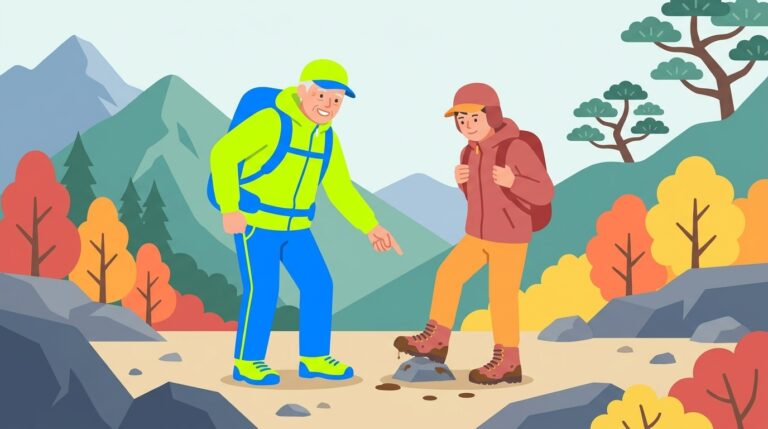
Imagine this: It is a crisp autumn morning in Seoul. You decided to hike Bukhansan Mountain. You are huffing and puffing up a steep, rocky trail, feeling pretty proud of yourself. Suddenly, an older Korean man—decked out head-to-toe in blindingly bright neon hiking gear—points his trekking pole directly at your feet and shouts something in Korean.
Your heart drops. Did you break a mountain rule? Are your shoes offensive?
Before you panic and apologize, look down. He is probably just saying, “Hey, your shoelace is untied!”
In Korean hiking culture, strangers are not really strangers; they are your temporary mountain family. If your shoelaces are loose on a rocky trail, they will not just walk past you. They will stop, warn you, and sometimes even wait until you tie them securely. Missing this nuance might make you feel scolded, but understanding it unlocks the warm, insider world of Korean ‘Jeong’ (affection).
This guide is based on real panicked questions from my students who thought they were getting yelled at on the mountain. Let us turn you into a mountain insider!
Phase 2: Core Expressions Deep Dive
1. 신발 끈 풀렸어요
- Pronunciation: sinbal kkeun pullyeosseoyo (sin-bal kkeun pool-yeot-so-yo)
- Sound-alike guide for English speakers: ‘eu’ in kkeun sounds like the disgusted “ugh” sound you make when stepping in gum.
- Meaning: Literal: The shoe string has come undone. / Real nuance: Your shoelace is untied (Watch out!).
- K-Culture Moment: You will hear this not just on mountains, but on crowded subways or busy streets. Koreans are very observant of others’ safety. If a stranger says this to you, it is an act of pure kindness.
- Editor’s Insight: This phrase feels like a quick, helpful tap on the shoulder. It is not an accusation; it is just a friendly heads-up.
- Situation Spectrum:
- Casual (Friends): ✅ (Just drop the ‘yo’ -> 신발 끈 풀렸어)
- Semi-formal (Strangers/Coworkers): ✅
- Formal (Boss/Elders): ⚠️ (Better to say: 부장님, 신발 끈이 풀리셨어요)
- 🤔 Think About It: Why do Koreans often drop the word “Your” (당신의) in this sentence? In English, we say “YOUR shoelace.” In Korean, the context makes it obvious, reflecting a high-context culture where unnecessary words are naturally omitted!
2. 꽉 묶으세요
- Pronunciation: kkwak mukkeuseyo (kkwak moo-kkeu-se-yo)
- Sound-alike guide: ‘kkwak’ sounds like a duck quacking, but sharper. ‘eu’ is that same “ugh” sound.
- Meaning: Literal: Tie it tightly. / Real nuance: Double-knot it so you do not trip!
- K-Culture Moment: An older hiker (Ahjeossi or Ajumma) will often stand right next to you, watching you tie your shoe to make sure you do it right. It feels a bit like having a Korean parent for five minutes.
- Editor’s Insight: The word ‘꽉’ (tightly/firmly) is a fun adverb. You can use it when holding hands (꽉 잡아!) or closing a lid (꽉 닫아!).
- Situation Spectrum:
- Casual: ✅ (꽉 묶어)
- Semi-formal: ✅
- Formal: 🚫 (Sounds too commanding to a boss)
- 🤔 Think About It: Giving unsolicited advice (like telling an adult how to tie their shoes) might be considered rude in some Western cultures. Why is it considered a sign of affection in Korea?
3. 다쳐요
- Pronunciation: dachyeoyo (da-chyeo-yo)
- Meaning: Literal: You will get hurt. / Real nuance: Be careful, it’s dangerous!
- K-Culture Moment: You are reaching for a hot pot of kimchi stew, and the restaurant owner slaps your hand away saying, “다쳐요!” On the mountain, if your laces are loose, they will say “꽉 묶어요, 다쳐요!”
- Editor’s Insight: This is the ultimate “I care about you” warning. It might sound blunt, but it is deeply affectionate.
- Situation Spectrum:
- Casual: ✅ (다쳐!)
- Semi-formal: ✅
- Formal: 🚫 (Use 조심하세요 instead)
Phase 3: Textbook vs. Real Korean
[Warning someone about their shoelaces]
* Textbook Korean: 신발 끈이 풀렸습니다. 넘어지지 않게 조심하십시오. (Very robotic and formal)
* Real Korean: 어? 끈 풀렸어요! 꽉 묶어요!
* Why?: In urgent or caring situations, Koreans drop subject markers (이/가) and use shorter, punchier phrases. Efficiency and emotion over perfect grammar!
[Wishing someone a safe hike]
* Textbook Korean: 안전하게 등산하시기를 바랍니다. (Sounds like a public service announcement)
* Real Korean: 안산하세요! (Short for 안전 산행하세요)
* Why?: Korean culture loves abbreviations! Hikers shortened “Safe Hiking” into a cute, breezy catchphrase.
Bottom Note: At a B1 level, you do not need to speak perfectly like a news anchor. Using natural phrases like “끈 풀렸어요” will make locals instantly warm up to you.
Phase 4: Cultural Context — K-Culture Deep Dive
4-1. Non-Verbal Elements
When a Korean stranger points out your untied shoelace, they might literally point at your feet with their finger, umbrella, or trekking pole. Do not feel threatened! Also, if you need to tie your shoe on a trail, Korean Nunchi dictates you step completely off the narrow path so you do not block others.
4-2. K-Culture Connection: The K-Drama Shoelace Trope
Have you ever noticed how often shoelaces appear in K-Dramas? The male lead dramatically drops to one knee to tie the female lead’s shoelace (think of the legendary scene in Descendants of the Sun). It is the ultimate gesture of protection and service.
However, let us be critical: in a drama, it is romance. In reality, on a Korean mountain, if an Ahjeossi stops to look at your shoes, it is pure survival and community spirit! Do not expect a handsome doctor to tie your shoes for you; but do expect a friendly local to offer you a slice of cucumber after you tie them yourself.
Phase 5: Real-Life Roleplay Scenario
Setting: Saturday, 10:00 AM. Halfway up Bukhansan Mountain. The air is crisp, and the leaves are red. You step onto a flat rock to catch your breath. A local hiker in a neon orange jacket stops walking and looks at your hiking boots.
Characters:
* YOU: An expat who started hiking to enjoy Korean autumn.
* Ahjeossi (NPC): 60 years old, carrying a massive backpack, extremely friendly but loud.
Ahjeossi: 어이구, 학생! 거기 신발 끈 풀렸어.
(eoigu, haksaeng! geogi sinbal kkeun pullyeosseo.)
[Oh my, student! Your shoelace is untied there.]
Stage Direction: He points at your right boot with his hiking stick.
You: 헉, 진짜요? 몰랐어요.
(heok, jinjjayo? mollasseoyo.)
[Gasp, really? I didn’t know.]
Ahjeossi: 산에서 끈 풀리면 크게 다쳐. 얼른 꽉 묶어!
(saneseo kkeun pullimyeon keuge dachyeo. eolleun kkwak mukkeo!)
[If your lace comes undone on the mountain, you get badly hurt. Tie it tightly right now!]
Your Turn! How will you answer?
A) “아, 네. 알겠습니다.” (Polite, but a bit cold)
B) “알려주셔서 감사합니다! 꽉 묶을게요.” (Warm, appreciative, uses the vocabulary)
C) “제 신발이니까 제가 알아서 할게요.” (Wait, no! This means “It’s my shoe, I’ll handle it.” Very rude!)
Best Choice: B — Acknowledging their help and showing you are taking their advice (I will tie it tightly) perfectly matches the Korean “Jeong” culture.
Ahjeossi: 그래, 그래. 이거 오이 하나 먹고 천천히 가~
(geurae, geurae. igeo oi hana meokgo cheoncheonhi ga~)
[Yeah, yeah. Have this cucumber and go slowly~]
Stage Direction: He hands you a mysterious piece of raw cucumber and walks away.
Phase 6: 10-Second Shadowing Drill
Practice reading this aloud to nail the Korean mountain rhythm!
😲 어? / 신발 끈이 / 풀렸어요! (eo? / sinbal kkeuni / pullyeosseoyo!)
😤 다치니까 / 꽉 / 묶으세요! (dachinikka / kkwak / mukkeuseyo!)
😊 네, / 감사합니다! / 안산하세요~ (ne, / gamsahamnida! / ansanhaseyo~)
Phase 7: K-Culture Mini Dictionary
- 눈치
* Romanization: nunchi
* English: Social awareness / reading the room
* Context: On the mountain, Nunchi means stepping aside when tying your shoes so others can pass safely.
- 등산복
* Romanization: deungsanbok
* English: Hiking clothes
* Context: Korean hiking fashion is famous for its ultra-bright, neon colors. It is not just for style; it is for visibility and safety!
- 정
* Romanization: jeong
* English: Deep affection / community bonding
* Context: The reason strangers care about your shoelaces or offer you food. It is the invisible glue of Korean society.
- 안산
* Romanization: ansan
* English: Safe hike (Abbreviation)
* Context: The standard greeting and farewell among hikers. Short for “안전 산행하세요”.
Phase 8: Traveler Survival Kit
Even if you are just hiking Namsan Tower, keep these in your back pocket!
Survival Expressions TOP 3
* 🇰🇷 “정상까지 얼마나 걸려요?” (jeongsangkkaji eolmana geollyeoyo?)
* English: How long until the summit?
* 📍 Use it: When you are exhausted. (Warning: Koreans will always say “Just 15 more minutes!” even if it is an hour away).
- 🇰🇷 “먼저 가세요.” (meonjeo gaseyo.)
- English: Please go ahead.
- 📍 Use it: When you need to stop to tie your shoes or catch your breath on a narrow trail.
-
🇰🇷 “길을 잃었어요.” (gireul ileosseoyo.)
- English: I am lost.
- 📍 Use it: If you wander off the trail.
Editor’s Travel Note
* App to use: Do not use Google Maps on Korean mountains. Use Naver Map or KakaoMap; they actually show the hiking trails!
* Cash is King: Bring physical cash. There are often small vendors selling ice cream, water, or Makgeolli near the peaks, and they might not take international cards.
Phase 9: Critical Thinking Corner — One Step Deeper
Think Deeper: Food & Identity on the Trail
Have you ever wondered why a stranger telling you about your shoelace immediately offers you a cucumber, cherry tomatoes, or a cup of Makgeolli? In Korea, eating together is the ultimate form of boundary-breaking. It transforms you from “strangers on a trail” to “companions sharing the mountain.” Giving unsolicited advice (like “tie your shoes”) and giving food are two sides of the same coin: Korean Jeong. They are expressions of collective care, treating you as part of their extended community.
Your Turn: Does your culture have a tradition of sharing food or giving safety advice to absolute strangers? Let us know in the comments!
Phase 10: FAQ & Avoiding Misunderstandings
Q: The Ahjeossi spoke to me informally (Banmal). Should I be offended?
A: No! Older Koreans often use casual speech with younger people, especially in informal settings like a mountain. It is meant to be friendly, not disrespectful. However, you should still reply politely in Yo-form (요).
Q: Should I call him Ahjeossi?
A: Ahjeossi (middle-aged man) is totally fine to use on the mountain! It is the standard way to get a hiker’s attention.
Common Mistakes
* Mistake 1: Saying “미안합니다” (I am sorry) when someone points out your shoelace. You didn’t do anything wrong! Say “고맙습니다” (Thank you) instead.
* Mistake 2: Stopping dead in the middle of a rocky stairway to tie your shoe. Always pull over!
* Mistake 3: Refusing a small snack out of politeness multiple times. If they offer a cherry tomato, accepting it with a smile is the best cultural response.
Phase 11: Summary & Action Items
One-Liner Summary: When a Korean points at your feet and says “끈 풀렸어요,” smile, say thank you, and tie your shoes tightly to survive the mountain!
Action Mission 3 Steps:
* Bronze (Solo): Pretend to tie your shoe and say “꽉 묶으세요” to yourself in the mirror.
* Silver (Online): Leave a comment below using the phrase “안산하세요!” (Have a safe hike!).
* Gold (Real World): Next time you see a Korean friend with an untied shoelace, bravely tell them: “끈 풀렸어요!”
K-Culture Mission:
Go to YouTube, search “Korean hiking vlog” (한국 등산 브이로그), and spot the neon outfits! See if you can catch hikers greeting each other on the trail.
Phase 12: Quiz — Interactive Challenge
-
Situational Judgment: You are hiking and your Korean friend says, “끈 풀렸어. 다쳐!” What is the best response?
A) “미안해!” (I’m sorry!)
B) “고마워! 꽉 묶을게.” (Thanks! I’ll tie it tightly.)
C) “왜 그래?” (What’s wrong with you?)
Answer: B. Do not apologize, just show gratitude and action! -
True or False: If an older hiker drops honorifics and tells you to tie your shoe tightly, they are angry at you.
Answer: False! It is an expression of ‘Jeong’ and worry for your safety. -
Fill in the Blank: To wish someone a safe hike, you can use the abbreviation: “___하세요!”
*Answer: 안산 (Ansan)*
Frequently Asked Questions (FAQ)
Q: What does "신발 끈 풀렸어요" mean in Korean and how do you pronounce it?
A: In Korean, "신발 끈 풀렸어요" is pronounced [sinbal kkeun pullyeosseoyo (sin-bal kkeun pool-yeot-so-yo] and means: Literal: The shoe string has come undone. / Real nuance: Your shoelace is untied (Watch out!).
Q: What does "꽉 묶으세요" mean in Korean and how do you pronounce it?
A: In Korean, "꽉 묶으세요" is pronounced [kkwak mukkeuseyo (kkwak moo-kkeu-se-yo] and means: Literal: Tie it tightly. / Real nuance: Double-knot it so you do not trip!
Q: What does "다쳐요" mean in Korean and how do you pronounce it?
A: In Korean, "다쳐요" is pronounced [dachyeoyo (da-chyeo-yo] and means: Literal: You will get hurt. / Real nuance: Be careful, it's dangerous!







