

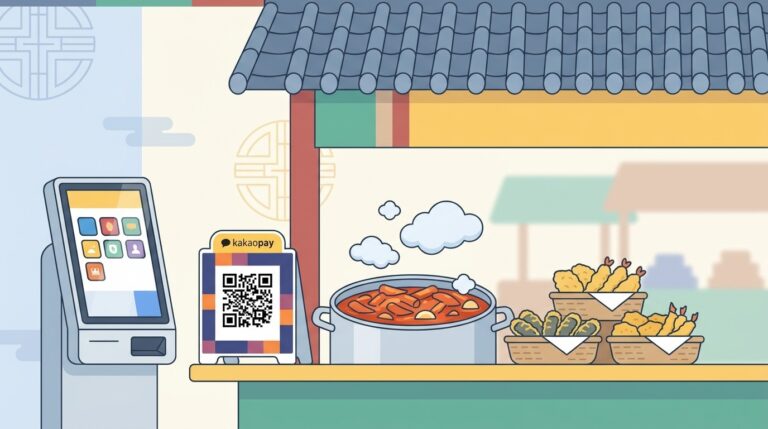
Welcome to the Digital Joseon Era!
Hello! This is your Daily Hangul Editor. Have you ever watched a K-Drama where the main characters go on a cute date to a traditional Korean market? They eat hotteok (sweet pancakes), share a bowl of noodles, and hand over a few crumpled Korean Won bills to a friendly grandmother.
But if you actually walk into Gwangjang Market or Mangwon Market today, you might be in for a surprise. Right next to the towering mountains of traditional fried chicken and steaming dumplings, you will find sleek digital kiosks, QR codes for instant bank transfers, and vendors with smartwatches.
Welcome to the modernized Korean traditional market! It is a fascinating mix of the old and the new. Knowing how to navigate this unique environment not only saves you from awkward moments (like holding up a line of hungry locals because you cannot find cash) but also earns you massive respect from the vendors. This guide is based on real struggles from my foreign students who thought they only needed to know ‘How much is it?’ but ended up facing a touch screen instead! Let’s dive into the authentic, B2-level phrases you actually need.
Core Expressions for the Modern Market
1. 카드 되나요?
- Pronunciation: ka-deu doe-na-yo? (Sound analogy: ‘doe’ sounds like the word ‘dough’ but cut short).
- Meaning: Literal: Does card work? / Real nuance: Do you accept credit cards?
- K-Culture Moment: You are buying a small twisted doughnut (Kkabaegi) for 1,000 Won. In the past, using a card for such a small amount was frowned upon. Nowadays, many modernized markets welcome cards, but it is always polite to ask first using this phrase!
- Editor’s Insight: The verb 되다 (to become / to work) is magic in Korean. We use it to ask for permission or availability. It feels much softer and more natural than asking ‘Can I pay with a credit card?’
- Situation Spectrum:
- Casual / Street vendors: ✅
- Semi-formal / Store clerks: ✅
- Formal / High-end boutiques: ⚠️ (They obviously take cards, so asking might sound strange)
- 🤔 Think About It: Why do Koreans prefer asking ‘Does the card work?’ instead of ‘Can I use my card?’ How does this reflect the Korean tendency to focus on the situation rather than the individual ego?
2. 계좌이체 할게요
- Pronunciation: gye-jwa-i-che hal-ge-yo (‘gye’ sounds like ‘gyeh’ in a swift motion).
- Meaning: Literal: I will do an account transfer. / Real nuance: I will send the money directly to your bank account.
- K-Culture Moment: You will see A4 papers with bank account numbers taped to almost every market stall. In Korea, sending money between banks via mobile apps takes about 3 seconds and has no fees. Young Koreans often leave their wallets at home and just transfer money!
- Editor’s Insight: If you have a Korean bank account (like KakaoBank or Toss), this phrase makes you look like a total local.
- Situation Spectrum:
- Traditional Markets / Street food stalls: ✅
- Mom-and-pop stores: ✅
- Big franchise cafes: 🚫 (They prefer cards or kiosks)
- 🤔 Think About It: The rapid adoption of mobile bank transfers in small markets shows Korea’s ‘Palli-Palli’ (hurry up) culture. Do traditional vendors in your country adapt to digital payments quickly?
3. 영수증 버려주세요
- Pronunciation: yeong-su-jeung-eun beo-ryeo-ju-se-yo.
- Meaning: Literal: Please throw away the receipt. / Real nuance: I don’t need the receipt.
- K-Culture Moment: After successfully paying with your card at a modernized market shop, the machine prints a receipt. Koreans hate carrying small trash. If you say this as soon as your card is swiped, the vendor will smile and nod.
- Editor’s Insight: Notice the structure 버리다 (throw away) + 주다 (to do for someone). You are literally asking them to do you the favor of throwing it away. It sounds much more natural than saying ‘영수증 필요 없어요’ (I don’t need a receipt), which can sound a bit cold.
- Situation Spectrum:
- Anywhere you buy things: ✅
- 🤔 Think About It: Why do we ask someone else to throw away our trash instead of just declining the receipt? It is part of the service culture where clerks handle the transaction from start to finish.
Textbook vs. Real Korean: Payment Edition
[Situation 1: Asking if they accept digital payment]
* Textbook Korean: 삼성페이로 지불할 수 있습니까? (Very robotic and stiff)
* Real Korean: 삼성페이 되죠? (Samsung Pay works, right?)
* Why it’s different: Koreans value efficiency in speech. Using the -죠 ending assumes a positive answer and makes the interaction smoother and friendlier.
[Situation 2: Asking for a plastic bag]
* Textbook Korean: 비닐봉투를 하나 주시겠습니까? (Sounds like a strict news anchor)
* Real Korean: 봉투 하나 주세요. (Please give me one bag.)
* Why it’s different: Modern markets now charge 50 won or 100 won for bags due to environmental laws. Keeping the request short and sweet is the standard.
[Situation 3: When the owner points to a digital screen]
* Textbook Korean: 무인 단말기를 사용하여 주문하겠습니다. (I will order using the unmanned terminal.)
* Real Korean: 아, 키오스크로 할게요. (Ah, I’ll use the kiosk.)
* Why it’s different: The English loanword ‘kiosk’ (키오스크) is universally used across all generations in Korea now, even by grandmothers in the market.
Cultural Context: The K-Market Revolution
1. Non-verbal: The ‘Two-Hand’ Card Pass
Even in a highly digital, fast-paced environment, traditional manners remain. When handing your credit card to an older vendor, do not just toss it on the counter or hand it over with one hand. Use both hands, or at least use your left hand to support your right arm. It is a sign of respect that bridges the gap between modern technology and traditional Korean etiquette.
2. K-Culture Link: Variety Shows and Market ‘Hot Places’
If you watch K-Variety shows like ‘Running Man’ or ‘Amazing Saturday’, traditional markets are no longer depicted as just places to buy cheap groceries. They are ‘Hot Places’ (핫플) where culinary trends are born. You will see vendors selling fusion foods like Marshmallow Ice Cream or Truffle Hotteok. These trendy spots almost always use modern ordering systems. The vendors might look like traditional ‘Ajummas’, but they are savvy business people running Instagram-famous stalls. Do not let the rustic aesthetic fool you; their business operations are as modern as a Gangnam cafe!
Real-Life Roleplay: The Digital Tteokbokki Stand
Setting: Friday evening, 6 PM at Gwangjang Market. The neon signs are turning on, steam is rising from the food stalls, and the smell of spicy Tteokbokki fills the air. You (a foreign traveler on your 4th day in Seoul) want to buy some street food, but you only have a credit card and a 50,000 Won bill.
Characters:
– YOU: Hungry and trying to be polite.
– 아주머니 (Auntie): The energetic stall owner, wearing an apron and a smart watch.
아주머니: 어서 와요! 삼촌, 뭐 줄까? 맛있어!
(eoseo wayo! samchon, mwo julkka? masisseo!)
(Welcome! Uncle/Young man, what can I get you? It’s delicious!)
(Stage Direction: Auntie points to the bubbling red sauce with her tongs)
YOU: 떡볶이 1인분 포장해 주세요.
(tteokbokki irinbun pojanghae juseyo.)
(Please pack 1 serving of Tteokbokki to go.)
아주머니: 네~ 떡볶이 하나! 4천 원이에요.
(ne~ tteokbokki hana! sacheon wonieyo.)
(Okay~ One Tteokbokki! It’s 4,000 won.)
YOU: 저기… 카드 되나요?
(jeogi… kadeu doenayo?)
(Excuse me… do you accept cards?)
아주머니: 아유, 요즘 시장은 다 카드 되지! 줘봐요.
(ayu, yojeum sijangeun da kadeu doeji! jwobwayo.)
(Oh my, all markets take cards these days! Hand it over.)
YOU: 다행이네요. 여기 있습니다.
(dahaengineyo. yeogi itseumnida.)
(That’s a relief. Here you go.)
(Stage Direction: You hand the card politely with two hands)
아주머니: 결제 다 됐어요. 영수증 줄까?
(gyeolje da dwaesseoyo. yeongsujeung julkka?)
(Payment is done. Shall I give you the receipt?)
🔀 Your Turn! How should you respond?
* A) 네, 주시겠습니까? (Yes, would you give it to me?)
* B) 아니요, 버려주세요. (No, please throw it away.)
* C) 영수증 필요 없어요. (I don’t need a receipt.)
Best Choice: B. It is the most natural and considerate way to decline a receipt in Korea.
Choice A Analysis: Too formal. You are at a market stall, not a bank!
Choice C Analysis: It’s okay, but it lacks the polite ‘please’ factor that B has.
YOU: 아니요, 영수증은 버려주세요.
(aniyo, yeongsujeung-eun beoryeojuseyo.)
(No, please throw the receipt away.)
아주머니: 네~ 맛있게 먹어요!
(ne~ masitge meogeoyo!)
(Okay~ Enjoy your meal!)
YOU: 감사합니다! 많이 파세요~
(gamsahamnida! mani paseyo~)
(Thank you! Sell a lot / Have a good business~)
10-Second Shadowing Drill
Read out loud and focus on the pacing! Follow the pauses (/) and the emotion tags.
😊 친절하게 (Kindly): 저기요 / 혹시 / 카드 되나요?
(jeogiyo / hoksi / kadeu doenayo?)
😤 깔끔하게 (Neatly): 영수증은 / 그냥 / 버려주세요.
(yeongsujeung-eun / geunyang / beoryeojuseyo.)
😊 밝게 (Brightly): 떡볶이 / 1인분 / 포장해 주세요!
(tteokbokki / irinbun / pojanghae juseyo!)
K-Culture Mini Dictionary
1. 시장 인심
* Romanization: sijang insim
* English: Market generosity
* Context: The concept of vendors giving you a little extra food for free just because they like you. Even with digital payments, ‘sijang insim’ is still alive!
2. 덤
* Romanization: deom
* English: Extra / Bonus
* Context: Closely related to the above. If you buy 5 apples, the vendor giving you a 6th apple for free is called giving a ‘deom’.
3. 노포
* Romanization: nopo
* English: Historic / Long-standing eatery
* Context: Traditional market restaurants that have been open for decades. Young Koreans love visiting ‘nopo’ for the retro vibe, but expect them to have modern QR ordering systems now!
4. 계좌이체
* Romanization: gyejwa iche
* English: Bank transfer
* Context: The backbone of Korea’s modern street economy. Vendors display their bank names and account numbers so customers can send money instantly via their phones.
Traveler Survival Kit
Are you heading to a Korean market soon? Save these phrases to your phone!
Survival Phrase #1: Finding the Kiosk
* 🇰🇷 여기서 주문해요?
* (yeogiseo jumunhaeyo?)
* English: Do I order here?
* 📍 Where to use: When you are confused if you should talk to the vendor or use the machine.
Survival Phrase #2: Mobile Payment
* 🇰🇷 카카오페이 결제 되나요?
* (kakaopei gyeolje doenayo?)
* English: Can I pay with KakaoPay?
* 📍 Where to use: At modernized market stalls that have the yellow KakaoPay sticker.
Survival Phrase #3: Taking out
* 🇰🇷 먹고 갈 수 있어요?
* (meokgo gal su isseoyo?)
* English: Can I eat here?
* 📍 Where to use: Some market stalls look like takeout only but actually have hidden tables in the back or upstairs!
Editor’s Travel Note
* Cash vs. Card: Korea is a cashless society. While carrying a little cash (around 20,000 Won) in markets is safe for tiny purchases, do not worry if you only have a card. 95% of modernized markets accept cards effortlessly.
* Tip Culture: DO NOT tip the market vendors (or anyone in Korea). Giving extra money will cause confusion, and they might chase you down the street thinking you forgot your change!
Think Deeper: Media vs. Reality
When we watch historical K-Dramas or even modern romantic comedies, traditional markets are often painted as places frozen in time. They symbolize nostalgia, analog connections, and a break from the hyper-digital city life of Seoul. However, the reality of Korean traditional markets is deeply pragmatic.
Korean society prioritizes convenience and speed. To survive, market vendors quickly adopted Kiosks, digital menus, and mobile payment systems. This creates a beautiful, yet sometimes jarring, contrast: eating a centuries-old recipe while paying with facial recognition on your smartphone.
Your Turn: In your culture, do historical or traditional spaces resist modernization to keep their ‘authentic’ feel, or do they embrace technology like Korea? Let us know in the comments below!
FAQ & Avoiding Common Misunderstandings
Q: Can I use 반말 (casual language) at the market to sound friendly?
No! Some K-Drama fans think acting like a local means talking casually to the market Ajummas, just because the Ajummas use casual language with customers. Always use standard polite Korean (요 form). The vendors use casual speech as a sign of motherly affection, but if a young stranger does it back, it is considered very rude.
Q: Is it okay to haggle (깎아주세요) at the modernized markets?
Generally, no. With the introduction of digital payments and kiosks, prices are fixed. Haggling was common 20 years ago, but today, trying to negotiate the price of a 3,000 Won hotdog will just create an awkward situation. Instead, be polite, and you might naturally receive some ‘덤’ (extra food)!
Q: What if the Kiosk is entirely in Korean?
Look for a globe icon or flags at the top right corner of the screen. Almost all modern Kiosks in Korea support English, Japanese, and Chinese. If not, use the camera translation feature on your Papago app!
Common Mistake Alert!
* ❌ Saying ‘아줌마!’ (Ajumma!) loudly to get the vendor’s attention.
* ✅ Instead, say ‘사장님~’ (Sajangnim~ / Boss). It is much more respectful and professional, acknowledging them as business owners, especially in the modernized market economy.
Summary & Your Next Mission
One-Liner Summary: Korean traditional markets have modernized rapidly; knowing phrases for card payments, bank transfers, and taking out will help you blend right in with the locals!
Action Mission 3 Steps:
* Bronze (Solo): Practice saying ‘카드 되나요?’ with the correct intonation in front of a mirror three times.
* Silver (Online): Leave a comment below sharing what traditional Korean street food you want to buy using your new phrases!
* Gold (Real Life): Next time you are in Korea (or at a local Korean mart), confidently tell the cashier ‘영수증은 버려주세요’ after paying.
K-Culture Mission: Open Google Maps or KakaoMap and search for ‘Gwangjang Market’ (광장시장) or ‘Mangwon Market’ (망원시장). Look at the recent photo reviews. Try to spot the credit card terminals or QR code signs hiding next to the delicious food!
Did you find this guide helpful? What other traditional Korean places do you want to learn how to navigate? Let your Daily Hangul Editor know in the comments!
Interactive Quiz
Test your modern market survival skills!
1. Situational Judgment: You want to buy a pair of traditional socks for 2,000 Won, but you only have a credit card. What is the most natural way to ask if you can use it?
* A) 신용 카드 사용이 가능합니까?
* B) 카드 되나요?
* C) 현금 없어요.
2. Fill in the Blank: After paying, the vendor hands you a receipt, but you do not want to carry the paper waste.
‘영수증은 ___________.’ (Please throw it away).
3. True or False – K-Culture Edition: At a modernized traditional market in Korea, you should tip the vendor if the service and food were excellent. (T/F)
Answers:
1. B (A is too robotic, C is a bit blunt. B is perfectly natural and polite.)
2. 버려주세요 (beoryeojuseyo)
3. False! There is no tipping culture in Korea. Just tell them ‘맛있게 잘 먹었습니다!’ (I ate well / It was delicious!).
Frequently Asked Questions (FAQ)
Q: What does "카드 되나요?" mean in Korean and how do you pronounce it?
A: In Korean, "카드 되나요?" is pronounced [ka-deu doe-na-yo? (Sound analogy: 'doe' sounds like the word 'dough' but cut short] and means: Literal: Does card work? / Real nuance: Do you accept credit cards?
Q: What does "계좌이체 할게요" mean in Korean and how do you pronounce it?
A: In Korean, "계좌이체 할게요" is pronounced [gye-jwa-i-che hal-ge-yo ('gye' sounds like 'gyeh' in a swift motion] and means: Literal: I will do an account transfer. / Real nuance: I will send the money directly to your bank account.
Q: What does "영수증 버려주세요" mean in Korean and how do you pronounce it?
A: In Korean, "영수증 버려주세요" is pronounced [yeong-su-jeung-eun beo-ryeo-ju-se-yo.] and means: Literal: Please throw away the receipt. / Real nuance: I don't need the receipt.







