

Phase 1: Empathy (The K-Culture Cold Open)
Hello! I’m your Daily Hangul Editor.
Imagine this: You’re watching a massive hit K-Drama. The protagonist, usually someone from a humble background, is standing in the pouring rain, staring down the corrupt CEO of a massive conglomerate. The subtitles simply read, ‘This is unfair!’ or ‘You’re a hypocrite!’ But if you listen closely, the protagonist isn’t using textbook Korean. They are spitting out words that carry the heavy, complex weight of Korean modern society—words about power, hierarchy, and a collective thirst for justice.
When we talk about ‘Philosophy and Ethics’ or ‘What is justice in modern society?’ in Korean, we don’t just use academic terms. We use vivid, socially charged expressions born from the internet, the workplace, and daily struggles. At a C1 level, mastering these terms isn’t just about passing a test; it’s about deeply understanding the Korean mindset, reading the room, and maybe even surviving office politics.
Today, we are moving beyond the textbook. We are going to explore how Koreans truly talk about fairness, power dynamics, and justice in the real world. Let’s dive in!
Phase 2: Core Expressions Deep Dive
1. 갑질
- Pronunciation: gap-jil [Sounds like ‘gap’ + ‘jil’ (chill with a ‘j’)]
- Meaning: Literal: ‘A-behavior’ / Real nuance: A power trip, abusing one’s power or status over an underdog.
- K-Culture Moment: Think of that classic K-Drama scene where a wealthy VIP throws a glass of water in a restaurant worker’s face. That is the ultimate ‘gapjil’. In reality, it happens when a boss forces employees to run personal errands, or a customer screams at a part-timer.
- Editor’s Insight: This word comes from contracts where the employer is ‘Gap’ (Party A) and the employee is ‘Eul’ (Party B). Adding the suffix ‘-jil’ (which slightly degrades the action) creates a powerful word that Koreans use daily to describe everyday injustice.
- Situation Spectrum:
- Casual with friends (venting): ✅
- Semi-formal (colleagues): ⚠️ (Okay if venting together, but be careful who is listening)
- Formal (to your boss): 🚫 (Never call your boss out with this word to their face!)
- 🤔 Think About It: Why did Korean society need to invent a specific noun for ‘abusing one’s position’? How does the hierarchical structure of Korean age and rank contribute to this?
2. 내로남불
- Pronunciation: nae-ro-nam-bul [Sounds like ‘neh-ro-nahm-bool’]
- Meaning: Literal: ‘If I do it, it’s romance; if others do it, it’s an affair.’ / Real nuance: Hypocrisy, double standards.
- K-Culture Moment: You’ll see this everywhere in the comments section of K-Pop or political news. If a celebrity makes a mistake, fans of rival groups will attack. But if their favorite idol does the same thing, they defend it. Netizens will immediately call this out as ‘Naeronambul’.
- Editor’s Insight: It sounds like an ancient four-character Chinese idiom (Saja-seongeo), but it’s actually a modern slang acronym! It perfectly captures the frustration of subjective justice.
- Situation Spectrum:
- Casual: ✅
- Semi-formal: ⚠️
- Formal: 🚫
- 🤔 Think About It: Is there a catchy phrase in your native language that so perfectly captures the essence of a double standard?
3. 사이다
- Pronunciation: sa-i-da [Sounds like ‘sigh-dah’]
- Meaning: Literal: Cider (Korean Sprite/lemon-lime soda) / Real nuance: A refreshing, satisfying resolution to an unfair situation; sweet justice.
- K-Culture Moment: When the underdog protagonist finally gets their revenge, exposes the corrupt villain, and the police take the villain away—Koreans call this a ‘Saida ending’. It clears the heavy, stuffy feeling (called 고구마, sweet potato) in your chest.
- Editor’s Insight: Justice in Korea is heavily tied to emotional release. We don’t just want things to be fair legally; we want it to feel cathartically fair.
- Situation Spectrum:
- Casual: ✅
- Semi-formal: ✅
- Formal: ⚠️
- 🤔 Think About It: Why do you think modern Koreans often use food metaphors (sweet potato, soda) to describe social justice and emotional frustration?
Phase 3: Textbook vs. Real Korean
[Situation 1: Pointing out an unfair workplace situation]
* 📖 Textbook Korean: 상사님이 권력을 남용하고 있습니다. (The boss is abusing his power.)
* 🗣️ Real Korean: 아, 부장님 또 갑질하시네. (Ah, the manager is on a power trip again.)
* 💡 Why the difference?: ‘권력 남용’ (abuse of power) is mostly used in news broadcasts. ‘갑질’ is the emotional, everyday reality.
[Situation 2: Calling out a hypocrite]
* 📖 Textbook Korean: 그것은 모순적입니다. (That is contradictory.)
* 🗣️ Real Korean: 완전 내로남불 아니에요? (Isn’t that a total double standard?)
* 💡 Why the difference?: Modern Koreans love four-syllable abbreviations that pack a witty punch.
[Situation 3: Reacting to justice being served]
* 📖 Textbook Korean: 정의가 실현되었습니다. (Justice has been realized.)
* 🗣️ Real Korean: 와, 완전 사이다! 속이 다 시원하네. (Wow, total Saida! I feel so refreshed.)
* 💡 Why the difference?: Legal justice feels distant; emotional catharsis feels personal.
Bottom Note: At a C1 level, using terms like ‘갑질’ and ‘내로남불’ at the right time shows you have moved beyond language mechanics and truly grasp the Korean social pulse.
Phase 4: Cultural Context — K-Culture Deep Dive
4-1. Non-Verbal Cues: The ‘Nunchi’ of Justice
When dealing with unfairness in Korea, 눈치 (Nunchi) is everything. Even if your boss is clearly wrong (gapjil), pointing it out aggressively in front of everyone makes you look bad because it disrupts group harmony. The Korean way is often to use silence, a heavy sigh, or to vent privately with peers over drinks later. Confrontation is usually a last resort.
4-2. The ‘Spoon Theory’ in K-Dramas
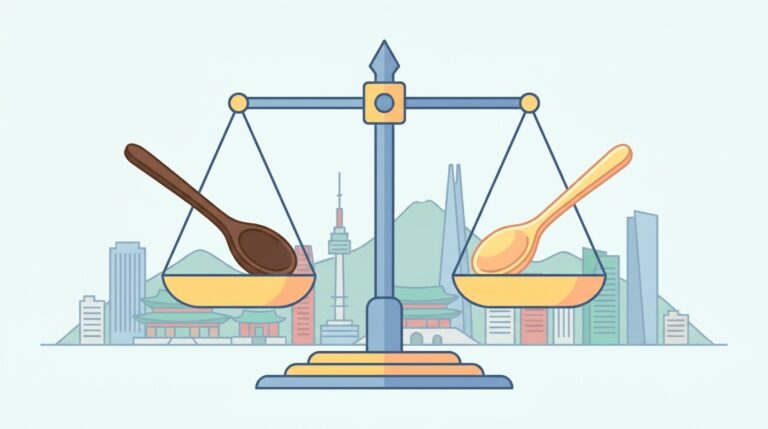
If you watch dramas discussing justice (Itaewon Class, Reborn Rich, The Golden Spoon), you will constantly hear about 수저론 (Spoon Class Theory).
* 금수저 (Gold spoon): Born into a wealthy, powerful family.
* 흙수저 (Dirt spoon): Born into a poor family.
In modern Korea, the debate around ‘Justice’ (정의) and ‘Fairness’ (공정) is heavily focused on whether a ‘dirt spoon’ can ever beat a ‘gold spoon’ purely through merit. K-Dramas heavily dramatize this because, in reality, the wealth gap makes it incredibly difficult. The public loves revenge dramas because they deliver the ‘Saida’ justice that real life often lacks.
Phase 5: Real-Life Roleplay Scenario
Setting: Friday night, 8 PM. A noisy, smoke-filled Samgyeopsal (pork belly) restaurant near Gangnam Station. Empty Soju bottles are lining up. You are drinking with your Korean coworkers after a brutally unfair week at the office.
Characters:
– YOU: A foreign employee who has been working in Seoul for 2 years. Highly capable, but frustrated.
– Min-su (32): Your Korean coworker. Loyal, cynical about corporate life, and currently grilling the meat.
Dialogue:
Min-su: 하아… 오늘 진짜 최악이었어. 고기나 먹자. 🥩
(Haa… oneul jinjja choeagieosseo. Gogina meokja.)
[Sigh… Today was really the worst. Let’s just eat meat.]
YOU: 부장님 또 그러시는 거예요? 주말에 출근하라고?
(Bujangnim tto geureosineun geoyeyo? Jumare chulgeunharago?)
[Is the manager doing it again? Telling us to work on the weekend?]
Min-su: 어. 자기는 금요일마다 일찍 퇴근하면서. 완전 내로남불이야.
(Eo. Jagineun geumyoilmada iljjik toegeunhamyeonseo. Wanjeon naeronamburiya.)
[Yeah. While he leaves early every Friday. Total hypocrite (Naeronambul).]
YOU: 이거 진짜 심각한 갑질 아니에요? 인사팀에 말해야 하는 거 아니에요?
(Igeo jinjja simgakan gapjil anieyo? Insatime malhaeya haneun geo anieyo?)
[Isn’t this a really serious power trip (Gapjil)? Shouldn’t we tell HR?]
Min-su: (🎭 Stage Direction: Min-su lowers his voice and looks around) 인사팀? 다 같은 편이지 뭐. 한국 회사가 원래 그래.
(Insatim? Da gateun pyeoniji mwo. Hanguk hoesaga wollae geurae.)
[HR? They’re all on the same side. Korean companies are just like that.]
YOU: 그래도 이건 공정하지 않잖아요. 우리만 고생하고.
(Geuraedo igeon gongjeonghaji anchanayo. Uriman gosaenghago.)
[Still, this isn’t fair (Gong-jeong). It’s only us suffering.]
Min-su: 맞아. 그래서 내가 블라인드(직장인 익명 앱)에 글 하나 쓰려고.
(Maja. Geuraeseo naega beullaindeue geul hana sseuryeogo.)
[Right. That’s why I’m going to write a post on Blind (an anonymous app for employees).]
🔀 Your Turn! How do you respond?
– A) “제가 부장님께 직접 말씀드릴게요.” (I will speak to the manager directly.)
– B) “오, 대박! 완전 사이다 결말 기대할게요.” (Oh, awesome! I’ll look forward to a refreshing ‘Saida’ ending.)
– C) “참으세요. 어쩔 수 없잖아요.” (Just endure it. There’s nothing we can do.)✅ Best Choice: B — Reason: It shows empathy, supports your colleague, and uses advanced K-Culture slang perfectly in a casual setting.
⚠️ Choice A Analysis: While morally brave, speaking directly to the boss in Korea without group consensus is seen as reckless and could put a target on your back.
Min-su: (Laughs) 그래! 터뜨려버리자! 짠 해, 짠! 🍻
(Geurae! Teotteuryeobeorija! Jjan hae, jjan!)
[Yeah! Let’s blow it up! Cheers, cheers!]
Phase 6: 10-Second Shadowing Drill
Read this out loud. Focus on the intonation and emotional release!
😤 와, / 자기는 안 하면서 / 남한테 하라는 건 / 완전 / 내로남불 / 아니에요?
(Wa, / jagineun an hamyeonseo / namhante haraneun geon / wanjeon / naeronambul / anieyo?)
“Wow, / telling others to do it / while not doing it themselves / isn’t that / a total / double standard?”
Phase 7: K-Culture Mini Dictionary
Here are the key C1 vocabulary words you need to understand Korean social issues.
1. 눈치 (Nunchi)
* Romanization: nun-chi
* English: Situational awareness / emotional intelligence.
* Context: The unspoken rule of sensing the mood. The core of maintaining harmony (and sometimes enduring injustice) in Korea.
2. 꼰대 (Kkon-dae)
* Romanization: kkon-dae
* English: A condescending older person / boomer.
* Context: Someone who forces outdated beliefs on younger people. Often the perpetrators of ‘Gapjil’.
3. 무임승차 (Mu-im-seung-cha)
* Romanization: mu-im-seung-cha
* English: Free-riding.
* Context: Literally means riding without a ticket, but widely used to describe a lazy person taking credit for a group project or team’s hard work. Highly triggering for fairness-obsessed Korean youths.
4. 팩트폭력 (Fact-pok-ryeok)
* Romanization: paek-teu-pong-nyeok
* English: Fact violence (attacking someone with indisputable truths).
* Context: When someone dishes out harsh, undeniable truths to expose hypocrisy or injustice. Often abbreviated as ‘팩폭’ (Paek-pok).
Phase 8: Traveler’s Survival Kit
Even as a traveler, you might face minor injustices or ‘Gapjil’ (like a taxi driver taking a long route or a vendor overcharging). Here’s how to defend yourself politely but firmly.
🆘 Survival Expressions for Justice
– 🇰🇷 “이건 좀 아닌 것 같은데요.” (Igeon jom anin geot gateundeyo.)
– 🗣️ English translation: “I don’t think this is quite right.”
– 📍 Where to use: Taxis, markets, hotels when something unfair happens.
– 💡 Pro Tip: Never raise your voice first. Saying this calmly with a serious expression is incredibly effective in Korea.📌 Editor’s Travel Note
– Dashcams & CCTVs: Korea is covered in cameras. If you face a truly unfair situation, point out calmly that there is a camera. People usually back down immediately.
– The Power of Apps: Don’t argue with taxi drivers. Just use Kakao T. It ensures fairness (공정) because the route and fare are pre-calculated!
Phase 9: Critical Thinking — “One Step Deeper”
Language & Power (언어와 권력)
Have you ever wondered why ‘Gapjil’ (Power abuse) is so common in Korea? It’s deeply woven into the language itself. Korean requires you to use honorifics (존댓말) to older people or superiors, while they often use informal language (반말) back to you. This builds a permanent, invisible hierarchy from the moment you say “Hello.”
When a boss unilaterally uses ‘Banmal’ to a new employee, it’s not just casual; it establishes who holds the power. Therefore, the fight for ‘Justice’ in Korea isn’t just about legal rights; it’s a daily struggle against the rigid walls of age and rank.
💬 Your Turn: Does your native language have ways to enforce hierarchy? How do people in your culture challenge unfairness from an older person or a boss? Let us know in the comments!
Phase 10: FAQ & Avoiding Misunderstandings
- Q: Can I use ‘갑질’ (Gapjil) in a formal presentation?
- A: No. While common in news analysis, in an academic or corporate presentation, use the formal term ‘권력 남용’ (Abuse of power) instead.
- Q: Is it okay to call an older person ‘꼰대’ (Kkondae) to their face?
- A: Absolutely NOT. It is highly insulting. It’s a word used behind their back.
- Q: How do Koreans protest unfairness?
- A: Collectively. You’ll see massive, highly organized, and peaceful candlelight protests in Gwanghwamun. Koreans believe collective action is the truest form of justice.
❌ Common Mistake #1: Calling out injustice by directly saying “You are wrong!” (당신이 틀렸어!)
✅ Do This Instead: Use passive structures or ‘we’ statements. “이건 원칙에 맞지 않는 것 같습니다.” (It seems this doesn’t fit the principles.) It saves face but makes the point.
Phase 11: Summary & Action Items
- One-Liner Summary: To understand modern Korean justice, you must understand the emotional battle between ‘Gapjil’ (power trips), ‘Naeronambul’ (hypocrisy), and the desperate desire for a ‘Saida’ (refreshing) resolution.
Action Mission:
– 🥉 Bronze: Look in the mirror and practice sighing and saying “완전 내로남불 아니야?” with maximum frustration.
– 🥈 Silver: Leave a comment in Korean on a news article or YouTube video where someone is abusing power, writing: “전형적인 갑질이네요.” (Typical Gapjil.)
– 🥇 Gold (K-Culture Mission): Watch an episode of a revenge K-Drama like Itaewon Class or The Glory. Try to pinpoint the exact moment the protagonist delivers a ‘팩폭’ (Fact-violence) to the villain. Did it feel like ‘Saida’?
Phase 12: Interactive Challenge — Quiz Time!
1. Situational Judgment:
You are at a cafe. A customer is screaming at a young part-time worker for getting an order slightly wrong. The customer is demanding the worker kneel. What word best describes the customer’s behavior?
A) 공정 (Fairness)
B) 갑질 (Gapjil)
C) 사이다 (Saida)
2. Fill in the Blank:
When your boss preaches about being punctual but arrives an hour late every day, you can secretly whisper to your coworker:
“우와, 우리 부장님 진짜 ( ) 대박이다.”
3. True or False – K-Culture Edition:
In modern Korea, ‘Nunchi’ means you should always aggressively confront a boss the moment you feel something is unfair. (T/F)
(Answers: 1. B, 2. 내로남불, 3. False – Nunchi often involves reading the room and finding a strategic, non-disruptive way to handle it.)
Frequently Asked Questions (FAQ)
Q: What does "갑질" mean in Korean and how do you pronounce it?
A: In Korean, "갑질" is pronounced [gap-jil [Sounds like 'gap' + 'jil' (chill with a 'j'] and means: Literal: 'A-behavior' / Real nuance: A power trip, abusing one's power or status over an underdog.
Q: What does "내로남불" mean in Korean and how do you pronounce it?
A: In Korean, "내로남불" is pronounced [nae-ro-nam-bul [Sounds like 'neh-ro-nahm-bool'] and means: Literal: 'If I do it, it's romance; if others do it, it's an affair.' / Real nuance: Hypocrisy, double standards.
Q: What does "사이다" mean in Korean and how do you pronounce it?
A: In Korean, "사이다" is pronounced [sa-i-da [Sounds like 'sigh-dah'] and means: Literal: Cider (Korean Sprite/lemon-lime soda) / Real nuance: A refreshing, satisfying resolution to an unfair situation; sweet justice.






