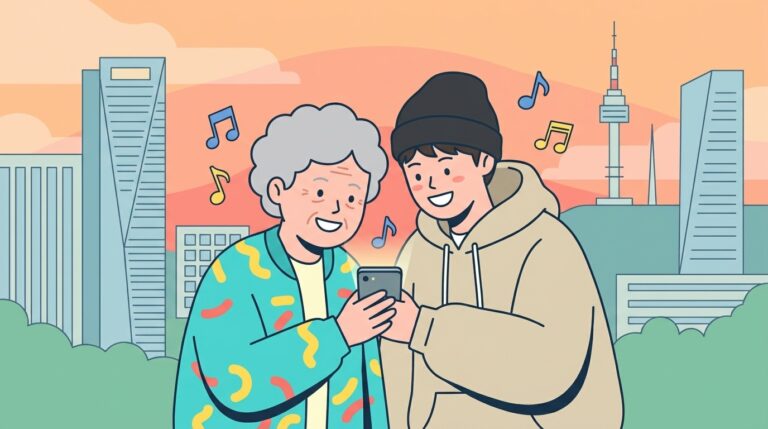
Phase 1: Empathy (Immersive Open)
Hello! This is your Daily Hangul Editor.
Picture this: You’re on the Seoul subway, and sitting next to you is an elegant elderly gentleman in a tailored suit. But wait… what is he doing on his phone? He has five different music apps open, continuously playing the same song, and he’s rapidly tapping a voting screen with the dedication of a hardcore K-Pop teen.
If you thought K-Pop fandom culture was only for Gen Z, welcome to the Trot Craze (트로트 열풍).
Over the past few years, Trot (Korea’s traditional pop music) has evolved from “the music your grandparents listen to on a mountain hike” to a massive, unstoppable national syndrome. Audition shows like Mr. Trot haven’t just revived a genre; they’ve created an unprecedented phenomenon: Generational Integration (세대 통합). Grandmothers, fathers, and teenagers are now sharing the exact same fandom vocabulary.
As a C2-level Korean learner, understanding this cultural shift is your golden ticket. Knowing how older generations have adopted youth slang—and how youth have embraced older music—will instantly elevate your Korean from “textbook perfect” to “deeply culturally fluent.” Let’s dive into the fascinating linguistic bridge of Korea’s entertainment world!
Phase 2: In-Depth Analysis of Core Expressions
Here are the absolute must-know expressions that have crossed generational lines thanks to the Trot boom.
1. 입덕 부정기 (The Stanning Denial Phase)
- Pronunciation: [ip-deok bu-jeong-gi] + [eep-duck boo-jung-gee]
- Meaning:
- Literal: The denial period of entering fandom.
- Real nuance: That phase where you insist “I just like this one song, I’m not a crazed fan,” right before buying $500 worth of concert merchandise.
- K-Culture Moment: Ten years ago, only teenagers used this K-Pop term. Today? You’ll hear 60-year-old mothers on TV saying, “어머, 내가 임영웅 입덕 부정기를 겪었잖아” (Oh my, I went through a Lim Young-woong denial phase). It perfectly captures how deeply idol culture has penetrated the older demographic.
- Editor’s Insight: This phrase brings a playful, almost self-deprecating humor. When an older person uses it, it shows they are modern, trendy, and fully aware of how passionate their fandom has become.
- Situation Spectrum:
- Friends (Casual): ✅
- Co-workers (Semi-formal): ✅ (Great for ice-breaking!)
- Formal/Elders (Formal): ⚠️ (Use cautiously, but fine if they bring up their favorite singer first!)
- 🤔 Think About It: Why do you think older Koreans adopted youth slang instead of creating their own words for being a fan? How does shared vocabulary bridge the age gap in your culture?
2. 효도 티켓팅 / 피켓팅 (Filial Piety Ticketing / Blood Ticketing)
- Pronunciation: [hyodo tikesing / pikesing] + [hyo-doh tee-ket-ting / pee-ket-ting]
- Meaning:
- Literal: Filial duty ticketing / Blood ticketing.
- Real nuance: The fierce, blood-bath competition among Millennials and Gen Z to secure Trot concert tickets for their parents.
- K-Culture Moment: Every time a major Trot star announces a tour, Korean internet cafes (PC Bangs) fill up with office workers in their 20s and 30s. They aren’t gaming; they are clicking furiously to buy VIP seats for their moms. Failing to get a ticket is considered a failure of “filial piety” (효도).
- Editor’s Insight: This word brilliantly combines traditional Confucian values (효도 – filial piety) with hyper-modern digital culture (티켓팅 – online ticketing).
- Situation Spectrum:
- Friends (Casual): ✅
- Co-workers (Semi-formal): ✅ (A huge topic of sympathy in the office)
- Formal/Elders (Formal): 🚫 (Not a bad word, but it’s a slang compound)
- 🤔 Think About It: Does the concept of “filial piety” exist in your culture in such a commercialized, modern way?
3. 스밍 돌리다 (To Run Streams)
- Pronunciation: [seuming dollida] + [s-ming dohl-lee-da]
- Meaning:
- Literal: To turn streaming.
- Real nuance: To continuously play a singer’s song on music apps (like Melon or Spotify) on mute 24/7 to boost their chart rankings.
- K-Culture Moment: It’s no longer just BTS fans doing this. Trot fandoms hold “Streaming Study Classes” where tech-savvy fans teach senior citizens how to create accounts, buy streaming passes, and loop songs.
- Editor’s Insight: Using “돌리다” (to run/operate a machine) implies that listening to music is no longer just a hobby; it’s a systematic, mechanical operation to support your star.
- Situation Spectrum:
- Friends (Casual): ✅
- Co-workers (Semi-formal): ✅
- Formal/Elders (Formal): ⚠️
- 🤔 Think About It: Does organized fan labor exist in your country’s music industry, or is it unique to K-Culture?
Phase 3: Textbook vs. Real Korean
Let’s upgrade your Korean from a rigid news report to how people actually talk about the Trot craze over a cup of iced Americano.
[Describing Extreme Popularity]
* 📖 Textbook Korean: 트로트가 인기가 매우 많습니다. (Trot is very popular.)
* 🗣️ Real Korean: 요새 트로트가 신드롬급이잖아요. (Trot is at a syndrome-level these days.) / 폼 미쳤어요. (Their form/momentum is crazy.)
* 💡 Why the difference?: Koreans love using dramatic, hyperbolic English loanwords (like “syndrome”) to describe cultural waves that dominate daily life.
[Becoming a Fan]
* 📖 Textbook Korean: 저는 그 가수의 팬이 되었습니다. (I became a fan of that singer.)
* 🗣️ Real Korean: 저 완전 덕통사고 당했잖아요. (I totally suffered a fandom-car-crash.)
* 💡 Why the difference?: “덕통사고” (덕후 + 교통사고) means falling in love with a celebrity as suddenly and unexpectedly as a car crash. It emphasizes the uncontrollable nature of emotions.
Bottom Note: At a C2 level, you shouldn’t just know these slangs; you should know when to drop them to sound witty, rather than childish. Use them with a smile and a tone of slight exaggeration!
Phase 4: Cultural Context — K-Culture Deep Dive
4-1. Non-verbal Elements: The Art of Generational Nunchi (눈치)
When you discuss Trot with an older Korean (say, your boss or a friend’s mother), pay attention to your non-verbal cues. If they mention they went to a Lim Young-woong concert, your eyes should widen, and you should cover your mouth slightly in awe. Why? Because you know how insanely difficult it is to get those tickets (Hyodo Ticketing!). Your reaction validates their social status and their children’s devotion.
4-2. K-Culture Connection: Fandom Colors and K-Pop Mimicry
If you watch a Trot concert, you’ll see a sea of middle-aged women dressed head-to-toe in neon mint, baby pink, or bright purple.
* The Shift: In the past, older generations wore dark, muted colors to avoid standing out. But the Trot craze gave them a “fandom color.” Wearing these bright colors is an act of reclaiming their youth and loudly expressing their identity.
* Critical View: Is this just older folks copying K-Pop? No. It’s an evolution. While K-Pop fans buy photo cards, Trot fans buy health supplements endorsed by their stars. The market has cleverly adapted idol culture to fit the physical and financial realities of the “Silver Surfer” generation.
Phase 5: Practical Roleplay Scenario
Setting: Monday morning, 9:00 AM, at the office pantry. You are pouring a cup of coffee. Your strict Department Manager, Mr. Kim (55), walks in. Usually, he only talks about work, but today he looks exhausted yet strangely triumphant.
Characters:
– YOU: A foreign expat working in Seoul, highly observant of Korean trends.
– Manager Kim: 55 years old, usually stoic, but secretly a massive fan of Trot singer Song Ga-in.
Dialogue:
Manager Kim: 아휴, 주말 내내 컴퓨터 앞에 앉아있었더니 허리가 다 아프네. ☕️
(Ahyu, jumal naenae keompyuteo ape anjaisseotdeoni heoriga da apeune.)
(Sigh, my back hurts from sitting in front of the computer all weekend.)
YOU: 부장님, 주말에 잔업 하셨어요? 너무 무리하시는 거 아니에요?
(Bujangnim, jumare janeop hasyeosseoyo? Neomu murihasineun geo anieyo?)
(Manager, did you work overtime this weekend? Aren’t you pushing yourself too hard?)
Manager Kim: (Laughs shyly) 아니, 그게 아니고… 우리 어머니가 송가인 팬이신데, 콘서트 티켓팅 좀 하느라고.
(Ani, geuge anigo… uri eomeoniga Song Ga-in paenisinde, konseoteu tiketing jom haneurago.)
(No, it’s not that… My mother is a fan of Song Ga-in, so I was trying to get concert tickets.)
🔀 Your Turn! How should you respond?
– A) “아, 노래가 참 좋죠.” (Ah, the songs are very good.)
– B) “와! 부장님, 혹시 효도 티켓팅 성공하셨어요? 피켓팅이었을 텐데!” (Wow! Manager, did you succeed in the filial piety ticketing? It must have been a blood-bath!)
– C) “저도 덕통사고 당했어요!” (I also suffered a fandom car crash!)✅ Best Choice: B — Why? By using the term “효도 티켓팅” and “피켓팅,” you instantly acknowledge the immense effort he put in. You are complimenting him as a good son while showing off your deep understanding of current Korean culture. Manager Kim will be extremely impressed.
⚠️ Choice C Analysis: Too abrupt. You made it about yourself using a slang term that doesn’t fit the context of him talking about his mother.
Manager Kim (If you chose B): 오! 〇〇씨가 ‘피켓팅’이라는 말도 알아요? 맞아, 광클(fast clicking) 하느라 죽는 줄 알았어요. 그래도 VIP석 구했습니다!
(O! 〇〇ssiga ‘pikesing’iraneun maldo arayo? Maja, gwangkeul haneura jungneun jul arasseoyo. Geuraedo VIP-seok guhaetseumnida!)
(Oh! You know the word ‘blood-ticketing’? That’s right, I thought I was going to die from clicking so fast. But I managed to get VIP seats!)
YOU: 대박이네요! 부장님 정말 최고의 아들이십니다. 어머님이 진짜 좋아하시겠어요!
(Daebagineyo! Bujangnim jeongmal choegoui adeurisimnida. Eomeonimi jinjja joahasigesseoyo!)
(That’s amazing! You are truly the best son. Your mother must be so happy!)
Phase 6: 10-Second Shadowing Drill
Master the intonation to sound like a true Seoulite gossiping about the latest trend.
Read this aloud in 10 seconds:
😲 와, / 요즘 트로트 팬덤 / 화력이 / 장난이 아니더라고요!
(Wa, / yojeum teuroteu paendeom / hwaryeogi / jangnani anideoragoyo!)
[Wow, the firepower of Trot fandoms these days is no joke!]
Pro-tip:
– Put a heavy emphasis on 장난 (jang-nan).
– “화력” (Firepower) is an advanced K-Pop term used to describe a fandom’s ability to buy albums, stream songs, and vote. Applying it to Trot shows you are C2-certified!
Phase 7: K-Culture Mini Dictionary
1. 눈치
* Romanization: nunchi
* English: Situational awareness / reading the room
* Context: The core social sense in Korea. Knowing when to praise someone’s “Hyodo Ticketing” is prime nunchi.
2. 조공
* Romanization: jogong
* English: Fandom tribute / catering
* Context: Originally meaning “tribute to a king,” it now refers to fans sending luxury meals or coffee trucks to a star’s filming set. Trot fans are famous for sending incredibly expensive and high-quality Jogong.
3. 실버 서퍼
* Romanization: silbeo seopeo
* English: Silver Surfer
* Context: The elderly demographic who are highly adept at using smartphones, internet, and apps. The driving force behind the Trot digital charts.
4. 총공
* Romanization: chonggong
* English: All-out attack / Coordinated streaming
* Context: Short for 총공격. When a fandom coordinates a specific time to stream a song massively to push it to #1 on the charts.
Phase 8: Traveler Survival Kit
Even if you aren’t a Trot fan, you will encounter this culture if you travel in Korea—especially in the subway or near concert venues (like KSPO Dome).
🆘 Survival Expressions #1
– 🇰🇷 “이 전광판 광고, 언제까지 하나요?” (i jeongwangpan gwanggo, eonjekkaji hanayo?)
– 🗣️ Pronunciation: [ee jeon-gwang-pan gwang-go, un-jae-kka-jee ha-na-yo?]
– 📍 Where to use: Subway stations
– 💡 Pro Tip: Trot fans place massive birthday ads for their stars in subway stations. If you want to take a picture but it’s changing screens, ask the station staff or other fans taking photos.📌 Editor’s Travel Note
– Concert Days: If you are using Line 9 towards Olympic Park on a weekend, beware! If a Trot concert is ending, the subway will be flooded with thousands of grandmothers in neon colors.
– Merch Booths (굿즈샵): Unlike K-Pop where fans use credit cards on apps, Trot merch booths outside stadiums often accept direct bank transfers (계좌이체) or cash, as older fans prefer it.
Phase 9: Critical Thinking Corner — “One Step Deeper”
🧠 Think Deeper: Media vs Reality & The Graying Power
The Trot craze is fascinating from a socio-economic perspective. Historically, youth dictated pop culture because they were the most active consumers. However, Korea is rapidly becoming an aging society. The media quickly realized that the “Silver Generation” possesses high disposable income and ample free time. Audition programs gamified their nostalgia, creating a new, highly lucrative market. While the media portrays this as “Generational Integration” (세대 통합) because teens and elders watch the same shows, critics argue it’s merely a commercial commodification of the elderly. Yet, undeniably, it has taught older Koreans how to navigate digital landscapes (streaming, online voting, e-commerce) much faster than any government IT program ever could.💬 Your Turn: In your country, is the entertainment industry mostly focused on the youth, or is there a genre where the older generation exercises immense economic and cultural power? Share your thoughts below!
Phase 10: FAQ & Avoiding Misunderstandings
Q: “Can I call a Trot singer ‘Oppa’ (오빠) even if the fans are grandmothers?”
– Maybe. While younger fans use “Oppa” or “Unnie,” older fans have created a unique culture where they often call the singers respectfully with their full name or even “Teacher” (선생님) or “Prince” (왕자님). Just stick to the singer’s name + 씨 (Mr./Ms.) if you aren’t sure!
Q: “If I am invited to karaoke (Noraebang) with older Korean colleagues, should I sing a Trot song?”
– YES! It is the ultimate cheat code. But remember, don’t sing a slow, sad Trot song. Pick an upbeat, energetic one (like “무조건” or “찐이야”). They will love you for it.
❌ Common Mistake #1: Calling Trot “Ajumma/Ajusshi (Old people) music” in front of Koreans.
✅ Do this instead: Acknowledge it as a massive, respected cultural genre. Say, “트로트는 한국의 소울 뮤직 같아요” (Trot feels like Korea’s soul music).
Phase 11: Summary & Action Items
- One-Liner Summary: The Trot craze has merged traditional filial piety with modern K-Pop idol culture, creating a unique cross-generational language of fandom.
-
Action Mission 3 Steps:
- 🥉 Bronze (Solo): Say “요새 트로트가 신드롬급이잖아요” in front of the mirror 3 times.
- 🥈 Silver (Online): Find a Korean music video (Trot or K-Pop) and leave a comment using “입덕 부정기” (e.g., “저 지금 입덕 부정기인 것 같아요…”).
- 🥇 Gold (Real-Life): Next time you talk to an older Korean, ask them, “혹시 임영웅 씨 좋아하세요?” (By chance, do you like Lim Young-woong?) Watch their face light up!
- K-Culture Mission: Search for “임영웅 콘서트” (Lim Young-woong concert) on YouTube. Look at the audience—observe the fandom colors and the sheer scale of the generational integration!
Phase 12: Quiz — Interactive Challenge
1. Situational Judgment: Your Korean friend’s mother asks if you know any Trot singers. You want to show off your advanced vocabulary. What is the BEST thing to say?
– A) 트로트는 노인들 음악 아닙니까? (Isn’t Trot music for old people?)
– B) 어머님, 혹시 최근에 콘서트 효도 티켓팅 성공하셨나요? (Mother, by any chance, did you succeed in filial piety ticketing for a concert recently?)
– C) 저는 K-Pop만 듣습니다. (I only listen to K-Pop.)
👉 Click for Answer
Answer: B. It shows deep cultural nunchi and immediately opens up a passionate conversation topic!
2. True or False — K-Culture Edition:
Only teenagers use terms like “스밍 돌리다” (streaming) and “덕통사고” (fandom car crash) in Korea today.
👉 Click for Answer
False! The Trot craze has taught millions of older Koreans this exact vocabulary. The generational language gap in fandoms has officially closed.
Frequently Asked Questions (FAQ)
Q: What does "입덕 부정기 (The Stanning Denial Phase)" mean in Korean and how do you pronounce it?
A: In Korean, "입덕 부정기 (The Stanning Denial Phase)" is pronounced [ip-deok bu-jeong-gi] and means: Literal: The denial period of entering fandom.
Q: What does "효도 티켓팅 / 피켓팅 (Filial Piety Ticketing / Blood Ticketing)" mean in Korean and how do you pronounce it?
A: In Korean, "효도 티켓팅 / 피켓팅 (Filial Piety Ticketing / Blood Ticketing)" is pronounced [hyodo tikesing / pikesing] and means: Literal: Filial duty ticketing / Blood ticketing.
Q: What does "스밍 돌리다 (To Run Streams)" mean in Korean and how do you pronounce it?
A: In Korean, "스밍 돌리다 (To Run Streams)" is pronounced [seuming dollida] and means: Literal: To turn streaming.