

Phase 1: Empathy (Immersion Open)
Hello there! This is your Daily Hangul Editor.
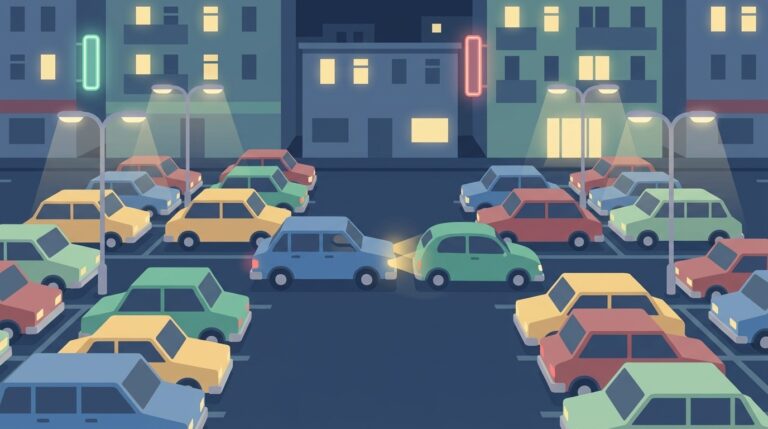
Imagine this classic K-Drama scene: The main character is fast asleep after a long night of drinking Soju. Suddenly, at 7:00 AM, their phone rings. They jolt awake, grab a random tracksuit, and sprint down to the apartment parking lot, bowing repeatedly to a grumpy neighbor.
What just happened? Was it an emergency?
Welcome to Korea’s infamous “Parking War” (주차 전쟁). Because South Korea is a mountainous country with a massive population concentrated in cities, space is a luxury. The result? Double parking (이중 주차) isn’t just common; it’s a daily, unspoken social contract in older apartment complexes and crowded alleys.
If you’re planning to rent a car in Korea, or even if you’re just taking a taxi through a narrow Seoul alleyway, understanding the “etiquette of the blocked car” is essential. This guide, built from the panicked questions of real expats living in Seoul, will help you navigate this uniquely Korean urban survival skill like a true local.
Phase 2: Core Expressions Deep Dive
1. 차 좀 빼주시겠어요?
- Pronunciation: Cha jom ppae-ju-si-gess-eo-yo? [Cha (like cha-cha) / jom (like dome, but with a J) / bbae (like ‘pet’ without the ‘t’, spoken forcefully)-joo-she-geh-seo-yo?]
- Meaning: Literal: Would you please take out your car? / Real nuance: I’m blocked in, could you please move your car?
- K-Culture Moment: You’ll hear this a lot outside busy restaurants. When your K-BBQ dinner is interrupted by the owner shouting, “Who owns the white Sonata? 차 좀 빼주세요!”, someone is mid-bite, rushing out to move their vehicle.
- Editor’s Insight: The word 빼다 (to take out/remove) is incredibly versatile in Korean. We use it for moving a car, losing weight (살을 빼다), or leaving out an ingredient (오이 빼주세요 – No cucumbers, please). Notice the “좀 (a little)”—it softens the request, making it polite rather than demanding.
- Situation Spectrum:
- Casual/Friends: ✅ (야, 차 좀 빼! – Hey, move your car!)
- Strangers/Neighbors (Semi-formal): ✅ (This is the perfect polite form)
- Aggressive: 🚫 (Never drop the honorifics with neighbors!)
- 🤔 Think About It: Why does Korean rely so heavily on words like “좀” (a little) when asking for favors? How does your culture soften requests to avoid sounding rude?
2. 이중 주차 했어요. 사이드 풀려있어요.
- Pronunciation: I-jung ju-cha haess-eo-yo. Sa-i-deu pul-lyeo-iss-eo-yo. [Ee-joong joo-cha heh-seo-yo. Sa-ee-deu (Side) pool-lyuh-ee-seo-yo.]
- Meaning: Literal: I did double parking. The side is released. / Real nuance: I double-parked, but I left the handbrake off (so you can push it).
- K-Culture Moment: In older Korean apartments (built in the 80s and 90s), underground parking is notoriously scarce. Residents are forced to park horizontally in front of already parked cars. The cardinal rule? Always leave the car in neutral with the handbrake off so others can physically push your car out of the way.
- Editor’s Insight: “사이드” is Konglish for “side brake” (handbrake/parking brake). “풀려있어요” means it’s untied or released. If you forget to do this, be prepared for some very angry 6 AM phone calls.
- Situation Spectrum:
- Giving a heads-up to a neighbor: ✅
- Leaving a note on the dashboard: ✅
- Professional Valet: ⚠️ (They will handle it for you!)
- 🤔 Think About It: Pushing a stranger’s heavy car with your bare hands is a daily morning workout for many Koreans. Does the idea of strangers touching your car feel invasive to you, or practical?
3. 앞에 차가 막혀서요.
- Pronunciation: A-pe cha-ga ma-kyeo-seo-yo. [Ah-peh cha-gah mah-kyuh-suh-yo.]
- Meaning: Literal: Because a car is blocked in front. / Real nuance: A car is blocking me, so I can’t get out.
- K-Culture Moment: This is the ultimate excuse for being late to a morning meeting or a morning class. “I’m so sorry, I’m late because… 앞에 차가 막혀서요 (The car in front was blocking me, and the owner wouldn’t answer their phone!).” Everyone will nod in deep, painful sympathy.
- Editor’s Insight: “막히다” means to be blocked or clogged. We use it for traffic jams (차 막혀요), blocked noses (코 막혀요), and when someone double-parks you in. It implies the situation is completely out of your control.
- Situation Spectrum:
- Calling your boss to say you’re late: ✅
- Calling the person blocking you: ⚠️ (They already know!)
- 🤔 Think About It: Korean culture values punctuality (빨리빨리 – hurry hurry). How does the unpredictable nature of double parking clash with this fast-paced lifestyle?
Phase 3: Textbook vs. Real Korean
[Situation 1: Asking someone to move their car over the phone]
* 📖 Textbook Korean: 실례합니다만, 자동차를 이동시켜 주시겠습니까? (Excuse me, but would you be able to relocate your automobile?)
* 🗣️ Real Korean: 여보세요, 주차장인데요, 차 좀 빼주실 수 있나요? (Hello, I’m at the parking lot, could you move your car?)
* 💡 Why the difference?: Real life requires urgency but politeness. Using “이동시키다” sounds like a police officer giving an order, whereas “차를 빼다” is the everyday, natural phrasing.
[Situation 2: Apologizing for making them wait]
* 📖 Textbook Korean: 오래 기다리게 해서 대단히 죄송합니다. (I am extremely sorry for making you wait a long time.)
* 🗣️ Real Korean: 아유, 죄송합니다! 금방 뺄게요! (Ah, I’m so sorry! I’ll move it right away!)
* 💡 Why the difference?: When someone is waiting, speed is more important than poetic apologies. Adding “금방 뺄게요” (I’ll move it in a second) reassures the frustrated driver.
Bottom Note: At the
B1 (Intermediate)level, it’s crucial to grasp these functional, everyday phrases. The goal isn’t just to be grammatically correct, but to sound situationally appropriate so you don’t accidentally escalate a stressful parking situation!
Phase 4: Cultural Context — K-Culture Deep Dive
4-1. Non-Verbal Elements: The “Apology Jog”
When you are the one blocking someone, words aren’t enough. As soon as you exit your apartment lobby, you must perform the “Apology Jog” (종종걸음). You don’t have to break into a full sprint, but doing a slight, bouncy jog shows the waiting party that you respect their time. Combine this with a slight bow of the head as you approach the car, and any anger they had will instantly melt away. In Korea, Nunchi (reading the room) dictates that looking relaxed while someone waits for you is a massive sign of disrespect.
4-2. The Dashboard Billboard (Contact Info)
Have you ever noticed that almost every car in a Korean drama (and real life) has a glowing neon phone number on the dashboard? Because of the double-parking culture, leaving your phone number visibly in your car is mandatory. If you rent a car in Jeju Island or Seoul, the rental company will usually give you a little placard to write your phone number. If you block someone and don’t have a number displayed? That’s how you become the villain of the neighborhood.
Phase 5: Real-Life Roleplay Scenario
Setting: 8:15 AM on a Tuesday. The underground parking lot of a typical Seoul apartment building. You are already running late for your language exchange meetup. You rush to your rental car, only to find a black Grandeur parked horizontally right behind your bumper. The handbrake is pulled up, so you can’t push it. You call the glowing number on the dashboard.
Characters:
– YOU: An expat eager to practice Korean but currently stressed about being late.
– Ahjussi (Mr. Kim): A sleepy neighbor in his 50s who forgot to leave his car in neutral.
Dialogue:
(Phone ringing…)
Mr. Kim: 여보세요… (Yoboseyo… / Hello…)
(🎭 Stage Direction: His voice is thick with sleep.)
YOU: 여보세요, 안녕하세요. 지하 1층 주차장인데요. (Hello, I’m in the B1 parking lot.)
Mr. Kim: 아, 네. 무슨 일이시죠? (Ah, yes. What is the matter?)
YOU: 제 차 앞에 주차를 하셨는데, 차가 안 밀려서요. (You parked in front of my car, and it won’t push.)
Mr. Kim: 앗! 제가 사이드 브레이크를 채워놨나요? (Oops! Did I leave the parking brake on?)
YOU: 네, 당장 차 좀 빼주시겠어요? (Yes, could you move your car right now?)
Mr. Kim: 아이고, 정말 죄송합니다. 5분 안에 내려갈게요. (Oh my, I am so sorry. I’ll be down in 5 minutes.)
🔀 Your Turn! How do you respond?
– A) “빨리 오세요! 늦었어요!” (Come quickly! I’m late!)
– B) “네, 알겠습니다. 천천히 오세요.” (Yes, understood. Take your time.)
– C) “네, 차 앞에서 기다릴게요.” (Yes, I’ll wait in front of the car.)✅ Best Choice: C — It applies slight pressure (I am waiting here) without being outright rude.
⚠️ Choice A Analysis: While true, shouting “Come quickly” to an older neighbor in Korea crosses the line from understandably frustrated to highly disrespectful.
⚠️ Choice B Analysis: If you say “take your time,” a Korean person might actually take their time. You’re late! Don’t offer politeness you can’t afford.
(Mr. Kim arrives, doing the “Apology Jog” in his slippers.)
Mr. Kim: 아이고, 바쁘실 텐데 죄송합니다. (Oh my, you must be busy, I am so sorry.)
YOU: 괜찮습니다. 조심히 들어가세요. (It’s okay. Have a safe trip back inside.)
Phase 6: 10-Second Shadowing Drill
Let’s practice the most important phrase when you’re trapped! Follow the rhythm:
🥺 아이고 / 늦었는데 / 차가 / 안 밀려요!
(A-i-go / neu-jeonn-neun-de / cha-ga / an mil-lyeo-yo!)
Oh no / I’m late / the car / won’t push!
Pro-tip: Put the stress on “안” (won’t) to emphasize your helpless situation!
Phase 7: K-Culture Mini Dictionary
| 한국어 (Korean) | Romanization | English | Context |
|---|---|---|---|
| 이중 주차 | ijung jucha | Double parking | Parking horizontally blocking other cars. |
| 사이드 풀다 | saideu pulda | Release the handbrake | Essential etiquette when double parking. |
| 중립 기어 | jungnip gieo | Neutral gear | Putting the gear in ‘N’ before turning off the car. |
| 문콕 | munkok | Door ding | The act of hitting another car’s door when opening yours (문 = door, 콕 = poking sound). |
| 블랙박스 | beullaekbakseu | Dashcam | Almost 100% of Korean cars have these to monitor parking accidents. |
Phase 8: Traveler Survival Kit
Renting a car in Korea (especially in Jeju or Busan) is a fantastic way to travel, but you will face tight parking spaces.
🆘 Survival Phrases for Drivers
– 🇰🇷 “제 차가 막혔어요.” (Je cha-ga ma-kyeoss-eo-yo.)
– 🗣️ Meaning: My car is blocked.
– 📍 Where to use: Asking a hotel receptionist or parking attendant for help finding the owner of the blocking car.
– 💡 Pro Tip: Take a photo of the license plate of the car blocking you and show it to the attendant.📌 Editor’s Travel Note
– Nav Apps: Do NOT use Google Maps for driving in Korea; it doesn’t navigate well. Use Naver Map or Kakao T.
– The Dashboard Number: If you rent a car, the rental company will provide a slip of paper. Write your local number (or a KakaoTalk ID if you only have a data SIM) and place it on the dashboard.
– Valet Culture: Many restaurants in Seoul (Gangnam, Itaewon) do not have parking. Instead, look for a small booth that says “발렛 파킹” (Valet Parking). It usually costs around 3,000 to 5,000 KRW, paid in cash or by bank transfer.
Phase 9: Critical Thinking Corner — “One Step Deeper”
Space and Community (High-Density Living)
Korea’s double-parking culture reveals a profound aspect of its society: a high level of implicit social trust. In many western countries, touching a stranger’s car—let alone physically pushing it out of the way—would be considered trespassing or cause for an argument. In Korea, it is an accepted communal compromise. Because 70% of the population lives in high-rise apartments, individuals must surrender a degree of personal boundary (the untouched car) for the greater efficiency of the community (fitting everyone’s cars in the lot).
🧠 Think Deeper:
The act of leaving your car in neutral so a neighbor can push it requires immense trust that they won’t smash it into a wall.💬 Your Turn: How would people in your home country react if someone physically pushed their parked car to get out? Share your thoughts in the comments!
Phase 10: FAQ & Avoiding Misunderstandings
- “Can I get angry if someone blocks me?”
Usually, no. Unless they didn’t leave a phone number, or they parked with the handbrake up and aren’t answering their phone. If they answer and apologize, the cultural norm is to say “괜찮습니다” (It’s okay) and let it go. It happens to everyone. -
“What if I push a car and it bumps into another car?”
This is a big problem. By law, the person who pushed the car is held responsible for the damage, not the owner of the double-parked car. Always check the space behind the car before pushing, and push gently!
❌ Common Mistake #1: Leaving your rental car’s handbrake UP when you double park.
✅ How to fix it: Shift to ‘P’, turn off the engine, then press the ‘Shift Lock Release’ button near the gear shift to move it to ‘N’ (Neutral).
Phase 11: Summary & Action Items
- One-Liner Summary: In Korea’s dense cities, double parking is a cooperative dance—always leave your number, leave it in neutral, and politely say “차 좀 빼주시겠어요?” when trapped.
-
Action Mission 3 Steps:
- 🥉 Bronze (Solo): Look at your own car and figure out how to put it in neutral when the engine is off.
- 🥈 Silver (Online): Find a YouTube video of a Korean parking lot and spot the cars that are double-parked.
- 🥇 Gold (Real Life): Next time you take a taxi in a narrow alley in Korea and a car is blocking the way, listen closely to see if the driver uses the phrase “차 좀 빼주세요!”
- K-Culture Mission: Watch episode 1 of a K-Drama. I guarantee you will spot a car with a phone number glowing on the dashboard. Take a screenshot!
Phase 12: Quiz — Interactive Challenge
1. Situational Judgment: You are staying at an Airbnb and need to double-park your rental car because the lot is full. What are the two essential things you must do?
– A) Lock the doors and turn off your phone so you can sleep.
– B) Leave the handbrake off (Neutral) and leave a phone number on the dashboard.
– C) Honk three times so neighbors know you are parking.
2. Fill in the Blank:
You are trapped by a car. You call the owner:
“여보세요, 차가 안 밀려서요. 차 좀 ______-주시겠어요?”
– A) 먹어 (eat)
– B) 빼 (take out/move)
– C) 사 (buy)
3. True or False — K-Culture Edition:
– If you physically push a stranger’s double-parked car to get your car out, the police will arrest you for tampering with a vehicle. (True / False)
(Answers: 1: B, 2: B, 3: False – it is completely normal and expected, as long as you don’t crash it into a wall!)
Frequently Asked Questions (FAQ)
Q: What does "차 좀 빼주시겠어요?" mean in Korean and how do you pronounce it?
A: In Korean, "차 좀 빼주시겠어요?" is pronounced [Cha jom ppae-ju-si-gess-eo-yo? [Cha (like cha-cha] and means: Literal: Would you please take out your car? / Real nuance: I'm blocked in, could you please move your car?
Q: What does "이중 주차 했어요. 사이드 풀려있어요." mean in Korean and how do you pronounce it?
A: In Korean, "이중 주차 했어요. 사이드 풀려있어요." is pronounced [I-jung ju-cha haess-eo-yo. Sa-i-deu pul-lyeo-iss-eo-yo. [Ee-joong joo-cha heh-seo-yo. Sa-ee-deu (Side] and means: Literal: I did double parking. The side is released. / Real nuance: I double-parked, but I left the handbrake off (so you can push it).
Q: What does "앞에 차가 막혀서요." mean in Korean and how do you pronounce it?
A: In Korean, "앞에 차가 막혀서요." is pronounced [A-pe cha-ga ma-kyeo-seo-yo. [Ah-peh cha-gah mah-kyuh-suh-yo.] and means: Literal: Because a car is blocked in front. / Real nuance: A car is blocking me, so I can't get out.







