

Phase 1: Empathy – The “Danggeun” Moment
Hello! I’m your Daily Hangul Editor.
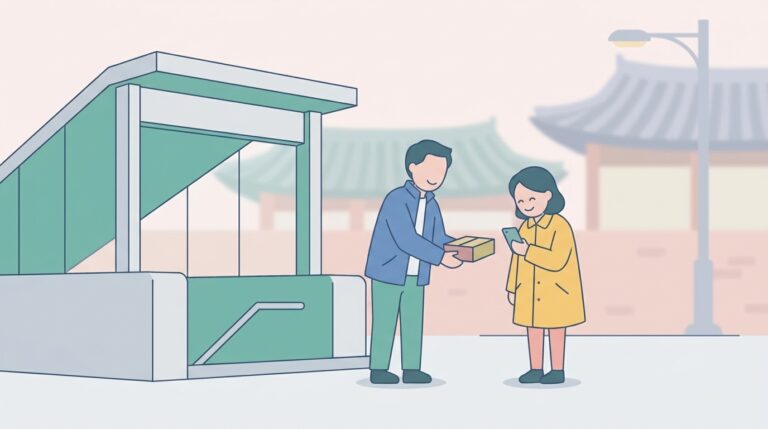
Picture this: You’re watching a Korean reality show, and a famous K-Pop idol sneaks out of their dorm, wearing a mask and a bucket hat. They stand awkwardly at a subway station exit, glancing at their phone. A stranger approaches, and the idol whispers just one word: “Danggeun…?” (Carrot?)
Are they looking for vegetables? No! They are confirming a second-hand trade. In Korea, buying and selling used items—especially through the app ‘Karrot’ (당근마켓, Danggeun Market)—is a massive cultural phenomenon. From limited-edition K-Pop photocards to vintage cameras, everyone uses it.
But what happens when you actually meet the seller? You check the item, you like it… and then your mind goes blank. How do you ask to pay? How do you say goodbye politely without making it awkward?
This guide is built on real questions from my students who successfully bought their dream K-Pop merch and travel gear in Seoul. Let’s learn how to complete a transaction like a true Korean local!
Phase 2: Core Expressions Deep Dive
1. 계좌 번호 알려주세요. (Please give me your account number.)
- Pronunciation: gye-jwa beon-ho al-lyeo-ju-se-yo [gyeh-jwa bun-ho ahl-lyuh-joo-seh-yo]
- Meaning: Literal: Please let me know the account number. / Real nuance: I’ll transfer the money, what’s your bank info?
- K-Culture Moment: While tourists use cash, locals almost always use bank transfers (계좌 이체) for second-hand trades. You’ll hear this exact phrase outside subway stations hundreds of times a day.
- Editor’s Insight: It sounds very polite but straight to the point. It shows you are ready to pay immediately, which Koreans love!
- Situation Spectrum:
- Casual (Friends): ⚠️ (Friends usually just use KakaoPay without asking)
- Semi-formal (Strangers on an app): ✅
- Formal (Boss): 🚫
- 🤔 Think About It: Why do Koreans prefer bank transfers over cash, even for small amounts? How does Korea’s advanced digital banking system shape everyday trust?
2. 방금 입금했어요. (I just transferred it.)
- Pronunciation: bang-geum ib-geum-hae-sseo-yo [bahng-geum eep-geum-heh-ssoh-yo]
- Meaning: Literal: I deposited just now. / Real nuance: The money is sent, please check your app.
- K-Culture Moment: You hit ‘send’ on your banking app, show the screen slightly to the seller, and say this. It’s the climax of the transaction!
- Editor’s Insight: The word ‘방금’ (just now) is crucial here. It gives the seller the cue to refresh their banking app immediately.
- Situation Spectrum:
- Casual: ✅ (방금 입금했어!)
- Semi-formal: ✅
- Formal: ✅ (방금 입금했습니다.)
- 🤔 Think About It: “입금(入金)” uses Hanja (Chinese characters) meaning “entering money.” Notice how many financial terms in Korean rely on these ancient root words?
3. 잘 쓰세요! / 예쁘게 입으세요! (Use it well! / Wear it nicely!)
- Pronunciation: jal sseu-se-yo / ye-ppeu-ge ib-eu-se-yo [jahl sseu-seh-yo / yeh-ppuh-geh ee-beu-seh-yo]
- Meaning: Literal: Use it well / Dress prettily. / Real nuance: Thank you for buying, enjoy the item!
- K-Culture Moment: The trade is done. You bow slightly. Instead of just saying “Goodbye,” the seller wishes you a good experience with the item.
- Editor’s Insight: This is the ultimate “warm-hearted” closing phrase. If you buy a jacket, they say “예쁘게 입으세요.” If you buy a K-Pop album, they say “잘 들으세요” (Listen well). It adds a human touch to a cold transaction.
- Situation Spectrum:
- Casual: ✅
- Semi-formal: ✅
- Formal: ✅
- 🤔 Think About It: Why does the Korean language have specific farewells based on the action the person will take next, rather than a universal “Have a good day”?
Phase 3: Textbook vs. Real Korean
[When asking to pay]
* 📖 Textbook Korean: 돈을 지불하겠습니다. (I will pay the money.)
* 🗣️ Real Korean: 계좌로 보낼게요. (I will send it to your account.)
* 💡 Why the difference?: “지불하다” sounds like you are signing a legal contract. In daily life, “보내다” (to send) or “입금하다” (to deposit) is much more natural.
[When confirming they got the money]
* 📖 Textbook Korean: 돈을 받았습니까? (Did you receive the money?)
* 🗣️ Real Korean: 확인해 주세요~ (Please check~)
* 💡 Why the difference?: Asking directly if they got the money can sound a bit aggressive. Asking them to politely “check” (확인) is the social standard.
Bottom Note: At the A2 level, try using “~할게요” (I will do ~) and “~해 주세요” (Please do ~). It instantly makes you sound softer and more native!
Phase 4: Cultural Context — K-Culture Deep Dive
4-1. Non-Verbal Cues: The Art of the “Slight Bow”
When you complete a trade, you don’t wave broadly, and you certainly don’t hug! The standard Korean etiquette is the “15-degree slight bow” (목례, mok-rye). Hand the cash or show your transfer screen with both hands, nod your head and shoulders slightly, and say “감사합니다” (Thank you). It shows respect without being overly formal.
4-2. The “Cool-Georae” (쿨거래) Culture
If you watch K-Dramas, you might see characters haggling intensely at a traditional market. But on modern second-hand apps, young Koreans prefer “쿨거래” (Cool-georae).
* “Cool” means no drama, no dragging things out.
* “Georae” means transaction.
A “Cool Trade” means you meet up, you don’t complain about the price, you transfer the money immediately, and you say goodbye in 30 seconds. Being a “Cool” buyer gives you excellent ratings on your profile!
Phase 5: Real-Life Roleplay Scenario
Setting: A chilly Friday evening at Hongdae Station, Exit 9. You are a tourist who found a rare, discontinued K-Pop concert lightstick on a second-hand app. You are meeting the seller, Ji-eun.
Characters:
– YOU: A K-Pop fan, excited but a bit nervous about your first Korean trade.
– Ji-eun (20s): The seller. Friendly, holding a paper bag.
Dialogue:
YOU: 혹시… 당근이세요? 🥕
(hok-si… dang-geun-i-se-yo?)
[Excuse me… are you Danggeun (Karrot)?]
(🎭 Stage Direction: You cautiously make eye contact and point at your phone.)
Ji-eun: 아, 네! 응원봉 사시는 분 맞으시죠?
(a, ne! eung-won-bong sa-si-neun bun ma-jeu-si-jyo?)
[Ah, yes! Are you the one buying the lightstick?]
YOU: 네, 맞아요! 혹시 물건 한 번 봐도 될까요?
(ne, ma-ja-yo! hok-si mul-geon han beon bwa-do doel-kka-yo?)
[Yes, that’s me! Can I take a look at the item?]
Ji-eun: 네, 여기요. 불 잘 들어와요.
(ne, yeo-gi-yo. bul jal deu-reo-wa-yo.)
[Yes, here. The light works perfectly.]
YOU: 우와, 상태가 너무 좋네요. 이거 살게요.
(u-wa, sang-tae-ga neo-mu jon-ne-yo. i-geo sal-ge-yo.)
[Wow, the condition is so good. I’ll buy it.]
Ji-eun: 네, 감사합니다. 현금으로 하시나요?
(ne, gam-sa-ham-ni-da. hyeon-geu-meu-ro ha-si-na-yo?)
[Yes, thank you. Are you paying with cash?]
YOU: 아뇨, 계좌 번호 알려주세요. 이체할게요.
(a-nyo, gye-jwa beon-ho al-lyeo-ju-se-yo. i-che-hal-ge-yo.)
[No, please let me know your account number. I will transfer.]
Ji-eun: 국민은행 123-456-7890 입니다.
(guk-min-eun-haeng 123-456-7890 im-ni-da.)
[It’s Kookmin Bank 123-456-7890.]
(🎭 Stage Direction: You type quickly on your phone.)
YOU: 방금 입금했어요. 확인해 주세요!
(bang-geum ib-geum-hae-sseo-yo. hwa-gin-hae ju-se-yo!)
[I just transferred it. Please check!]
Ji-eun: 네, 들어왔네요. 감사합니다!
(ne, deu-reo-wan-ne-yo. gam-sa-ham-ni-da!)
[Yes, it came through. Thank you!]
🔀 Your Turn! How should YOU reply to finish the deal?
– A) “안녕히 계세요!” (Goodbye! – Standard textbook)
– B) “네, 잘 쓸게요! 안녕히 가세요~” (Yes, I will use it well! Goodbye~)
– C) “수고하세요!” (Keep up the hard work!)✅ Best Choice: B — Saying “I will use it well” (잘 쓸게요) shows appreciation for the item. It’s the perfect, warm way to end a trade in Korea!
⚠️ Choice C Analysis: “수고하세요” is usually for service workers (like convenience store clerks), not for equal peer-to-peer trades. It might sound a little awkward here.
Phase 6: 10-Second Shadowing Drill
Practice out loud! Pay attention to the pauses (/) and the mood tags.
- 📱 Ready to transfer:
😊 혹시 / 계좌 번호 / 어떻게 되세요?
(hok-si / gye-jwa beon-ho / eo-tteo-ke doe-se-yo?) -
💸 Money sent:
😤 방금 / 입금했어요! / 확인해 주세요~
(bang-geum / ib-geum-hae-sseo-yo! / hwa-gin-hae ju-se-yo~) -
👋 Saying goodbye:
😊 감사합니다! / 잘 쓸게요~
(gam-sa-ham-ni-da! / jal sseul-ge-yo~)
Phase 7: K-Culture Mini Dictionary
| Korean | Romanization | English | Context & Meaning |
|---|---|---|---|
| 당근 | dang-geun | Carrot | Refers to the ‘Karrot’ app. Used as a greeting when meeting for a trade. |
| 쿨거래 | kul-geo-rae | Cool trade | A fast, smooth transaction with no haggling or annoying questions. |
| 네고 | ne-go | Negotiation | Asking for a discount. (Short for negotiation). Often written as “네고 불가” (No bargaining). |
| 잠수 | jam-su | Ghosting | Lit. “diving underwater.” When a buyer/seller suddenly disappears and stops replying. |
| 계좌 이체 | gye-jwa i-che | Bank transfer | The most common way to pay for second-hand items in Korea. |
Phase 8: Traveler’s Survival Kit
Are you traveling in Korea? You might want to buy cheap camera gear, a second-hand winter coat, or K-Pop concert tickets from locals. Here is your survival kit!
🆘 Survival Phrases for Traveling Buyers
– 🇰🇷 “현금 드려도 될까요?” (hyeon-geum deu-ryeo-do doel-kka-yo?)
– 🗣️ Meaning: Is it okay if I give you cash?
– 📍 Where to use: Since tourists often can’t use Korean bank transfer apps, always ask this before meeting!
- 🇰🇷 “여기에 기스가 있네요.” (yeo-gi-e gi-seu-ga in-ne-yo.)
- 🗣️ Meaning: There is a scratch here.
- 📍 Where to use: When inspecting the item.
📌 Editor’s Travel Note
– App verification: To use Korean second-hand apps, you usually need a Korean phone number for SMS verification. If you don’t have one, ask a Korean friend or a friendly hostel staff member to help you contact the seller!
– Meeting Spots: Always choose a safe, public place like inside a subway station near the ticket gates (개찰구) or in front of a convenience store.
Phase 9: Think Deeper — “A Step Further”
Language & Power: The Politeness of Strangers
In many Western cultures, an online transaction on Craigslist or Facebook Marketplace uses very casual language: “Is this available?” “Yes. Come to this address.”
However, in Korea, even when interacting anonymously on an app, people use high-level honorifics (존댓말). You’ll constantly see “~부탁드립니다” (I respectfully request) and “감사합니다” (Thank you). This reflects the core Korean value of maintaining social harmony and respect, even with complete strangers. The language sets a boundary of mutual respect, which is one reason why second-hand trading in Korea is remarkably safe and scam-rates are relatively low.
💬 Your Turn: Do people use formal language when buying used items in your country? Or is it super casual? Share your culture in the comments!
Phase 10: FAQ & Avoiding Misunderstandings
❓ “Can I say ‘Annyeong’ to the seller if they look younger than me?”
NO. Absolutely not! Even if the seller is a middle school student selling photocards and you are 30 years old, you are strangers. Always use “안녕하세요” and formal language (존댓말). Using informal language (반말) to a stranger is considered very rude.
❓ “What if I want a discount on the spot?”
It’s highly frowned upon to ask for a discount after you meet. If you want to negotiate (네고), you must do it in the chat before agreeing to meet up.
❌ Common Mistake: Walking away without checking the item.
✅ Do this instead: Always say “한 번 확인해 봐도 될까요?” (Can I check it once?) and open the box right there. Once you transfer the money and leave, it’s very hard to get a refund!
Phase 11: Summary & Action Items
One-Liner Summary: To complete a trade like a pro, check the item, ask for the account (계좌 번호), announce your transfer (방금 입금했어요), and wish them well (잘 쓰세요)!
Action Mission:
– 🥉 Bronze: Say “계좌 번호 알려주세요” out loud 3 times right now.
– 🥈 Silver: Write down your own response to a seller handing you an item in your study notes.
– 🥇 Gold: Next time you buy something directly from someone (even at a flea market or from a friend), try using “계좌 이체 할게요”!
K-Culture Mission:
Go to YouTube and search “아이돌 당근마켓” (Idol Karrot Market). Watch how nervous and polite even famous celebrities get when they meet a seller on the street!
Phase 12: Interactive Quiz
1. Fill in the Blank:
You just sent the money. You look at the seller and say, “( ) 입금했어요. 확인해 주세요!”
* A) 당근 (Danggeun)
* B) 방금 (Bang-geum / Just now)
* C) 현금 (Hyeon-geum / Cash)
2. True or False – K-Culture Edition:
“It is normal and expected to give a small tip to the seller if the used item is in really good condition.”
* True or False?
3. Situational Judgment:
You bought a beautiful winter coat. The seller hands it to you. What is the most culturally appropriate thing to say?
* A) 수고하세요! (Keep working hard!)
* B) 안녕! (Bye!)
* C) 예쁘게 입을게요! 감사합니다. (I’ll wear it nicely! Thank you.)
Click here for Answers!
1. B (방금 – Just now. It prompts them to check their app immediately.)
2. False. Korea has absolutely no tipping culture. Tipping the seller would confuse them greatly! Just say thank you.
3. C. It matches the item (clothes) and is very polite and warm.
Frequently Asked Questions (FAQ)
Q: What does "계좌 번호 알려주세요. (Please give me your account number.)" mean in Korean and how do you pronounce it?
A: In Korean, "계좌 번호 알려주세요. (Please give me your account number.)" is pronounced [gye-jwa beon-ho al-lyeo-ju-se-yo [gyeh-jwa bun-ho ahl-lyuh-joo-seh-yo] and means: Literal: Please let me know the account number. / Real nuance: I'll transfer the money, what's your bank info?
Q: What does "방금 입금했어요. (I just transferred it.)" mean in Korean and how do you pronounce it?
A: In Korean, "방금 입금했어요. (I just transferred it.)" is pronounced [bang-geum ib-geum-hae-sseo-yo [bahng-geum eep-geum-heh-ssoh-yo] and means: Literal: I deposited just now. / Real nuance: The money is sent, please check your app.
Q: What does "잘 쓰세요! / 예쁘게 입으세요! (Use it well! / Wear it nicely!)" mean in Korean and how do you pronounce it?
A: In Korean, "잘 쓰세요! / 예쁘게 입으세요! (Use it well! / Wear it nicely!)" is pronounced [jal sseu-se-yo / ye-ppeu-ge ib-eu-se-yo [jahl sseu-seh-yo / yeh-ppuh-geh ee-beu-seh-yo] and means: Literal: Use it well / Dress prettily. / Real nuance: Thank you for buying, enjoy the item!







