

Surviving Korea’s Camping Bloodbath: Essential Phrases for the Auto-Camping Reservation War
Phase 1: Empathy (Welcome to the Battlefield)
Hello there! This is your Senior Editor at Daily Hangul.
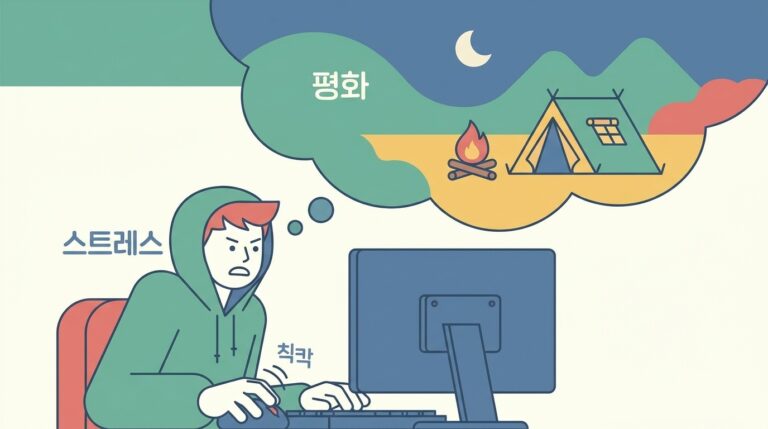
Imagine this: You are watching a K-Drama. The main couple escapes the bustling city of Seoul and magically arrives at a serene, fairy-light-covered camping deck overlooking a misty lake in Gapyeong. They set up their tent, stare into the campfire (Bul-meong), and roast samgyeopsal. Sounds perfectly romantic and spontaneous, right?
Well… what the drama doesn’t show you is the absolute bloodbath that took place a month prior just to get that spot. In Korea, booking a good auto-camping (오토캠핑) deck on a weekend is no different from trying to snag front-row VIP tickets to a BTS concert. We even use the same word for it: 피켓팅 (Piketting – Blood Ticketing).
If you don’t know the specific “click-fast” culture and the vocabulary that goes with it, you might end up pitching your tent in your own living room. Many expats feel utterly defeated when they see “Fully Booked” at exactly 12:00:01 AM. Don’t worry! I’ve been there, crying over my keyboard. Today, I’m going to teach you the real-life phrases and strategies you need to survive Korea’s camping reservation war.
Phase 2: Core Expressions Deep Dive
Here are the top phrases you need in your arsenal before the clock strikes reservation time.
1. 광클하다
- Pronunciation: [gwang-keul-hada] – Sounds like “Gwang” (like the ‘gwang’ in Gwangju) + “Kull” (like cull) + “Ha-da”.
- Meaning: Literal: Light-speed clicking. Real nuance: To click like a madman/crazy person.
- K-Culture Moment: This is born from Korea’s PC Bang (gaming cafe) and K-Pop fandom culture. When the clock hits 2:00 PM for reservations, your fingers must gwang-keul the refresh button. If you’re teaming up with Korean friends to book a campsite, someone will definitely yell, “Guys, get ready to gwang-keul!”
- Editor’s Insight: It carries a feeling of desperation and intense focus. You aren’t just clicking; you are fighting for your life (or your weekend getaway).
- Situation Spectrum:
- Casual with friends: ✅
- Semi-formal (Coworkers): ⚠️ (Okay if they are close)
- Formal (Boss/Elders): 🚫
- 🤔 Think About It: Why does Korean internet culture have so many words for “doing things extremely fast”? How does this reflect the “Pali-pali” (Hurry, hurry) mindset embedded in modern Korean society?
2. 이선좌
- Pronunciation: [i-seon-jwa] – Sounds like “Eee-sun-jwa” (‘jwa’ rhymes with ‘mwah’).
- Meaning: Literal: This is a pre-selected seat. Real nuance: The heartbreaking pop-up message that tells you someone else clicked a millisecond faster than you.
- K-Culture Moment: It is an abbreviation of 이미 선택된 좌석입니다 (This seat has already been selected). It’s the ultimate trauma trigger for K-Pop fans buying concert tickets and campers booking prime decks. Seeing this pop-up means you failed.
- Editor’s Insight: You use this to express utter defeat. You slump in your chair and sigh, “Ah, I-seon-jwa again.”
- Situation Spectrum:
- Casual with friends: ✅
- Semi-formal (Coworkers): ✅ (A great way to show you understand modern slang!)
- Formal (Boss/Elders): 🚫
- 🤔 Think About It: Koreans love to abbreviate long phrases into 3 or 4 syllables. Does your native language have acronyms or abbreviations born entirely out of digital frustration?
3. 줍줍하다
- Pronunciation: [jup-ju-pada] – Sounds like “Joop-joop” (like ‘hoop’ with a J) + “Ha-da”.
- Meaning: Literal: To pick up and pick up. Real nuance: To happily snatch up cancellations or leftovers.
- K-Culture Moment: You failed the initial ticketing. What now? You become a scavenger. You constantly refresh the page hoping someone cancels their reservation, and when they do, you jup-jup it! This is also heavily used in real estate and stock markets in Korea.
- Editor’s Insight: It sounds very cute because of the repetitive “jup-jup” sound, mimicking someone picking up breadcrumbs.
- Situation Spectrum:
- Casual with friends: ✅
- Semi-formal (Coworkers): ✅
- Formal (Boss/Elders): 🚫
- 🤔 Think About It: The act of “Jup-jup” requires relentless patience. It highlights that in Korea, even if you lose the first race, persistence (and hitting F5) can still get you the prize.
Phase 3: Textbook vs. Real Korean
Let’s see how the textbook differs from the battlefield.
[Situation 1: Asking if there are any spots left]
* 📖 Textbook Korean: 빈 자리가 있습니까? (Are there any empty seats?)
* 🗣️ Real Korean: 혹시 취소표 나온 거 있나요? (Did any cancelled tickets/spots come out by chance?)
* 💡 Why is it different?: In highly competitive settings, nothing is “empty.” You are always waiting for a 취소표 (cancelled ticket), relying on someone else changing their plans.
[Situation 2: Failing the reservation]
* 📖 Textbook Korean: 예약을 실패했습니다. (I failed the reservation.)
* 🗣️ Real Korean: 아, 광탈했어요. (Ah, I was eliminated at the speed of light.)
* 💡 Why is it different?: “Gwang-tal” (광탈) combines ‘light’ and ‘elimination’. It emphasizes the dramatic speed at which the spots vanished, shifting the blame from your lack of skill to the fierce competition.
[Situation 3: Trying to find someone to sell you their spot]
* 📖 Textbook Korean: 예약을 저에게 파시겠어요? (Would you sell your reservation to me?)
* 🗣️ Real Korean: 캠핑장 양도 구합니다! (Looking for a campsite transfer!)
* 💡 Why is it different?: Koreans prefer the word 양도 (transfer) over “buy/sell” for reservations, as it implies a polite passing of rights rather than crude scalping.
Bottom Note: For B2 level learners, using words like 취소표 (cancellation) and 양도 (transfer) will make you sound incredibly fluent and culturally plugged-in without sounding too informal.
Phase 4: Cultural Context — K-Culture Deep Dive
4-1. Non-verbal Nuances
In Korea, the concept of 눈치 (Nunchi)—the subtle art of reading the room—is crucial even in digital spaces. If your office colleagues are all trying to book campsites on a Friday afternoon, you’ll notice a heavy silence in the room at 1:59 PM. Do not ask a loud question at this time! They are in the “zone.” Respect the 1:59 PM silence.
4-2. The K-Pop Connection: Blood Ticketing (피켓팅)
Why is camping so competitive? During the pandemic, camping exploded in popularity. All the fierce fans who were used to buying K-Pop concert tickets (where 50,000 seats sell out in 3 seconds) transferred their skills to camping reservations.
They use the exact same methods: going to a PC Bang for the fastest internet, syncing their computers to the server clock using sites like Navyism, and practicing clicking. If you want a good campsite with an ocean view in Gangwon-do, you aren’t just competing against dads; you are competing against the fastest clickers on earth.
4-3. The K-Drama Reality Check
Drama vs Reality: In dramas, a couple just drives up to a mountain, sets up a beautiful aesthetic tent, and drinks drip coffee. In reality, that mountain spot requires you to log into a Naver Cafe, level up your membership by leaving 20 comments, and then battle 5,000 other people at midnight to secure a 4×4 wooden deck.
Phase 5: Real-Life Roleplay Scenario
Setting: It is Thursday, 1:58 PM. You and your Korean coworker, Min-su, are at a fast-internet PC Bang during your lunch break. You both have two monitors open. The most famous auto-camping site in Gapyeong opens its October reservations at exactly 2:00 PM.
Characters:
– YOU: An expat trying to experience proper Korean autumn camping for the first time.
– Min-su (32): Your coworker, a camping gear enthusiast, and a veteran of the reservation war.
Dialogue:
Min-su: 거의 다 됐어요. 서버 시계 켜놨죠? ⌚
(geoui da dwaesseoyo. seobeo sigye kyeonwatjyo?)
[It’s almost time. You turned on the server clock, right?]
YOU: 네! 아, 벌써 심장이 떨려요.
(ne! a, beolsseo simjangi tteollyeoyo.)
[Yes! Ah, my heart is already trembling.]
Min-su: 2시 정각에 새로고침 누르고 바로 광클해야 돼요. 알겠죠?
(dusi jeonggage saerogochim nureugo baro gwang-keul-haeya dwaeyo. algetjyo?)
[At exactly 2:00, hit refresh and gwang-keul immediately. Got it?]
(🎭 Stage Direction: The clock strikes 1:59:59… 2:00:00! You both click furiously)
YOU: 앗! 자리 눌렀는데 결제창이 안 넘어가요!
(at! jari nulleonneunde gyeoljechangi an neomeogayo!)
[Ah! I clicked a spot but the payment page isn’t loading!]
Min-su: 아… 그거 튕긴 거예요. 저도 방금 이선좌 떴어요. 망했네. 😭
(a… geugeo twinggin geoyeyo. jeodo banggeum i-seon-jwa tteosseoyo. manghaenne.)
[Ah… you got bounced out. I just got the “already selected seat” message too. We’re doomed.]
YOU: 헐… 1분도 안 지났는데 다 매진이에요?
(heol… il-bundo an jinanneunde da maejinieyo?)
[OMG… It hasn’t even been 1 minute and it’s all sold out?]
Min-su: 그러니까요. 진짜 광탈이네요.
(geureonilkkayo. jinjja gwang-tarineyo.)
[Tell me about it. We totally got eliminated at the speed of light.]
🔀 Your Turn! What should you do next?
– A) “포기할까요? 그냥 집에서 자요.” (Shall we give up? Let’s just sleep at home.)
– B) “계속 새로고침 해볼게요. 취소표 줍줍해야죠!” (I’ll keep refreshing. We have to pick up a cancellation!)
– C) “암표 없나요? 돈 더 줄게요.” (Are there scalpers? I’ll pay more.)✅ Best Choice: B — Reason: Koreans rarely give up immediately. Trying to “jup-jup” (pick up cancellations) shows you have the true Korean fighting spirit!
⚠️ Choice C Analysis: Buying from scalpers (플미 – premium) is highly frowned upon in Korean camping culture and can get you banned from campsites.
Phase 6: 10-Second Shadowing Drill
Practice this sentence to sound like a true Korean who just lost the reservation battle but hasn’t lost hope!
😤 아, / 이선좌 떴어. / 계속 새로고침해서 / 취소표 / 줍줍해야겠다!
(a, / i-seon-jwa tteosseo. / gyesok saerogochimhaeseo / chwisopyo / jup-ju-pae-ya-get-da!)
[Ah, the “seat taken” error popped up. I’ll keep refreshing and pick up a cancellation!]
Tip: Put emphasis on 줍줍 (jup-jup). Make it sound punchy and determined!
Phase 7: K-Culture Mini Dictionary
| 한국어 | Romanization | English | Cultural Context |
|---|---|---|---|
| 피켓팅 | piketting | Blood Ticketing | A portmanteau of ‘Blood’ (피) and ‘Ticketing’. Refers to violently competitive reservations. |
| 불멍 | bul-meong | Fire-zoning out | Staring blankly at a campfire. The ultimate healing goal of Korean camping. |
| 장비빨 | jang-bi-ppal | Gear power | Relying heavily on expensive, aesthetic camping gear to look like a pro. |
| 노지캠핑 | no-ji-kaem-ping | Wild camping | Camping in unmanaged nature (free, but no electricity/toilets) vs Auto-camping (paid, facilities). |
| 양도 | yang-do | Transfer | Passing your reserved spot to someone else, usually done via secondhand apps like Karrot (당근마켓). |
Phase 8: Traveler Survival Kit
Even if you aren’t fighting in the midnight reservation war, if you travel to Korea and want to rent a glamping spot or visit a campsite, you need these survival phrases.
🆘 Survival Phrases for K-Camping
– 🇰🇷 “혹시 빈 데크 있나요?” (hoksi bin dekeu innayo?)
– 🗣️ Meaning: Do you have any empty decks (camping platforms) by chance?
– 🇰🇷 “전기 릴선 빌릴 수 있나요?” (jeongi ril-seon billil su innayo?)
– 🗣️ Meaning: Can I borrow an electric extension cord? (Essential for Korean auto-camping!)
– 🇰🇷 “매점 몇 시에 닫아요?” (maejeom myeot sie dadayo?)
– 🗣️ Meaning: What time does the convenience store/kiosk close?📌 Editor’s Travel Note
– App Check: Most camping reservations are done via apps like 캠핑톡 (Camping Talk) or 땡큐캠핑 (Thank You Camping).
– ID Verification: Many sites require Korean phone number verification. If you are a tourist without an ARC (Alien Registration Card), look for campsites that accept Naver reservations (which sometimes allow foreign credit cards) or ask a Korean friend for help.
– Manner Time (매너타임): Korean campsites have strict “Manner Times” (usually starting at 10 PM or 11 PM). No loud talking, music, or drinking games allowed after this time!
Phase 9: Critical Thinking Corner — “A Step Deeper”
Media vs Reality: The Illusion of Spontaneous Korean Romance
K-Dramas often portray camping as a spontaneous, romantic getaway where couples drive off into the sunset to escape their stressful lives. However, the reality of Korean camping is intensely structured. Because Korea is a small, mountainous country with a massive population concentrated in urban areas, accessing “peaceful nature” requires months of hyper-competitive planning (Piketting), expensive equipment (Jang-bi-ppal), and strict adherence to community rules (Manner Time). The “healing” you see on screen is actually a hard-earned reward for surviving a highly stressful, digital-savvy reservation war.
🧠 Think Deeper:
The contrast between the intense digital battle to book a spot and the desire to “disconnect” in nature is a fascinating paradox of modern Korean life.💬 Your Turn: Does your culture treat camping as a spontaneous, rugged adventure, or is it also a highly planned, competitive “glamping” experience? Share in the comments!
Phase 10: FAQ & Avoiding Misunderstandings
Q: Can I just show up at an auto-camping site and ask for a spot?
A: Mostly NO. In Korea, auto-campsites are 99% reservation-based. Walk-ins are almost impossible on weekends unless it’s the dead of winter. Always book in advance.
Q: Is it okay to buy reservations from people on Twitter or secondhand apps?
A: Yes and No. 양도 (transferring) at the original price is a common and helpful culture. However, buying from scalpers who charge a premium (플미) is hated by the community and campsites often check IDs to prevent this.
❌ Common Mistake #1: Assuming campsites provide everything.
✅ Do This Instead: Auto-camping means you rent the space (a wooden deck or gravel spot) and electricity access. Unless you booked “Glamping” (글램핑), you must bring your own tent, gear, and food.
Phase 11: Summary & Action Items
One-Liner Summary: To enjoy the peaceful Bul-meong (fire-gazing) of Korean camping, you must first survive the relentless Gwang-keul (mad-clicking) of the reservation war!
Action Mission:
– 🥉 Bronze: Say “아, 이선좌 떴어!” out loud next time your computer is loading too slowly.
– 🥈 Silver: Leave a comment on this post using the word 줍줍 (Jup-jup).
– 🥇 Gold: Download a Korean camping app (like 캠핑톡) and try to see if you can find a single available spot near Seoul for this weekend. Experience the despair firsthand!
K-Culture Mission: Watch a K-Drama camping scene or a K-Pop idol’s reality show (like In the SOOP). Notice how pristine and isolated it looks, and appreciate the hidden staff who fought the reservation war for them!
Did you ever fail a reservation in your country? Tell me your worst “sold out” story in the comments below! 👇
Phase 12: Interactive Quiz
1. Situational Judgment:
You missed the 2:00 PM reservation window for the Gapyeong campsite. What is the most “Korean” way to handle this?
* A) Call the campsite and beg the owner.
* B) Give up and go to a hotel.
* C) Constantly refresh the page for the next week hoping to 줍줍 (Jup-jup) a cancelled spot.
2. Fill in the Blank:
“I tried to book the BTS concert, but I couldn’t click fast enough. I totally _______.”
* A) 불멍 (bul-meong)
* B) 광탈했어요 (gwang-tal-haesseoyo)
* C) 양도 (yang-do)
3. True or False – K-Culture Edition:
“Manner Time (매너타임)” at a Korean auto-campsite means you must dress politely when greeting other campers.
🚨 Click here for Answers!
1. Correct Answer: C. Jup-jup (picking up cancellations) is a lifestyle in Korea!
2. Correct Answer: B. 광탈했어요 (Eliminated at light-speed).
3. False. Manner Time refers to quiet hours, usually starting at 10 PM or 11 PM, where loud talking, music, and clinking alcohol glasses must stop so everyone can sleep.
Frequently Asked Questions (FAQ)
Q: What does "광클하다" mean in Korean and how do you pronounce it?
A: In Korean, "광클하다" is pronounced [gwang-keul-hada] and means: Literal: Light-speed clicking. Real nuance: To click like a madman/crazy person.
Q: What does "이선좌" mean in Korean and how do you pronounce it?
A: In Korean, "이선좌" is pronounced [i-seon-jwa] and means: Literal: This is a pre-selected seat. Real nuance: The heartbreaking pop-up message that tells you someone else clicked a millisecond faster than you.
Q: What does "줍줍하다" mean in Korean and how do you pronounce it?
A: In Korean, "줍줍하다" is pronounced [jup-ju-pada] and means: Literal: To pick up and pick up. Real nuance: To happily snatch up cancellations or leftovers.







