

Phase 1: Empathy (Welcome to the Real Korea!)
Hello there! I’m your Daily Hangul Editor, your personal Korean tutor and local culture navigator.
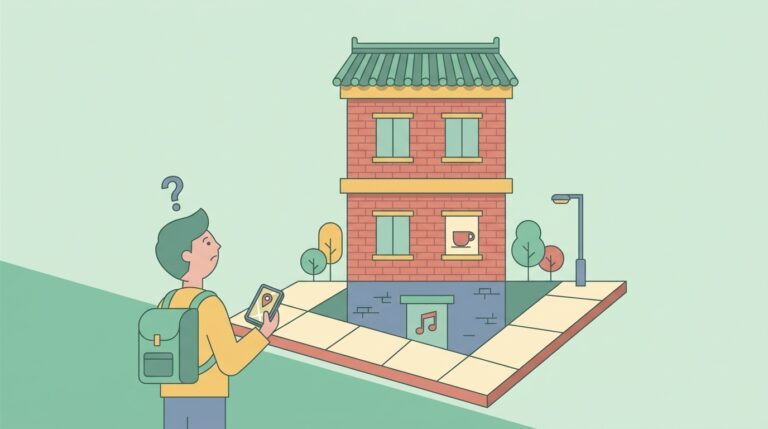
Picture this: You are standing in the middle of Hongdae, Seoul. You’ve got your map app open. The little blue dot says you have ‘Arrived’ at that incredibly aesthetic cafe you saw on TikTok. You look around, but all you see is a convenience store, a phone shop, and a noodle restaurant. You start to panic. Did the cafe close down? Are you lost?
Then, a friendly local points UP.
Ah! The cafe is right above your head. In Korea, especially in bustling cities like Seoul, space is limited. The hottest cafes, K-Pop merchandise stores, and best BBQ joints aren’t always on the ground floor. They are on the 2nd floor, 3rd floor, or even the basement!
If you don’t know how to read or ask for ‘floors’ in Korean, you might miss out on half the fun. Don’t worry. Today, we are learning the absolute basics of Sino-Korean numbers to say ‘1st floor’ and ‘2nd floor.’ I promise, this will be a game-changer for your K-Travel adventures!
Phase 2: Core Expression Deep Dive
In Korean, we have two number systems. For floors, dates, and money, we use Sino-Korean numbers (numbers that originated from Chinese characters). To say a floor, you just say the number + 층 (cheung).
1. 1층 (First Floor)
- Pronunciation: [il-cheung] (일 층)
- Sound-alike guide: ‘il’ sounds like ‘eel’ (the fish), but shorter. For ‘cheung’, the ‘eu’ sounds like the disgusted noise you make when you step in gum (‘Ugh!’), plus an ‘ng’ at the end.
- Meaning: 1st floor / Ground floor.
- K-Culture Moment: You walk into a building looking for a bathroom. The security guard crosses their arms and says, “1층에 없어요.” (It’s not on the 1st floor.)
- Editor’s Insight: Remember, Korea doesn’t use the British “Ground Floor” concept. The street level is simply the 1st floor (1층).
- Situation Spectrum:
- Casual: ✅
- Semi-formal: ✅
- Formal: ✅ (Numbers are neutral!)
- 🤔 Think About It: Why does Korea consider the ground level the ‘1st’ floor, while some cultures call it the ‘Ground’ or ‘0th’ floor?
2. 2층 (Second Floor)
- Pronunciation: [i-cheung] (이 층)
- Sound-alike guide: ‘i’ sounds like the letter ‘E’.
- Meaning: 2nd floor.
- K-Culture Moment: You ask a waiter where the restroom is in a crowded BBQ restaurant. Without even looking up from grilling the pork belly, they point to the ceiling and shout: “2층이요!” (2nd floor!)
- Editor’s Insight: This is the most common answer you will hear in cafes and restaurants. Space is expensive, so restrooms are often shared upstairs.
- Situation Spectrum:
- Casual: ✅
- Semi-formal: ✅
- Formal: ✅
- 🤔 Think About It: Can you guess what 3rd floor is? (Hint: ‘sam’ is 3!).
3. 지하 1층 (Basement 1)
- Pronunciation: [ji-ha il-cheung] (지하 일 층)
- Sound-alike guide: ‘ji’ (jee) + ‘ha’ (hah).
- Meaning: B1 / Basement 1st floor.
- K-Culture Moment: You are in The Hyundai Seoul (a massive, famous department store) looking for a K-Pop idol’s pop-up store. You ask a staff member, and they reply, “지하 1층입니다.” (It’s on B1.)
- Editor’s Insight: ‘지하’ (Jiha) means ‘underground’. Korea has massive underground malls, subway networks, and food courts. B1 is where the magic (and the best food) happens!
- Situation Spectrum:
- Casual: ✅
- Semi-formal: ✅
- Formal: ✅
Phase 3: Textbook vs. Real Korean
How do native speakers actually say these words in the wild?
[Looking for a cafe in a building]
* 📖 Textbook Korean: 이 건물 이 층에 있습니다. (i geonmul i cheung-e itseumnida.) – It is on the second floor of this building.
* 🗣️ Real Korean: 2층이요. (i-cheung-iyo.) – 2nd floor. (Usually accompanied by pointing up).
* 💡 Why the difference?: Koreans love efficiency! The “-요 (-yo)” makes it polite, so you don’t need a full sentence. Just “[Noun] + 이요/요” is perfect for quick directions.
[Asking for the restroom]
* 📖 Textbook Korean: 화장실은 몇 층에 있습니까? (hwajangsil-eun myeot cheung-e itseumnikka?) – On which floor is the restroom?
* 🗣️ Real Korean: 저기요, 화장실 몇 층이에요? (jeogiyo, hwajangsil myeot cheung-ieyo?) – Excuse me, what floor is the restroom?
* 💡 Why the difference?: The textbook version sounds like a police interrogation. The real version is soft, natural, and friendly!
Bottom Note for A1 Learners: Don’t stress about full sentences right now. If you just say “화장실… 몇 층?” (Restroom… what floor?) with a polite smile, Koreans will totally understand and help you!
Phase 4: Cultural Context — K-Culture Deep Dive
4-1. Non-verbal Cue: The “Chin Point”
When a Korean tells you the restroom or cafe is on the 2nd floor (2층), they might not use their hands. Often, you’ll see the ‘Chin Point’—a quick upward nod of the head. It’s not rude; it’s just a quick, casual way to indicate “upstairs” while their hands are busy carrying food or ringing up your order!
4-2. K-Travel Connection: Looking UP in Seoul
If you watch K-Dramas, you might notice characters meeting in cafes with huge windows overlooking the street. Those are almost always on the 2층 (2nd floor) or 3층 (3rd floor). Because real estate on the ground floor is incredibly expensive in Seoul, businesses like Noraebangs (karaoke rooms) often go to the basement (지하), while aesthetic cafes, hair salons (K-Beauty!), and restaurants go upstairs.
Survival Tip: Always look up at the building’s exterior signs or check the directory next to the elevator!
Phase 5: Real-Life Roleplay Scenario
Setting: A bustling Saturday afternoon at a huge department store in Seoul. You are looking for a special K-Pop merchandise pop-up store, but the building is like a maze. You spot an information desk.
Characters:
– YOU (The Tourist): A K-pop fan who just arrived in Seoul yesterday. You know basic Korean words.
– Minji (20s): Friendly information desk staff. She speaks a little English but appreciates it when tourists try Korean.
(Dialogue)
YOU: 저기요… (jeogiyo…)
Excuse me…
Minji: 네, 안녕하세요! (ne, annyeonghaseyo!)
Yes, hello!
YOU: 케이팝 팝업스토어… 어디에요? (keipap pabeop-seutoeo… eodieyo?)
K-Pop pop-up store… where is it?
Minji: 아! 팝업스토어요? (A! pabeop-seutoeoyo?)
Ah! The pop-up store?
YOU: 네, 맞아요! (ne, majayo!)
Yes, that’s right!
Minji: 팝업스토어는 지하 1층에 있어요. (pabeop-seutoeo-neun jiha il-cheung-e isseoyo.)
The pop-up store is on Basement 1.
YOU: 지하 1층이요? (jiha il-cheung-iyo?)
B1?
Minji: 네, 저기 에스컬레이터 타세요. (ne, jeogi eseukeolleiteo taseyo.)
Yes, take the escalator over there.
(🎭 Stage Direction: Minji points towards a downward escalator with an open hand)
🔀 Your Turn! How do you reply?
– A) “오케이, 바이!” (Okay, bye!)
– B) “감사합니다!” (Thank you!)
– C) “지하 1층… 대박!” (B1… awesome!)✅ Best Choice: B — “감사합니다” (gamsahamnida) is the golden rule of politeness in Korea. You bow your head slightly and say thank you.
⚠️ Choice A Analysis: Too informal for a staff member!
⚠️ Choice C Analysis: “대박” is a fun slang word, but a bit awkward to say to an information desk clerk who just gave you directions.
Minji: 네, 즐거운 여행 되세요! (ne, jeulgeoun yeohaeng doeseyo!)
Yes, have a great trip!
YOU: 네, 수고하세요! (ne, sugohaseyo!)
Yes, keep up the good work!
Bonus Roleplay: The Cafe Restroom
- You: 화장실… 1층에 있어요? (hwajangsil… il-cheung-e isseoyo?) / Is the restroom on the 1st floor?
- Cafe Staff: 아니요, 2층이요. 비밀번호는 1234예요. (aniyo, i-cheung-iyo. bimilbeonhoneun 1234yeyo.) / No, 2nd floor. The password is 1234.
- You: 아, 2층… 감사합니다! (ah, i-cheung… gamsahamnida!) / Ah, 2nd floor… thank you!
Phase 6: 10-Second Shadowing Drill
Let’s practice! Follow the rhythm and pauses (/).
🥺 Asking for help:
저기요, / 케이팝 스토어는 / 몇 층이에요?
(jeogiyo, / keipap seuto-eo-neun / myeot cheung-ieyo?)
Excuse me, which floor is the K-Pop store?
😊 Confirming the floor:
아~ / 2층이요? / 감사합니다!
(A~ / i-cheung-iyo? / gamsahamnida!)
Ah~ 2nd floor? Thank you!
Phase 7: K-Culture Mini Dictionary
| 한국어 | Romanization | English | Cultural Context |
|---|---|---|---|
| 화장실 | hwajangsil | Restroom | Always check the receipt for the password! |
| 계단 | gyedan | Stairs | If it’s just to the 2층, Koreans usually take the stairs. |
| 엘리베이터 | ellibeiteo | Elevator | Often written as ‘승강기’ (seung-gang-gi) in older buildings. |
| 지하 | jiha | Basement/Underground | B1 is 지하 1층, B2 is 지하 2층. This is where subway stations and massive food courts are! |
Phase 8: Traveler’s Survival Kit
If you are traveling to Korea, you MUST know these expressions related to buildings and locations.
🆘 Survival Expression #1
– 🇰🇷 “화장실 몇 층이에요?” (hwajangsil myeot cheung-ieyo?)
– 🗣️ English meaning: What floor is the restroom?
– 📍 Where to use: Cafes, restaurants, small buildings.
– 💡 Pro Tip: Look for a key attached to a giant stuffed animal or wooden spoon. Some old buildings lock their shared restrooms, and you have to take the physical key from the cafe up to the 2층!🆘 Survival Expression #2
– 🇰🇷 “여기 몇 층이에요?” (yeogi myeot cheung-ieyo?)
– 🗣️ English meaning: What floor is this here?
– 📍 Where to use: When you get lost in a massive mall or subway station.
📌 Editor’s Travel Note
– Elevator buttons: In some Korean elevators, the 4th floor is written as ‘F’ instead of ‘4’. In Sino-Korean, the number 4 (사 – sa) sounds exactly like the word for ‘death’ (사 – sa). So, you might see 1, 2, 3, F, 5!
Phase 9: Critical Thinking Corner — “한 발 더 깊이”
Language & History: Why Two Number Systems?
🧠 Think Deeper:
You might be wondering, “Why do I have to learn Sino-Korean numbers for floors, and Native Korean numbers for counting apples?” It comes down to history. Historically, Korea used Chinese characters (Hanja) for official business, math, and architecture. Therefore, anything related to dates, money, math, and building floors uses the Sino-Korean system. Meanwhile, the Native Korean system was kept alive by the common people for everyday objects, ages, and people. When you learn Korean numbers, you are literally experiencing the historical blend of two cultures!💬 Your Turn: Does your language have words borrowed from another ancient language (like Latin or Greek in English) that are used for specific situations? Let us know in the comments!
Phase 10: FAQ & Avoiding Misunderstandings
Q: Can I just point at my fingers to say the floor?
Yes! If you are nervous, you can hold up two fingers and say “이 층?” (i-cheung?). Koreans are very visual and accommodating to foreigners.
Q: What if I accidentally use the Native Korean number (하나, 둘) for floors?
❌ Common Mistake #1: Saying “하나 층” (Hana cheung) or “두 층” (Du cheung).
✅ Do this instead: Always use 일 (1), 이 (2), 삼 (3). If you say “두 층”, a native speaker will understand it as “two layers” (like a cake) rather than “the 2nd floor.”
Phase 11: Summary & Action Items
- One-Liner Summary: To find your way around Korean buildings, remember that 1층 is the ground floor, 2층 is upstairs, and 지하 1층 is the basement!
Action Mission 3 Steps:
– 🥉 Bronze (Solo): Look at your current building. Say what floor you are on right now in Korean! (e.g., “이 층!”)
– 🥈 Silver (Online): Leave a comment below telling us what floor your bedroom is on using Sino-Korean numbers.
– 🥇 Gold (Real Life): The next time you are in a Korean restaurant or cafe, confidently ask: “화장실 몇 층이에요?”
🎬 K-Culture Mission: Watch any K-Drama episode today. Pay attention to the elevator scenes. Look closely at the buttons—can you spot the ‘F’ instead of a 4?
Phase 12: Quiz — Interactive Challenge
1. Situational Judgment: You are in a cafe on the 1st floor. You ask the barista where the bathroom is. They say, “이 층이요.” Where do you go?
– A) Downstairs to the basement.
– B) Upstairs to the 2nd floor.
– C) Outside the building.
2. True or False – K-Culture Edition:
In Korea, the ground level that opens to the street is called the 0th floor or Ground Floor, and the next level up is the 1st floor.
– (True / False)
3. Fill in the Blank:
You are looking for a restaurant in the basement. You should press the elevator button that says [ _______ 1층 ].
– A) 지하 (Jiha)
– B) 일 (Il)
– C) 계단 (Gyedan)
(Answers: 1. B / 2. False! The ground level is the 1st floor (1층) / 3. A)
Frequently Asked Questions (FAQ)
Q: What does "1층 (First Floor)" mean in Korean and how do you pronounce it?
A: In Korean, "1층 (First Floor)" is pronounced [il-cheung] and means: a key conversational Korean expression covered in this lesson.
Q: What does "2층 (Second Floor)" mean in Korean and how do you pronounce it?
A: In Korean, "2층 (Second Floor)" is pronounced [i-cheung] and means: a key conversational Korean expression covered in this lesson.
Q: What does "지하 1층 (Basement 1)" mean in Korean and how do you pronounce it?
A: In Korean, "지하 1층 (Basement 1)" is pronounced [ji-ha il-cheung] and means: a key conversational Korean expression covered in this lesson.







