

Phase 1: 공감 (몰입형 오프닝)
Hello! I’m your Daily Hangul Editor.
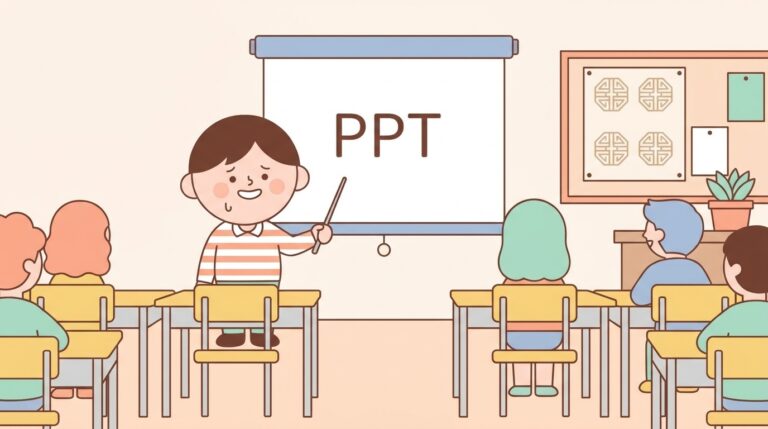
Imagine this: You are watching a classic university K-Drama like Cheese in the Trap or Nevertheless. The protagonist is standing nervously in front of a massive screen. The professor looks strict, and their teammates (who probably did zero work) are sweating in the back row. The protagonist takes a deep breath, grips the microphone, and says one magical sentence. The class falls silent, and the presentation begins.
Giving a presentation (발표, balpyo) in a foreign language is terrifying. I completely get it! But whether you are studying at a Korean language school or an exchange student at a university in Seoul, presentations are completely unavoidable.
If you only rely on textbooks, you might sound a bit like a robot. But if you know the natural rhythm and a few ‘insider’ phrases, you won’t just survive—you’ll get an A+! This guide is packed with real-world tips from my A2 students who successfully conquered their Korean class presentations. Let’s turn that panic into confidence!
Phase 2: 핵심 표현 심층 분석
Here are the top 3 lifesaver phrases you must know for your presentation.
1. 발표를 시작하겠습니다.
- Pronunciation: balpyo-reul sijak-haget-seumnida + [bal-pyo-rul shee-jak-ha-get-sum-nee-da]
- Meaning: Literal: I will start the presentation. / Real nuance: Let’s begin!
- K-Culture Moment: This is the ultimate signal. In K-Dramas, when the main character says this, the background music usually drops, and the camera zooms in on their confident face. It instantly grabs everyone’s attention.
- Editor’s Insight: The ending
~겠습니다(-get-seumnida) shows your strong intention and sounds very professional. It’s much better than just saying “시작해요” (sijakhaeyo).- Situation Spectrum:
- 친구 사이(Casual): 🚫
- 학교 친구들 앞(Semi-formal): ✅
- 교수님 앞(Formal): ✅
- 🤔 Think About It: Why do Koreans formally announce the start of an event? In Korean culture, clearly defining the start and end of a formal situation shows respect for the audience’s time.
2. 제 주제는 ~입니다.
- Pronunciation: je juje-neun ~imnida + [jeh joo-jeh-nun ~im-nee-da]
- Meaning: Literal: My topic is ~. / Real nuance: Today, I’ll be talking about ~.
- K-Culture Moment: You’ll hear this exactly 5 seconds after the first phrase. Whether you are presenting your favorite K-Pop idol or introducing your home country’s food, plug your noun right into the
~spot.- Editor’s Insight: It’s simple but highly effective for A2 learners. Instead of trying to make a complex sentence like “I want to explain to you about…”, just say “제 주제는 (My topic) + [Noun] + 입니다 (is).”
- Situation Spectrum:
- 친구 사이(Casual): ⚠️ (A bit too stiff for a cafe chat)
- 직장/학교(Formal): ✅
- 🤔 Think About It: Notice the word
제(My). In formal Korean, we use제instead of내to lower ourselves and show respect to the listeners.3. 들어주셔서 감사합니다.
- Pronunciation: deureo-jusyeoseo gamsa-hamnida + [du-ro-joo-syo-so gam-sa-ham-nee-da]
- Meaning: Literal: Because you listened, thank you. / Real nuance: Thank you for listening.
- K-Culture Moment: The presentation is over! The presenter bows exactly 45 degrees while saying this, and the whole class claps.
- Editor’s Insight: Never just say “끝!” (Finished!) and walk away. In Korea, expressing gratitude to the audience for their attention is the most crucial part of finishing any public speaking.
- Situation Spectrum:
- 친구 사이(Casual): 🚫 (Too formal)
- 교수님/어른 앞(Formal): ✅
- 🤔 Think About It: Korean often uses “Action + -아/어서 (because) + Thank you/Sorry”. Do you have a similar structure in your language, or do you just say “Thank you for [Action]”?
Phase 3: 교과서 vs 진짜 한국어
Let’s compare what you study in books with what actually happens in a Korean university classroom.
[Moving to the next slide]
* 📖 교과서 한국어: 다음 페이지로 넘어가겠습니다. (I will move to the next page.)
* 🗣️ 진짜 한국어: 다음 장 보시겠습니다. (Let’s look at the next page.) OR (To a teammate) 다음 넘겨주세요. (Next, please.)
* 💡 왜 다를까?: Saying “Let’s look together” (보시겠습니다) sounds softer and more engaging than mechanically announcing you are moving to the next slide.
[When you make a mistake]
* 📖 교과서 한국어: 제가 실수를 했습니다. 죄송합니다. (I made a mistake. I am sorry.)
* 🗣️ 진짜 한국어: 아, 죄송합니다. 다시 하겠습니다. (Ah, sorry. I’ll do it again.)
* 💡 왜 다를까?: In real life, there’s no time to explain your mistake. A quick “Sorry, I will start (that sentence) again” shows you are composed and ready to move on.
Bottom Note: For A2 level, keeping your sentences short and clear is much better than trying to use difficult vocabulary and stuttering!
Phase 4: 문화적 맥락 — K-Culture 딥다이브
4-1. 비언어적 요소 (Non-verbal cues)
- The 45-Degree Bow: In Korea, you must bow when you step up to the podium, and bow again when you finish. It’s a physical manifestation of “Hello” and “Thank you.”
- Eye Contact / 눈치 (Nunchi): Don’t just stare at the professor! Use your Nunchi to read the room. Scan your classmates, smile slightly, and try not to hide behind your paper script.
4-2. K-Culture 연결 고리: The Infamous “팀플” (Group Project)
If you watch college K-Dramas, you will inevitably see the 팀플 (Tim-peul, Team Play) scenes. It’s a huge part of Korean university life. Often, it’s a nightmare: one person does all the research, one person makes the PPT, one person presents (발표자), and there’s always one “free rider” (프리라이더) who ghosts the group chat.
* Pro Tip: If you are the foreign exchange student, you might be nervous about being the presenter. But Korean students love it when international students try their best to present in Korean! They will definitely cheer for you.
Phase 5: 실전 롤플레이 시나리오
Setting: It’s Tuesday, 10:00 AM at a university in Seoul. You are standing in front of your Korean speaking class. The screen shows your carefully crafted PPT. Your professor is sitting in the front row with a grading rubric.
Characters:
– YOU: An exchange student, nervous but prepared.
– 김 교수님 (Prof. Kim): Your Korean teacher. Strict but encouraging.
– 수진 (Sujin): Your Korean teammate who is controlling the PPT slides for you.
Dialogue:
김 교수님: 자, 다음 조 나오세요. 준비됐나요?
(Ja, da-eum jo na-o-se-yo. Junbi-dwaen-na-yo?)
[Next group, come on up. Are you ready?]
YOU: 네, 교수님.
(Ne, gyo-su-nim.)
[Yes, Professor.]
YOU: 안녕하세요. 발표를 시작하겠습니다.
(Annyeong-haseyo. Balpyo-reul sijak-haget-seumnida.)
[Hello. I will start the presentation.]
(🎭 Stage Direction: You give a polite 45-degree bow)
김 교수님: (Nods) 네, 시작하세요.
(Ne, sijak-haseyo.)
[Yes, please start.]
YOU: 제 주제는 ‘나의 고향’입니다.
(Je juje-neun ‘naui gohyang’imnida.)
[My topic is ‘My Hometown’.]
YOU: (Looking at Sujin) 수진 씨, 다음 장 넘겨주세요.
(Sujin ssi, da-eum jang neomgyeo-juseyo.)
[Sujin, next slide please.]
(🎭 Stage Direction: Sujin clicks the mouse)
YOU: 이곳은 제 고향의 유명한 공원입니다. 아주 아름답습니다.
(I-gos-eun je gohyang-ui yumyeong-han gong-won-imnida. Aju a-reum-dap-seumnida.)
[This is a famous park in my hometown. It is very beautiful.]
김 교수님: 오, 날씨가 어때요?
(O, nalssi-ga eo-ttae-yo?)
[Oh, how is the weather?]
YOU: 한국의 가을과 비슷합니다. 따뜻합니다.
(Hanguk-ui ga-eul-gwa biseut-hamnida. Ttatteut-hamnida.)
[It is similar to Korea’s autumn. It is warm.]
YOU: 제 발표는 여기까지입니다.
(Je balpyo-neun yeogi-kkaji-imnida.)
[My presentation is up to here (That’s all for my presentation).]
🔀 당신의 차례! 어떻게 대답할까요? (Decision Point)
You need to officially end the presentation. What do you say?
– A) 끝! 수고하셨습니다! (Finished! Good job everyone!)
– B) 안녕히 계세요! (Goodbye!)
– C) 들어주셔서 감사합니다. (Thank you for listening.)✅ Best Choice: C — It is the most standard, polite way to conclude a speech.
⚠️ Choice A 분석: “끝” is way too informal. “수고하셨습니다” is usually said by the professor to the student, or among teammates after the class. Saying it to the professor is a bit rude!
Phase 6: 10초 섀도잉 드릴
Practice these lines out loud. Focus on the pauses (/) and the feeling!
- 😊 당당하게 (Confidently):
안녕하세요! / 저는 / [이름]입니다.
(Annyeong-haseyo! / jeo-neun / [Name]imnida.) -
😤 프로페셔널하게 (Professionally):
지금부터 / 발표를 / 시작하겠습니다.
(Jigeum-buteo / balpyo-reul / sijak-haget-seumnida.) -
🥺 감사한 마음으로 (With gratitude):
끝까지 / 들어주셔서 / 감사합니다! (Bow)
(Kkeut-kkaji / deureo-jusyeoseo / gamsa-hamnida!)
Phase 7: K-Culture 미니 사전
| 한국어 | Romanization | 영어 | 맥락 설명 |
|---|---|---|---|
| 발표 | balpyo | Presentation | Any formal speaking in front of a class or meeting. |
| 피피티 | pipiti | PPT (PowerPoint) | Koreans rarely say “PowerPoint.” We always say “피피티.” |
| 팀플 | tim-peul | Group Project | Short for “Team Play.” The ultimate test of friendship. |
| 떨리다 | tteollida | To be nervous | Literally “to tremble/shake.” Used when you have butterflies in your stomach! |
Phase 8: 여행자 & 유학생 서바이벌 키트
Even if you are just a student, getting to your presentation involves moving around the campus or city! Here are essential survival phrases for finding your way on a massive Korean campus or printing your script.
🆘 서바이벌 표현 TOP 3
– 🇰🇷 “복사집이 어디에 있어요?” (boksa-jib-i eo-di-e isseoyo?)
– 🗣️ Meaning: Where is the print/copy shop?
– 📍 쓰는 곳: Asking campus students when you urgently need to print your PPT.
– 🇰🇷 “학생회관은 어떻게 가요?” (hak-saeng-hoe-gwan-eun eo-tteo-ke gayo?)
– 🗣️ Meaning: How do I go to the Student Union building?
– 🇰🇷 “이거 한 장 뽑아주세요.” (i-geo han jang ppo-ba-juseyo.)
– 🗣️ Meaning: Please print one copy of this.📌 Editor’s Travel Note
– Campus Maps: Google Maps rarely works well inside Korean university campuses. Download Naver Map or KakaoMap—they even show walking paths inside universities!
– Printing: Most universities have a “복사실” (copy room) or a 24-hour un-manned print cafe (무인 프린트 카페) near the gates. You need a credit/debit card to use them!
Phase 9: 비판적 사고 코너 — “한 발 더 깊이”
언어와 권력 (Language & Power in the Classroom)
🧠 Think Deeper:
Have you noticed how much Korean students bow and use high-level honorifics (~습니다,~시~) when talking to a professor? In Korea, the classroom is not just a place for learning; it’s a reflection of society’s hierarchical structure. The deep respect for teachers (교권) is rooted in Confucianism. Saying “들어주셔서 감사합니다” (Thank you for listening) isn’t just a polite habit; it’s acknowledging that the audience (especially the teacher) granted you their valuable time and attention.💬 Your Turn: How do you start or end a presentation in your home country? Do you talk to your professors like friends, or is there a strict hierarchy? Let us know in the comments!
Phase 10: FAQ & 오해 방지
Q: Can I use “~요” (yo) instead of “~다/까” (da/kka) in a presentation?
Yes, but it depends on the vibe! If it’s a small, friendly class, using “요” (like “제 주제는 한국 음식이에요”) is okay and sounds soft. But for mid-terms, finals, or strict professors, always stick to the formal “~습니다/비니다” format.
Q: Is it okay to read directly from my script?
In Korean universities, reading directly from a paper without looking at the audience is considered bad manners. Try to memorize your key points, or use small cue cards!
❌ 흔한 실수 (Common Mistake):
Saying “질문 있어요?” (Do you have questions?) to the professor.
✅ 이렇게 하세요:
“질문 있으십니까?” (formal) or simply wait for the professor to ask you a question.
Phase 11: 요약 및 액션 아이템
One-Liner Summary: A successful Korean presentation starts with a confident “발표를 시작하겠습니다” and ends with a polite “들어주셔서 감사합니다” + a 45-degree bow!
Action Mission 3단계:
– 🥉 Bronze (혼자서): Stand in front of a mirror, bow, and practice the 3 core phrases out loud.
– 🥈 Silver (온라인): Record a 10-second voice memo of yourself starting a presentation in Korean and listen to your pronunciation.
– 🥇 Gold (실전): The next time you have a Korean class, volunteer to be the presenter for your group!
🎬 K-Culture Mission:
Search for a K-Drama campus scene on YouTube (Try searching for “치즈인더트랩 발표” or “대학생 팀플”). Spot the moment they use the phrases we learned today!
Phase 12: 퀴즈 — 인터랙티브 챌린지
1. 상황 판단 문제 (Situational Judgment)
You just finished your 5-minute presentation about your hometown. What is the BEST way to end it?
* A) 끝! (Kkeut!)
* B) 안녕히 계세요. (Annyeong-hi gyeseyo.)
* C) 들어주셔서 감사합니다. (Deureo-jusyeoseo gamsa-hamnida.)
2. 빈칸 채우기 (Fill in the Blank)
“Hello, I will _____ the presentation.”
“안녕하세요, 발표를 __________.”
(Hint: starts with 시~)
3. True or False — K-Culture 에디션
“In Korean universities, it is perfectly fine to call your professor by their first name during a presentation.” (T / F)
(정답: 1. C / 2. 시작하겠습니다 / 3. F – Never! Always use 교수님 [Professor].)
Did this guide help calm your presentation nerves? Share your biggest classroom fear in the comments below, and let’s conquer it together! 화이팅! (Hwaiting!)
Frequently Asked Questions (FAQ)
Q: What does "발표를 시작하겠습니다." mean in Korean and how do you pronounce it?
A: In Korean, "발표를 시작하겠습니다." is pronounced [balpyo-reul sijak-haget-seumnida + [bal-pyo-rul shee-jak-ha-get-sum-nee-da] and means: Literal: I will start the presentation. / Real nuance: Let's begin!
Q: What does "제 주제는 ~입니다." mean in Korean and how do you pronounce it?
A: In Korean, "제 주제는 ~입니다." is pronounced [je juje-neun ~imnida + [jeh joo-jeh-nun ~im-nee-da] and means: Literal: My topic is ~. / Real nuance: Today, I'll be talking about ~.
Q: What does "들어주셔서 감사합니다." mean in Korean and how do you pronounce it?
A: In Korean, "들어주셔서 감사합니다." is pronounced [deureo-jusyeoseo gamsa-hamnida + [du-ro-joo-syo-so gam-sa-ham-nee-da] and means: Literal: Because you listened, thank you. / Real nuance: Thank you for listening.






