

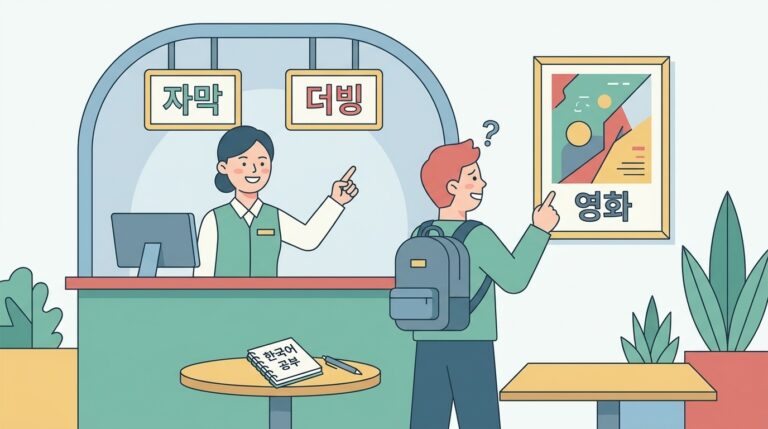
Phase 1: Empathy & The Cinematic Moment
Hello there! I am your Daily Hangul Editor, your local Korean friend, and veteran tutor.
Imagine this: It is a rainy Saturday evening in Seoul. You decide to escape the weather by visiting a glamorous Korean cinema in Gangnam. You buy your ticket, grab a massive bucket of half-and-half popcorn (sweet caramel and savory cheese, of course!), and sink into a plush leather seat. The lights dim, the movie starts, and suddenly you realize… wait. Is this movie dubbed in Korean? Or are there English subtitles?
You sit there for two hours, watching an action blockbuster, nodding along to intense dialogues without understanding a single word.
We have all been there! Going to the movies in Korea is a world-class experience, but the language barrier can turn a fun night out into a silent guessing game. Today, we are going to learn a lifesaver phrase for A1 beginners: “Are there subtitles?”
By learning this simple phrase, you will save your money, your time, and actually get to enjoy that movie. This guide is based on real questions my beginner students ask when they first arrive in Korea. Let’s dive in!
Phase 2: Core Expressions Deep Dive
Here are the absolute basic survival phrases you need at the cinema.
1. 자막 있어요?
- Pronunciation: ja-mak i-sseo-yo? [ja-mak sounds like “jamac” + ee-saw-yo]
- Meaning: Are there subtitles? (Literal: Subtitles exist?)
- K-Culture Moment: You are standing at the ticket counter. You point to a poster of the newest Hollywood movie, look at the staff, and ask this. It is short, polite, and gets the job done instantly.
- Editor’s Insight: The word
있어요 (i-sseo-yo)is magic in Korean. It means “I have,” “you have,” or “there is.” Just put the noun you want in front of it! - Situation Spectrum:
- Casual (Friends): ✅ (Drop the ‘yo’: 자막 있어?)
- Semi-formal (Staff): ✅
- Formal (Boss/Elders): ⚠️ (Better to use full formal sentences, though this is acceptable).
- 🤔 Think About It: In Korean, we often drop the subject (“Is there” or “Do you have”) if the context is clear. Why do you think Korean culture prefers to skip the “I” or “You” in sentences?
2. 영어 자막
- Pronunciation: yeong-eo ja-mak [young-uh ja-mak]
- Meaning: English subtitles.
- K-Culture Moment: Finding a Korean movie with English subtitles in a local theater is like finding a hidden treasure. Some theaters in Seoul (like specific CGV branches) host special “foreigner-friendly” screenings with
영어 자막. - Editor’s Insight: You can combine this with our first phrase!
영어 자막 있어요?(Are there English subtitles?) - Situation Spectrum:
- Casual: ✅
- Semi-formal: ✅
- Formal: 🚫
- 🤔 Think About It: English words are heavily used in Korean daily life, but “English” itself is “Yeong-eo” (영어). Do you have a unique name for the English language in your mother tongue?
3. 더빙이에요?
- Pronunciation: deo-bing-i-e-yo? [dubbing-ee-eh-yo?]
- Meaning: Is it dubbed?
- K-Culture Moment: You want to watch a Disney animation. In Korea, animations are usually released in two versions: Subbed (자막) and Dubbed (더빙) featuring famous Korean voice actors.
- Editor’s Insight: Yes, “deo-bing” is literally the English word “dubbing” spoken with a Korean accent!
- Situation Spectrum:
- Casual: ✅
- Semi-formal: ✅
- Formal: ⚠️
- 🤔 Think About It: Why do you think Korea uses the English word “dubbing” instead of making a native Korean word for it?
Phase 3: Textbook vs. Real Korean
Let’s see how real people talk at the movie theater compared to what you might see in a heavy grammar book.
[Asking about movie translation]
* 📖 Textbook Korean: 이 영화는 영어 자막이 제공됩니까? (Is this movie provided with English subtitles?)
* 🗣️ Real Korean: 영어 자막 있어요? (English subtitles exist?)
* 💡 Why the difference?: Koreans value ‘Pali-Pali’ (hurry) culture. In a fast-paced environment like a ticket line, short and practical sentences are always preferred over long, formal ones.
[Checking for dubbed movies]
* 📖 Textbook Korean: 한국어 더빙판입니까? (Is this the Korean dubbed version?)
* 🗣️ Real Korean: 더빙이에요? (Is it dubbing?)
* 💡 Why the difference?: Efficiency! If you are in Korea, it is naturally assumed you are asking about Korean dubbing, so people just shorten it.
Bottom Note: For A1 beginners, stick to
Noun + 있어요?. It is polite, natural, and you will never sound awkward using it!
Phase 4: Cultural Context — K-Culture Deep Dive
4-1. Non-verbal Communication
When asking the cinema staff, remember the Korean “Nunchi” (social sense).
– Do not aggressively point at the screen with one finger. If you need to gesture toward a movie poster, use your whole hand with the palm facing up.
– A slight head bow when saying “자막 있어요?” goes a long way in showing politeness.
4-2. K-Travel & Cinema Connection
Korean cinemas (like CGV, Megabox, Lotte Cinema) are tourist destinations in themselves! They offer incredible food (fried squid, garlic popcorn) and amazing seats (recliner beds!).
If you are a traveler:
– Hollywood Live-Action Movies: Almost always shown in English with Korean subtitles (자막).
– Animations (Disney, Pixar): Always double-check! They often have both Dubbed (더빙) and Subbed (자막) versions. Make sure you buy the “자막” ticket, or you’ll be watching Elsa sing “Let it go” in Korean!
– Korean Movies: Rarely have English subtitles, unless you visit a specific tourist-friendly branch in Seoul (e.g., Yongsan or Myeongdong).
Phase 5: Real-Life Roleplay Scenario
Setting: Friday night, 8:00 PM. The mega Lotte Cinema in Hongdae. The smell of sweet popcorn is in the air. You want to watch the new animated blockbuster.
Characters:
– YOU: An A1 Korean learner wanting to relax after a long week of exploring Seoul.
– Staff (Jiwon, 20s): A friendly part-time worker at the ticket booth.
Dialogue:
Jiwon: 안녕하세요! 영화 예매 도와드릴까요?
(an-nyeong-ha-se-yo! yeong-hwa ye-mae do-wa-deu-ril-kka-yo?)
(English) Hello! Can I help you book a movie ticket?
YOU: 네, ‘슈퍼 마리오’ 표 한 장 주세요.
(ne, ‘syu-peo ma-ri-o’ pyo han jang ju-se-yo.)
(English) Yes, one ticket for ‘Super Mario’, please.
Jiwon: 네, 더빙으로 드릴까요, 자막으로 드릴까요?
(ne, deo-bing-eu-ro deu-ril-kka-yo, ja-mak-eu-ro deu-ril-kka-yo?)
(English) Yes, would you like the dubbed version or the subtitled version?
(🎭 Stage Direction: Jiwon points to the screen showing two different showtimes)
YOU: 음… 영어 자막 있어요?
(eum… yeong-eo ja-mak i-sseo-yo?)
(English) Hmm… are there English subtitles?
Jiwon: 아, 애니메이션은 한국어 더빙이나 한국어 자막만 있어요.
(a, ae-ni-me-i-syeon-eun han-guk-eo deo-bing-i-na han-guk-eo ja-mak-man i-sseo-yo.)
(English) Ah, animations only have Korean dubbing or Korean subtitles.
🔀 YOUR TURN! How do you reply?
– A) “안 사요!” (I won’t buy it!)
– B) “아, 그럼 자막으로 주세요.” (Ah, then please give me the subtitled one.)
– C) “대박!” (Awesome!)✅ Best Choice: B — If it’s an English animation, the “subtitle” (자막) version means the audio is in original English, and the subtitles on screen will be Korean! Perfect for you!
⚠️ Choice A & C Analysis: Choice A is way too aggressive and rude. Choice C (“Daebak”) doesn’t make sense here because you are slightly disappointed or just making a choice.
Phase 6: 10-Second Shadowing Drill
Let’s practice saying this naturally. Do not sound like a robot! Follow the slash (/) for pauses.
🥺 저기요, / 영어 / 자막 / 있어요?
(jeo-gi-yo, / yeong-eo / ja-mak / i-sseo-yo?)
Excuse me, are there English subtitles?
Tip: Say it slightly slowly and with an inquisitive, hopeful tone!
Phase 7: K-Culture Mini Dictionary
| Korean | Romanization | English | Context |
|---|---|---|---|
| 영화관 | yeong-hwa-gwan | Cinema/Movie theater | Places like CGV, Megabox, Lotte Cinema. |
| 자막 | ja-mak | Subtitles | Usually implies Korean subtitles in Korea. |
| 더빙 | deo-bing | Dubbing | Voice-over acting, very popular for kids’ movies. |
| 매진 | mae-jin | Sold out | The word you never want to see on the ticket screen! |
| 예매 | ye-mae | Advance booking | Reserving a ticket before the showtime. |
Phase 8: Traveler’s Survival Kit
If you are visiting a cinema or watching TV at a hotel in Korea, keep these phrases handy!
🆘 Survival Expression TOP 3
1. 🇰🇷 “이거 영어 자막 있어요?” (i-geo yeong-eo ja-mak i-sseo-yo?)
– 🗣️ Guide: [ee-guh young-uh ja-mak ee-saw-yo?]
– 📍 Where: Cinema ticket booth, asking about Netflix shows.
2. 🇰🇷 “표 두 장 주세요.” (pyo du jang ju-se-yo.)
– 🗣️ Guide: [pyo doo jang joo-seh-yo]
– 📍 Where: Buying tickets (Means: Two tickets, please).
3. 🇰🇷 “화장실 어디예요?” (hwa-jang-sil eo-di-ye-yo?)
– 🗣️ Guide: [hwa-jang-shil uh-di-yeh-yo?]
– 📍 Where: During the movie when you drank too much soda!📌 Editor’s Travel Note
– Booking Apps: Koreans use apps like CGV or Megabox to book seats in advance, but they often require a Korean phone number and local credit card. As a tourist, it is much easier to just buy tickets at the physical kiosk or counter!
– Snack Culture: You MUST try Korean cinema popcorn. Caramel and Onion (Consomme) flavors are absolute game-changers.
Phase 9: Critical Thinking — A Step Deeper
Let’s think about Media vs Reality when it comes to Korean movies.
🧠 Think Deeper: The Reading Culture in Cinemas
In many European countries, foreign Hollywood movies are completely dubbed into the local language. However, in Korea, adults strongly prefer subtitles (자막) to hear the original actor’s voice. This “reading over listening” preference shows Korea’s high literacy rate and a cultural openness to experiencing foreign media in its authentic form. But ironically, because Korean media (K-Dramas) is becoming so popular globally, many foreigners now watch Korean shows dubbed into English!💬 Your Turn: Do people in your country prefer Dubbed movies or Subtitled movies? Share your cinema culture in the comments!
Phase 10: FAQ & Avoiding Common Mistakes
Q1: Can I use “자막 있어요?” to older staff?
Yes! Because it ends in ‘요(yo)’, it is polite enough for staff members of any age.
Q2: Will I find English subtitles for Korean movies easily?
No. Regular cinemas do not provide English subtitles for Korean movies. You need to search for “English Subtitle Screenings (영어 자막 상영)” on specific theater websites.
Q3: Can I bring outside food into a Korean cinema?
Yes! Since 2008, you are legally allowed to bring outside food (like a burger or coffee) into Korean cinemas, as long as it doesn’t have a severely strong smell (like spicy garlic noodles!).
❌ Common Mistake #1: Confusing 자막 (ja-mak: subtitle) with 제목 (je-mok: title).
✅ Do this instead: Memorize “Ja-mak” by thinking of “Jamming” to the “Mac” (Ja-mac)… while reading the words on screen!
Phase 11: Summary & Action Items
One-Liner Summary: Use “자막 있어요? (ja-mak i-sseo-yo?)” to ask if there are subtitles, so you don’t end up staring at a screen in confusion!
Your 3-Step Action Mission:
– 🥉 Bronze (Solo): Stand in front of your mirror and ask yourself, “영어 자막 있어요?” 3 times.
– 🥈 Silver (Online): Turn on Netflix, switch a Korean drama to Korean subtitles, and try to catch the word “있어요(i-sseo-yo)”.
– 🥇 Gold (Real Life): Next time you visit a Korean cinema (or a Korean DVD shop), confidently ask the clerk, “자막 있어요?”
🎬 Special K-Culture Mission:
Go to a Korean movie trailer on YouTube right now. Look at the comments. Try to find the Hangul characters for 자막!
Phase 12: Interactive Quiz Challenge
Test your knowledge!
1. Situational Judgment: You want to watch a Hollywood movie, but you want to hear the original English voices, not the Korean voice actors. What should you look for on the ticket?
– A) 더빙 (Deo-bing)
– B) 자막 (Ja-mak)
– C) 매진 (Mae-jin)
2. Fill in the Blank:
Excuse me, are there English subtitles?
저기요, 영어 ____ 있어요?
3. True or False — K-Culture Edition:
You are not allowed to bring your own coffee into a Korean movie theater. (T / F)
4. Roleplay Application:
If the screen says “매진”, what should you do?
– A) Walk in confidently.
– B) Ask for subtitles.
– C) Choose another movie time because it is Sold Out.
(Answers: 1: B, 2: 자막(ja-mak), 3: False – you can bring outside food!, 4: C)
Frequently Asked Questions (FAQ)
Q: What does "자막 있어요?" mean in Korean and how do you pronounce it?
A: In Korean, "자막 있어요?" is pronounced [ja-mak i-sseo-yo? [ja-mak sounds like "jamac" + ee-saw-yo] and means: Are there subtitles? (Literal: Subtitles exist?)
Q: What does "영어 자막" mean in Korean and how do you pronounce it?
A: In Korean, "영어 자막" is pronounced [yeong-eo ja-mak [young-uh ja-mak] and means: English subtitles.
Q: What does "더빙이에요?" mean in Korean and how do you pronounce it?
A: In Korean, "더빙이에요?" is pronounced [deo-bing-i-e-yo? [dubbing-ee-eh-yo?] and means: Is it dubbed?







