

Hello! I’m your Daily Hangul Editor, your local friend in Seoul.
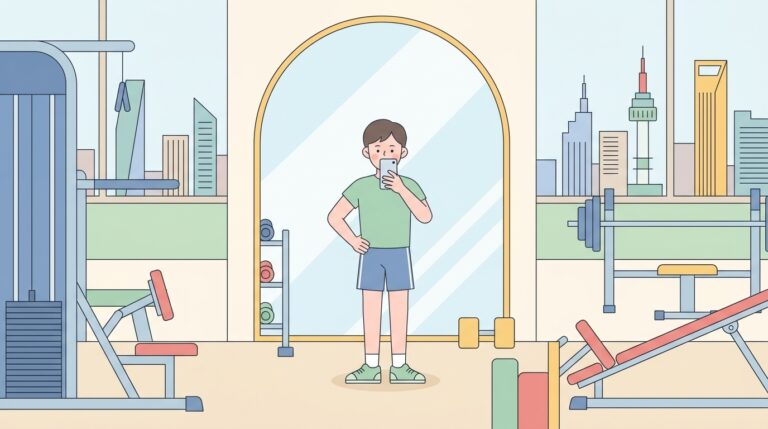
Have you ever been scrolling through Instagram, looking at your Korean friends’ stories, and suddenly noticed a mirror selfie in a gym with the hashtag #오운완? What does that mean? Are they bragging? Are they just letting you know they didn’t skip leg day?
Working out is no longer just a hobby in Korea; it’s a massive cultural trend. From K-Pop idols sharing their intense routines to your coworkers casually mentioning their ‘PT’ (Personal Training) sessions during lunch, fitness is everywhere. If you want to make friends in Seoul, knowing how to talk about your workout routine is the ultimate icebreaker!
This guide isn’t just about textbook grammar. It’s based on real questions from my students who wanted to sound like actual locals. Let’s dive into the real Korean way to say “I work out!”
Phase 2: Core Expressions Deep Dive
1. 저 운동해요 (I work out)
- Pronunciation: jeo undong-haeyo [jeo sounds like ‘joe’ without the w, undong sounds like ‘oon-dong’]
- Meaning: (Literal) I do exercise. vs (Real nuance) I work out / I keep fit.
- K-Culture Moment: When a Korean colleague asks what you do on weekends, saying this makes you look incredibly diligent. It’s the safest, most natural way to say you are active.
- Editor’s Insight: We use this as a big umbrella term. You could be running, doing yoga, lifting heavy weights, or just doing squats in your living room—it’s all ‘운동해요’!
- Situation Spectrum:
- Casual (Friends): ✅
- Semi-formal (Coworkers): ✅
- Formal (Boss/Elders): ✅
- 🤔 Think About It: Koreans love asking what you do in your free time. Why? In Korean culture, finding common ground quickly is the fastest way to build Jeong (정, emotional connection). Does your culture value small talk about hobbies too?
2. 헬스장 다녀요 (I go to the gym)
- Pronunciation: heulseujang danyeoyo [heul sounds like the ‘hull’ of a ship, danyeoyo means ‘I attend/commute’]
- Meaning: (Literal) I attend the health place. vs (Real nuance) I go to the gym regularly.
- K-Culture Moment: You’ll see this in K-Dramas when the handsome CEO is angrily lifting weights early in the morning to relieve stress!
- Editor’s Insight: Notice two things! First, we don’t say ‘Gym’ (짐). We use the Konglish word ‘Health-jang’. Second, we say ‘attend’ (다녀요), not ‘go’ (가요), to show it’s a dedicated habit, not just a one-time visit.
- Situation Spectrum:
- Casual (Friends): ✅
- Semi-formal (Coworkers): ✅
- Formal (Boss/Elders): ✅
- 🤔 Think About It: Why does Korean use the English word ‘Health’ to mean ‘Gym’? How does your native language adapt foreign fitness words?
3. 오운완 (Workout complete for today)
- Pronunciation: o-un-wan [oh-oon-wahn]
- Meaning: (Literal) Today’s Exercise Complete. vs (Real nuance) Crushed my workout today! #Gains
- K-Culture Moment: The ultimate Instagram hashtag. If you take a mirror selfie at the gym, this hashtag is mandatory.
- Editor’s Insight: This is an acronym for 오늘 운동 완료 (Today Workout Complete). You probably won’t say this out loud to your boss, but you will definitely type it to your friends or post it online!
- Situation Spectrum:
- Casual (Friends): ✅
- Semi-formal (Coworkers): ⚠️ (Only if they are young and trendy)
- Formal (Boss/Elders): 🚫
- 🤔 Think About It: Koreans love abbreviating everything (Palli-palli/hurry-hurry culture applies to language too!). Do you have trendy internet acronyms for working out in your country?
Phase 3: Textbook vs. Real Korean
[Saying ‘Gym’ in Korean]
* 📖 Textbook Korean: 저는 체육관에 갑니다. (I go to the gymnasium.)
* 🗣️ Real Korean: 저 헬스장 가요. (I’m going to the health club.)
* 💡 Why is it different?: ‘체육관’ sounds like an old-school boxing ring or a high school gym with wooden floors. ‘헬스장’ is the modern fitness center with treadmills and weights!
[Talking about your specific workout]
* 📖 Textbook Korean: 저는 운동을 좋아합니다. (I like exercising.)
* 🗣️ Real Korean: 저 요즘 피티(PT) 받아요. (I’m getting PT these days.)
* 💡 Why is it different?: Personal Training (PT) is so common in Korea now that saying “I get PT” is a massive flex of your commitment to self-improvement.
Bottom Note: At the A2 (Beginner) level, just knowing the word ‘헬스장’ (Gym) will make you sound 10 times more natural than using textbook words!
Phase 4: Cultural Context — K-Culture Deep Dive
4-1. Non-Verbal Cues: The Gym Mirror Selfie
When Koreans go to the gym, taking a picture in the big mirror isn’t just vanity; it’s proof of hard work. If you text a friend “운동해요”, sending a quick mirror selfie makes the conversation much more authentic!
4-2. The “Body Profile” (바디프로필) Craze
Have you noticed K-Pop idols always thanking their personal trainers or doing V-Live broadcasts right after a workout? The “Self-Improvement” (자기계발) culture is huge in Korea right now. Being physically fit shows you are diligent and work hard at life.
This led to the massive trend of the Body Profile (바프 – Bapeu). Young Koreans will train intensely for 3 to 6 months, go on strict diets, and book a professional photoshoot to capture their peak physical condition. It’s almost like a modern coming-of-age ceremony! Also, ‘Athleisure’ is everywhere. Wearing leggings or workout clothes to a trendy cafe in Yeonnam-dong is totally acceptable now, which definitely wasn’t the case 10 years ago!
Phase 5: Real-Life Roleplay Scenario
Setting: Friday evening, 6 PM. You are packing your bag at the office in Gangnam. Your coworker, Min-su (30s, friendly and talkative), comes over.
Characters:
– YOU: A foreign employee, trying to fit in with the local office culture.
– Min-su: Your Korean coworker who loves chatting.
민수: OO씨, 오늘 금요일인데 약속 있어요? 🍻
(OO-ssi, oneul geumyoil-inde yaksok isseoyo?)
[OO, it’s Friday today, do you have plans?]
YOU: 아니요, 저는 오늘 바로 집에 가요.
(aniyo, jeoneun oneul baro jibe gayo.)
[No, I’m going straight home today.]
민수: 에이, 왜요? 불금인데!
(ei, waeyo? bulgeum-inde!)
[Aw, why? It’s Fire Friday!]
YOU: 저 오늘 운동해야 돼요.
(jeo oneul undong-haeya dwaeyo.)
[I have to work out today.]
(🎭 Stage Direction: You proudly pat your gym bag)
민수: 오, 진짜요? 헬스장 다녀요?
(o, jinjjayo? heulseujang danyeoyo?)
[Oh, really? Do you go to a gym?]
🔀 Your Turn! How should you answer?
– A) “비밀이에요.” (It’s a secret.)
– B) “네, 회사 근처 헬스장 다녀요.” (Yes, I go to a gym near the office.)
– C) “오운완!”✅ Best Choice: B — It’s natural, answers the question, and keeps the conversation flowing politely.
⚠️ Choice C Analysis: “오운완” is internet slang! Saying a hashtag out loud in an office might make Min-su laugh because it sounds like you’re speaking in memes, but it’s a bit unnatural for spoken conversation.
Phase 6: 10-Second Shadowing Drill
Let’s practice saying “I go to the gym these days” with a proud, confident tone!
😊 저 요즘 / 헬스장 다녀요! (jeo yojeum / heulseujang danyeoyo!)
Tip: Put a slight emphasis on ‘heul’ and smile. Remember, working out is a flex!
Phase 7: K-Culture Mini Dictionary
| Korean | Romanization | English | Context |
|---|---|---|---|
| 헬스장 | heulseujang | Gym / Fitness Center | The Konglish word for gym. Never say ‘gymnasium’ (체육관). |
| 피티 | piti | PT (Personal Training) | Very popular in Korea. “피티 받아요” means “I get PT.” |
| 바디프로필 | badipeuropil | Body Profile | A professional photoshoot showing off your fitness results. Often shortened to ‘바프’ (Bapeu). |
| 홈트 | homteu | Home Training | Working out at home using YouTube videos. Huge trend since 2020! |
Phase 8: Traveler Survival Kit
Are you visiting Seoul and want to keep up with your gains? Here is your fitness survival kit!
🆘 Survival Phrases #1
– 🇰🇷 “일일권 있나요?” (il-il-gwon itnayo?)
– 🗣️ English guide: [eel-eel-gwon een-nah-yo?]
– 📍 Where to use: At the gym reception desk.
– 💡 Pro Tip: It means “Do you have a one-day pass?” Many gyms in Seoul offer this for travelers!📌 Editor’s Travel Note
– Indoor Shoes Rule: Many Korean gyms require you to bring a separate pair of clean indoor shoes. Don’t wear your street sneakers on their pristine treadmills!
– The Han River (한강): Don’t want to pay for a gym? Running along the Han River is free, safe at night, and gives you the ultimate K-Drama main character vibe. Look for the purple running tracks!
Phase 9: Critical Thinking — “One Step Deeper”
🧠 Think Deeper: Media vs Reality (The Pressure of Perfection)
In K-Dramas and on Korean Instagram, it seems like everyone has a perfect six-pack and wakes up at 6 AM to do Pilates. The “Body Profile” trend has pushed many young Koreans to diet extremely just for a single photo. While staying healthy is amazing, there’s a growing debate in Korea right now: Is this fitness culture about actual health, or is it just another form of pressure to look perfect for social media?
💬 Your Turn: Is there a strong fitness or gym culture in your home country? Does social media make the pressure to look fit worse? Share your thoughts in the comments!
Phase 10: FAQ & Avoiding Common Mistakes
Q: “Can I use ‘운동해요’ if I just play soccer with friends?”
Yes! ‘운동해요’ is a great umbrella term for any physical activity, from lifting weights to playing tennis.
Q: “I heard a Korean friend say ‘다이어트해요’. Does that mean they are working out?”
Great catch! In Korea, doing a ‘Diet’ (다이어트) doesn’t just mean changing what you eat. It almost always implies that they are working out to lose weight too!
❌ Common Mistake #1: Saying “스포츠 해요” (I do sports).
✅ Do this instead: This is a direct translation from English and sounds very awkward in Korean. Just say “운동해요” (General) or name the specific sport like “축구해요” (I play soccer).
Phase 11: Summary & Action Items
One-Liner Summary: Forget the textbook word ‘gymnasium’—say “저 헬스장 다녀요” to talk about your fitness routine like a true Seoulite!
Action Mission 3 Steps:
– 🥉 Bronze (Solo): Stand in front of a mirror, flex your arm, and say “저 운동해요!” 3 times out loud.
– 🥈 Silver (Online): Find a Korean friend’s workout post on Instagram and comment “오운완! 🔥”
– 🥇 Gold (Real Life): Next time a Korean speaker asks what you do on weekends, boldly say “저 요즘 헬스장 다녀요!”
K-Culture Mission: Search the hashtag #오운완 on Instagram right now. See what kinds of workouts Koreans are doing today and try to spot the mirror selfies!
Phase 12: Quiz — Interactive Challenge
1. Fill in the blank: What do Koreans naturally call the gym? “저 ___ 다녀요.”
A) 짐 (Jim)
B) 체육관 (Cheyukgwan)
C) 헬스장 (Heulseujang)
2. True or False: If your Korean friend texts you “오운완”, it means they just finished eating a big meal.
True / False
3. Situational: You want to tell your coworker that you do ‘Home Training’ with YouTube videos. What is the correct Korean slang for this?
A) 룸트 (Room-teu)
B) 홈트 (Hom-teu)
C) 집트 (Jip-teu)
(Answers: 1: C, 2: False – it means ‘Workout Complete for today’, 3: B – Hom-teu stands for Home Training!)
Frequently Asked Questions (FAQ)
Q: What does "저 운동해요 (I work out)" mean in Korean and how do you pronounce it?
A: In Korean, "저 운동해요 (I work out)" is pronounced [jeo undong-haeyo [jeo sounds like 'joe' without the w, undong sounds like 'oon-dong'] and means: (Literal) I do exercise. vs (Real nuance) I work out / I keep fit.
Q: What does "헬스장 다녀요 (I go to the gym)" mean in Korean and how do you pronounce it?
A: In Korean, "헬스장 다녀요 (I go to the gym)" is pronounced [heulseujang danyeoyo [heul sounds like the 'hull' of a ship, danyeoyo means 'I attend/commute'] and means: (Literal) I attend the health place. vs (Real nuance) I go to the gym regularly.
Q: What does "오운완 (Workout complete for today)" mean in Korean and how do you pronounce it?
A: In Korean, "오운완 (Workout complete for today)" is pronounced [o-un-wan [oh-oon-wahn] and means: (Literal) Today's Exercise Complete. vs (Real nuance) Crushed my workout today! #Gains







