

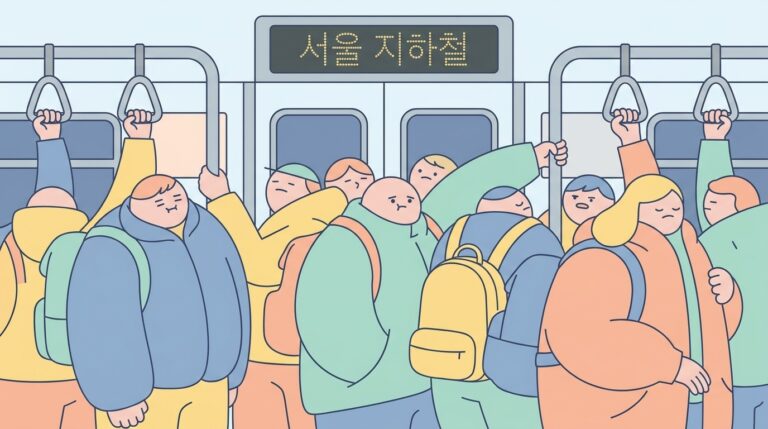
Phase 1: Empathy (The K-Drama Cold Open)
Hello! I’m the Senior Editor at Daily Hangul.
Picture this: You are watching a K-Drama like My Liberation Notes (나의 해방일지). The protagonist stares blankly out of a subway window, their face pressed against the glass, surrounded by an ocean of exhausted office workers. There’s no personal space, no air, just the rhythmic clack-clack of the train. The subtitles simply read, “The subway is crowded today.”
But if you live in Seoul and take Line 2 or Line 9 at 8:00 AM, you know it’s not just “crowded.” It is a battle for survival. It’s an experience that tests your physical endurance and your mastery of nunchi (reading the room).
If you only know the textbook phrase, “사람이 많아요” (There are many people), you are missing out on the dramatic, almost comical way Koreans actually describe this daily commute. Today, I’m going to teach you the real survival Korean for navigating Seoul’s infamous rush hour. This guide is built from the literal sweat and tears of my expat students who survived the commute to Gangnam. Let’s dive in!
Phase 2: Core Expressions Deep Dive
1. 지옥철
- Pronunciation: [jiokcheol] – Sounds like “jee-ok-chul”.
- Meaning: Literal: Hell subway. Real nuance: The absolute nightmare of a crowded rush-hour subway.
- K-Culture Moment: You finally make it to the office, your hair is messy, and you’re holding a crushed iced americano. Your coworker looks at you with pity and says, “Did you take the jiokcheol today?”
- Editor’s Insight: This is a combination of ‘지옥’ (Hell) and ‘지하철’ (Subway). It perfectly captures the collective misery of the commute. It’s not a swear word; it’s a highly relatable, everyday slang used by everyone from high school students to CEOs.
- Situation Spectrum:
- Casual with friends: ✅
- Semi-formal with coworkers: ✅
- Formal with strict bosses: ⚠️ (Maybe stick to “출근길이 붐볐습니다” – The commute was crowded)
- 🤔 Think About It: Why do you think Koreans combine extreme words like “hell” with everyday places? Does your native language have a dramatic term for a bad commute?
2. 낑겨(서) 가다
- Pronunciation: [kkinggyeo(seo) gada] – The ‘kk’ is a tense, tight sound, just like how you feel on the train!
- Meaning: Literal: To go wedged. Real nuance: To be squeezed or crushed between people while traveling.
- K-Culture Moment: When you are recounting your morning to a friend: “I couldn’t even grab the handle. I just floated because I was so kkinggyeo between people!”
- Editor’s Insight: The standard verb is ‘끼이다’ (to be caught/stuck), but in spoken Korean, especially to emphasize the physical discomfort of being squished, people use the slightly colloquial “낑기다”. It sounds vivid and relatable.
- Situation Spectrum:
- Casual with friends: ✅
- Semi-formal with coworkers: ✅
- Formal with strict bosses: 🚫
- 🤔 Think About It: Notice how Korean uses highly descriptive, sensory verbs to express physical states. How would you describe the physical sensation of a crowded bus in English?
3. 콩나물시루
- Pronunciation: [kongnamulsiru] – “Kong-na-mul-shee-roo”
- Meaning: Literal: A pot for growing bean sprouts. Real nuance: Packed like sardines.
- K-Culture Moment: If you watch Korean news during the holidays or transit strikes, reporters will invariably describe the subway cars as a kongnamulsiru.
- Editor’s Insight: English speakers say “packed like sardines.” Koreans say “like a bean sprout pot.” Why? Because Korean bean sprouts grow densely packed together in traditional clay pots, standing straight up. When you are standing upright, shoulder-to-shoulder on Line 9, you are the bean sprout.
- Situation Spectrum:
- Casual with friends: ✅
- Semi-formal with coworkers: ✅
- Formal with strict bosses: ✅ (It’s a widely accepted idiom)
- 🤔 Think About It: Idioms often reflect a country’s traditional diet or lifestyle. “Sardines” vs. “Bean sprouts.” What is a common idiom for “crowded” in your culture, and where does it come from?
Phase 3: Textbook vs. Real Korean
[Describing a highly crowded train]
* 📖 Textbook Korean: 지하철에 사람이 너무 많습니다. (There are too many people on the subway.)
* 🗣️ Real Korean: 완전 콩나물시루였어요. 발 디딜 틈도 없었어요. (It was totally a bean sprout pot. There wasn’t even room to step.)
* 💡 Why the difference?: Koreans love using vivid metaphors (like “no room to step”) to evoke empathy rather than just stating factual observations.
[Telling someone you had a hard time getting to work]
* 📖 Textbook Korean: 오늘 출근하는 것이 힘들었습니다. (It was difficult to commute today.)
* 🗣️ Real Korean: 오늘 아침에 지옥철 타고 오느라 진 다 빠졌어요. (I took the hell-subway this morning and my energy is completely drained.)
* 💡 Why the difference?: “진(이) 빠지다” (energy is drained) focuses on the emotional and physical toll, which builds solidarity among coworkers.
Bottom Note: At the B2 level, moving away from robotic facts to emotional, sensory idioms is the key to sounding like a native. Don’t be afraid to exaggerate a little—it shows you understand the vibe!
Phase 4: Cultural Context — K-Culture Deep Dive
4-1. Non-verbal Elements: The Art of Subway Nunchi
In the jiokcheol, words are secondary. Body language is everything.
* The Backpack Hug: If you wear a backpack on your back during rush hour, you will get glaring looks. The unspoken rule is to take it off and hold it in front of you or put it on the overhead rack.
* The Squeeze-In: You don’t ask “Can I come in?” You use your nunchi. If there’s a 10cm gap, you turn your shoulders sideways, take a deep breath, and slide in backward.
* Eye Contact: Avoid it at all costs. Stare at your phone, the floor, or the blinking subway map.
4-2. K-Drama Connection: The Exhausted Office Worker Trope
If you’ve watched Misaeng (Incomplete Life) or My Liberation Notes, you know the “Hell Subway” is a recurring character. It’s not just a mode of transport; it symbolizes the heavy burden of modern life. In dramas, the camera often focuses on the protagonist’s weary eyes reflecting off the dark subway window while sad indie music plays. Understanding the word jiokcheol helps you grasp why the protagonists in these dramas are so desperate for a break—their day starts with a battle before they even reach their desks.
Phase 5: Real-Life Roleplay Scenario
Setting: Friday, 8:45 AM. The breakroom at your office in Gangnam. You just survived commuting on Subway Line 2. Your hair is slightly messy, and you are aggressively stirring an instant Maxim coffee.
Characters:
* YOU (The Reader): An expat working in Seoul, still adjusting to the morning rush.
* Min-su (32): Your friendly Korean coworker who commutes from the deep suburbs and has accepted his fate.
Dialogue:
Min-su: OOO 씨, 오늘 아침부터 왜 이렇게 피곤해 보여요? ☕
(OOO ssi, oneul achim-buteo wae ireoke pigonhae boyeoyo?)
[OOO, why do you look so tired from the morning?]
YOU: 말도 마세요. 오늘 2호선 완전 지옥철이었어요.
(Maldo maseyo. oneul ihoseon wanjeon jiokcheol-ieosseoyo.)
[Don’t even mention it. Line 2 was a total hell-subway today.]
Min-su: 아휴, 2호선은 원래 그래요. 강남역에서 내릴 때 안 힘들었어요?
(Ahyu, ihoseon-eun wollae geuraeyo. Gangnam-yeogeseo naeril ttae an himdeureosseoyo?)
[Sigh, Line 2 is always like that. Wasn’t it hard getting off at Gangnam station?]
YOU: 진짜 낑겨 죽는 줄 알았어요. 사람들이 안 비켜줘서 못 내릴 뻔했다니까요.
(Jinjja kkinggyeo jungneun jul arasseoyo. Saramdeuri an bikyeojwoseo mot naeril ppeonhaetdanikkayo.)
[I really thought I was going to be squeezed to death. People wouldn’t move, so I almost couldn’t get off.]
Min-su: ㅋㅋㅋ 그럴 땐 어떻게 해야 하는지 알죠?
(Kkk geureol ttaen eotteoke haeya haneunji aljyo?)
[Hahaha, you know what to do in that situation, right?]
🔀 Your Turn! How do you respond?
– A) “비켜주세요!” (Move out of the way!)
– B) “잠시만요! 내릴게요!” (Excuse me! I’m getting off!)
– C) “Excuse me?”✅ Best Choice: B — Reason: Saying “잠시만요! 내릴게요!” (Excuse me, I’m getting off!) with a loud, polite-but-firm voice is the ultimate survival code. People will instantly part like the Red Sea.
⚠️ Choice A Analysis: “비켜주세요” literally means “Move,” and it sounds demanding and slightly aggressive. Koreans rarely use it on the subway.
⚠️ Choice C Analysis: Honestly? If you yell “Excuse me!” in a panic, Koreans might actually panic and move out of the way faster, but it’s better to use the local language!
(Continuing the dialogue assuming you chose B)
YOU: “잠시만요, 내릴게요!” 하면서 밀고 나왔죠. 완전 전투적이었어요.
(“Jamsimanyo, naerilgeyo!” hamyeonseo milgo nawawatjyo. Wanjeon jeontujeog-ieosseoyo.)
[I pushed my way out saying, “Excuse me, I’m getting off!” I was totally combative.]
Min-su: 오~ 이제 완전 한국인 다 됐네요! 이따 점심은 제가 쏠게요. 고생했어요!
(O~ ije wanjeon hangugin da dwaenneyo! Itta jeomsim-eun jaega ssolgeyo. Gosaenghaesseoyo!)
[Oh~ you’ve become completely Korean now! I’ll treat you to lunch later. Good job enduring it!]
YOU: 진짜요? 대박. 그럼 저 돈가스 먹을래요! 🥩
(Jinjjayo? Daebak. Geureom jeo dongaseu meogeullaeyo!)
[Really? Awesome. Then I want to eat Tonkatsu!]
Phase 6: 10-Second Shadowing Drill
Read this out loud. Pay attention to the pauses (/) and stretch the highlighted vowels to sound like a tired local!
😩 Exhausted / Emphasizing the struggle:
오늘 아침에 / 완전 콩나물시루라서 / 낑~~~겨서 왔어요.
(Oneul achime / wanjeon kongnamulsiruraseo / kking~~~gyeoseo wasseoyo.)
This morning / it was totally a bean sprout pot, so / I came squeeeezed all the way.
Phase 7: K-Culture Mini Dictionary
| Korean | Romanization | English | Cultural Context |
|---|---|---|---|
| 지옥철 | jiokcheol | Hell subway | The agonizingly crowded commuter trains, mostly lines 2, 9, and the Sinbundang line. |
| 눈치 | nunchi | Social intuition | Knowing when to push into a train or wait for the next one without anyone telling you. |
| 출퇴근길 | chultoegeun-gil | Commute path | The daily journey to (출근) and from (퇴근) work. A sacred, yet dreaded time. |
| 양보 | yangbo | Yielding/Concession | Offering your seat to the elderly, pregnant women, or children. Very strictly observed in Korea. |
Phase 8: Traveler Survival Kit
Even if you aren’t commuting to work, as a traveler, you will accidentally find yourself in the rush hour at some point. Here is how to survive.
🆘 Survival Phrases Top 3
– 🇰🇷 “잠시만요, 내릴게요!” (Jamsimanyo, naerilgeyo!)
– 🗣️ Meaning: Excuse me, I’m getting off!
– 📍 Where to use: When the doors open and 50 people are blocking your exit.
- 🇰🇷 “내리실 건가요?” (Naerisil geongayo?)
- 🗣️ Meaning: Are you getting off (at this stop)?
- 📍 Where to use: Asking the person standing right in front of the door so you know if you need to maneuver around them.
🇰🇷 “가방 좀 앞으로 메주세요.” (Gabang jom apeuro mejuseyo.)
- 🗣️ Meaning: Please wear your bag in the front.
- 📍 Where to use: (Advanced) If someone is suffocating you with their giant hiking backpack.
📌 Editor’s Travel Note
– App Tip: Use KakaoMetro or Naver Map. They tell you exactly which door (e.g., 3-1, 4-2) is closest to your transfer point! Koreans rely heavily on this to save time.
– Etiquette: Never sit in the Pink Seats (Pregnant Women) or the seats at the very ends of the train (Elderly/Disabled), even if the train is packed. It’s a huge cultural faux pas!
Phase 9: Critical Thinking — “One Step Deeper”
🧠 Think Deeper: Media vs. Reality
K-Dramas often romanticize public transportation. You might see a tall, handsome male lead shielding the female lead with his arms in a crowded subway (the classic “manner hands” trope), making eye contact while soft romantic music plays. In reality, the Seoul jiokcheol is not a place for romance. It’s an arena of survival where people are stressed, sweaty, and staring at their phones. Dramas use the crowded subway to force physical proximity for romantic tension, but real Koreans use noise-canceling headphones to create a mental barrier against the crowd.
💬 Your Turn: Do movies or shows in your country romanticize public transportation, or do they show the gritty reality? Share in the comments!
Phase 10: FAQ & Avoiding Mistakes
Q: If someone pushes me really hard on the train, should I say something?
Editor’s Answer: Honestly, NO. In the jiokcheol, minor pushing is completely normal and unintentional. Saying “Watch out” or getting angry will only cause an uncomfortable scene. Just hold your ground and let it go!
Q: Can I use “지옥철” (jiokcheol) in a formal business meeting?
Editor’s Answer: Maybe. If you are making small talk before the meeting starts to break the ice (“오시는데 지옥철 아니었어요?”), it can show you are culturally savvy. But don’t use it in an official presentation.
❌ Common Mistake #1: Yelling “비켜주세요!” (Bikyeojuseyo! – Move!) to get out of the train.
✅ Do This Instead: Say “잠시만요!” (Jamsimanyo! – Just a moment/Excuse me) or “지나가겠습니다!” (Jinagagetseumnida! – I am passing through!). It is much more polite and culturally appropriate.
Phase 11: Summary & Action Items
- One-Liner Summary: To survive Seoul’s rush hour, you don’t just take the subway; you survive the jiokcheol (hell subway) packed like a kongnamulsiru (bean sprout pot).
Action Mission 3 Steps:
* 🥉 Bronze (Solo): Stand in front of your mirror, pretend you are crushed by people, and loudly practice saying: “잠시만요, 내릴게요!”
* 🥈 Silver (Online): Go to your favorite Korean learning forum or Discord and write: “I don’t want to ride the 지옥철 today!”
* 🥇 Gold (Real Life): Next time you are in Korea (or a crowded elevator!), use “잠시만요” to navigate through the crowd instead of English.
🚇 K-Culture Mission:
Find a subway scene in a Korean drama or movie (like My Mister, My Liberation Notes, or even Train to Busan—though that’s a different kind of hell!). See if you can spot anyone wearing their backpack on the front!
Phase 12: Quiz — Interactive Challenge
1. Situational Judgment: You are on Line 9 at 6:00 PM. It is your stop, but a wall of office workers is blocking the door. What do you do?
* A) Tap someone’s shoulder and say “비켜주세요.” (Move.)
* B) Miss your stop because you are too shy.
* C) Say “잠시만요! 내릴게요!” loudly while gently nudging your way through.
2. Fill in the Blank:
“오늘 지하철에 사람이 너무 많아서 완전 ( __________ ) 였어요. 낑겨 죽는 줄 알았어요.”
Hint: It involves a vegetable!
3. True or False – K-Culture Edition:
“If the subway is incredibly crowded, it is perfectly fine to sit in the empty pink seats designated for pregnant women, as long as you get up when a pregnant woman boards.”
(Answers: 1. C, 2. 콩나물시루 (kongnamulsiru), 3. False. In Korea, those seats are usually left empty at all times as a sign of respect and ease for pregnant women who might not visibly show yet!)
Frequently Asked Questions (FAQ)
Q: What does "지옥철" mean in Korean and how do you pronounce it?
A: In Korean, "지옥철" is pronounced [jiokcheol] and means: Literal: Hell subway. Real nuance: The absolute nightmare of a crowded rush-hour subway.
Q: What does "낑겨(서) 가다" mean in Korean and how do you pronounce it?
A: In Korean, "낑겨(서) 가다" is pronounced [kkinggyeo(seo] and means: Literal: To go wedged. Real nuance: To be squeezed or crushed between people while traveling.
Q: What does "콩나물시루" mean in Korean and how do you pronounce it?
A: In Korean, "콩나물시루" is pronounced [kongnamulsiru] and means: Literal: A pot for growing bean sprouts. Real nuance: Packed like sardines.







