

Phase 1: Empathy (The Blank Page Dilemma)
Hello! I’m your Daily Hangul Editor.
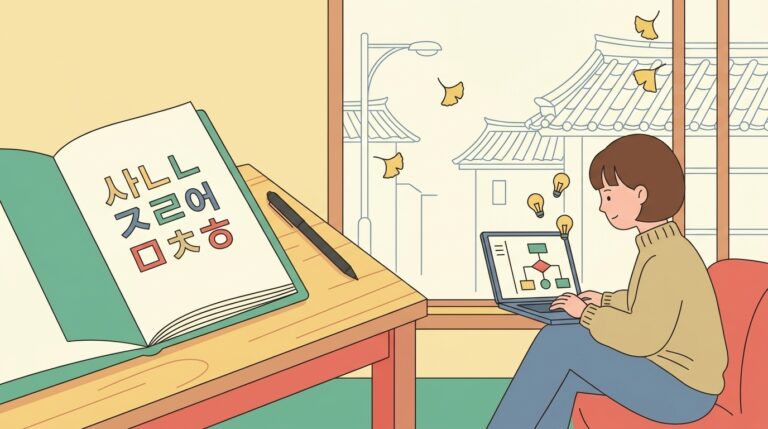
Picture this: You are sitting at a beautifully aesthetic café in Yeonnam-dong. Your iced Americano is sweating onto the table, but you haven’t taken a sip in twenty minutes. You’re staring at a blank screen. It’s time to write that advanced Korean essay—whether for your TOPIK II exam, a university assignment, or a personal blog.
In K-Dramas like Romance is a Bonus Book, writers always seem to stare out the window, have a sudden ‘aha!’ moment, and furiously type a masterpiece that instantly becomes a bestseller. But in reality? We just sit there, deleting the same sentence over and over.
Writing in Korean isn’t just about translating your English thoughts. It involves a completely different structural DNA. At the C1 level, your professors or readers expect you to demonstrate Nunchi (social awareness) in your writing flow. Today, we are diving deep into the sophisticated vocabulary and cultural mindsets you need to select a topic and structure your writing like a true native.
Phase 2: Core Expressions Deep Dive
Let’s look at the absolute must-know expressions for brainstorming and structuring.
1. 주제를 잡다
- Pronunciation: juje-reul japda (Sounds like you are grabbing something solid out of thin air)
- Meaning: Literal: To catch a topic / Real nuance: To lock in or finalize a topic
- K-Culture Moment: Imagine an indie publishing house in Hongdae. The editor-in-chief slams their hand on the table and says, “Let’s lock in this concept!” It implies the topic was floating around like a butterfly, and you finally caught it.
- Editor’s Insight: This feels much more active and dynamic than just saying “주제를 결정하다” (to decide a topic). It shows agency and relief.
- Situation Spectrum:
- Casual with friends: ✅
- Semi-formal (Study group): ✅
- Formal (Reporting to a professor): ⚠️ (Better to use “주제를 정했습니다”)
- 🤔 Think About It: Why does Korean use the verb ‘잡다’ (to catch/grab) for ideas, dates (날짜를 잡다), and topics? Does it reflect a culture that views time and concepts as things that will slip away if not actively captured?
2. 갈피를 못 잡다
- Pronunciation: galpi-reul mot japda (gal-pee-reul mot jap-da)
- Meaning: Literal: Cannot catch the pages / Real nuance: To lose one’s way, to not know where to start, or to fail to grasp the point.
- K-Culture Moment: You’ll hear this a lot in K-Dramas when a character is dealing with severe writer’s block or when a detective is completely lost in an investigation.
- Editor’s Insight: ‘갈피’ originally refers to the layers or pages of a book. So “갈피를 못 잡다” vividly describes the feeling of flipping through a book and not being able to find the exact page you need. It’s the perfect phrase for feeling mentally stuck.
- Situation Spectrum:
- Casual with friends: ✅
- Semi-formal (Study group): ✅
- Formal (To a superior): ⚠️ (It sounds a bit emotional; better to ask for guidance directly)
- 🤔 Think About It: Does your language have a physical metaphor for feeling mentally lost, like “losing the plot” or “being at sea”?
3. 개요를 짜다
- Pronunciation: gaeyo-reul jjada (gae-yo-reul jja-da)
- Meaning: Literal: To squeeze/weave an outline / Real nuance: To structure or draft an outline.
- K-Culture Moment: University libraries during midterms. Students fueled by energy drinks, whispering, “아, 개요 짜기 너무 힘들어…” (Ah, making this outline is so hard…)
- Editor’s Insight: Notice the verb ‘짜다’. It’s the same verb used for weaving fabric, squeezing water, or making a plan (계획을 짜다). Structuring a Korean essay requires weaving your thoughts tightly together.
- Situation Spectrum:
- Casual with friends: ✅
- Semi-formal (Coworkers): ✅
- Formal (Professor): ✅
- 🤔 Think About It: Weaving thoughts (개요를 짜다). Does this imply that an essay is seen as a piece of interconnected fabric rather than just a stack of isolated facts?
Phase 3: Textbook vs. Real Korean
[Situation 1: Announcing you finally picked a topic]
* 📖 Textbook Korean: 저는 에세이 주제를 결정했습니다. (I have decided on my essay topic.)
* 🗣️ Real Korean: 저 드디어 주제 잡았어요! or 아, 주제 픽(Pick)했어요!
* 💡 Why?: Using ‘잡다’ sounds much more natural. Among younger generations, the English word ‘Pick’ (popularized by K-Pop survival shows like Produce 101) is widely used to mean selecting an option.
[Situation 2: Expressing writer’s block]
* 📖 Textbook Korean: 에세이를 어떻게 써야 할지 모르겠습니다. (I don’t know how I should write the essay.)
* 🗣️ Real Korean: 아, 진짜 갈피를 못 잡겠네. 완전 멘붕이에요. (Ah, I really can’t get the hang of this. Total mental breakdown.)
* 💡 Why?: Koreans love descriptive language for hardships. ‘멘붕’ (Mental Breakdown) is a slightly older but permanently ingrained slang for moments of utter confusion or panic.
Bottom Note: For C1 (Advanced) learners, integrating metaphorical verbs like ‘잡다’ and ‘짜다’ into your vocabulary is the key to crossing the bridge from “fluent” to “natural.”
Phase 4: Cultural Context — K-Culture Deep Dive
4-1. The ‘Nunchi’ of Korean Writing
Writing an essay in Korean requires a deep level of Nunchi. In many Western writing styles, the structure is highly direct: Thesis statement up front, followed by body paragraphs proving it.
However, Korean academic and essay writing often favors a softer, more circular approach. You don’t just shove your opinion into the reader’s face; you build context, show empathy for opposing views, and gently guide the reader to your conclusion. This is Nunchi on paper—reading the room of your audience before delivering the punchline.
4-2. The Holy Grail of Korean Structure: 기승전결 (Gi-seung-jeon-gyeol)
If you watch a brilliant K-Drama, you’ll notice a specific pacing. This comes from the ancient 4-act narrative structure used in East Asian literature: 기승전결.
* 기 (Introduction): Setting the scene.
* 승 (Development): Expanding the topic.
* 전 (Twist/Turn): The climax, a shift in perspective, or introducing the counter-argument (this is where the plot twists in K-Dramas happen!).
* 결 (Conclusion): Tying it all together, often ending with an emotional resonance or a broader societal question.
When writing a C1-level essay (like TOPIK Question 54), simply listing points isn’t enough. You need that ‘전’ (Turn)—a moment of critical reflection—to truly impress a Korean reader.
Phase 5: Real-Life Roleplay Scenario
Setting: It’s 8:00 PM on a Friday. You are inside a vibrant study café in Sinchon. You and your study partner, Ji-hoon, are working on a final paper. The sound of aggressive laptop typing fills the room.
Characters:
– YOU: An advanced Korean learner, currently battling writer’s block for your TOPIK II essay prep.
– Ji-hoon (28): A Korean university student. He is direct, slightly stressed about his own thesis, but always ready to help.
Dialogue:
Ji-hoon: 야, 너 아직도 빈 화면이냐? 마감 내일까지 아니야?
(Ya, neo ajikdo bin hwamyeon-inya? Magam naeil-kkaji aniya?)
[Hey, are you still staring at a blank screen? Isn’t the deadline tomorrow?]
YOU: 어… 주제는 대충 생각했는데, 어떻게 시작해야 할지 모르겠어.
(Eo… juje-neun daechung saenggak-haenneunde, eotteoke sijak-haeya halji moreugesseo.)
[Uh… I kind of thought of a topic, but I don’t know how to start.]
Ji-hoon: 주제 확실히 잡은 거 맞아? 갈피를 못 잡고 있는 것 같은데.
(Juje hwaksilhi jabeun geo maja? Galpi-reul mot japgo inneun geot gateunde.)
[Are you sure you locked in the topic? You look like you’re completely lost.]
YOU: (Sighs) 사실 네 말이 맞아. 계속 썼다 지웠다 반복 중이야.
(Sasil ne mari maja. Gyesok sseotda jiwotda banbok jung-iya.)
[Actually, you’re right. I just keep writing and deleting repeatedly.]
Ji-hoon: 개요부터 다시 짜보자. 내가 좀 도와줄까?
(Gaeyo-buteo dasi jjaboja. Naega jom dowajulkka?)
[Let’s build the outline again from scratch. Want me to help?]
🔀 Your Turn! How should you respond?
– A) “네, 개요 작성을 도와주시면 감사하겠습니다.” (Very textbook, a bit too stiff for a close study buddy.)
– B) “아, 진짜? 완전 땡큐지! 기승전결 짜는 것만 좀 봐줘.”
– C) “아니야, 내가 알아서 할게.” (Independent, but you might fail the assignment!)✅ Best Choice: B — Reason: It matches the casual, friendly tone Ji-hoon used, incorporates modern slang (땡큐), and correctly uses the advanced concept ‘기승전결’ (4-act structure) that shows you understand Korean essay writing!
Phase 6: 10-Second Shadowing Drill
Practice the intonation of a stressed writer finally having a breakthrough!
😫 아, 진짜 / 갈피를 / 못 잡겠어...
(Ah, jinjja / galpi-reul / mot japgesseo…)
Focus on drawing out the ‘진짜’ with frustration.
😊 오! / 드디어 / 주제 잡았어! / 이제 개요 짜야지!
(O! / deudieo / juje jabasseo! / ije gaeyo jjayaji!)
Brighten your tone on ‘오’ and put a determined emphasis on ‘짜야지’.
Phase 7: K-Culture Mini Dictionary
| Korean | Romanization | English | Context |
|---|---|---|---|
| 기승전결 | gi-seung-jeon-gyeol | 4-act structure | The gold standard narrative arc in Korean writing and storytelling. |
| 퇴고 | toe-go | Revision/Editing | Polishing your draft. A highly formal but essential term for writers. |
| 글발 | geul-bal | Writing flair | A colloquial term for someone’s natural talent in writing. (e.g., 글발이 좋다) |
| 마감 | ma-gam | Deadline | The true muse of all writers. Often used with verbs like 마감을 맞추다 (meet a deadline). |
| 밤샘 | bam-saem | All-nighter | What happens when you fail to “개요를 짜다” early on! |
Phase 8: Traveler Survival Kit (Café Writer Edition)
Writing takes place in cafes! If you’re hunting for a spot to write your essay in Seoul, you need these survival phrases.
🆘 Survival Expression #1
– 🇰🇷 “혹시 콘센트 있는 자리 있나요?” (Hoksi konsenteu inneun jari innayo?)
– 🗣️ English Guide: Are there any seats with outlets by any chance?
– 💡 Pro Tip: Koreans say ‘콘센트’ (from concentric plug), not ‘outlet’ or ‘socket’!🆘 Survival Expression #2
– 🇰🇷 “와이파이 비밀번호가 뭐예요?” (Waipai bimilbeonhoga mwoyeyo?)
– 🗣️ English Guide: What is the Wi-Fi password?
– 💡 Pro Tip: Often, it’s written on the receipt. Check the bottom of your receipt before asking!📌 Editor’s Travel Note
– Café Etiquette: It is totally normal to leave your laptop on the table while going to the restroom in Korea. Korea is incredibly safe regarding personal belongings in cafes!
– Time Limits: Some popular aesthetic cafes in Yeonnam-dong or Seongsu have a 2-hour time limit. If you are “갈피를 못 잡고” (struggling) for too long, you might have to buy another drink or move!
Phase 9: Critical Thinking — “One Step Deeper”
Language & Power: The Weight of Sino-Korean Words in Academic Writing
🧠 Think Deeper:
When you transition from speaking Korean to writing a formal essay, you’ll notice a massive shift in vocabulary. Native Korean verbs (like 생각하다) are suddenly replaced by heavier Sino-Korean (한자어) equivalents (like 고찰하다 – to consider deeply). This isn’t just about sounding fancy. In Korean culture, the historical use of Hanja (Chinese characters) was a symbol of scholarship, authority, and class. Today, using dense Sino-Korean words in an essay signals to the professor or editor that you are operating within a highly educated, formal framework. It establishes your authority as a writer.💬 Your Turn: In your culture, do academic essays require a completely different, almost archaic set of vocabulary compared to daily conversation? Share your thoughts in the comments!
Phase 10: FAQ & Avoiding Misunderstandings
- Q: Can I use ‘기승전결’ in daily life, not just for essays?
- Yes! It’s often used metaphorically. For example, if your friend always ends up talking about their crush no matter how the conversation starts, you can say: “너는 완전 기승전-민수야!” (Your conversations always end with Minsu!)
- Q: If I’m writing a formal email to a professor about my topic, what do I say?
- Don’t say “주제 잡았어요.” Use formal language: “교수님, 에세이 주제를 정했습니다.” (Professor, I have decided on the essay topic.)
❌ Common Mistake #1: Translating “I need to make an outline” directly as “나는 아웃라인을 만들어야 해.”
✅ Do This Instead: While “아웃라인” is sometimes understood, “개요를 짜다” proves you have high-level C1 vocabulary skills.
Phase 11: Summary & Action Items
One-Liner Summary: To master advanced Korean writing, remember to catch your topic (주제를 잡다), don’t lose your pages (갈피를 못 잡다), and weave your outline (개요를 짜다).
Action Mission 3 Steps:
– 🥉 Bronze: Say “아, 갈피를 못 잡겠네” out loud the next time you feel stuck on any task.
– 🥈 Silver: Write a 3-sentence “기승전결” outline about your day today in your notes app.
– 🥇 Gold: Use “주제를 잡다” when discussing a project or study plan with a Korean-speaking friend or tutor.
📝 K-Culture Mission:
Next time you watch a K-Drama, map out the plot using the 기승전결 structure. Identify the exact moment the “전” (Twist) happens—it usually hits around episode 11 or 12!
Phase 12: Quiz — Interactive Challenge
1. Situational Judgment: You are presenting your essay progress to your Korean professor, but you are still struggling to narrow down the topic. What is the most appropriate way to express this?
– A) 교수님, 아직 갈피를 못 잡겠습니다.
– B) 교수님, 아직 주제를 구체화하는 데 어려움이 있습니다.
– C) 교수님, 주제 픽(Pick)이 힘드네요.
(Answer: B. While A is natural, it’s a bit too informal/emotional for a strict professor. C is slang. B uses C1-level formal vocabulary “구체화하다” (to make concrete).)
2. Fill in the Blank:
“내일까지 제출인데 아직 에세이 ____를 못 짰어!”
(Answer: 개요 – outline)
3. True or False – K-Culture Edition:
“In a Korean university, it is considered perfectly normal to leave your laptop on your café table while you go to the bathroom for 10 minutes.”
(Answer: True! Korea’s ‘cafe trust culture’ is real, though you should still always take your wallet/passport just in case!)
Frequently Asked Questions (FAQ)
Q: What does "주제를 잡다" mean in Korean and how do you pronounce it?
A: In Korean, "주제를 잡다" is pronounced [juje-reul japda (Sounds like you are grabbing something solid out of thin air] and means: Literal: To catch a topic / Real nuance: To lock in or finalize a topic
Q: What does "갈피를 못 잡다" mean in Korean and how do you pronounce it?
A: In Korean, "갈피를 못 잡다" is pronounced [galpi-reul mot japda (gal-pee-reul mot jap-da] and means: Literal: Cannot catch the pages / Real nuance: To lose one's way, to not know where to start, or to fail to grasp the point.
Q: What does "개요를 짜다" mean in Korean and how do you pronounce it?
A: In Korean, "개요를 짜다" is pronounced [gaeyo-reul jjada (gae-yo-reul jja-da] and means: Literal: To squeeze/weave an outline / Real nuance: To structure or draft an outline.







