

Phase 1: Empathy (The K-Culture Cold Open)
Hello! I’m your Daily Hangul Editor.
Picture this: It’s a Friday night at a bustling Samgyeopsal (pork belly) restaurant in Seoul. The clinking of Soju glasses fills the air. You’re sitting with your Korean male friends or coworkers, and suddenly, they get loud, passionate, and incredibly animated. What are they talking about? Is it politics? A blockbuster K-Drama? K-Pop?
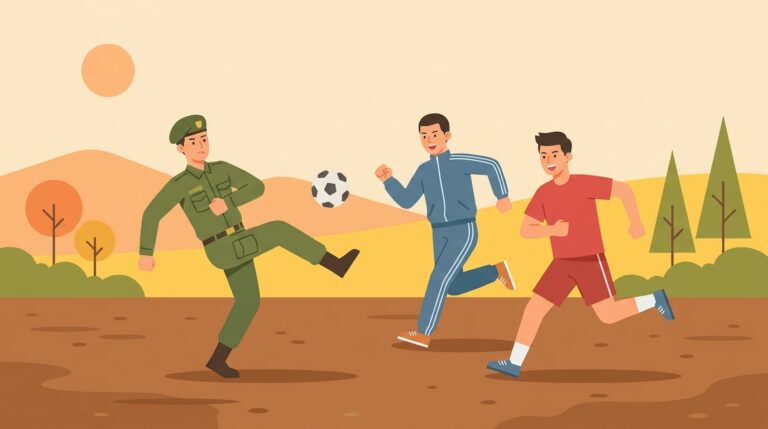
Nope. They are talking about… playing soccer in the military.
If you’ve watched enough Korean variety shows or K-Dramas, you might know the famous joke: “The three worst things a man can talk about on a blind date are 1. The military, 2. Soccer, and 3. Playing soccer in the military!”
But here’s the secret: understanding this specific culture—and the slang that comes with it—is your ultimate cheat code for surviving Korean small talk and bonding with Korean ‘bros.’ Today, we are diving into the legendary world of Gundaesliga (군대스리가). Don’t worry, even if you hate sports, the cultural insights here are pure gold!
(Note: This post is inspired by the countless confused faces of my B1-level students during language exchange meetups!)
Phase 2: Core Expressions Deep Dive
Let’s break down the ultimate vocabulary you need when the topic of sports or military comes up.
1. 군대스리가 (Gundaesliga)
- Pronunciation: [gun-dae-seu-ri-ga] — Sounds like you’re saying ‘Goon-dae’ (military) combined with ‘Bundesliga’ (the German soccer league).
- Meaning: (Literal) Military + Bundesliga / (Real Nuance) The intense, hyper-competitive soccer matches played by soldiers during their mandatory military service.
- K-Culture Moment: When a guy boasts about his athletic skills, he’ll often say, “In Gundaesliga, I was the MVP!”
- Editor’s Insight: This word is meant to be funny. It shows how seriously Korean men take their recreational soccer while serving in the army. It’s a mix of nostalgia, exaggeration, and pure pride.
- Situation Spectrum:
- Casual with friends: ✅
- Semi-formal (Coworkers): ⚠️ (Only if the vibe is relaxed)
- Formal (Boss/Elders): 🚫
- 🤔 Think About It: Why do Koreans love creating portmanteaus (blending words) with global terms, like Gundaesliga or K-Pop? Does your language mix local words with global sports leagues?
2. 완전 개발이야 (Wanjeon gaebariya)
- Pronunciation: [wan-jeon gae-bal-i-ya] — ‘Wanjeon’ sounds like ‘one-john’, and ‘Gae’ sounds like the ‘ge’ in ‘get’, ‘bal’ like ‘ball’.
- Meaning: (Literal) I am completely a dog’s foot. / (Real Nuance) I have two left feet; I’m terrible at sports (especially kicking).
- K-Culture Moment: In variety shows like Running Man, when a cast member completely misses the ball, the editors will put a huge paw print on the screen with the caption “개발” (Dog foot).
- Editor’s Insight: The prefix ‘개-‘ (gae), meaning dog, is often used in slang to mean “extreme” or sometimes implies poor quality. Here, comparing one’s foot to a dog’s paw means it’s useless for playing soccer.
- Situation Spectrum:
- Casual with friends: ✅
- Semi-formal (Coworkers): ⚠️ (Only as self-deprecation)
- Formal (Boss/Elders): 🚫
- 🤔 Think About It: Why is the word “dog” (개) used in both cute and derogatory ways in Korean slang?
3. 짬에서 나오는 바이브 (Jjam-eseo naoneun baibeu)
- Pronunciation: [jjam-e-seo na-o-neun ba-i-beu] — ‘Jjam’ has a strong, tense ‘jj’ sound, like the ‘zz’ in ‘pizza’ but sharper.
- Meaning: (Literal) A vibe coming from leftover military food. / (Real Nuance) The undeniable skill or aura that only comes from years of experience.
- K-Culture Moment: This phrase became a massive meme in Korea! It originated from the military. “Jjam” originally means the leftover food in the military, which became a metaphor for “time served.” If you’ve eaten a lot of “Jjam,” you have high rank and experience.
- Editor’s Insight: You can use this for anything, not just soccer! If your friend fixes a computer in 3 seconds because they work in IT, you say, “Wow, jjam-eseo naoneun baibeu!”
- Situation Spectrum:
- Casual with friends: ✅
- Semi-formal (Coworkers): ✅ (A witty way to praise a senior’s skills)
- Formal (Boss/Elders): 🚫
- 🤔 Think About It: How does tying “experience” to “meals eaten” reflect Korean culture’s deep connection to food?
Phase 3: Textbook vs. Real Korean
[Situation 1: Describing someone who is bad at sports]
* 📖 Textbook Korean: 저는 축구를 잘 못합니다. (I am not good at soccer.)
* 🗣️ Real Korean: 아, 저 완전 개발이에요. (Ah, I’m a total ‘dog foot’.)
* 💡 Why different?: Textbook Korean is polite and factual, but using “개발” shows humility through humor, making you instantly more approachable.
[Situation 2: Praising someone’s undeniable experience]
* 📖 Textbook Korean: 역시 경험이 많으시네요. (As expected, you have a lot of experience.)
* 🗣️ Real Korean: 크~ 역시 짬에서 나오는 바이브! (Keu~ As expected, the vibe from experience!)
* 💡 Why different?: Slang like this acts as an “insider code.” Using internet/meme culture to praise someone makes the compliment feel much more enthusiastic and modern.
Bottom Note: At the B1 (Intermediate) level, using these slang phrases correctly shows that you don’t just study Korean from a book—you actually absorb the culture!
Phase 4: Cultural Context — K-Culture Deep Dive
4-1. The Non-Verbal “Nunchi” on the Field
Even on the soccer field, Korean hierarchy (based on age and military rank) exists. If you’re a Private playing against a Sergeant in the military, do you tackle him hard? This requires immense 눈치 (Nunchi – situational awareness). You have to play well enough so your team doesn’t lose, but not so aggressively that you embarrass your superior. It’s a delicate dance of respect and sportsmanship!
4-2. The “Worst Blind Date Topic” Trope in K-Dramas
If you watch romantic comedies, you’ll often see a scene where a guy tries to impress his date by recreating his glorious military soccer moments. He uses his hands to show how the ball curved, getting overly excited. The camera then pans to the woman, sipping her coffee with a deadpan, bored expression.
Why? Because mandatory military service is an exclusively male experience in Korea. For many women, hearing “Gundaesliga” stories feels repetitive and disconnected from their reality.
Pro Tip for Learners: If a Korean guy starts telling you his military soccer story, sigh playfully and say, “아… 또 군대 얘기예요?” (Ah… military story again?). He will burst into laughter because you perfectly understood the cultural joke!
Phase 5: Real-life Roleplay Scenario
Setting: Friday night, 8 PM. A Chimaek (Chicken and Beer) pub near Gangnam Station. The TV on the wall is showing a Premier League match. You are hanging out with a few Korean friends.
Characters:
* YOU: An expat who has been living in Korea for a year, trying to practice natural Korean.
* Minsoo (30): Your Korean friend. Friendly, loves sports, and tends to exaggerate.
Dialogue:
Minsoo: 저 선수 방금 패스 봤어? 와, 나 군대 있을 때 생각나네. 🍺
(Jeo seonsu banggeum paeseu bwasseo? Wa, na gundae isseul ttae saenggangnane.)
[Did you see that player’s pass just now? Wow, reminds me of when I was in the military.]
(🎭 Stage Direction: Minsoo takes a dramatic sip of his beer, looking nostalgic.)
YOU: 또 군대 얘기예요? 설마 그 유명한… 군대스리가?
(Tto gundae yaegiyeyo? Seolma geu yumyeonghan… Gundaeseuriga?)
[Military stories again? Don’t tell me it’s the famous… Gundaesliga?]
Minsoo: 빙고! 내가 우리 부대 에이스였잖아.
(Binggo! Naega uri budae eiseuyeotjana.)
[Bingo! I was the ace of our unit, you know.]
YOU: 에이~ 거짓말. 축구 잘해요?
(Ei~ geojitmal. Chukgu jalhaeyo?)
[Hey~ lie. Are you actually good at soccer?]
Minsoo: 진짜지! 내가 공 잡으면 다들 피했다고.
(Jinjjaji! Naega gong jabeumyeon dadeul pihaetdago.)
[I’m serious! When I got the ball, everyone got out of my way.]
🔀 Your Turn! How should you respond?
– A) 와, 대단하시네요. 축구를 정말 잘하셨군요. (Wow, that’s amazing. You must have been really good.)
– B) 아, 상대방이 개발이라서 피한 거 아니에요? 🤣 (Ah, didn’t they avoid you because you have ‘dog feet’?)
– C) 저는 축구를 안 좋아합니다. (I don’t like soccer.)✅ Best Choice: B — Korean friendships thrive on playful teasing (Tikitaka). Using the word “개발” (gaebal/terrible player) here is the ultimate witty comeback.
⚠️ Choice A Analysis: Too robotic and polite. It kills the fun vibe.
(Continuing with Choice B)
Minsoo: 야! 나 진짜 잘했어. 짬에서 나오는 바이브가 있다고!
(Ya! Na jinjja jalhaesseo. Jjameseo naoneun baibeuga itdago!)
[Hey! I was really good. I have that vibe that comes from experience!]
YOU: 알겠어요, 알겠어. 에이스님, 치킨이나 드세요! 🍗
(Algesseoyo, algesseo. Eiseunim, chikinina deuseyo!)
[Alright, alright. Mr. Ace, just eat your chicken!]
Phase 6: 10-Second Shadowing Drill
Practice this sentence to perfect your “playfully annoyed” K-Drama character vibe!
😒 아, / 또 군대스리가 얘기예요? / 완전 지루해~
(A, / tto gundaeseuriga yaegiyeyo? / wanjeon jiruhae~)
[Sigh] Ah, / Gundaesliga stories again? / So boring~
- Intonation Tip: Drag out the “아~” at the beginning with a slight sigh. Pitch goes slightly up on “예요?” and drag the “해~” at the end playfully.
Phase 7: K-Culture Mini Dictionary
| Korean (Hangul) | Romanization | English Meaning | Cultural Context |
|---|---|---|---|
| 군대스리가 | gundaeseuriga | Military Soccer | A funny exaggeration of military soccer matches. |
| 개발 | gaebal | Dog’s foot (clumsy) | Slang for someone terrible at kicking/sports. |
| 짬 | jjam | Experience/Rank | Originated from military leftover food; means years of experience. |
| 에이스 | eiseu | Ace / MVP | Konglish for the best player or the most competent person in a team. |
| 족구 | jokgu | Foot Volleyball | A Korean sport mixing tennis and soccer. Huge in the military and company picnics! |
Phase 8: Traveler’s Survival Kit
You might not join the Korean military, but what if you’re walking along the Han River and see people playing soccer, or you want to bond with people at a guesthouse?
🆘 Survival Expressions for Sports & Bonding
– 🇰🇷 “저도 같이 해도 돼요?” (Jeodo gachi haedo dwaeyo?)
– 🗣️ Meaning: Can I join too? (Perfect for pickup games at parks)
- 🇰🇷 “나이스 패스!” (Naiseu paeseu!)
- 🗣️ Meaning: Nice pass! (Konglish is heavily used in Korean sports)
🇰🇷 “제가 완전 개발이라서요…” (Jega wanjeon gaebariraseoyo…)
- 🗣️ Meaning: Because I’m terrible at sports… (Use this to politely decline playing)
📌 Editor’s Travel Note
– Sports Etiquette: Koreans are very welcoming if foreigners want to join casual games at places like Banpo Hangang Park. Just bring a smile and some sportsmanship.
– Cheering: If you ever go to a K-League soccer game or a baseball game in Korea, be prepared for coordinated chanting and singing. The fan culture is just as intense as K-Pop!
Phase 9: Critical Thinking — “A Step Deeper”
Language & Power (언어와 권력)
🧠 Think Deeper:
The concept of Gundaesliga isn’t just about soccer; it’s a microcosm of Korean social hierarchy. In the military, rank is absolute. Yet, on the soccer field, a low-ranking soldier with amazing skills (the “Ace”) suddenly gains temporary power and respect. However, the language they use during the game remains strictly tied to honorifics. A Private might score a brilliant goal, but he must still say “나이스 패스입니다, 병장님!” (That was a nice pass, Sergeant!) rather than a casual “Nice!” It shows how deeply embedded social hierarchy is in the Korean language, even in the heat of a sports match.💬 Your Turn:
Does your language change depending on who you are playing sports with? Or is the sports field an “equalizer” in your culture? Let us know in the comments!
Phase 10: FAQ & Avoiding Common Mistakes
Q: Can I joke about military service with any Korean man?
A: Be careful. While Gundaesliga is a lighthearted topic, military service itself can be a sensitive issue involving hardship and strict discipline. Wait for them to bring up funny stories first before you start making jokes.
Q: Can I use the prefix ‘개-‘ (gae/dog) in formal situations to mean “very”?
A: Absolutely NOT. While “개맛있어” (freaking delicious) or “개발” (terrible at sports) are incredibly common among friends, using ‘개-‘ in front of older people or your boss is considered highly disrespectful and uneducated.
❌ Common Mistake #1: Saying “저는 개발입니다” during a formal job interview when they ask about your weaknesses.
✅ Do this instead: Use “운동 신경이 부족합니다” (I lack athletic coordination) in formal settings.
Phase 11: Summary & Action Items
- One-Liner Summary: Gundaesliga is the ultimate gateway to understanding Korean male bonding, hierarchy, and self-deprecating sports slang!
Action Mission:
* 🥉 Bronze (Solo): Say “아, 완전 개발이야!” in front of the mirror next time you accidentally trip or drop something.
* 🥈 Silver (Online): Leave a comment in a Korean language community: “제 한국어 실력은 아직 개발이에요 ㅠㅠ” (My Korean skills are still ‘dog feet’ T_T).
* 🥇 Gold (Real-world): Next time a Korean guy friend mentions sports, playfully ask him, “혹시 군대스리가 에이스?” (Were you the Gundaesliga Ace?). Watch his eyes light up!
🎬 Special K-Culture Mission:
Go to YouTube and search for “Running Man Jokgu” (런닝맨 족구). Watch how they interact, complain, and use “dog foot” moments for comedy!
Phase 12: Interactive Quiz
1. Situational Judgment: Your Korean coworker is bragging that he used to score 5 goals a game in his military days. What is the most culturally savvy, playful response?
* A) 거짓말하지 마세요. (Stop lying.)
* B) 와~ 짬에서 나오는 바이브네요! (Wow~ the vibe from experience!)
* C) 신고할 거예요. (I will report you.)
(Answer: B. It feeds into his bragging playfully using the slang we learned!)
2. Fill in the Blank:
“I am so bad at soccer. I’m a complete ________.”
* A) 에이스 (Ace)
* B) 짬 (Jjam)
* C) 개발 (Gaebal)
(Answer: C)
3. True or False – K-Culture Edition:
In K-Dramas, women love it when men talk non-stop about military soccer on a first date.
(Answer: False! It is notoriously known as the worst topic for a blind date in Korean pop culture!)
Frequently Asked Questions (FAQ)
Q: What does "군대스리가 (Gundaesliga)" mean in Korean and how do you pronounce it?
A: In Korean, "군대스리가 (Gundaesliga)" is pronounced [gun-dae-seu-ri-ga] and means: (Literal) Military + Bundesliga / (Real Nuance) The intense, hyper-competitive soccer matches played by soldiers during their mandatory military service.
Q: What does "완전 개발이야 (Wanjeon gaebariya)" mean in Korean and how do you pronounce it?
A: In Korean, "완전 개발이야 (Wanjeon gaebariya)" is pronounced [wan-jeon gae-bal-i-ya] and means: (Literal) I am completely a dog's foot. / (Real Nuance) I have two left feet; I'm terrible at sports (especially kicking).
Q: What does "짬에서 나오는 바이브 (Jjam-eseo naoneun baibeu)" mean in Korean and how do you pronounce it?
A: In Korean, "짬에서 나오는 바이브 (Jjam-eseo naoneun baibeu)" is pronounced [jjam-e-seo na-o-neun ba-i-beu] and means: (Literal) A vibe coming from leftover military food. / (Real Nuance) The undeniable skill or aura that only comes from years of experience.







