

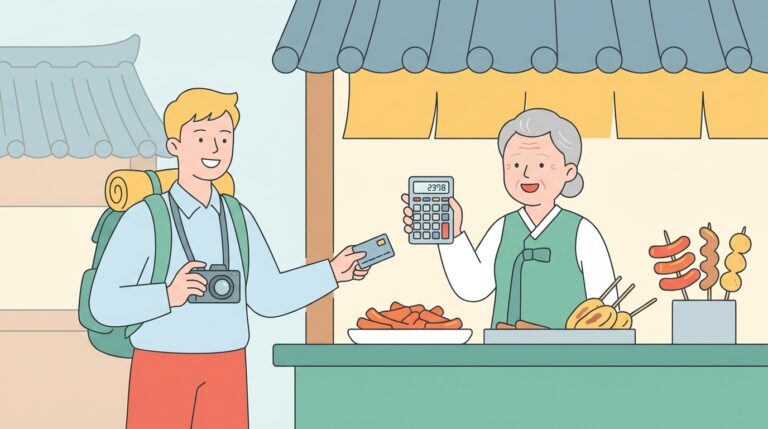
Phase 1: Empathy (The K-Culture Cold Open)
Hello there! This is your Daily Hangul Editor.
Picture this: You are standing in the middle of the bustling Myeongdong Underground Shopping Center. The fluorescent lights are bright, K-Pop hits are blasting from the speakers, and right in front of you is the perfect oversized K-Drama style sweater. You look for the price tag. There isn’t one. The shop owner, a friendly-looking middle-aged woman, is looking right at you with a welcoming smile.
You panic. You know the word for “sweater,” you know how to say “hello,” but how do you actually ask for the price without sounding like a robotic translation app?
If you’ve ever felt that sweat dripping down your neck in a Korean market, or if you’ve ever watched a K-Drama where the main character charmingly haggles down the price of a hairpin, this guide is for you. Today, we are mastering Asking for Prices and Numbers in Korean. Knowing these simple phrases won’t just save you money—it’ll earn you the ultimate insider smile from the locals. Let’s dive in! (This guide is based on real questions from my A2 beginner students who survived Myeongdong!)
Phase 2: Core Expressions Deep Dive
1. 이거 얼마예요? (How much is this?)
- Pronunciation: igeo eolmayeyo? [ee-guh / ull-ma-ye-yo?]
(Tip: ‘얼’ sounds like the ‘ul’ in ‘ultimate’, and ‘예요’ is a breezy ‘ye-yo’.)- Meaning:
- Literal: This thing, how much is it?
- Real Nuance: “How much is this?”
- K-Culture Moment: This is the ultimate survival phrase. You’ll hear this a million times in Dongdaemun Night Market or at street food stalls selling sizzling Tteokbokki.
- Editor’s Insight: This phrase is a lifesaver because you don’t even need to know the Korean name of the item. Just point and say “이거” (this) + “얼마예요?” (how much is it?). It works like magic.
- Situation Spectrum:
- Casual with friends (Just dropping ‘요’): ✅ (이거 얼마야?)
- Store clerks/Restaurants: ✅
- Very formal/Luxury boutiques: ⚠️ (They might use the more formal ‘얼마입니까?’)
- ጧ️ Think About It: Why do Koreans use ‘이거’ (this thing) so often instead of naming the object? Korean is a highly high-context language where pointing and shared space matter more than naming every single noun!
2. 너무 비싸요. 조금 깎아 주세요. (It’s too expensive. Please give me a discount.)
- Pronunciation: neomu bissayo. jogeum kkakka juseyo. [nuh-moo / bee-ssa-yo. jo-geum / kka-kka / joo-se-yo]
(Tip: ‘깎’ has a strong double ‘kk’ sound, like the sharp crack of a twig.)- Meaning:
- Literal: Too expensive. A little bit cut please.
- Real Nuance: “It’s a bit pricey, could you do a little better on the price?”
- K-Culture Moment: In K-Dramas, you always see the sassy protagonist doing cute acts (Aegyo) to the market vendor saying “Ahhh, Imo~ 깎아 주세요~” to get a cheaper price on a pair of socks.
- Editor’s Insight: Use this with a bright smile! If you say it with an angry face, it sounds rude. It’s supposed to be a playful negotiation, a game between you and the vendor.
- Situation Spectrum:
- Traditional Markets/Underground malls: ✅
- Department Stores/Franchise Cafes: 🚫 (Never haggle at Starbucks or Olive Young!)
- ጧ️ Think About It: Haggling (Enuri culture) is deeply rooted in traditional Korean markets. It’s not just about money; it’s about building a quick, playful human connection. Does your culture have a haggling tradition?
3. 카드로 결제할게요 / 카드 되나요? (I’ll pay by card / Do you take cards?)
- Pronunciation: kadeuro gyeoljaehalgeyo / kadeu doenayo? [ka-deu-ro / gyul-jje-hal-gge-yo / ka-deu / dwe-na-yo?]
- Meaning:
- Literal: With card I will pay / Is card becoming?
- Real Nuance: “I’ll put this on my card” / “Can I use a credit card here?”
- K-Culture Moment: Korea is incredibly cashless. You’ll see office workers paying for a 1,500 KRW iced Americano with a sleek credit card or Samsung Pay without blinking an eye.
- Editor’s Insight: At street markets, cash is still king, but everywhere else, card is preferred. Always ask “카드 되나요?” if you’re unsure at a small stall.
- Situation Spectrum:
- Any store/restaurant: ✅
- Street food vendors (Pojangmacha): ⚠️ (Always have some cash just in case!)
- ጧ️ Think About It: Korea shifted to a cashless society extremely fast. Why do you think technological adoption happens so quickly in Korean daily life?
Phase 3: Textbook vs Real Korean
Let’s see how the textbooks differ from the lively streets of Seoul.
[Situation 1: Asking for the price]
* 📖 Textbook Korean: 이것의 가격은 얼마입니까? (What is the price of this item?)
* 🗣️ Real Korean: 사장님, 이거 얼마예요? (Boss, how much is this?)
* 💡 Why the difference?: Real Korean thrives on omitting unnecessary words like “of this item.” Plus, calling the owner “사장님” (Sajangnim – Boss) is a respectful, common icebreaker.
[Situation 2: Deciding to buy]
* 📖 Textbook Korean: 저는 그것을 사겠습니다. (I will buy that.)
* 🗣️ Real Korean: 이거 주세요. / 이걸로 할게요. (Please give me this / I’ll go with this one.)
* 💡 Why the difference?: Koreans prefer softer expressions like “Please give me” rather than the direct “I will purchase this,” which sounds like a business contract!
[Situation 3: When something is too expensive]
* 📖 Textbook Korean: 가격이 너무 높습니다. (The price is too high.)
* 🗣️ Real Korean: 헉, 너무 비싸요~ (Heok, it’s too expensive~)
* 💡 Why the difference?: Adding sound effects like ‘헉’ (gasp) and drawing out the end of the sentence makes the refusal softer and more conversational.
Bottom Note: For A2 level learners, you don’t need fancy vocabulary. Mastering “이거 얼마예요?” and “이거 주세요” will successfully get you through 90% of your shopping trips!
Phase 4: Cultural Context — K-Culture Deep Dive
4-1. Non-Verbal Elements (The Art of Handing Over)
When you ask “이거 얼마예요?” and hand over your credit card, pay attention to your hands! In Korea, handing something to someone older or a service worker with two hands is a sign of basic respect.
– Actionable tip: You don’t need to bow 90 degrees. Just lightly support your right elbow with your left hand when passing your card. It shows great Nunchi (social awareness) and earns instant respect!
4-2. K-Travel Connection: The Street Market Vibe
Let’s talk about Namdaemun and Dongdaemun Markets.
If you are traveling to Korea, these markets are shopping paradises.
– The Numbers Hurdles: In Korean, money is counted in Sino-Korean numbers (일, 이, 삼…). The biggest shock for foreigners? The unit 만 (Man – 10,000).
– 10,000 KRW isn’t “ten thousand” in Korean; it’s just “One Man” (일만/만).
– 50,000 KRW is “오만” (O-man = 5 x 10,000).
– Survival Tip: Don’t let the zeroes scare you! 10,000 KRW is roughly $7-8 USD. When at a bustling market, the vendor might just type the price on a giant calculator and show it to you.
– Tourist vs Local: Vendors in tourist spots might try to speak English, but replying with “비싸요~ 깎아 주세요” in Korean immediately changes the dynamic. You upgrade from “Tourist” to “Savvy K-Culture fan.”
Phase 5: Real-Life Roleplay Scenario
Scenario A: The Myeongdong Underground Haul
- Setting: A bustling underground shopping mall in Myeongdong. Racks of trendy clothes are everywhere. You spot the perfect vintage-wash denim jacket.
- Characters:
- YOU: A K-Culture enthusiast on your second day in Seoul. You want that jacket, but you’re on a budget.
- Sajangnim (사장님): The shop owner. A friendly lady in her 50s with a sharp eye for fashion (and sales).
YOU: 저기요, 사장님! 이거 얼마예요?
(jeogiyo, sajangnim! igeo eolmayeyo?)
[Excuse me, boss! How much is this?]
(🎭 Stage Direction: You point to the denim jacket with bright eyes)
Sajangnim: 아, 그거? 그거 진짜 예뻐요. 신상이에요. 오만 오천 원.
(a, geugeo? geugeo jinjja yeppeoyo. sinsangieyo. oman ocheon won.)
[Ah, that one? That’s really pretty. It’s a new arrival. 55,000 won.]
YOU: 오만 오천 원이요? 음…
(oman ocheon woniyo? eum…)
[55,000 won? Hmm…]
(🎭 Stage Direction: You look a little hesitant, checking your wallet)
Sajangnim: 입어봐도 돼요. 한 번 입어봐요!
(ibeobwado dwaeyo. han beon ibeobwayo!)
[You can try it on. Try it on once!]
YOU: (After trying it on) 너무 마음에 드는데… 조금 비싸요.
(neomu maeume deuneunde… jogeum bissayo.)
[I really like it, but… it’s a bit expensive.]
🔀 Your Turn! How should you respond next to get a deal?
– A) “안 살게요. 안녕히 계세요.” (I won’t buy it. Goodbye.)
– B) “사장님~ 오만 원에 주시면 안 돼요? 깎아 주세요~” (Boss~ Can’t you give it to me for 50,000 won? Please give me a discount~)
– C) “진짜 비싸네. 헐.” (Really expensive. Wtf.)✅ Best Choice: B — Reason: It’s polite, uses a tiny bit of charming aegyo, and suggests a reasonable slight discount (cutting 5,000 won).
⚠️ Choice C Analysis: “헐” is internet slang and saying “비싸네” (casual form) to an older shop owner is considered quite rude!
Sajangnim: (Laughs) 학생이네~ 알았어요. 현금으로 하면 오만 원에 줄게요.
(haksaengine~ arasseoyo. hyeongeumeuro hamyeon oman wone julgeyo.)
[You’re a student~ Okay. If you pay with cash, I’ll give it to you for 50,000 won.]
YOU: 우와! 감사합니다! 현금 여기 있어요.
(uwa! gamsahamnida! hyeongeum yeogi isseoyo.)
[Wow! Thank you! Here is the cash.]
Sajangnim: 예쁘게 입어요~
(yeppeuge ibeoyo~)
[Wear it prettily~]
Scenario B: K-Food Bonus Roleplay (The Street Food Cart)
- Setting: A late-night Pojangmacha (street tent) smelling of spicy sauce.
- YOU: “이모님! 떡볶이 1인분 얼마예요?” (Auntie! How much is one serving of Tteokbokki?)
- Imo-nim: “삼천 원이에요~” (It’s 3,000 won~)
- YOU: “우와, 싸다! 떡볶이 1인분 주세요!” (Wow, cheap! One serving please!)
Phase 6: 10-Second Shadowing Drill
Let’s practice the intonation! In Korean, the emotion is all in the tone. Follow the pauses (/) and emotions.
- 😊 밝게 (Brightly):
저기요, / 이거 / 얼마예요?(jeo-gi-yo, / i-geo / eol-ma-ye-yo?) - 🥺 애교 섞어서 (With a bit of charm):
사장님~ / 너무 / 비싸요~ / 깎아 주세요~(sa-jang-nim~ / neo-mu / bi-ssa-yo~ / kka-kka-ju-se-yo~) - 😄 친절하게 (Politely):
카드로 / 결제할게요.(ka-deu-ro / gyeol-jae-hal-gge-yo.)
Phase 7: K-Culture Mini Dictionary
| Korean | Romanization | English | Cultural Context |
|---|---|---|---|
| 사장님 | sajangnim | Boss/Owner | The polite go-to title for any store owner or taxi driver. |
| 영수증 | yeongsujeung | Receipt | Cashiers will always ask: “영수증 드릴까요?” (Do you need the receipt?) |
| 현금 | hyeongeum | Cash | Getting a “현금 할인” (Cash discount) is very common in underground malls! |
| 신상 | sinsang | New arrival | Short for ‘신상품’. K-fashion moves incredibly fast, so ‘신상’ is a buzzword! |
| 가성비 | gaseongbi | Cost-effectiveness | A beloved slang term! When a cheap item is high quality, Koreans shout “가성비 최고!” |
Phase 8: Traveler’s Survival Kit
Since asking for prices is 100% a travel-essential skill, here is your ultimate cheat sheet.
🆘 Survival Phrase TOP 3
1. 🇰🇷 “이거 얼마예요?” (igeo eolmayeyo?) – How much is this?
2. 🇰🇷 “영수증 버려 주세요.” (yeongsujeung beoryeo juseyo.) – Please throw away the receipt. (Very useful at convenience stores!)
3. 🇰🇷 “봉투 하나 주세요.” (bongtu hana juseyo.) – Please give me a plastic bag. (Bags cost 50-100 won extra in Korea!)📍 Where to use: Convenience stores (CU, GS25), traditional markets, cafes.
💡 Pro Tip: If the vendor says a number too fast in Korean, just point to your phone or hold out your hand, and say “계산기…” (Calculator…). They will happily type the price for you!📌 Editor’s Travel Note
– Cash vs Card: Korea is a “card paradise.” You can pay for a 1,000 won item with a card. HOWEVER, at street food stalls (Myeongdong, Gwangjang Market) or underground clothing malls (Goto Mall), cash or local bank transfers are often required. Bring some 10,000 won bills!
– Tipping Culture: There is NO tipping in Korea! If you leave money on the table, the waiter will chase you down the street thinking you forgot your change. Don’t tip; just say “잘 먹었습니다” (I ate well) on your way out!
Phase 9: Critical Thinking — “One Step Deeper”
🧠 Think Deeper: Media vs Reality (The Myth of Haggling)
If you watch K-Dramas, you might think Koreans haggle for everything everywhere. In reality, the Enuri (에누리 – haggling) culture is strictly confined to traditional markets (like Dongdaemun) or underground shopping centers. Modern Korea operates on a strict 정찰제 (Fixed Price System). If you try to say “깎아 주세요” (Give me a discount) at a franchise cafe, a department store, or an Olive Young, the part-time worker will look at you in utter confusion. Haggling in traditional markets is seen as “정” (Jeong – warm human connection), but doing it in a corporate store is just making the poor cashier’s life hard!💬 Your Turn: In your country, is haggling common, or are prices strictly fixed? Let me know in the comments!
Phase 10: FAQ & Avoiding Common Mistakes
- Q: Can I use “이거 얼마예요?” to someone much older than me?
- Yes! “~예요” is the polite form (요금/Yondae-mal). It is perfectly respectful to use with an older shop owner.
- Q: Can I ask for a discount if I’m buying just one cheap item?
- Usually, no. Vendors are more likely to give a discount if you buy multiple items or pay with cash.
❌ Common Mistake #1: Mixing up Native and Sino-Korean numbers for money.
✅ How to fix it: Money ALWAYS uses Sino-Korean numbers (일, 이, 삼, 사). Do not say “하나 백 원” (Hana Baek Won). Just say “백 원” (Baek Won – 100 won).❌ Common Mistake #2: Reading “10,000” as “십 천” (Ten Thousand) literally.
✅ How to fix it: Korean has a special unit for 10,000 called “만” (Man). 10,000 is “만 원” (Man won), not 십 천 원.
Phase 11: Summary & Action Items
- One-Liner Summary: Point boldly, smile brightly, and ask, “이거 얼마예요?” (How much is this?) to master shopping in Korea!
-
Action Mission 3 Steps:
- 🥉 Bronze (Solo): Stand in front of your mirror, hold up an item, and practice saying “사장님, 이거 얼마예요?” three times.
- 🥈 Silver (Online): Go to your favorite K-Pop merch store online, find an item, and write its price in Korean numbers in your notebook.
- 🥇 Gold (Real World): Visit a local Korean grocery store (H-Mart etc.), bring an item to the counter, and ask the cashier, “이거 얼마예요?”
- 🇰🇷 K-Culture Mission: Go to YouTube and search for “Gwangjang Market Street Food Vlog.” Listen closely to the background noise. I guarantee you will hear “얼마예요?” within the first 5 minutes!
Did you learn something new today? What’s the first thing you want to buy in Korea? Let’s chat in the comments!
Phase 12: Interactive Quiz
Test your shopping survival skills!
1. Situational Judgment: You are at a trendy Olive Young store buying a lip tint. The price says 15,000 won. Which phrase should you NOT use?
– A) 카드로 할게요. (I’ll pay by card.)
– B) 영수증 주세요. (Please give me the receipt.)
– C) 조금 비싸요. 깎아 주세요~ (It’s a bit expensive. Give me a discount~)
2. Fill in the Blank:
You want to buy a cute phone case at a night market.
You point to it and say: “이거 [ ______ ]?”
3. True or False – K-Culture Edition:
– “If you leave a 5,000 won tip at a Korean BBQ restaurant, the staff will be very thankful and happy.” (True / False)
(Scroll down for answers!)
Click here to see the answers!
1. Answer: C. Olive Young is a corporate franchise with a fixed price system (정찰제). You cannot haggle there! You will just confuse the cashier.
2. Answer: 얼마예요 (eolmayeyo). “이거 얼마예요?” is the golden rule.
3. Answer: False. There is no tipping culture in Korea. They might think you accidentally left your change behind and run after you!
Frequently Asked Questions (FAQ)
Q: What does "이거 얼마예요? (How much is this?)" mean in Korean and how do you pronounce it?
A: In Korean, "이거 얼마예요? (How much is this?)" is pronounced [igeo eolmayeyo? [ee-guh / ull-ma-ye-yo?] and means: Literal: This thing, how much is it?
Q: What does "너무 비싸요. 조금 깎아 주세요. (It's too expensive. Please give me a discount.)" mean in Korean and how do you pronounce it?
A: In Korean, "너무 비싸요. 조금 깎아 주세요. (It's too expensive. Please give me a discount.)" is pronounced [neomu bissayo. jogeum kkakka juseyo. [nuh-moo / bee-ssa-yo. jo-geum / kka-kka / joo-se-yo] and means: Literal: Too expensive. A little bit cut please.
Q: What does "카드로 결제할게요 / 카드 되나요? (I'll pay by card / Do you take cards?)" mean in Korean and how do you pronounce it?
A: In Korean, "카드로 결제할게요 / 카드 되나요? (I'll pay by card / Do you take cards?)" is pronounced [kadeuro gyeoljaehalgeyo / kadeu doenayo? [ka-deu-ro / gyul-jje-hal-gge-yo / ka-deu / dwe-na-yo?] and means: Literal: With card I will pay / Is card becoming?







