

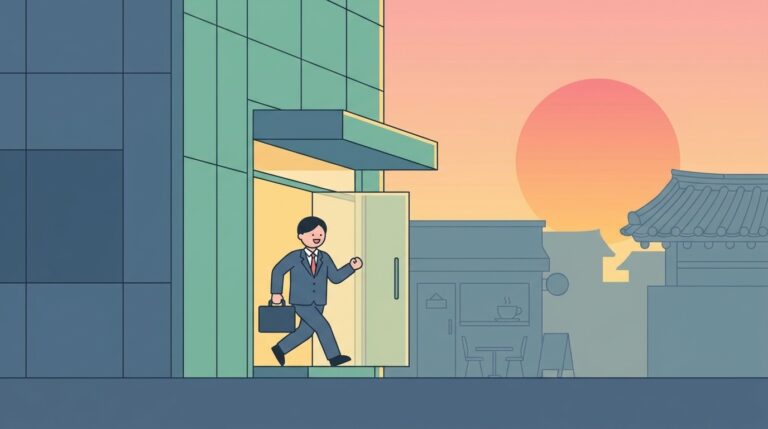
Phase 1: The ‘6 PM K-Drama Clock’ 🕒
Hello! This is your Daily Hangul Editor.
Picture this: You are watching a K-Drama set in an office. The digital clock on the wall slowly flips to 6:00 PM. But wait… nobody moves! The protagonist keeps typing, occasionally glancing at the boss’s door. The tension is palpable.
Then, finally, someone stands up, grabs their bag, bows slightly, and says a magical phrase. Instantly, the tension breaks. The day is over.
Whether you’re working in Seoul, studying at a Korean university, or simply texting your Korean friends to meet up for dinner, the transition from ‘work/school time’ to ‘my time’ is a huge deal in Korean daily routine.
If you use the dictionary translation for “I’m leaving work,” you might sound like a robot. But if you master the authentic expressions we’re about to cover, you’ll instantly sound like a local who truly understands Korean Nunchi (social sense).
This guide is built from the real struggles of my beginner students who stood awkwardly by the office door, not knowing how to say goodbye. Let’s fix that today!
Phase 2: Core Expressions Deep Dive
Let’s look at the 3 most essential phrases you need when your day is done.
1. 퇴근해요
- Pronunciation: [toe-geun-hae-yo] (The ‘oe’ sounds a bit like ‘weh’ in ‘wet’)
- Meaning: I get off work / I am leaving work
- K-Culture Moment: You’ll hear this constantly in Korean subways. Someone answers their phone, sighs with relief, and says, “어, 나 지금 퇴근해요” (Yeah, I’m getting off work now). It’s the ultimate phrase of freedom!
- Editor’s Insight: This word specifically means ‘leaving the workplace.’ You cannot use this if you are finishing school or a hobby class.
- Situation Spectrum:
- Casual (Friends): ✅ (퇴근해 / toe-geun-hae)
- Semi-formal (Co-workers): ✅ (퇴근해요 / toe-geun-hae-yo)
- Formal (Boss/Elders): ⚠️ (퇴근하겠습니다 / toe-geun-ha-get-seum-ni-da is safer)
- 🤔 Think About It: In Korean, we have a specific, frequently used verb just for ‘leaving work’ (퇴근하다) and ‘going to work’ (출근하다). Why do you think separating ‘work life’ from ‘home life’ requires its own special vocabulary in Korea?
2. 수고하셨습니다
- Pronunciation: [su-go-ha-syeot-seum-ni-da]
- Meaning: (Literal) You put in a lot of effort / (Real nuance) Thank you for your hard work today; Goodbye!
- K-Culture Moment: The moment the director yells “Cut!” on a K-Pop music video set, all the idols and staff bow to each other shouting this phrase. It’s the standard wrap-up greeting.
- Editor’s Insight: This is NOT “I’m sorry” or “Goodbye.” It’s the most beautiful way to acknowledge someone’s effort. You say this to your co-workers when you (or they) leave the office.
- Situation Spectrum:
- Casual (Friends): ✅ (수고했어 / su-go-haes-seo)
- Semi-formal (Co-workers): ✅
- Formal (Boss): 🚫 (Wait, what? See Phase 10 for why!)
- 🤔 Think About It: Does your native language have a phrase that specifically thanks people for their daily labor as a way of saying goodbye?
3. 학교 끝났어요
- Pronunciation: [hak-gyo kkeut-nat-seo-yo]
- Meaning: (Literal) School finished / (Real nuance) I’m done with school for the day.
- K-Culture Moment: High school students texting each other to meet at the Tteokbokki (spicy rice cake) shop. “너 학교 끝났어?” (Are you done with school?)
- Editor’s Insight: For A1 beginners, it’s easier to say “School finished” rather than “I leave school.” It sounds much more natural and conversational!
- Situation Spectrum:
- Casual (Friends): ✅ (학교 끝났어 / hak-gyo kkeut-nat-seo)
- Semi-formal (Acquaintances): ✅
- Formal (Elders): ✅
- 🤔 Think About It: Korean students often don’t go straight home after school; they go to Hagwons (cram schools). So “school is over” rarely means the day’s studying is over!
Phase 3: Textbook vs. Real Korean
Let’s see how language changes when you step out of the classroom and onto the streets of Seoul.
[Situation 1: Leaving the Office]
* 📖 Textbook Korean: 안녕히 계세요. (an-nyeong-hi gye-se-yo / Goodbye – Stay well)
* 🗣️ Real Korean: 먼저 가보겠습니다! (meon-jeo ga-bo-get-seum-ni-da / I will get going first!) followed by 수고하셨습니다!
* 💡 Why the difference?: Simply saying “Goodbye” feels too cold in a Korean workplace. Saying “I’m leaving first” acknowledges that others are still working, showing respect and Nunchi.
[Situation 2: Getting out of School]
* 📖 Textbook Korean: 하교합니다. (ha-gyo-ham-ni-da / I am departing school.)
* 🗣️ Real Korean: 저 학교 끝났어요! (jeo hak-gyo kkeut-nat-seo-yo / My school is finished!)
* 💡 Why the difference?: ‘하교하다’ is a formal, written Chinese-root word. Real students just say “it finished” to emphasize they are finally free!
Bottom Note: For A1 level, you don’t need to memorize complicated slang. Just swapping “안녕히 계세요” with “내일 뵙겠습니다” (See you tomorrow) at work makes you sound like a pro!
Phase 4: Cultural Context — K-Culture Deep Dive
4-1. Non-Verbal Cues (Body Language)
Language is only half the battle. When you say “먼저 가보겠습니다” (I’m leaving first) or “수고하셨습니다” (Thank you for your hard work), you must bow.
You don’t need a full 90-degree bow like in historical dramas. A polite 30-degree nod while maintaining a warm smile is perfect. Also, don’t just shout it from the door; make brief eye contact with your immediate team members as you say it.
4-2. The “Nunchi” of Leaving Work (K-Drama Connection)
Have you ever watched a K-Drama where the villainous boss stacks files on a desk at 5:55 PM? That triggers the dreaded 야근 (ya-geun / night overtime).
In traditional Korean corporate culture, leaving exactly at 6:00 PM while your boss is still working required immense 눈치 (Nunchi – the ability to read the room). Historically, people would wait until the boss left.
Critical View: While dramas often depict extreme “Nunchi” battles, modern Korean companies (especially IT or startups) actively encourage 칼퇴 (kal-toe / leaving work exactly on time like a knife cut). So don’t be too scared! The culture is changing fast.
Phase 5: Interactive Roleplay Scenario
Setting: Friday evening, 6:00 PM. A marketing agency office in Gangnam. You’ve finished all your tasks for your first week. You are packing your bag.
Characters:
– YOU: A foreign intern who just survived their first week.
– Minsu (32): Your friendly Korean manager.
Dialogue:
Minsu: 일주일 동안 고생 많았어요!
(il-ju-il dong-an go-saeng man-at-seo-yo!)
[You worked really hard for a week!]
(🎭 Stage Direction: Minsu stretches his arms and smiles at you)
YOU: 감사합니다. 매니저님도요!
(gam-sa-ham-ni-da. mae-ni-jeo-nim-do-yo!)
[Thank you. You too, Manager!]
Minsu: 오늘 불금인데, 퇴근하고 뭐 해요?
(o-neul bul-geum-in-de, toe-geun-ha-go mwo hae-yo?)
[Today is ‘Fire Friday’, what are you doing after getting off work?]
🔀 Your Turn! How do you answer?
– A) 저 퇴근해요. (jeo toe-geun-hae-yo – I am getting off work.)
– B) 친구 만나러 가요! 먼저 가보겠습니다. (chin-gu man-na-reo ga-yo! meon-jeo ga-bo-get-seum-ni-da. – I’m going to meet a friend! I will get going first.)
– C) 야근 안 해요! (ya-geun an hae-yo! – I am not doing night work!)✅ Best Choice: B — It naturally answers the question, adds a friendly detail, and politely announces your departure.
⚠️ Choice A Analysis: Minsu already knows you are leaving work! He is asking what your plans are after you leave.
⚠️ Choice C Analysis: A bit too aggressive! It sounds like you are angry at the company.
Minsu: 아, 좋네요! 재밌게 놀아요. 월요일에 봐요.
(a, jon-ne-yo! jae-mit-ge no-ra-yo. wo-ryo-i-re bwa-yo.)
[Ah, sounds good! Have fun. See you on Monday.]
YOU: 네! 주말 잘 보내세요. 수고하셨습니다!
(ne! ju-mal jal bo-nae-se-yo. su-go-ha-syeot-seum-ni-da!)
[Yes! Have a great weekend. Thank you for your hard work!]
(🎭 Stage Direction: You give a slight bow and walk out into the Seoul sunset)
Phase 6: 10-Second Shadowing Drill
Practice speaking this aloud. Follow the pauses (/) and the emotion tags!
- 😊 (Brightly to a coworker):
매니저님 / 먼저 / 가보겠습니다!
(mae-ni-jeo-nim / meon-jeo / ga-bo-get-seum-ni-da!) -
🥺 (Tired but polite):
오늘 / 너무 / 수고하셨습니다.
(o-neul / neo-mu / su-go-ha-syeot-seum-ni-da.) -
🥳 (Excitedly texting a friend):
나 / 방금 / 퇴근했어!
(na / bang-geum / toe-geun-haes-seo!)
Phase 7: K-Culture Mini Dictionary
| Korean | Romanization | English | Cultural Context |
|---|---|---|---|
| 눈치 | nunchi | Social sense | The art of reading the atmosphere. Crucial when deciding exactly when to leave the office. |
| 칼퇴 | kal-toe | “Knife” leave | Leaving work exactly on the dot (e.g., 6:00:00 PM). The dream of every Korean worker! |
| 야근 | ya-geun | Night work | Working overtime. Often accompanied by company-paid dinner. |
| 회식 | hoe-sik | Company dinner | Going out to eat and drink with coworkers after work to build team bonding. |
| 불금 | bul-geum | Fire Friday | TGIF! “Burning Friday” when people go out to party after work. |
Phase 8: Traveler’s Survival Kit
Even if you are just visiting Korea for travel or study, you will likely meet up with Korean friends. Knowing how to communicate around “finishing the day” is a survival skill!
🆘 Survival Phrases for Meeting Up
– 🇰🇷 “어디예요?” (eo-di-ye-yo?)
– 🗣️ Meaning: Where are you?
– 📍 When to use: When you arrive at the subway station after school/work to meet your friend.
- 🇰🇷 “저 이제 끝났어요.” (jeo i-je kkeut-nat-seo-yo)
- 🗣️ Meaning: I just finished now.
- 📍 When to use: Texting your friend that your class or daily tour is over.
📌 Editor’s Travel Note
– Rush Hour Warning: In Seoul, 퇴근시간 (toe-geun-si-gan / get-off-work time) is between 6 PM and 7:30 PM. The subway (especially Line 2) becomes a “hell train” (지옥철). Avoid traveling with heavy luggage during this time!
– Useful Apps: KakaoMetro is essential to navigate the subway during rush hour to meet your friends accurately.
Phase 9: Critical Thinking — “One Step Deeper”
Language & Power: The Hierarchy of ‘Hard Work’
🧠 Think Deeper:
Let’s talk about the phrase “수고하셨습니다” (Thank you for your hard work). In many Western cultures, saying “Goodbye, see you tomorrow” is perfectly sufficient. But in Korea, acknowledging the effort someone put into the community (the company or team) is deeply ingrained in the language. It reflects a collective society where group effort is valued. However, because of strict age and rank hierarchy, the direction of this phrase matters immensely. You acknowledge your peers, but praising a boss’s hard work can actually sound condescending!💬 Your Turn: Does your culture focus more on the individual’s departure (“I am leaving”) or the group’s collective effort (“We worked hard today”) when the workday ends? Let me know in the comments!
Phase 10: FAQ & Avoiding Common Mistakes
Many beginners make these exact mistakes. Don’t worry, I’ve got your back!
Q: Can I say “수고하셨습니다” (su-go-ha-syeot-seum-ni-da) to my boss?
Editor’s Answer: NO! (Usually). This is a very common trap! While it means “thank you for your hard work,” in Korean corporate culture, a junior evaluating a senior’s “hard work” is considered slightly rude.
❌ Common Mistake #1: Saying “수고하세요” (su-go-ha-se-yo) to a boss. This literally commands them to “Keep working hard!”
✅ Do this instead: To a boss or older person, just say: “먼저 가보겠습니다. 내일 뵙겠습니다!” (I will get going first. See you tomorrow!)❌ Common Mistake #2: Telling your friend “나 하교해” (I am departing school).
✅ Do this instead: Text them “나 학교 끝났어” (My school finished!). It sounds 100x more natural.
Phase 11: Summary & Action Items
One-Liner Summary: When leaving work, use “먼저 가보겠습니다” to show respect, and when finishing school, just say “학교 끝났어요” to sound like a local!
Action Mission:
– 🥉 Bronze (Solo): Look at your watch at 6 PM today and confidently say “퇴근해요!” out loud to yourself.
– 🥈 Silver (Online): Leave a comment below using the phrase “오늘 수고하셨습니다!” (You worked hard today!).
– 🥇 Gold (Real Life): Next time you finish a Korean class or a meetup, tell your Korean friend “저 끝났어요! 어디예요?” (I’m finished! Where are you?).
K-Culture Mission:
Watch one episode of a modern Korean office drama (like Misaeng or Extraordinary Attorney Woo). Pay close attention to the final 5 minutes of their workday scene. See if you can spot them bowing and hear the word “퇴근”!
Phase 12: Interactive Quiz
Test your new Nunchi skills!
Question 1: You are an A1 Korean learner. You just finished your Korean language class at a university. Your friend texts you: “뭐 해?” (What are you doing?). What is the most natural reply?
1) 저 퇴근해요.
2) 저 하교합니다.
3) 저 학교 끝났어요.
Hint: Check Phase 3!
(Correct Answer: 3. ‘퇴근’ is only for work. ‘하교’ is too textbook. Number 3 is the perfect natural response!)
Question 2 (True/False – K-Culture Edition):
When you leave the office in Korea, it’s totally fine to just wave your hand, shout “BYE!”, and walk out without acknowledging your coworkers.
(Answer: FALSE! Always give a slight bow and say “먼저 가보겠습니다” or “수고하셨습니다” to show respect for the team’s ongoing effort.)
Frequently Asked Questions (FAQ)
Q: What does "퇴근해요" mean in Korean and how do you pronounce it?
A: In Korean, "퇴근해요" is pronounced [toe-geun-hae-yo] and means: I get off work / I am leaving work
Q: What does "수고하셨습니다" mean in Korean and how do you pronounce it?
A: In Korean, "수고하셨습니다" is pronounced [su-go-ha-syeot-seum-ni-da] and means: (Literal) You put in a lot of effort / (Real nuance) Thank you for your hard work today; Goodbye!
Q: What does "학교 끝났어요" mean in Korean and how do you pronounce it?
A: In Korean, "학교 끝났어요" is pronounced [hak-gyo kkeut-nat-seo-yo] and means: (Literal) School finished / (Real nuance) I'm done with school for the day.






