

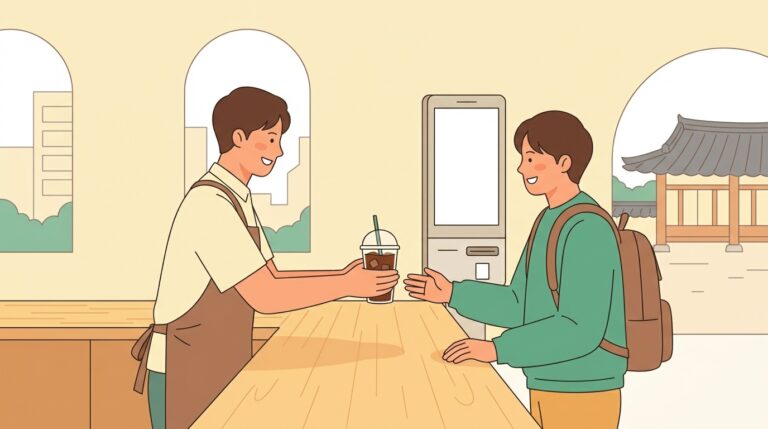
Mastering the Korean Cafe: How to Order an Americano Like a Local
Phase 1: Empathy (The Coffee Crisis)
Hello! I’m the Lead Editor at Daily Hangul. Imagine this: You’re in Seongsu-dong, often called the Brooklyn of Seoul. You walk into a beautifully aesthetic, minimalist cafe. The rich smell of espresso hits you, and a trendy barista greets you with a bright “안녕하세요!”
You just want to order the holy grail of Korean beverages: an Iced Americano. But suddenly, your mind goes blank. The barista asks you something at warp speed, and you just nod, accidentally ordering a hot coffee to-go instead of an iced one to drink inside. Does this sound familiar?
Don’t worry! Every expat and traveler has been there. In K-Dramas, ordering coffee looks effortless, but in reality, Korean cafes have their own unique rhythm, vocabulary, and ‘pali-pali’ (hurry-hurry) culture. Today, I’ll teach you exactly how to order your coffee with confidence, understand the barista’s questions, and look like an absolute insider.
(Note: This guide is tailored for A2 learners, based on real questions from my students who survived the Seoul cafe scene!)
Phase 2: Core Expressions Deep Dive
1. 아이스 아메리카노 한 잔 주세요.
- Pronunciation: [aiseu amerikano han jan juseyo]
- Sound-alike guide: Ice ah-meh-ri-ka-no hahn jahn joo-seh-yo. (Think of ‘joo-seh-yo’ as ‘juice-say-yo’)
- Meaning: Please give me one iced Americano. (Literal: Iced Americano one glass give please.)
- K-Culture Moment: If you watch office K-Dramas, you’ll see the main characters speed-walking to work at 8 AM holding a plastic cup with a brown liquid. That’s the “Ah-Ah” (Iced Americano) — the lifeblood of the Korean workforce.
- Editor’s Insight: The phrase “~주세요” (Please give me) is your magic wand in Korea. Just put the noun first, then add “juseyo.”
- Situation Spectrum:
- Casual (to a friend): ☑️ (Without ‘juseyo’)
- Semi-formal/Barista: ✅
- Formal/Elders: ✅
- 🤔 Think About It: Why do Koreans use specific counting words like “잔” (jan – glass/cup) instead of just saying “one Americano”? Does your language have specific counters for different shapes of objects?
2. 드시고 가시나요?
- Pronunciation: [deushigo gasinayo?]
- Sound-alike guide: deu-shee-go gah-shee-nah-yo?
- Meaning: Will you be drinking it here? (Literal: Are you going to eat and go?)
- K-Culture Moment: Because of Korea’s strict recycling laws, cafes cannot serve drinks in disposable plastic cups if you stay inside. The barista must ask you this question!
- Editor’s Insight: You don’t need to say this phrase yourself, but you must be able to hear and understand it! If you hear “…gasinayo?”, they are asking if you are staying.
- Situation Spectrum:
- Casual: 🚫
- Semi-formal: ⚠️
- Formal (Customer Service): ✅
- 🤔 Think About It: “드시다” is the highly respectful version of “먹다” (to eat/drink). Why do customer service workers use such elevated language toward strangers?
3. 테이크아웃 할게요. / 가져갈게요.
- Pronunciation: [teikeu-aut halgeyo] / [gajeogalgeyo]
- Sound-alike guide: take-out hal-geh-yo / gah-juh-gal-geh-yo
- Meaning: I will take it out. / To-go, please.
- K-Culture Moment: You’ll often see people grabbing their drinks during their 1-hour lunch break and rushing back to the office.
- Editor’s Insight: “테이크아웃” (Takeout) is Konglish (Korean-English), but it’s used more often than the pure Korean translation for to-go drinks!
- Situation Spectrum:
- Casual: ✅ (Just drop the ‘yo’)
- Semi-formal: ✅
- Formal: ✅
- 🤔 Think About It: English words (Konglish) are deeply mixed into modern Korean cafe culture. Do you find it easier to remember Konglish words?
Phase 3: Textbook vs. Real Korean
[Ordering Your Coffee]
* 📖 Textbook Korean: 저는 아이스 아메리카노를 마시고 싶습니다. (I would like to drink an iced Americano.)
* 🗣️ Real Korean: 아아 한 잔 주세요. (Ah-ah han jan juseyo.)
* 💡 Why the difference?: Koreans love efficiency. “아아” (Ah-Ah) is the famous abbreviation for 아이스 아메리카노. It saves time and sounds incredibly native.
[Choosing the Cup/Location]
* 📖 Textbook Korean: 음료를 포장해 주시겠습니까? (Would you please package the beverage?)
* 🗣️ Real Korean: 테이크아웃이요. (Takeout-iyo.)
* 💡 Why the difference?: “포장” is usually for food (like taking leftover pizza). For coffee, Konglish “테이크아웃” is the undisputed champion.
Phase 4: Cultural Context — K-Culture Deep Dive
4-1. Non-Verbal Communication: The Trust Culture
When you order in a Korean cafe, you’ll likely receive a 진동벨 (Jindong-bel – Vibrating bell). Don’t stand at the counter waiting! Take the bell, find a seat, and wait for it to buzz and flash wildly.
Also, notice how Koreans “reserve” their seats by leaving their expensive laptops, phones, or bags on the table while they go order. This is a testament to Korea’s high-trust society. Nobody will touch your laptop, but if you leave an umbrella on a rainy day, it might disappear!
4-2. K-Food Connection: “Eol-juk-ah”
Have you heard of 얼죽아 (Eol-juk-ah)? It’s an abbreviation for “얼어 죽어도 아이스 아메리카노” (Even if I freeze to death, Iced Americano). It reflects a unique cultural phenomenon where Koreans will drink ice-cold coffee even in the middle of a freezing snowy winter (-10°C). Why? Because the Iced Americano isn’t just a drink; it’s a “cooling potion” to survive the stressful, fast-paced Korean lifestyle!
Phase 5: Real-Life Roleplay Scenario
Setting: A bustling cafe in Hongdae, 1 PM. Indie K-Pop is playing softly in the background. The line is moving fast. It’s your turn at the register.
Characters:
– YOU: A traveler who just spent 3 hours walking around the shopping district. You need caffeine.
– Barista (Ji-hoon, 25): Friendly, efficient, moving his hands at lightning speed.
Barista: 안녕하세요! 주문하시겠어요?
(annyeonghaseyo! jumunhasigesseoyo?)
[Hello! Would you like to order?]
YOU: 네, 아이스 아메리카노 한 잔 주세요.
(ne, aiseu amerikano han jan juseyo.)
[Yes, one iced Americano, please.]
Barista: 네, 원두는 산미 있는 거랑 고소한 거 중에 어떤 걸로 하시겠어요?
(ne, wonduneun sanmi itneun georang gosohan geo junge eotteon geollo hasigesseoyo?)
[Okay, for the beans, would you like the sour/fruity one or the nutty/savory one?]
YOU: 고소한 걸로 주세요.
(gosohan geollo juseyo.)
[The nutty one, please.]
Barista: 네, 영수증 드릴까요?
(ne, yeongsujeung deurilkkayo?)
[Okay, shall I give you the receipt?]
YOU: 아니요, 버려주세요.
(aniyo, beoryeojuseyo.)
[No, please throw it away.]
Barista: 네, 결제 도와드리겠습니다.
(ne, gyeolje dowadeurigetseumnida.)
[Okay, I’ll help you with the payment.]
(🎭 Stage Direction: You tap your card. Ji-hoon looks at you holding a plastic cup.)
Barista: 손님, 드시고 가시나요?
(sonnim, deushigo gasinayo?)
[Customer, are you having it here?]
🔀 Your Turn! How do you answer? You want to drink it while walking outside.
– A) “네, 먹고 갈게요.” (Yes, I’ll eat and go.)
– B) “아니요, 가져갈게요.” (No, I’ll take it to-go.)
– C) “아메리카노 주세요.” (Americano please.)✅ Best Choice: B — “가져갈게요” (or “테이크아웃 할게요”) is the perfect natural response indicating you want a disposable cup to leave.
⚠️ Choice A Analysis: This means you want to stay in the cafe. The barista will give you a glass mug, and you can’t take it outside!
Phase 6: 10-Second Shadowing Drill
Practice reading this aloud to nail the intonation! The slash (/) means a tiny pause.
😊 안녕하세요! / 아이스 아메리카노 / 한 잔 / 주세요!
(an-nyeong-ha-se-yo! / ah-ee-seu ah-meh-ri-ka-no / han jahn / joo-seh-yo!)
(Speak brightly and confidently!)
😌 아니요, / 영수증은 / 버려주세요.
(ah-ni-yo, / yeong-soo-jeung-eun / buh-ryuh-joo-seh-yo.)
(Speak politely but firmly!)
Phase 7: K-Culture Mini Dictionary
| 한국어 | Romanization | English | Context/Meaning |
|---|---|---|---|
| 아아 | a-a | Iced Americano | The ultimate abbreviation. Used mostly with friends or casual cafes. |
| 얼죽아 | eol-juk-a | “Iced Americano even if I freeze to death” | A proud title for those who refuse to drink hot coffee in winter. |
| 진동벨 | jindong-bel | Vibrating bell | The buzzer the cafe gives you to let you know your order is ready. |
| 키오스크 | kioseukeu | Kiosk | Many modern cafes don’t have human cashiers. You must order through the touch screen kiosk! |
| 자리 찜하기 | jari jjimhagi | Reserving a seat | Leaving your personal items on a cafe table to claim it before ordering. |
Phase 8: Traveler Survival Kit
🆘 Survival Phrases for the Cafe
– 🇰🇷 “와이파이 비밀번호가 뭐예요?” (waipai bimilbeonhoga mwoyeyo?)
– 🗣️ Eng: What is the Wi-Fi password?
– 💡 Pro Tip: Usually, the password is on the receipt. That’s why sometimes you shouldn’t throw the receipt away!
- 🇰🇷 “화장실 비밀번호 있어요?” (hwajangsil bimilbeonho isseoyo?)
- 🗣️ Eng: Is there a password for the restroom?
- 💡 Pro Tip: Cafe restrooms in Korea often have a keypad lock. The code is usually written near the counter or on the receipt.
📌 Editor’s Travel Note
– Kiosks: Many franchise cafes (like Mega Coffee or Compose Coffee) only use kiosks. Don’t panic! Most have an “English” button at the top right corner.
– Payment: Korea is a cashless society. Use a credit card, Apple Pay (in major franchises), or a travel card like NAMANE or T-Money. Handing over cash might actually confuse the barista!
– Tipping: There is NO tipping culture in Korea. Do not leave coins on the counter; they will run down the street to give it back to you!
Phase 9: Critical Thinking — “One Step Deeper”
Food, Pace, & Identity: The “Pali-Pali” Brew
In many European cultures, coffee is meant to be sipped slowly while chatting with friends or people-watching. But in Korea, the Iced Americano is often consumed for pure survival and efficiency. The “Pali-Pali” (hurry up) culture demands a drink that can be made in 30 seconds, cooled down instantly with ice, and sucked through a straw while walking back to the office. It reflects a society that values speed, productivity, and modern convenience over traditional leisure.
💬 Your Turn: How is coffee culture different in your country? Is it a quick energy boost, or a slow social event? Let us know in the comments!
Phase 10: FAQ & Avoiding Misunderstandings
Q: Can I just say “Americano” without “아이스” (Iced) or “따뜻한” (Hot)?
Usually, the barista will pause and ask you: “아이스로 드릴까요, 따뜻한 걸로 드릴까요?” (Would you like it iced or hot?). To save time and sound fluent, always state the temperature first!
Q: Is it rude to hand my credit card with one hand?
To be super polite, support your right elbow with your left hand when handing over your card to the barista. It shows respect and understanding of Korean etiquette!
❌ Common Mistake #1: Saying “Yes” (네) to everything the barista says because they talk too fast.
✅ Do This Instead: If you don’t understand, look at the cup they are holding. If they point to a glass mug, they are asking if you are staying. If they point to a plastic cup, they are asking if it’s takeout.
Phase 11: Summary & Action Items
One-Liner Summary: Remember “아이스 아메리카노 한 잔 주세요” to order, and decide between “먹고 갈게요” (for here) or “가져갈게요” (to go)!
🚀 Action Mission:
– 🥉 Bronze: Stand in front of your mirror and say “아아 한 잔, 테이크아웃 할게요” three times.
– 🥈 Silver: Write down your favorite cafe drink in Korean in your notes app.
– 🥇 Gold: Go to a Korean cafe (or a local cafe run by Koreans) and order your drink entirely in Korean!
🎥 K-Culture Mission:
Watch a modern K-Drama this week. Find a scene where office workers are holding their coffees. Are they drinking hot coffee or an “Ah-Ah”?
Phase 12: Interactive Quiz
1. Situational Judgment: The barista asks you “드시고 가시나요?” but you need to catch a train in 10 minutes. What do you say?
– A) 네, 드시고 갑니다.
– B) 아니요, 테이크아웃이요.
– C) 영수증 버려주세요.
2. True or False: In Korea, it’s polite to leave a 10% tip in the tip jar at a cafe. (T / F)
3. Fill in the Blank: “Even if I freeze to death, I will drink an iced americano.” In Korean slang, this is called ( ______ ).
(Answers: 1: B, 2: False – Korea has no tipping culture!, 3: 얼죽아/Eol-juk-ah)
Frequently Asked Questions (FAQ)
Q: What does "아이스 아메리카노 한 잔 주세요." mean in Korean and how do you pronounce it?
A: In Korean, "아이스 아메리카노 한 잔 주세요." is pronounced [aiseu amerikano han jan juseyo] and means: Please give me one iced Americano. (Literal: Iced Americano one glass give please.)
Q: What does "드시고 가시나요?" mean in Korean and how do you pronounce it?
A: In Korean, "드시고 가시나요?" is pronounced [deushigo gasinayo?] and means: Will you be drinking it here? (Literal: Are you going to eat and go?)
Q: What does "테이크아웃 할게요. / 가져갈게요." mean in Korean and how do you pronounce it?
A: In Korean, "테이크아웃 할게요. / 가져갈게요." is pronounced [teikeu-aut halgeyo] and means: I will take it out. / To-go, please.







