

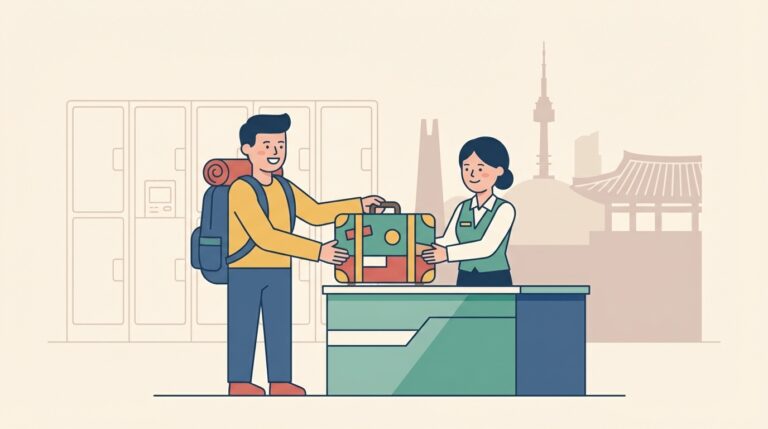
Phase 1: Empathy & The K-Travel Reality Check
Hello! I’m your Daily Hangul Editor.
Imagine this: You’ve just taken the red-eye flight to Incheon Airport. You navigate the subway system and finally arrive at your trendy boutique hotel in Hongdae. It’s 10:00 AM. You are ready to eat some delicious Korean street food, maybe do a little shopping, and visit a K-Pop pop-up store. But there is one massive problem—your check-in time is 3:00 PM, and you are dragging a 28-inch suitcase that weighs 20kg.
You can’t possibly drag that monster through the crowded streets of Myeongdong or Hongdae! You need to ask the front desk to keep it for you. Sure, you could just point at your bag and say “Bag… please?” but knowing the exact, natural phrase will not only get you a warm smile from the staff but also make you feel like a true travel pro.
This guide is based on real SOS messages I’ve received from students standing awkwardly in hotel lobbies. Let’s learn how to ask to store your luggage like a confident local!
Phase 2: Core Expressions Deep Dive
Here are the top three expressions you need for this exact situation.
1. 체크인 전인데, 짐 좀 맡겨도 될까요?
- Pronunciation: chekeuin jeoninde, jim jom matgyeodo doelkkayo? [che-keu-in juhn-in-deh, jeem johm maht-gyuh-doh dwel-kka-yo?]
- Meaning: (Literal) It’s before check-in, but may I entrust my luggage? -> (Real nuance) I’m early for check-in. Can I leave my bags here?
- K-Culture Moment: The word 짐 (jim) means luggage, baggage, or even a ‘burden’. The magic verb here is 맡기다 (matgida), which means ‘to entrust’. In Korean culture, you don’t just ‘put’ your bag somewhere; you ‘entrust’ it to someone’s care.
- Editor’s Insight: The phrase starts with laying out the situation (“It’s before check-in…”) before making the request. Koreans love this structure because it softens the question and explains the why before the what.
- Situation Spectrum:
- Casual (친구 사이): 🚫 (You wouldn’t check into a hotel with a friend like this)
- Semi-formal (호텔 직원/가게 직원): ✅
- Highly Formal (5성급 호텔 매니저): ✅
- 🤔 Think About It: Why do Koreans use the word ‘entrust’ (맡기다) instead of ‘keep’ (보관하다) in everyday speech? How does this reflect the relationship between the customer and the service provider?
2. 맡겨둔 짐 찾으러 왔는데요.
- Pronunciation: matgyeodun jim chajeureo wanneundeyo. [maht-gyuh-doon jeem cha-juh-ruh wahn-neun-deh-yo.]
- Meaning: (Literal) I came to find the entrusted luggage. -> (Real nuance) I’m here to pick up the luggage I left earlier.
- K-Culture Moment: When you return from your tiring shopping spree, you don’t say “Give me my bag.” Instead, you use the verb 찾다 (chatda), which means ‘to find’ or ‘to retrieve’. You use this same verb when withdrawing money from a bank (돈을 찾다)!
- Editor’s Insight: Ending the sentence with “~는데요 (~neundeyo)” leaves the conversation slightly open, which is a very polite and soft way to state your purpose in Korean. It prompts the staff to respond with, “Ah, yes! May I have your number tag?”
- Situation Spectrum:
- Casual: 🚫
- Semi-formal: ✅
- Highly Formal: ✅
- 🤔 Think About It: Direct commands like “Please give it back” can sound harsh in Korean. How do you soften your requests in your native language?
3. 짐은 언제까지 찾으러 오면 될까요?
- Pronunciation: jimeun eonjekkaji chajeureo omyeon doelkkayo? [jeem-eun uhn-jeh-kka-jee cha-juh-ruh oh-myuhn dwel-kka-yo?]
- Meaning: (Literal) By when would it be okay if I come to find the luggage? -> (Real nuance) By what time should I come back to pick up my bags?
- K-Culture Moment: This is crucial if you are leaving your bags after checking out. Some smaller guesthouses or boutique hotels don’t have a 24-hour front desk.
- Editor’s Insight: Use this to show respect for the staff’s time. The pattern “~아/어/여도 될까요?” (Would it be okay if…) is your best friend for B1 level polite requests.
- Situation Spectrum:
- Casual: 🚫
- Semi-formal: ✅
- Highly Formal: ✅
- 🤔 Think About It: In Korea, customer service is top-notch, but showing consideration for the worker’s schedule is highly appreciated. Is this mutual respect emphasized in your country’s service culture?
Phase 3: Textbook vs. Real Korean
[Situation 1: Asking to store the luggage]
* 📖 Textbook Korean: 제 가방을 보관해 주시겠습니까? (Would you please store my bag?)
* 🗣️ Real Korean: 짐 좀 맡길 수 있을까요? (Could I leave my luggage for a bit?)
* 💡 Why the difference?: “보관하다” (to store) sounds like a legal or official term. “짐 좀 맡기다” is exactly what locals say. Also, using “가방” (bag) is fine, but “짐” (luggage/stuff) is much more natural for travel bags.
[Situation 2: Coming back to get it]
* 📖 Textbook Korean: 제 가방을 돌려주세요. (Please return my bag.)
* 🗣️ Real Korean: 아까 맡긴 짐 찾으러 왔어요. (I’m here to pick up the luggage I left earlier.)
* 💡 Why the difference?: “돌려주세요” sounds accusatory, almost as if the hotel stole your bag and you are demanding it back!
Bottom Note: For B1 (Lower Intermediate) learners, mastering the verbs 맡기다 (to entrust) and 찾다 (to retrieve) will instantly elevate your Korean from “textbook robot” to “fluent traveler.”
Phase 4: Cultural Context — K-Culture Deep Dive
4-1. Non-verbal Cues (The Art of Nunchi)
When asking for a favor like this, even as a paying customer, a slight bow of the head goes a long way. When the staff hands you the 보관증 (Claim Tag / Number Tag), make sure to receive it with two hands or at least support your right arm with your left hand. It’s a small gesture that screams, “I understand Korean manners!”
4-2. K-Travel Connection: The ‘T-Locker’ Backup Plan
What if you rented an Airbnb or a small guesthouse that doesn’t have a front desk? Welcome to the ultimate K-Travel survival tip: 지하철 물품보관함 (Subway Coin Lockers).
Almost every major subway station in Seoul has electronic lockers (often called T-Lockers). You can pay with your credit card or T-Money card. If your host says no to luggage storage, just search “물품보관함” on Naver Maps or KakaoMap.
Critical view: While Korea is famous for being incredibly safe (people leave their laptops and wallets on cafe tables without a second thought!), hotels and subway stations still strictly use numeric tags or digital codes for luggage. Trust is high, but systemization is even higher.
Phase 5: Real-life Roleplay Scenario
Setting: 11:30 AM at the lobby of a sleek hotel in Myeongdong. The lobby is quiet, with gentle K-Indie music playing in the background. You want to go eat some famous Kalguksu, but your massive suitcase is weighing you down.
Characters:
– YOU: A savvy traveler who studied Daily Hangul.
– Ji-hoon (28): The polite, sharply-dressed front desk staff.
Dialogue:
YOU: 안녕하세요. 체크인은 3시부터죠?
(annyeonghaseyo. chekeuineun sesibuteojyo?)
[Hello. Check-in starts at 3, right?]
Ji-hoon: 네, 고객님. 체크인은 오후 3시부터 진행됩니다.
(ne, gogaengnim. chekeuineun ohu sesibuteo jinhaengdoemnida.)
[Yes, customer. Check-in proceeds from 3 PM.]
YOU: 제가 체크인 전인데, 짐 좀 맡겨도 될까요?
(jega chekeuin jeoninde, jim jom matgyeodo doelkkayo?)
[I’m here before check-in, but could I leave my luggage?]
Ji-hoon: 네, 물론입니다. 귀중품이나 파손되기 쉬운 물건은 없으신가요?
(ne, mullonimnida. gwijungpumina pasondoegi swiun mulgeoneun eopseusingayo?)
[Yes, of course. Do you have any valuables or fragile items?]
YOU: 네, 없어요. 옷만 들어있어요.
(ne, eopseoyo. onman deureoisseoyo.)
[No, I don’t. It’s just clothes.]
Ji-hoon: 알겠습니다. 여기 보관증 번호표입니다. 나중에 짐 찾으실 때 보여주세요.
(algetseumnida. yeogi bogwanjeung beonhopyoimnida. najunge jim chajeusil ttae boyeojuseyo.)
[Understood. Here is your luggage claim number tag. Please show it to us later when you retrieve your luggage.]
🔀 Your Turn! How do you respond to ensure everything is perfect?
– A) “감사합니다. 이따가 올게요!” (Thank you. I’ll come back later!)
– B) “네, 감사합니다. 짐은 언제까지 찾으러 오면 될까요?” (Yes, thank you. By when should I come back to pick it up?)
– C) “알겠어요. 내 가방 잘 지켜주세요.” (Okay. Watch my bag well.)✅ Best Choice: B — While A is fine, B shows you are an experienced traveler who wants to confirm the front desk’s operating hours.
⚠️ Choice C Analysis: Telling the staff to “guard” your bag sounds slightly rude and unnatural in Korean.
(🎭 Stage Direction: You take a picture of the number tag with your phone just in case, bow slightly, and head out to eat your Kalguksu!)
Bonus Scenario: The Airbnb/Subway Pivot
What if the guesthouse owner says they can’t keep it?
YOU: 혹시 근처에 짐 맡길 곳이 있을까요?
(hoksi geuncheoe jim matgil gosi isseulkkayo?)
[By any chance, is there a place nearby to leave my luggage?]
Owner: 아, 지하철역 안에 물품보관함이 있어요. 거기 맡기시면 돼요.
(a, jihacheollyeok ane mulpumbogwanhami isseoyo. geogi matgisimyeon dwaeyo.)
[Ah, there is a coin locker inside the subway station. You can leave it there.]
Phase 6: 10-Second Shadowing Drill
Practice these lines out loud! Pay attention to the pauses (/) and the emotion tags.
😊 친절하게 (Politely):
체크인 전인데, / 짐 좀 / 맡겨도 될까요?
(che-keu-in jeon-in-de, / jim jom / mat-gyeo-do dwel-kka-yo?)
😌 안도하며 (Relieved, picking it up later):
아까 / 맡겨둔 짐 / 찾으러 왔는데요~
(a-kka / mat-gyeo-dun jim / cha-jeu-reo wan-neun-de-yo~)
Phase 7: K-Culture Mini Dictionary
| 한국어 | Romanization | English | Context & Meaning |
|---|---|---|---|
| 짐 | jim | Luggage / Burden | Used for bags, suitcases, or even mental burdens. |
| 맡기다 | matgida | To entrust | The essential verb for leaving something in someone’s care. |
| 찾다 | chatda | To retrieve / find | Used to get your bags back, or withdraw money. |
| 보관증 | bogwanjeung | Claim tag | The paper or plastic tag the hotel gives you. Do not lose it! |
| 물품보관함 | mulpumbogwanham | Coin lockers | Electronic lockers found in subway stations. |
| 호캉스 | hokangseu | Hocance | Hotel + Vacance. Taking a staycation at a nice hotel. |
Phase 8: Traveler Survival Kit
If you are traveling around Korea with heavy bags, keep these expressions in your back pocket.
🆘 Survival Expression #1: Looking for Lockers
– 🇰🇷 “근처에 지하철역 물품보관함 있나요?” (geuncheoe jihacheollyeok mulpumbogwanham innayo?)
– 🗣️ English Pronunciation: [geun-chuh-eh jee-ha-chuhl-yeok mool-poom-bo-gwan-ham in-na-yo?]
– 📍 Where to use: Asking a station attendant or a convenience store worker.🆘 Survival Expression #2: Using the Locker
– 🇰🇷 “이거 어떻게 쓰는 거예요?” (igeo eotteoke sseuneun geoyeyo?)
– 🗣️ English Pronunciation: [ee-guh uh-ttuh-keh sseu-neun guh-yeh-yo?]
– 📍 Where to use: When the digital T-Locker screen is too confusing.📌 Editor’s Travel Note
– Useful Apps: KakaoMap and Naver Map both show you exactly where the lockers (물품보관함) are located inside subway stations.
– Payment: Most lockers no longer accept cash. You need a Korean credit card or a loaded T-Money card.
– Pro Tip: As soon as the hotel gives you the physical number tag, take a photo of it. If you lose the tag but have the photo, they will usually give you your bags without a fuss!
Phase 9: Critical Thinking Corner — “A Step Deeper”
Language & Power in Customer Service
🧠 Think Deeper:
Have you noticed that Korean hotel staff use extremely polite and formal language (존댓말 and 높임말) with you, adding words like “고객님” (esteemed customer)? This reflects Korea’s hyper-attentive service culture. In the West, a hotel clerk might casually say, “Sure, I can hold your bags, man. What’s your name?” to create a friendly, equal-footing atmosphere. In Korea, maintaining a professional distance through language shows respect and guarantees a high standard of service. The structure of the language itself—with its honorific suffixes—constantly defines the relationship between the server and the served.💬 Your Turn: Does customer service in your country sound more like a conversation between friends, or a formal transaction? Let me know in the comments!
Phase 10: FAQ & Mistake Prevention
Q: Is the word “짐 (Jim)” only used for big suitcases?
No! It can be a backpack, a shopping bag full of K-Beauty products, or a heavy coat. Anything you are carrying can be “짐”.
Q: Should I tip the hotel worker for holding my bags?
Absolutely NOT! Tipping is not a part of Korean culture. If you try to hand them 5,000 won, they will politely but firmly refuse, or they might even chase you down thinking you dropped your money. A polite “감사합니다” (Thank you) and a bow is the best tip.
❌ Common Mistake #1: Saying “가방 주세요” (Give me bag) when picking it up.
✅ Do this instead: Say “짐 찾으러 왔어요” (I came to retrieve my luggage). It sounds 100x more natural and polite.
Phase 11: Summary & Action Items
One-Liner Summary: Remember the magic duo: use 맡기다 (to entrust) to drop off your luggage, and 찾다 (to retrieve) to pick it up!
Action Mission:
– 🥉 Bronze: Say “짐 좀 맡겨도 될까요?” 3 times in front of the mirror right now.
– 🥈 Silver: Write down the 3 core expressions in your travel notebook or phone notes app so you can point to them if you freeze up in Seoul.
– 🥇 Gold (For your next trip): Actually use this exact phrase at a hotel front desk in Korea and watch the staff’s impressed reaction!
K-Culture Mission:
The next time you are watching a K-Drama and someone checks into a hotel, or someone uses a subway coin locker (very common in thriller dramas!), listen closely. Can you hear the word “보관함” or “짐”?
Phase 12: Quiz — Interactive Challenge
Let’s test what you’ve learned!
1. Situational Judgment: You had a great day shopping and returned to the hotel to get your suitcase. What do you say to the staff?
– A) 가방 이리 내. (Give the bag here.)
– B) 아까 맡긴 짐 찾으러 왔는데요.
– C) 짐을 보관해 주시겠습니까?
2. Fill in the Blank:
“제가 일찍 도착했는데, 짐 좀 _______ 될까요?”
(I arrived early, could I ______ my luggage?)
– A) 찾아도
– B) 맡겨도
– C) 버려도
3. True or False – K-Culture Edition:
If the hotel staff kindly holds your heavy bags for 6 hours, you should give them a $5 tip when you pick it up. (T / F)
(Answers: 1. B / 2. B (맡겨도) / 3. False – No tipping in Korea!)
How did you do? You are now fully prepared to travel around Korea without dragging your luggage everywhere! Safe travels, and see you in the next Daily Hangul post!
Frequently Asked Questions (FAQ)
Q: What does "체크인 전인데, 짐 좀 맡겨도 될까요?" mean in Korean and how do you pronounce it?
A: In Korean, "체크인 전인데, 짐 좀 맡겨도 될까요?" is pronounced [chekeuin jeoninde, jim jom matgyeodo doelkkayo? [che-keu-in juhn-in-deh, jeem johm maht-gyuh-doh dwel-kka-yo?] and means: (Literal) It's before check-in, but may I entrust my luggage? -> (Real nuance) I'm early for check-in. Can I leave my bags here?
Q: What does "맡겨둔 짐 찾으러 왔는데요." mean in Korean and how do you pronounce it?
A: In Korean, "맡겨둔 짐 찾으러 왔는데요." is pronounced [matgyeodun jim chajeureo wanneundeyo. [maht-gyuh-doon jeem cha-juh-ruh wahn-neun-deh-yo.] and means: (Literal) I came to find the entrusted luggage. -> (Real nuance) I'm here to pick up the luggage I left earlier.
Q: What does "짐은 언제까지 찾으러 오면 될까요?" mean in Korean and how do you pronounce it?
A: In Korean, "짐은 언제까지 찾으러 오면 될까요?" is pronounced [jimeun eonjekkaji chajeureo omyeon doelkkayo? [jeem-eun uhn-jeh-kka-jee cha-juh-ruh oh-myuhn dwel-kka-yo?] and means: (Literal) By when would it be okay if I come to find the luggage? -> (Real nuance) By what time should I come back to pick up my bags?







