

Phase 1: Empathy (Stepping into the Scene)
Hello! This is the Daily Hangul Editor.
You’ve definitely seen this scene if you’ve watched more than three K-Dramas: The protagonist finally opens their dream fried chicken shop or cozy cafe. Suddenly, their friends burst through the door, struggling to carry a massive, leafy green plant wrapped in a giant pink ribbon with huge letters printed on it.
But wait, is this just a TV trope? Not at all! In Korea, giving a potted plant (화분 – hwabun) is the ultimate way to say “Congratulations” for a new business, a new home, or a promotion. It’s a beautiful piece of K-Culture that symbolizes growth, prosperity, and taking root in a new place.
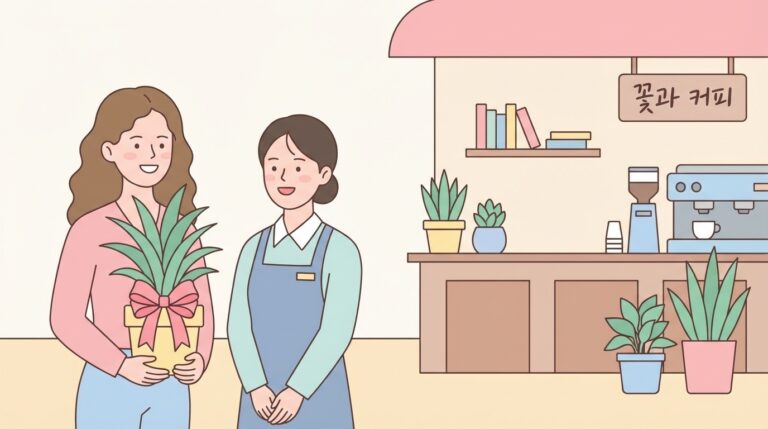
Now, imagine your Korean friend just moved into a new apartment, or maybe you just want a little green companion for your own desk in Seoul. You walk into a beautifully aesthetic Korean flower shop (꽃집 – kkotjip)… and freeze. How do you ask for something that won’t die in a week? How do you ask for that iconic ribbon?
Don’t worry! This guide is built from the exact panic moments my foreign students have faced. Let’s learn how to navigate a Korean flower shop like a true local.
Phase 2: Core Expressions Deep Dive
Here are the top 3 expressions you need to buy a potted plant like a pro.
1. 개업/집들이 선물할 건데, 추천해 주세요.
- Pronunciation: [gae-eop / jip-deu-ri seon-mul-hal geon-de, chu-cheon-hae ju-se-yo] + [gae-eop sounds like ‘get-up’ but with a ‘p’ / chu-cheon sounds like ‘choo-choo’ train + ‘chun’]
- Meaning: I’m buying a gift for a business opening/housewarming, please recommend something.
- K-Culture Moment: You walk into the shop looking lost. The moment you say this, the florist’s eyes will light up. They know exactly what to show you (usually plants that symbolize wealth, like the Money Tree).
- Editor’s Insight: Koreans love relying on the expert’s recommendation. Adding “~할 건데” (I am planning to ~) gives the listener the context they need to help you perfectly.
- Situation Spectrum:
- Casual (Friends): 🚫 (You wouldn’t say this to a friend, you say it to staff)
- Semi-formal (Staff/Clerks): ✅
- Formal (Elders): ⚠️ (Perfectly fine for staff, but maybe add ‘사장님’ at the start)
- 🤔 Think About It: Why do Koreans prefer asking for recommendations rather than just picking one? How does this reflect the Korean culture of trusting specialists and building a quick rapport with shop owners?
2. 이거 키우기 쉬워요?
- Pronunciation: [i-geo ki-u-gi swi-wo-yo?] + [ki-u-gi sounds like ‘key-ooh-gee’ / swi-wo-yo sounds like ‘she-woah-yo’]
- Meaning: Is this easy to grow? (Literal: Is this easy to raise?)
- K-Culture Moment: Perfect for when you’re looking at a gorgeous but intimidating orchid. You want to make sure your friend (or you) won’t accidentally kill it in 3 days.
- Editor’s Insight: Notice we use the verb 키우다 (to raise). In Korean, we “raise” plants and pets with the same word we use for raising children! It shows affection and care.
- Situation Spectrum:
- Casual (Friends): ✅ (Drop the ‘yo’: 이거 키우기 쉬워?)
- Semi-formal (Staff/Clerks): ✅
- Formal (Elders/Boss): ⚠️ (Better to say: 키우기 쉬운 편인가요?)
- 🤔 Think About It: Does your language use the same word for raising children and growing plants? What does this say about the Korean mindset toward nature and living things?
3. 리본에 글씨 써 주시나요?
- Pronunciation: [ri-bon-e geul-ssi sseo ju-si-na-yo?] + [ri-bon is just ‘ribbon’ with a Korean accent / sseo sounds like ‘so’ but with a sharp hissing ‘ss’]
- Meaning: Do you write letters on the ribbon?
- K-Culture Moment: This is the K-Drama moment! If you want those giant ribbons trailing down the pot, you must ask this. Usually, the left ribbon has your name/company, and the right ribbon has a witty or congratulatory message.
- Editor’s Insight: “~해 주시나요?” is a very polite, soft way to ask if a store provides a certain service without sounding demanding.
- Situation Spectrum:
- Casual (Friends): 🚫
- Semi-formal (Staff/Clerks): ✅
- Formal (Boss): 🚫
- 🤔 Think About It: Why is it so important to visually display the sender’s name and message on a giant ribbon in Korea? How does this relate to community and “face” (체면)?
Phase 3: Textbook vs. Real Korean
Let’s see how the textbooks differ from what you’ll actually hear in trendy neighborhoods like Hongdae or Seongsu-dong.
[Asking About Watering]
* 📖 Textbook Korean: 이 식물은 물을 얼마나 자주 주어야 합니까? (How often must I give water to this plant?)
* 🗣️ Real Korean: 물은 며칠에 한 번 줘요? (Water it once every how many days?)
* 💡 Why the difference?: Real spoken Korean loves efficiency. Dropping the subject (“I”) and the object particle, and just using the present tense “줘요” makes it sound natural and friendly.
[Making Your Final Choice]
* 📖 Textbook Korean: 저는 이것으로 사겠습니다. (I will buy this one.)
* 🗣️ Real Korean: 이걸로 할게요. (I’ll go with this one.)
* 💡 Why the difference?: “~로 할게요” is the ultimate magic phrase for making any choice in Korea, from picking a plant to ordering a coffee. It sounds much softer than “I will buy.”
Bottom Note: At the
A2 (Beginner)level, focus on these shorter, real-life phrases. They are much easier to memorize and will make you sound incredibly natural!
Phase 4: Cultural Context — K-Culture Deep Dive
4-1. Non-Verbal Cues: The Art of Nunchi at the Flower Shop
When you enter a Korean flower shop, you might notice it feels more like an art studio. Here, Nunchi (눈치 – the subtle art of reading the room) is key.
– Don’t touch the leaves: Potted plants are treated delicately. Instead of grabbing a pot to inspect it, point to it and ask the florist.
– State your budget early: It’s totally normal to say, “5만 원 정도로 맞춰주세요” (Please make it around 50,000 KRW). The florist will use their nunchi to create the best looking arrangement for that exact price.
4-2. K-Culture Connection: The ‘Opening a Business’ Trope
In K-Dramas like Itaewon Class or Coffee Prince, opening a business is a huge milestone. When friends bring a potted plant, they almost always bring a 금전수 (Geumjeonsu – Money Tree) or a 스투키 (Stuckyi – Snake Plant).
Why? Because they are incredibly hard to kill (perfect for busy shop owners) and symbolize wealth and prosperity. The witty messages on the ribbons are a modern trend. Instead of a boring “Congratulations,” younger Koreans write things like:
– “돈 세다 잠드소서” (May you fall asleep while counting your money!)
– “적게 일하고 많이 버세요” (Work less, earn a lot!)
Phase 5: Real-Life Roleplay Scenario
Setting: A Friday afternoon in Yeonnam-dong. The air is filled with the scent of eucalyptus. You are standing inside a minimalist flower shop with sunlight streaming in.
Characters:
– YOU: An expat living in Seoul. Your close Korean friend, Min-su, is opening a new cafe tomorrow, and you want to surprise him.
– Florist (사장님): A friendly 30-something plant expert wearing a beige apron.
Dialogue:
Florist: 어서 오세요~ 찾으시는 거 있으세요? 😊
(eoseo oseyo~ chajeusineun geo isseuseyo?)
[Welcome~ Are you looking for anything in particular?]
YOU: 네, 친구가 카페를 개업해서요. 개업 선물할 건데, 추천해 주세요!
(ne, chin-gu-ga ka-pe-reul gae-eop-hae-seo-yo. gae-eop seon-mul-hal geon-de, chu-cheon-hae ju-se-yo!)
[Yes, my friend is opening a cafe. I want to buy an opening gift, please recommend something!]
Florist: 아, 카페 개업이군요! 예산은 어느 정도로 생각하세요?
(a, ka-pe gae-eop-i-gun-yo! ye-san-eun eo-neu jeong-do-ro saeng-gak-ha-se-yo?)
[Ah, a cafe opening! What is your budget?]
YOU: 5만 원 정도요.
(o-man won jeong-do-yo.)
[Around 50,000 won.]
Florist: 그럼 이 ‘금전수’ 어때요? 돈이 많이 들어온다는 뜻이 있어서 제일 인기 많아요.
(geu-reom i ‘geum-jeon-su’ eo-ttae-yo? don-i man-i deul-eo-on-da-neun tteus-i isseo-seo je-il in-gi man-a-yo.)
[Then how about this ‘Money Tree’? It means a lot of money will come in, so it’s the most popular.]
🔀 Your Turn! How should you respond?
– A) “아니요, 너무 비싸요!” (No, it’s too expensive!)
– B) “오, 좋아요! 이거 키우기 쉬워요?” (Oh, great! Is this easy to grow?)
– C) “제가 알아서 고를게요.” (I will pick it myself.)✅ Best Choice: B — You validate the florist’s expert recommendation while asking a practical question.
⚠️ Choice A & C Analysis: Choice A is too blunt if the plant is within your stated budget. Choice C dismisses the florist’s help, which disrupts the friendly nunchi dynamic you just built.
(Assuming you chose B)
Florist: 네, 아주 쉬워요! 물은 한 달에 한 번만 주면 돼요.
(ne, a-ju swi-wo-yo! mul-eun han dal-e han beon-man ju-myeon dwae-yo.)
[Yes, very easy! You only need to water it once a month.]
YOU: 다행이네요. 그럼 이걸로 할게요. 아, 혹시 리본에 글씨 써 주시나요?
(da-haeng-i-ne-yo. geu-reom i-geol-ro hal-ge-yo. a, hok-si ri-bon-e geul-ssi sseo ju-si-na-yo?)
[That’s a relief. I’ll take this one. Ah, by any chance, do you write letters on the ribbon?]
Florist: 네, 양쪽에 달아 드려요. 뭐라고 써 드릴까요?
(ne, yang-jjok-e dal-a deu-ryeo-yo. mwo-ra-go sseo deu-ril-kka-yo?)
[Yes, we attach them to both sides. What shall I write for you?]
YOU: 오른쪽에는 “대박 나세요!”, 왼쪽에는 제 이름 써 주세요.
(o-reun-jjok-e-neun “dae-bak na-se-yo!”, oen-jjok-e-neun je i-reum sseo ju-se-yo.)
[On the right side, “Hit the jackpot!”, and on the left side, please write my name.]
Florist: 네, 예쁘게 포장해 드릴게요. 잠시만 기다려주세요!
(ne, ye-ppeu-ge po-jang-hae deu-ril-ge-yo. jam-si-man gi-da-ryeo-ju-se-yo!)
[Yes, I’ll wrap it up beautifully. Please wait a moment!]
Phase 6: 10-Second Shadowing Drill
Read this out loud. Pay attention to the pauses (/) and the emotion tags!
😊 사장님, / 이거 / 키우기 쉬워요?
(sa-jang-nim, / i-geo / ki-u-gi swi-wo-yo?)
🤔 물은 / 며칠에 한 번 / 줘요?
(mul-eun / myeo-chil-e han beon / jwo-yo?)
🥺 예쁘게 / 포장해 주세요!
(ye-ppeu-ge / po-jang-hae ju-se-yo!)
Phase 7: K-Culture Mini Dictionary
| 한국어 (Korean) | Romanization | English | Context / Explanation |
|---|---|---|---|
| 화분 | hwabun | Potted plant | The physical pot and the plant inside it. |
| 개업 | gae-eop | Opening a business | A major milestone in Korea, celebrated heavily with flowers and plants. |
| 집들이 | jipdeuri | Housewarming party | Friends visit a new home, usually bringing toilet paper (for things to “roll” out smoothly) or plants. |
| 대박 나세요 | daebak naseyo | Hit the jackpot! | The most common, cheerful wish for someone starting a new business. |
| 다육이 | dayugi | Succulent | Very popular desk plants in Korea because they are cute and easy to care for. |
Phase 8: Traveler’s Survival Kit
Even if you’re just visiting Korea for a week, you might want to buy a small succulent from a street vendor or market (like Yangjae Flower Market). Here is your survival kit:
🆘 Survival Phrases TOP 3
1. 🇰🇷 “이거 얼마예요?” (i-geo eol-ma-ye-yo?)
– 🗣️ Meaning: How much is this?
2. 🇰🇷 “들고 가기 편하게 해 주세요.” (deul-go ga-gi pyeon-ha-ge hae ju-se-yo.)
– 🗣️ Meaning: Please pack it so it’s easy to carry.
3. 🇰🇷 “영수증 주세요.” (yeong-su-jeung ju-se-yo.)
– 🗣️ Meaning: Please give me a receipt.📌 Editor’s Travel Note
– Carrying Plants on the Subway: If you buy a large plant, taking it on the crowded Seoul subway during rush hour (6 PM – 8 PM) is a big no-no! Koreans usually use a “콜밴” (Call Van) or ask the flower shop for “배달” (Delivery) for large items.
– Card vs. Cash: 99% of aesthetic street flower shops accept credit cards. However, if you go to a massive wholesale flower market, having cash or KakaoPay ready will make things faster.
Phase 9: Critical Thinking Corner — “One Step Deeper”
Media vs Reality: Do we really give human-sized trees?
🧠 Think Deeper:
In K-Dramas, wealthy CEOs or supportive friends always send towering, extravagant plants that take up half a room. While this makes for great television, the reality in modern Seoul is quite different. Because housing and cafe spaces in Korea are becoming increasingly compact, sending a massive plant can actually become a “nuisance gift” (예쁜 쓰레기 – pretty trash). Nowadays, young Koreans prefer gifting small, aesthetic desk plants or even “plant-raising kits” that fit perfectly in a small one-room studio. The K-Drama trope reflects an older generation’s idea of “bigger is better” for showing off success, while the modern reality leans heavily toward minimalism and practicality.💬 Your Turn:
In your culture, what is the most common gift when someone opens a new business or moves into a new house? Let us know in the comments!
Phase 10: FAQ & Avoiding Mistakes
Q: Can I bargain at a flower shop?
– No. In standard neighborhood flower shops, prices are fixed. Bargaining will make things awkward. The only exception is huge wholesale markets like the Express Bus Terminal Flower Market.
Q: Is it rude to ask for a plant that is “cheap”?
– Instead of saying “싼 거 주세요” (Give me a cheap one), it sounds much more polite to state your budget: “3만 원대 화분 있나요?” (Do you have any plants in the 30,000 won range?).
❌ Common Mistake #1: Trying to water the plant in the shop or touching delicate petals to see if they are real.
✅ Do this instead: Keep your hands behind your back and politely ask, “이거 진짜 식물인가요?” (Is this a real plant?)
Phase 11: Summary & Action Items
- One-Liner Summary: To buy a plant in Korea, share your purpose (gift/home), ask for recommendations, and don’t forget the K-Drama style ribbon!
Action Mission:
– 🥉 Bronze (Solo): Say “개업 선물할 건데, 추천해 주세요!” three times in front of the mirror.
– 🥈 Silver (Online): Go to a language exchange app and ask a Korean partner: “한국에서는 집들이 때 어떤 화분을 많이 선물해요?” (What kind of plants are often gifted for housewarmings in Korea?)
– 🥇 Gold (Real Life): Next time you pass by a flower shop in Korea, walk in, point to a cute succulent, and ask, “이거 물은 며칠에 한 번 줘요?”
🌸 K-Culture Mission:
Search “개업 화분” (Opening business plant) on Instagram. Look at the ribbons on the plants and try to spot the phrase “대박 나세요”!
Phase 12: Interactive Quiz
1. Situational Judgment:
You want to buy a small plant for your friend’s new apartment, but you don’t know much about plants. What is the most natural thing to say to the florist?
– A) “이 식물 이름이 무엇입니까?” (What is the name of this plant?)
– B) “집들이 선물할 건데, 키우기 쉬운 걸로 추천해 주세요.” (It’s a housewarming gift, please recommend something easy to grow.)
– C) “제일 비싼 화분 주세요.” (Give me the most expensive pot.)
2. Fill in the Blank:
You finally decided on a cute cactus. How do you tell the cashier “I will take this one” naturally?
– “이걸로 ______.”
3. True or False – K-Culture Edition:
– It is expected and polite to aggressively bargain for a lower price at a cute, aesthetic flower shop in Yeonnam-dong. (T/F)
(Answers)
1. B (A is too robotic, C is unnecessary. Asking for a recommendation based on the event is the most Korean way!)
2. 할게요 (halgeyo)
3. False (Bargaining is generally not done in retail shops/cafes in Korea, only in traditional open-air markets!)
Frequently Asked Questions (FAQ)
Q: What does "개업/집들이 선물할 건데, 추천해 주세요." mean in Korean and how do you pronounce it?
A: In Korean, "개업/집들이 선물할 건데, 추천해 주세요." is pronounced [gae-eop / jip-deu-ri seon-mul-hal geon-de, chu-cheon-hae ju-se-yo] and means: I'm buying a gift for a business opening/housewarming, please recommend something.
Q: What does "이거 키우기 쉬워요?" mean in Korean and how do you pronounce it?
A: In Korean, "이거 키우기 쉬워요?" is pronounced [i-geo ki-u-gi swi-wo-yo?] and means: Is this easy to grow? (Literal: Is this easy to raise?)
Q: What does "리본에 글씨 써 주시나요?" mean in Korean and how do you pronounce it?
A: In Korean, "리본에 글씨 써 주시나요?" is pronounced [ri-bon-e geul-ssi sseo ju-si-na-yo?] and means: Do you write letters on the ribbon?







