

Surviving Korean Traditional Markets: Order Street Food Like a True Local
Phase 1: Welcome to the Market Hustle!
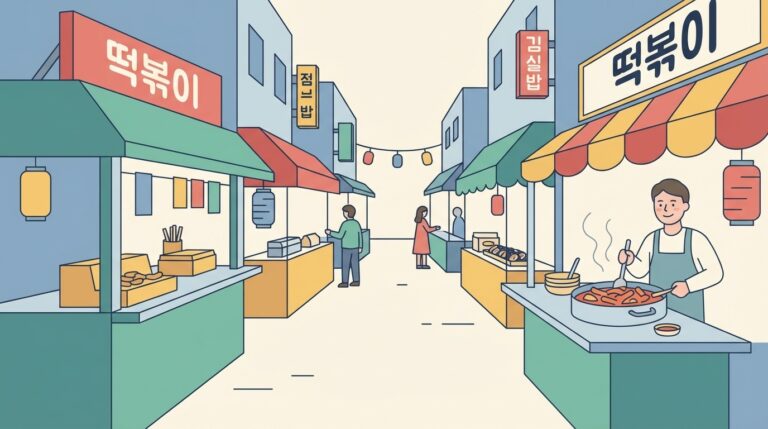
Hello! I’m your Daily Hangul Editor. Picture this: You are standing right in the middle of a bustling Korean traditional market—maybe Gwangjang Market or Namdaemun. The steam from the red, spicy tteokbokki is rising into the evening air, the savory scent of freshly fried bindaetteok (mung bean pancakes) makes your mouth water, and the vibrant energy is exactly like the scene you watched in that Netflix food documentary or your favorite K-Drama.
But wait… reality hits. The menus are just wooden plaques on the wall. There are no fancy touchscreens. The energetic stall owner is looking right at you, smiling, asking you something in rapid-fire Korean. Do you just point at the food, hold up one finger, and awkwardly smile? Sure, that might get you fed. But wouldn’t you rather pull up a plastic stool, order like a local, and get that approving nod from the owner?
This guide is built from the real panics and triumphs of foreign learners who took on the Korean street food scene. Let’s turn that overwhelming market chaos into your favorite culinary playground!
Phase 2: Core Expressions — Deep Dive
Here are the top expressions you need to survive and thrive at any Korean street food stall.
1. 여기서 먹고 갈게요 / 포장해 주세요.
- Pronunciation: yeogiseo meokgo galgeyo / pojanghae juseyo [yeo-gi-seo mok-go gal-ge-yo / po-jang-heh joo-seh-yo]
- Meaning: Literal: I will eat here and go / Please pack it. Real: For here / To go.
- K-Culture Moment: In K-Dramas, you’ll often see high school students or office workers sitting tightly on small plastic benches right at the cart, eating fish cake skewers (eomuk) and drinking the hot broth. That’s ‘먹고 갈게요’. On the flip side, bringing a black plastic bag full of late-night snacks to your family or friends is the ultimate ‘포장’ vibe.
- Editor’s Insight: These are the magic words that tell the vendor how to serve your food. If you say “먹고 갈게요”, they’ll usually hand you a plate and a cup for broth.
- Situation Spectrum:
- Casual Market Stall: ✅
- Restaurant: ✅
- High-end Fine Dining: 🚫 (They usually don’t do takeout like this!)
- 🤔 Think About It: Notice the phrase “먹고 갈게요” (eat and go). It implies a quick turnover. Why do you think Korean market language emphasizes “going” after eating? How does this reflect the ‘Palli-Palli’ (hurry up) culture?
2. 이거 1인분도 되나요?
- Pronunciation: igeo irinbundo doenayo? [i-geo il-in-boon-do dweh-na-yo?]
- Meaning: Literal: Is 1 portion of this also possible? Real: Can I order just for one person?
- K-Culture Moment: Korean food culture is highly communal. Stalls often sell food in massive, shared portions. If you are traveling solo and want to taste tteokbokki, sundae (blood sausage), AND fried foods (twigim), you need to know if you can buy small portions of each without buying a feast meant for three!
- Editor’s Insight: Market vendors love it when you ask this politely. It shows you understand that their standard serving might be huge.
- Situation Spectrum:
- Casual Market Stall: ✅
- Standard Restaurant: ✅
- Boss/Elders (asking them): 🚫 (This is a question for vendors, not a social phrase.)
- 🤔 Think About It: Korean dining is traditionally about sharing plates. Does your home culture prefer individual plates or shared family-style meals?
3. 이모님, 조금만 덜 맵게 해 주세요.
- Pronunciation: imonim, jogeumman deol maepge hae juseyo. [i-mo-nim, jo-geum-man dol map-ge heh joo-seh-yo. Note: ‘eol’ sounds like ‘ul’ in dull]
- Meaning: Literal: Auntie, please make it a little less spicy. Real: Auntie, please spare my tastebuds, I can’t handle the heat!
- K-Culture Moment: You’ll see K-Pop idols doing “Spicy Food Challenges.” While Koreans love their spice, even locals ask to tone it down sometimes! Calling the vendor Imo-nim (Auntie) is a cultural cheat code to build instant rapport.
- Editor’s Insight: Be careful! A Korean vendor’s idea of “a little less spicy” might still make you sweat. But asking this shows you’re actively engaging with the menu.
- Situation Spectrum:
- Friendly Market Vendor (older woman): ✅
- Young/Trendy Cafe Staff: 🚫 (Never call a young worker Imo-nim!)
- 🤔 Think About It: Why does Korea have such a strong culture of calling service workers family terms like “Auntie” or “Uncle”?
Phase 3: Textbook vs. Real Korean
Let’s upgrade your textbook Korean to “Hongdae Street” level.
[When ordering at a busy stall]
* 📖 Textbook Korean: 이것을 주십시오. (Please give me this.)
* 🗣️ Real Korean: 이모님~ 이거 하나요! (Auntie~ one of this, please!)
* 💡 Why the difference?: Market environments are loud and fast. Short, punchy phrases mixed with friendly terms of address (Imo-nim) are much more efficient and culturally warm than stiff, formal sentences.
[When reacting to the food]
* 📖 Textbook Korean: 매우 맛있습니다. (It is very delicious.)
* 🗣️ Real Korean: 와, 대박. 진짜 맛있어요! (Wow, jackpot. It’s really delicious!)
* 💡 Why the difference?: Koreans are very expressive about food. “대박” (Daebak) adds that dramatic flair you see in variety shows, showing your genuine excitement.
Bottom Note: For B2 learners, using “대박” is great with friends or casual vendors, but stick to “정말 맛있어요” (It’s really delicious) when trying to be a bit more polite!
Phase 4: Cultural Context — K-Culture Deep Dive
4-1. Non-Verbal Tips: The Art of Market Nunchi
Nunchi (눈치) is the Korean superpower of reading the room. At a traditional market, nunchi means understanding space. The stalls are tiny! When you finish eating your eomuk (fish cake), don’t sit there checking your phone. The polite thing to do is to pay, thank the vendor, and give up your seat for the next hungry customer. Also, when handing over cash or receiving a plate, try to use two hands (or support your right elbow with your left hand)—it’s a universal sign of respect in Korea.
4-2. K-Food Connection: The Freebie Culture (Service)
If you order well, smile, and maybe use a cute “너무 맛있어요!” (It’s so delicious!), the vendor might suddenly drop a few extra pieces of fried sweet potato onto your plate. They might say, “서비스야~” (It’s service~). In Korea, “Service” doesn’t mean the act of serving; it means a freebie given out of Jeong (정, warm affection). Accept it with a big smile and a loud “감사합니다!”
Phase 5: Real-Life Roleplay Scenario
Setting: Gwangjang Market, 7:00 PM. The market is packed with office workers getting their after-work drinks. You are standing in front of a bustling stall with mountains of red tteokbokki and crispy fried foods. You’re with your Korean friend, Minho.
Characters:
– YOU: A B2 Korean learner, confident but slightly intimidated by the market chaos.
– Minho (30): Your energetic Korean friend, acting as your local guide.
– Imo-nim (60s): The warm but incredibly busy stall owner.
Dialogue:
Minho: 여기 사람 진짜 많지? 뭐 먹을래?
(yeogi saram jinjja manjhi? mwo meogeullae?)
[There are so many people here, right? What do you want to eat?]
YOU: 음… 나 떡볶이 먹어보고 싶어!
(eum… na tteokbokki meogeobogo sipeo!)
[Hmm… I want to try tteokbokki!]
Minho: 오케이! (To the vendor) 이모님! 저희 떡볶이 1인분하고 튀김 1인분 주세요.
(okei! … imonim! jeohui tteokbokki irinbunhago twigim irinbun juseyo.)
[Okay! Auntie! Please give us 1 portion of tteokbokki and 1 portion of fried food.]
Imo-nim: 아이고, 어서 와요! 여기서 먹고 갈 거지?
(aigo, eoseo wayo! yeogiseo meokgo gal geoji?)
[Oh my, welcome! You’re going to eat here, right?]
YOU: 네! 여기서 먹고 갈게요.
(ne! yeogiseo meokgo galgeyo.)
[Yes! We’ll eat here.]
(🎭 Stage Direction: Imo-nim starts scooping the bright red, steaming tteokbokki onto a plate covered in a plastic bag.)
Imo-nim: 우리 집 떡볶이 좀 매운데, 외국인 친구 괜찮아?
(uri jip tteokbokki jom maeunde, oegugin chingu gwaenchana?)
[Our tteokbokki is a bit spicy, is your foreign friend okay with it?]
🔀 Your Turn! How do you reply?
– A) “아니요, 매운 거 못 먹어요.” (No, I can’t eat spicy food.)
– B) “조금만 덜 맵게 해 주세요! 저 매운 거 잘 먹어요!” (Please make it a little less spicy! I eat spicy food well!)
– C) “대박!” (Jackpot!)✅ Best Choice: B — Reason: It’s playful! You admit you need it a bit milder, but you show confidence. It’s a great conversational icebreaker with market vendors.
⚠️ Choice A Analysis: A bit too direct. If they already made the batch, they can’t change it much, so they might feel bad.
⚠️ Choice C Analysis: Totally out of context. Saying “Daebak” to a warning about spice level sounds like you are excited for the pain!
YOU: 조금만 덜 맵게 해 주세요! 그래도 도전해 볼게요!
(jogeumman deol maepge hae juseyo! geuraedo dojeonhae bolgeyo!)
[Please make it a little less spicy! But I’ll still challenge it!]
Imo-nim: (Laughs) 하하, 알았어. 어묵 국물은 서비스야!
(haha, arasseo. eomuk gukmureun seobiseuya!)
[(Laughs) Haha, got it. The fish cake broth is a freebie!]
YOU: 와, 이모님 최고! 잘 먹겠습니다!
(wa, imonim choego! jal meokgetseumnida!)
[Wow, Auntie is the best! We will eat well!]
🌟 Bonus K-Culture Roleplay: Solo Ordering
You are by yourself getting a Hotteok (sweet pancake) on the street.
– YOU: 사장님, 호떡 하나 얼마예요?
(sajangnim, hotteok hana eolmayeyo? – Boss, how much is one hotteok?)
– Vendor: 이천 원이에요.
(icheon wonieyo. – It’s 2,000 won.)
– YOU: 하나 포장해 주세요. 계좌이체 되나요?
(hana pojanghae juseyo. gyejwajiche doenayo? – Please pack one to go. Can I do a bank transfer?)
– Vendor: 네, 저기 번호로 보내주세요.
(ne, jeogi beonhoro bonaejuseyo. – Yes, please send it to the number over there.)
Phase 6: 10-Second Shadowing Drill
Let’s practice the rhythm! Pay attention to the pauses (/) and the emotion.
😊 이모님~ / 저희 / 여기서 / 먹고 갈게요!
(imonim~ / jeohui / yeogiseo / meokgo galgeyo!)
Speak brightly and clearly so the vendor can hear you over the noise!
🥺 사장님, / 이거 / 조금만 / 덜 맵게 해 주세요...
(sajangnim, / igeo / jogeumman / deol maepge hae juseyo…)
Use a slightly pleading, cute tone—like you are asking for mercy from the spice!
Phase 7: K-Culture Mini Dictionary
| 한국어 | Romanization | English | Cultural Context |
|---|---|---|---|
| 이모님 | imonim | Auntie | Used to respectfully but affectionately call middle-aged female service workers. |
| 1인분 | irinbun | 1 portion | Crucial for ordering. (2 portions = 2인분 / i-in-bun). |
| 포장 | pojang | Takeout / Packing | Used when you want your food wrapped up to take home. |
| 서비스 | seobiseu | Freebie | Complimentary food given by the restaurant as a gesture of kindness. |
| 계좌이체 | gyejwaiche | Bank Transfer | A very common way to pay at markets if you don’t have cash. |
| 길거리 음식 | gilgeori eumsik | Street Food | The overarching term for all the delicious cart foods! |
Phase 8: Traveler Survival Kit
If your brain freezes amid the market chaos, just remember these three lifesavers!
🆘 Survival Phrases TOP 3
1. 🇰🇷 “이거 하나 주세요.” (igeo hana juseyo.) – Please give me one of this.
2. 🇰🇷 “얼마예요?” (eolmayeyo?) – How much is it?
3. 🇰🇷 “휴지 좀 주실 수 있나요?” (hyuji jom jusil su innayo?) – Can you give me some tissues? (Trust me, eating street food gets messy!)📌 Editor’s Travel Note
– Cash vs. Card: South Korea is a cashless society… except at traditional markets! While many stalls now accept credit cards or bank transfers (계좌이체 via local bank apps), having 10,000 KRW bills on hand is highly recommended for street food.
– Trash Cans: You will notice a severe lack of public trash cans in Korea. If you ate at a stall, give the empty skewer or cup back to the vendor. They will throw it away for you!
– Tipping: ZERO. Do not tip the market vendor. It will confuse them. Just say “잘 먹었습니다!” (I ate well) loudly with a smile.
Phase 9: Critical Thinking Corner — “한 발 더 깊이”
🧠 Think Deeper: Food & Identity (음식과 정체성)
Have you ever noticed how Koreans at food stalls often eat tteokbokki or sundae from one shared plate, all using their own forks or skewers to stab the food together? This communal eating style is deeply rooted in the concept of Jeong (정) and Uri (우리 – ‘We’ or ‘Our’). In Korean culture, sharing food from the same vessel isn’t just about efficiency; it signifies breaking down boundaries and building a familial bond. We don’t say “my country” in Korean; we say “our country” (우리나라). We don’t say “my mom”; we say “our mom” (우리 엄마). Food is the ultimate expression of this collective identity.
💬 Your Turn: Does sharing food from one central plate feel intimate and warm to you, or does it feel like an invasion of personal space in your culture? Share your thoughts in the comments!
Phase 10: FAQ & Avoiding Mistakes
Q: Can I call the young trendy cafe worker “Imo-nim”?
A: 🚫 NO! “Imo-nim” is strictly for middle-aged or older women. Calling a 20-something barista “Imo-nim” will offend them. Use “저기요” (Excuse me) instead.
Q: Is it rude to ask for more “Service” (freebies)?
A: ⚠️ MAYBE. Service is a gift, not a right. If you explicitly demand it, it comes off as rude. It’s better to praise the food highly—vendors naturally reward good customers!
Q: Can I walk around the market while eating my skewer?
A: ⚠️ It’s becoming less common. Markets are crowded, and bumping into someone with a hot skewer is dangerous. It’s better culture to stand near the cart, finish it, and then move on.
❌ Common Mistake #1: Trying to pay for street food with a 50,000 won note for a 2,000 won item.
✅ Do This Instead: Break your large bills at a convenience store first. Vendors hate losing all their small change to one customer!
Phase 11: Summary & Action Items
- One-Liner Summary: Survive the market by mastering “먹고 갈게요” (eat here), “포장해 주세요” (take out), and flashing a friendly smile to the Imo-nim!
-
Action Mission 3 Steps:
- 🥉 Bronze (Solo): Stand in front of your mirror and practice saying “사장님, 조금만 덜 맵게 해 주세요” three times with a pleading face.
- 🥈 Silver (Online): Find a YouTube walking tour of Gwangjang Market, pause when they order food, and shadow what the locals say!
- 🥇 Gold (Real-world): Visit a Korean market or a local Korean restaurant, and successfully order a menu item using “이거 1인분도 되나요?”
- 🎬 K-Culture Mission: Watch an episode of Netflix’s Street Food: Asia (Seoul episode) or a K-Drama where they eat market food. See how many times you hear the word “이모님” or “포장”!
Phase 12: Quiz — Interactive Challenge
1. Situational Judgment:
You bought some spicy chicken skewers, and your mouth is on fire. You want a tissue. What do you say to the vendor?
– A) 이거 얼마예요?
– B) 휴지 좀 주실 수 있나요?
– C) 포장해 주세요.
2. Fill in the Blank:
You want to take the food back to your hotel.
“이모님, 이거 1인분 ________ 주세요.”
(Hint: Pack it up!)
3. True or False – K-Culture Edition:
At a traditional Korean market, giving a generous tip to the stall owner is the best way to show appreciation for the delicious food. (T/F)
👀 Click here for answers!
1. B (Can you give me some tissues? A means ‘How much is it?’, C means ‘Pack it to go’.)
2. 포장해 (pojanghae – please pack it.)
3. False! Korea does not have a tipping culture. Just give them a loud “잘 먹었습니다!” (I ate well!).
Frequently Asked Questions (FAQ)
Q: What does "여기서 먹고 갈게요 / 포장해 주세요." mean in Korean and how do you pronounce it?
A: In Korean, "여기서 먹고 갈게요 / 포장해 주세요." is pronounced [yeogiseo meokgo galgeyo / pojanghae juseyo [yeo-gi-seo mok-go gal-ge-yo / po-jang-heh joo-seh-yo] and means: Literal: I will eat here and go / Please pack it. Real: For here / To go.
Q: What does "이거 1인분도 되나요?" mean in Korean and how do you pronounce it?
A: In Korean, "이거 1인분도 되나요?" is pronounced [igeo irinbundo doenayo? [i-geo il-in-boon-do dweh-na-yo?] and means: Literal: Is 1 portion of this also possible? Real: Can I order just for one person?
Q: What does "이모님, 조금만 덜 맵게 해 주세요." mean in Korean and how do you pronounce it?
A: In Korean, "이모님, 조금만 덜 맵게 해 주세요." is pronounced [imonim, jogeumman deol maepge hae juseyo. [i-mo-nim, jo-geum-man dol map-ge heh joo-seh-yo. Note: 'eol' sounds like 'ul' in dull] and means: Literal: Auntie, please make it a little less spicy. Real: Auntie, please spare my tastebuds, I can't handle the heat!







