

Phase 1: Empathy (Immersion Open)
Hello! I’m your Daily Hangul Editor, your personal Korean tutor and local cultural navigator.
Imagine this: You are the main character in your own K-Drama. The emotional OST starts playing. It’s time to leave Seoul. You want to sit by the window, gazing at the glittering city lights or the fluffy clouds, reminiscing about the spicy Tteokbokki and the amazing K-Pop concert you just experienced.
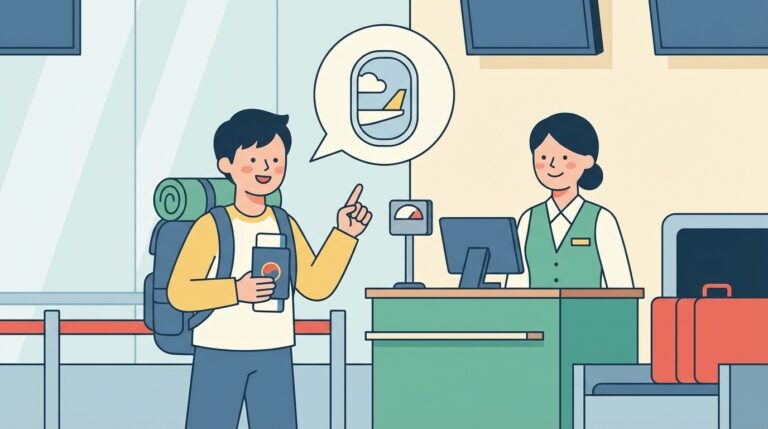
But then, you arrive at the check-in counter at Incheon International Airport. The agent asks you a question in rapid Korean. You panic, nod blindly, and end up sitting right next to the restrooms in the middle aisle. Cue the record scratch. 멈춰! (Stop!)
Knowing how to say “Window seat, please” isn’t just about legroom or taking that perfect Instagram story of the airplane wing. It’s about taking control of your K-Travel experience with confidence! Today, we are going to learn the magic word that gets you exactly what you want at the airport, without sounding like a robot. I’ve designed this guide based on real panicked text messages from my A1 students who were standing in line at Terminal 1. Let’s dive in!
Phase 2: Core Expressions Deep Dive
1. 창가 자리 주세요
- Pronunciation: chang-ga ja-ri ju-se-yo [Sound-alike: chang (like “ch” + “ah” + “ng”) gah jah-ree joo-seh-yo]
- Meaning: Literal: Window seat give me / Real nuance: I would like a window seat, please.
- K-Culture Moment: Think of your favorite K-Drama where the lead escapes to Jeju Island to clear their mind. They always have a window seat (창가 자리), leaning their head against the glass. This is the exact phrase you need to secure that main-character moment.
- Editor’s Insight: “주세요 (ju-se-yo)” is your ultimate survival tool in Korea. It means “Please give me.” You can literally put any noun in front of it. Coffee? 커피 주세요. Ticket? 티켓 주세요. It sounds polite, natural, and never rude when spoken with a soft tone.
- Situation Spectrum:
- Casual (Friends): ⚠️ (Friends don’t usually hand out seats!)
- Semi-formal (Service staff): ✅ (Perfect!)
- Formal (Elders/Boss): ✅ (Still perfectly polite!)
- 🤔 Think About It: In English, “Give me” can sound demanding, so we say “May I have…”. In Korean, “주세요” includes a built-in honorific marker (-yo), automatically making it polite. Does your native language have a word that instantly softens a demand into a polite request?
2. 통로 자리 주세요
- Pronunciation: tong-no ja-ri ju-se-yo [Sound-alike: tong-no (the ‘ng’ and ‘r’ blend into a soft ‘n’ sound: tong-no)]
- Meaning: Literal: Aisle seat give me / Real nuance: I would like an aisle seat, please.
- K-Culture Moment: You ate way too much Samgyeopsal (pork belly) and drank a bit too much Soju the night before your flight. You need easy access to the restroom. The aisle seat is your best friend.
- Editor’s Insight: Notice how the pronunciation of “통로” (tong-ro) changes to “tong-no”. Korean pronunciation often changes to make words flow easier off the tongue. Don’t stress too much about the spelling; just remember the sound!
- Situation Spectrum:
- Casual: ⚠️
- Semi-formal: ✅
- Formal: ✅
- 🤔 Think About It: Why is asking for what you need directly so accepted in Korean service culture? It ties back to 빨리빨리 (ppalli-ppalli / hurry up) culture—clarity equals efficiency!
3. 수하물 있어요
- Pronunciation: su-ha-mul i-sseo-yo [Sound-alike: soo-hah-mool ee-suh-yo]
- Meaning: Literal: Baggage exists / Real nuance: I have bags to check.
- K-Culture Moment: You went to Olive Young, bought 50 sheet masks, and raided the K-Pop merchandise store in Myeongdong. Your suitcase is bursting. You definitely have checked baggage!
- Editor’s Insight: “있어요 (i-sseo-yo)” means “I have” or “It exists.” Just like “주세요”, it’s a foundational Lego block of Korean. Noun + 있어요 = I have [Noun].
- Situation Spectrum:
- Casual: ✅ (When telling a friend you have bags)
- Semi-formal: ✅ (To the airport staff)
- Formal: ✅
- 🤔 Think About It: Korean often drops the subject “I”. The staff knows you are talking about your bags. How much is left unsaid in Korean culture compared to your own?
Phase 3: Textbook vs. Real Korean
[Situation 1: Requesting a Seat]
* 📖 Textbook Korean: 저는 창가 좌석을 원합니다. (I want a window seat.)
* 🗣️ Real Korean: 창가 자리 주세요. (Window seat, please.)
* 💡 Why the difference?: Textbooks teach “좌석” (seat) and “원합니다” (want), which sound very stiff, almost like a military report. “자리” (spot/seat) and “주세요” (give me) are what 100% of Koreans use in real life for efficiency and natural politeness.
[Situation 2: Checking in Luggage]
* 📖 Textbook Korean: 제 수하물을 위탁하고 싶습니다. (I would like to entrust my baggage.)
* 🗣️ Real Korean: 짐 부칠게요. (I’ll check my bags.) OR 수하물 있어요. (I have baggage.)
* 💡 Why the difference?: Formal Chinese-rooted words like “위탁” (entrust) are used on official signs, but spoken Korean prefers pure, simple native words like “짐” (luggage).
Bottom Note: For A1 level, stick to “[Noun] + 주세요”. It’s the ultimate ‘sensible’ and polite way to survive any shop, restaurant, or airport in Korea without sounding too stiff!
Phase 4: Cultural Context — K-Culture Deep Dive
4-1. Non-Verbal Communication: Two Hands, Please!
Language isn’t just words; it’s body language. When you ask for a window seat at the counter, you’ll be handing over your passport (여권 – yeogwon).
In Korea, passing items with two hands is a massive sign of respect. You don’t need to bow deeply; simply hold your passport with your right hand and lightly touch your right elbow with your left hand. Combining this gesture with “창가 자리 주세요” will make the airline staff’s eyes light up with appreciation. It shows excellent 눈치 (nunchi) – the ability to read the room and adapt to cultural norms!
4-2. The K-Travel Connection: The ” 친절한 ” (Kind) Traveler
Incheon International Airport consistently ranks as one of the best airports in the world. The service is incredibly fast and polite. However, airport staff interact with thousands of tired tourists daily.
Using a little bit of Korean—even just “안녕하세요” (Hello) and “창가 자리 주세요”—transforms you from a standard tourist into a respected guest. While airport staff generally speak great English, trying their language builds instant rapport. Who knows? That friendly connection might just be the reason they find you an extra-legroom seat!
Phase 5: Real-Life Roleplay Scenario
Setting: Sunday afternoon, Incheon Airport Terminal 1. The bright departure hall is buzzing with travelers. You’re exhausted but carrying a suitcase full of K-snacks and memories. You step up to the check-in counter.
Characters:
* YOU: An A1 Korean learner, a bit nervous but determined to use what you learned.
* Jiwon (20s): Friendly airline ground staff, typing rapidly on her keyboard.
Dialogue:
Jiwon: 안녕하세요! 여권 부탁드립니다. 😊
(An-nyeong-ha-se-yo! Yeo-gwon bu-tak-deu-rim-ni-da.)
[Hello! Passport, please.]
(🎭 Stage Direction: Jiwon holds out both hands to receive your passport)
YOU: 안녕하세요. 여기 있어요.
(An-nyeong-ha-se-yo. Yeo-gi i-sseo-yo.)
[Hello. Here it is.]
(🎭 Stage Direction: You hand it over with two hands)
Jiwon: 네, 감사합니다. 최종 목적지가 뉴욕 맞으신가요?
(Ne, gam-sa-ham-ni-da. Choi-jong mok-jeok-ji-ga nyu-yok ma-jeu-sin-ga-yo?)
[Yes, thank you. Is your final destination New York?]
YOU: 네, 맞아요.
(Ne, ma-ja-yo.)
[Yes, that’s right.]
Jiwon: 수하물 있으신가요?
(Su-ha-mul i-sseu-sin-ga-yo?)
[Do you have any checked baggage?]
YOU: 네, 수하물 있어요.
(Ne, su-ha-mul i-sseo-yo.)
[Yes, I have baggage.]
(🎭 Stage Direction: You heave your heavy bag onto the scale)
Jiwon: 좌석은 어디로 해 드릴까요?
(Jwa-seo-geun eo-di-ro hae deu-ril-kka-yo?)
[Where would you like your seat?]
🔀 Your Turn! How do you answer?
* A) “Window! 창가!” (Just yelling the word)
* B) “저는 창가 좌석을 원합니다.” (Robot textbook mode)
* C) “창가 자리 주세요~” (Polite and natural)✅ Best Choice: C — It’s the most natural, polite, and effective way to ask.
⚠️ Choice A Analysis: Just saying “Window!” or “창가!” sounds a bit blunt and demanding. Always attach “주세요” to soften it!
YOU: 창가 자리 주세요.
(Chang-ga ja-ri ju-se-yo.)
[Window seat, please.]
Jiwon: 네, 창가 자리로 배정해 드렸습니다. 즐거운 여행 되세요!
(Ne, chang-ga ja-ri-ro bae-jeong-hae deu-ryeot-seum-ni-da. Jeul-geo-un yeo-haeng doe-se-yo!)
[Yes, I’ve assigned you a window seat. Have a great trip!]
Phase 6: 10-Second Shadowing Drill
Let’s practice the intonation! Follow the slashes (/) to pause slightly, and mimic the emotion.
- 😊 밝고 친절하게 (Bright and polite):
창가 자리 / 주세~요!
(chang-ga ja-ri / ju-se~yo!) - 🥺 간절하게 (A bit desperate, if the flight is full!):
통로 자리는 / 없나요…?
(tong-no ja-ri-neun / eom-na-yo…?) -> Meaning: Are there no aisle seats…?
Phase 7: K-Culture Mini Dictionary
| Korean | Romanization | English | Context |
|---|---|---|---|
| 창가 | chang-ga | Window side | Essential for trains, cafes, and planes! |
| 통로 | tong-no | Aisle | For easy movement. (Remember the pronunciation shifts to tong-no!) |
| 여권 | yeogwon | Passport | The most important item you carry. |
| 수하물 | suhamul | Baggage | Specifically refers to checked baggage in travel contexts. |
| 빨리빨리 | ppalli-ppalli | Hurry, hurry | The driving force of Korea’s hyper-efficient airport service. |
| 눈치 | nunchi | Social awareness | Handing items with two hands shows great nunchi. |
Phase 8: Traveler Survival Kit
🆘 Survival Phrases at the Airport (Top 3)
* 🇰🇷 게이트가 어디예요? (ge-i-teu-ga eo-di-ye-yo?)
* 🗣️ Meaning: Where is the gate?
* 📍 Use it: When you’re lost after security.
* 🇰🇷 화장실 어디예요? (hwa-jang-sil eo-di-ye-yo?)
* 🗣️ Meaning: Where is the restroom?
* 📍 Use it: Everywhere!
* 🇰🇷 영수증 주세요. (yeong-su-jeung ju-se-yo.)
* 🗣️ Meaning: Receipt, please.
* 📍 Use it: Buying duty-free items or snacks.📌 Editor’s Travel Note
* Airport Kiosks: Incheon Airport uses a lot of automated Self-Bag Drop kiosks. If you get stuck, look for staff in brightly colored vests and say “도와주세요” (Do-wa-ju-se-yo / Please help me).
* Tipping: Remember, Korea is a no-tip culture. Do not try to tip the airport staff for giving you a good seat; it will confuse them and they are not allowed to accept it!
Phase 9: Critical Thinking — “One Step Deeper”
🧠 Think Deeper: Language & Power (The Magic of ‘-yo’)
Have you noticed that almost every phrase we learn ends in “-yo” (요)? In Korean, adding “-yo” isn’t just about grammar; it’s a social equalizer. It acknowledges the other person’s presence and labor. In some cultures, service workers might be addressed with blunt, direct commands because they are “doing their job.” However, in Korean society, the polite form is standard regardless of someone’s job title. Dropping the “-yo” and speaking in Banmal (casual speech) to a service worker is considered incredibly rude, sometimes even a power trip (갑질 – gapjil). Using “-yo” shows you respect the dignity of the person helping you.
💬 Your Turn: Does your language have a specific ending or word that shows respect regardless of social status? Share it in the comments below!
Phase 10: FAQ & Avoiding Misunderstandings
- Q: Can I use “창가 자리 주세요” at a cafe or restaurant?
- A: YES! Absolutely. If you go to a beautiful cafe in Seoul with a view, you can ask the staff, “창가 자리 있어요?” (Are there window seats?) or “창가 자리 주세요” if one is open.
- Q: Is it okay to point at the seat map on the screen and just say “여기요” (Here)?
- A: Yes. “여기요 (yeo-gi-yo)” means “Here, please.” It’s perfectly fine, especially if the airport is loud. Just remember the “-yo” at the end!
❌ Common Mistake #1: Saying “창가 자리 줘 (chang-ga ja-ri jwo)” to the airport staff.
✅ How to fix it: NEVER drop the “-yo” to strangers. “줘 (jwo)” is only for close friends or small children. Always say “주세요 (ju-se-yo)”.
Phase 11: Summary & Action Items
One-Liner Summary: Secure your perfect view and travel like a pro by simply adding “주세요” to “창가 자리” (Window seat) or “통로 자리” (Aisle seat).
Action Mission 3 Steps:
* 🥉 Bronze (Solo): Stand in front of your mirror and practice “창가 자리 주세요” with a polite K-Drama protagonist smile 3 times.
* 🥈 Silver (Online): Comment on this post with where you want to fly next using the format: “[Destination] 갈 거예요! 창가 자리 주세요!” (I’m going to [Destination]! Window seat, please!)
* 🥇 Gold (Real-world): Next time you fly, even if the agent speaks English, try asking for your seat in Korean at the check-in counter!
K-Culture Mission:
Go to YouTube and search for “Incheon Airport K-Pop Departure.” Watch how the idols walk through the airport. Notice the signs and the bustling atmosphere. Imagine yourself navigating that same space using your new Korean phrases!
Are you an aisle person or a window person? Let me know in the comments below! 👇
Phase 12: Quiz — Interactive Challenge
1. Situational Judgment:
You are at the Incheon Airport check-in counter. The agent asks where you want to sit. You want an aisle seat because you drink a lot of water on flights. What is the BEST response?
* A) 통로 자리 줘.
* B) 통로 자리 주세요.
* C) 창가 자리 주세요.
2. Fill in the Blank:
You bought way too many K-Beauty items. You need to check your bags.
“네, ________ 있어요.” (Yes, I have baggage.)
* A) 여권
* B) 수하물
* C) 창가
3. True or False – K-Culture Edition:
If the airport staff gives you an amazing window seat with extra legroom, you should slide them a $5 tip as a thank you. (T/F)
(Answers below!)
Click to reveal answers!
Answers:
1. B. (A is rude because it lacks “-yo”, C is asking for a window seat).
2. B (수하물 – suhamul).
3. False. Korea does not have a tipping culture. A bright “감사합니다! (Thank you!)” with a slight bow of the head is the perfect tip!
Frequently Asked Questions (FAQ)
Q: What does "창가 자리 주세요" mean in Korean and how do you pronounce it?
A: In Korean, "창가 자리 주세요" is pronounced [chang-ga ja-ri ju-se-yo [Sound-alike: chang (like "ch" + "ah" + "ng"] and means: Literal: Window seat give me / Real nuance: I would like a window seat, please.
Q: What does "통로 자리 주세요" mean in Korean and how do you pronounce it?
A: In Korean, "통로 자리 주세요" is pronounced [tong-no ja-ri ju-se-yo [Sound-alike: tong-no (the 'ng' and 'r' blend into a soft 'n' sound: tong-no] and means: Literal: Aisle seat give me / Real nuance: I would like an aisle seat, please.
Q: What does "수하물 있어요" mean in Korean and how do you pronounce it?
A: In Korean, "수하물 있어요" is pronounced [su-ha-mul i-sseo-yo [Sound-alike: soo-hah-mool ee-suh-yo] and means: Literal: Baggage exists / Real nuance: I have bags to check.






