

Phase 1: Empathy (The K-Cafe Reality Check)
Hello! I’m the Lead Editor at Daily Hangul.
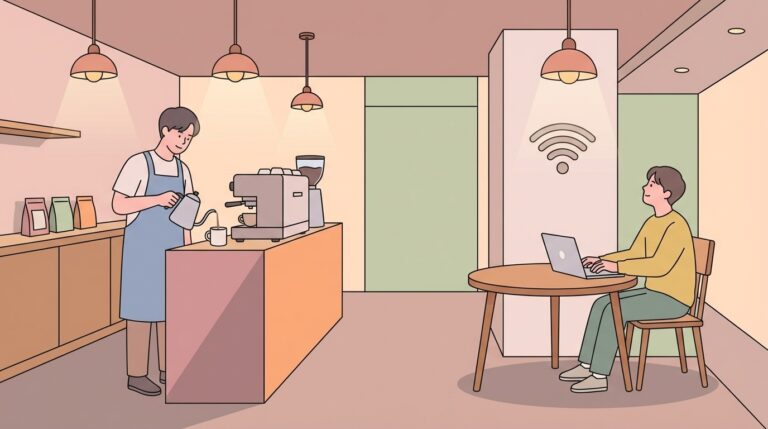
Picture this: You’ve just walked into one of those ultra-aesthetic cafes in Seongsu-dong. You successfully ordered your Ah-ah (Iced Americano), found the perfect corner seat, and pulled out your laptop. You’re ready to upload your aesthetic cafe vlog or get some remote work done.
But wait… you look around, and there’s no Wi-Fi sign on the wall. The barista is busy steaming milk, and the cafe is packed. You know you have to ask for the password, but suddenly, your mind goes blank. Does this sound familiar?
If you’ve ever ended up burning through your expensive roaming data just because you were too shy to ask the barista for the Wi-Fi password, you are not alone! Many of my A2 students confess that asking questions in a fast-paced Korean cafe is their biggest fear. But don’t worry—today, I’m giving you the ultimate insider cheat sheet. By the end of this post, you’ll be asking for the Wi-Fi like a true Seoul local!
Phase 2: Deep Dive into Core Expressions
Here are the top 3 phrases you need to survive. Notice how simple they are!
1. 와이파이 비밀번호가 뭐예요?
- Pronunciation: wa-i-pa-i bi-mil-beon-ho-ga mwo-ye-yo? (The ‘mwo-ye-yo’ rhymes with ‘boy, yeah, yo’)
- Meaning: What is the Wi-Fi password?
- K-Culture Moment: You’ll hear this a dozen times a day in any Korean cafe. It’s polite, direct, and exactly what locals say when there’s no sign around.
- Editor’s Insight: ‘비밀번호’ (bi-mil-beon-ho) literally means ‘secret number’. We use this word for everything—your phone PIN, your front door code, and the Wi-Fi password.
- Situation Spectrum:
- Casual (Friends): ✅ (Drop the ‘yo’: 와이파이 비밀번호가 뭐야?)
- Semi-formal (Staff/Barista): ✅
- Formal (Boss/Elders): ⚠️ (A bit too direct, better to ask if Wi-Fi is available first)
- 🤔 Think About It: Notice how we don’t say “Can you tell me the password?” We just ask “What is it?” Korean values efficiency. Direct questions are often preferred over long, beating-around-the-bush requests in service situations!
2. 와이파이 돼요?
- Pronunciation: wa-i-pa-i dwae-yo? (‘dwae’ sounds like ‘dway’ in ‘Dwight’)
- Meaning: Lit. Does the Wi-Fi work? / Can I use the Wi-Fi here?
- K-Culture Moment: Imagine sitting in a tiny, retro, mom-and-pop cafe (다방) in the countryside. You aren’t sure if they even have internet. This is the phrase you use to test the waters!
- Editor’s Insight: This sounds incredibly natural. It shows you’re not just a textbook learner but someone who catches the real ‘vibe’ of the language.
- Situation Spectrum:
- Casual: ✅
- Semi-formal: ✅
- Formal: 🚫
- 🤔 Think About It: The verb 되다 (to work/function/become) is magical in Korean. You can point at almost anything and say “이거 돼요?” (Does this work?). How would you ask if Apple Pay works using this verb?
3. 영수증에 비밀번호 있어요?
- Pronunciation: yeong-su-jeung-e bi-mil-beon-ho i-sseo-yo?
- Meaning: Is the password on the receipt?
- K-Culture Moment: You ask the busy barista for the Wi-Fi, and instead of speaking, they point to the little slip of paper on your tray. Plot twist: The password was in your hands the whole time!
- Editor’s Insight: In Korea, cafes change their Wi-Fi passwords often to prevent non-customers from using it. Printing it at the bottom of the receipt is the standard practice.
- Situation Spectrum:
- Casual: ✅
- Semi-formal: ✅
- Formal: ✅
Phase 3: Textbook vs. Real Korean
Let’s compare what you studied with what you’ll actually hear at a Hongdae cafe.
[Situation 1: Asking for the Wi-Fi password]
* 📖 Textbook Korean: 실례하지만, 와이파이 비밀번호를 알려주시겠습니까? (Excuse me, would you be so kind as to inform me of the Wi-Fi password?)
* 🗣️ Real Korean: 저기요, 와이파이 비밀번호가 뭐예요?
* 💡 Why the difference?: Cafes in Korea operate on Pali-pali (hurry-hurry) culture. Extremely formal sentences are actually burdensome to listen to during a rush hour.
[Situation 2: Checking if they have internet]
* 📖 Textbook Korean: 이곳은 무선 인터넷이 가능합니까? (Is wireless internet possible in this establishment?)
* 🗣️ Real Korean: 혹시 와이파이 돼요? (By any chance, does the Wi-Fi work?)
* 💡 Why the difference?: Nobody says ‘무선 인터넷’ (wireless internet) in daily life. English loanwords like ‘와이파이’ have completely taken over.
Bottom Note: At an A2 level, don’t worry about overly complex grammar. Just adding ‘요(yo)’ at the end of a noun + verb makes you perfectly polite!
Phase 4: Cultural Context — K-Culture Deep Dive
4-1. Non-Verbal Cues & ‘Nunchi’ (눈치)
When asking the barista for the Wi-Fi password, timing is everything. This is where Nunchi (the subtle art of reading the room) comes in. Don’t shout your question while the barista is pouring latte art! Wait for a moment of eye contact, give a slight head bow, and start with “저기요…” (Excuse me…).
4-2. The ‘Kagongjok’ (카공족) Culture
Why is Wi-Fi so important in Korea? Welcome to the world of Kagongjok (카공족), a slang word for the “cafe-studying tribe.” In K-Dramas, you’ve probably seen college students with their laptops taking up a large table, iced coffees in hand, studying for hours.
Because cafes act as second offices and libraries in Korea, providing fast, free Wi-Fi is considered a basic duty of the cafe owner. You’ll often find outlets (콘센트) under almost every seat. It’s a beautiful ecosystem of caffeine and productivity!
Phase 5: Real-Life Roleplay Scenario
Let’s put you to the test.
Setting: It’s 2 PM on a Saturday at a bustling, trendy cafe in Yeonnam-dong. You just ordered a cake and a coffee.
Characters:
– YOU: A traveler wanting to post an Instagram story of your amazing dessert.
– Min-ji (20s): The friendly but extremely busy barista.
Dialogue:
YOU: 저기요, 아이스 아메리카노 한 잔 주세요. ☕
(jeo-gi-yo, a-i-seu a-me-ri-ka-no han jan ju-se-yo.)
[Excuse me, one iced Americano please.]
Min-ji: 네, 드시고 가시나요?
(ne, deu-si-go ga-si-na-yo?)
[Yes, is it for here?]
YOU: 네. 먹고 갈게요. 저… 와이파이 비밀번호가 뭐예요?
(ne. meok-go gal-ge-yo. jeo… wa-i-pa-i bi-mil-beon-ho-ga mwo-ye-yo?)
[Yes, for here. Um… what is the Wi-Fi password?]
Min-ji: 아, 와이파이 비밀번호 영수증 하단에 있어요! 결제 도와드릴게요.
(a, wa-i-pa-i bi-mil-beon-ho yeong-su-jeung ha-dan-e i-sseo-yo! gyeol-je do-wa-deu-ril-ge-yo.)
[Ah, the Wi-Fi password is at the bottom of the receipt! I’ll help you with the payment.]
(🎭 Stage Direction: Min-ji hands you the card and the receipt, but out of habit, you say “Throw the receipt away please!” Wait, oh no…)
🔀 Your Turn! How do you respond to get the password back?
– A) (Just stare blankly and walk away in silence)
– B) “비밀번호 몰라요. 영수증 줘요.” (I don’t know the password. Give receipt.)
– C) “헉, 영수증 버려달라고 했는데… 혹시 비밀번호 알려주실 수 있어요?”✅ Best Choice: C — “Oops, I asked you to throw away the receipt… could you possibly tell me the password?” It’s honest, slightly apologetic, and perfectly polite!
⚠️ Choice B Analysis: This sounds incredibly rude and demanding, like a robot commanding a human.
Phase 6: 10-Second Shadowing Drill
Let’s practice the rhythm of Korean. Follow the slashes for pauses, and match the emotion!
- 🥺 Slightly hesitant, polite
저기요, / 혹시 / 와이파이 비밀번호가 / 뭐예요?
(jeo-gi-yo, / hok-si / wa-i-pa-i bi-mil-beon-ho-ga / mwo-ye-yo?) -
😊 Casual and friendly
여기 / 와이파이 / 돼요?
(yeo-gi / wa-i-pa-i / dwae-yo?)
Phase 7: K-Culture Mini Dictionary
Here are some cafe-related words you MUST know:
| Korean | Romanization | English | Cultural Context |
|---|---|---|---|
| 아아 | a-a | Iced Americano | An abbreviation for ‘아이스 아메리카노’. The unofficial national drink of Korea. |
| 영수증 | yeong-su-jeung | Receipt | Where the Wi-Fi password usually hides! |
| 콘센트 | kon-sen-teu | Electrical outlet | A Konglish word from “concentric plug.” Crucial for charging your phone. |
| 카공족 | ka-gong-jok | Cafe-studying tribe | People who study or work in cafes for hours. |
Phase 8: Traveler Survival Kit
🆘 Survival Phrases for the Cafe
– 🇰🇷 “콘센트 자리 있어요?” (kon-sen-teu ja-ri i-sseo-yo?)
– 🗣️ Meaning: Are there any seats with outlets?
– 📍 Where to use: Before ordering, if your phone is at 1%.
- 🇰🇷 “화장실 비밀번호 뭐예요?” (hwa-jang-sil bi-mil-beon-ho mwo-ye-yo?)
- 🗣️ Meaning: What is the restroom password?
- 💡 Pro Tip: In Korea, restrooms often share the same number pad lock system as the Wi-Fi! The code is usually printed on the receipt right next to the Wi-Fi code.
📌 Editor’s Travel Note
– Finding the password: Before asking the barista, look at three places: 1) The bottom of your receipt. 2) A small sticker attached to the POS machine/register. 3) A printed sign near the straw/napkin pick-up area.
– Tipping: Do NOT tip the barista for giving you the password (or for anything else). Tipping does not exist in Korea and will only cause confusion!
Phase 9: Critical Thinking Corner — “One Step Deeper”
Korean in the Global Era: The Power of Konglish
Have you noticed how many English words we used today? Wi-Fi, Americano, POS machine, receipt (wait, no, that’s pure Korean!), outlet (콘센트). In modern South Korea, especially in cafes, “Konglish” (Korean-style English) dominates.
Some language purists argue that this harms the beautiful, traditional Korean language (Hangul). However, younger generations view it as an evolution of language that makes global communication faster and easier. You don’t need to learn a new Korean word for Wi-Fi—you just need to learn the Korean accent for it!
💬 Your Turn: Do you have words in your native language that are just English words pronounced differently? Share them in the comments!
Phase 10: FAQ & Avoiding Mistakes
❌ Common Mistake #1: Saying ‘와이파이’ with a strong ‘F’ sound.
✅ Do this instead: The Korean alphabet doesn’t have an ‘F’ sound. We use the ‘ㅍ’ (p) sound. You must say it like “Wa-i-pa-i”. If you bite your lip to make an ‘F’ sound, they might not understand you!
❌ Common Mistake #2: Asking “당신 와이파이 있어요?” (Do ‘you’ have Wi-Fi?)
✅ Do this instead: Never use the word 당신 (dang-sin / you) to a stranger. It can sound aggressive! Drop the subject entirely and just say “와이파이 있어요?”
Q: Can I share the Wi-Fi password with my friend who didn’t buy anything?
A: Culturally, it’s polite for every person sitting in the cafe to buy at least one drink (1인 1음료 – 1 drink per person rule). Once everyone has ordered, sharing the password is totally fine!
Phase 11: Summary & Action Items
One-Liner Summary: To get connected in a Korean cafe, simply ask “와이파이 비밀번호가 뭐예요?” and don’t forget to check your receipt first!
Action Mission 3 Steps:
– 🥉 Bronze: Say “와이파이 비밀번호가 뭐예요?” out loud 3 times right now.
– 🥈 Silver: Next time you are at a local Starbucks or cafe in your country, pretend the barista is Korean and mutter the phrase under your breath.
– 🥇 Gold: Go to a Korean cafe, order your drink, and actually use this phrase to get the Wi-Fi code!
☕ K-Culture Mission:
Go on YouTube and search for “Korean cafe vlog” (한국 카페 브이로그). Watch how the barista hands over the receipt. Try to spot the tiny Wi-Fi information on the POS monitor!
Phase 12: Interactive Quiz
1. You are at a cafe and your laptop is dead. What do you look for?
A) 아아 (Ah-ah)
B) 카공족 (Kagongjok)
C) 콘센트 (Konsenteu)
2. True or False: If you ask nicely in textbook formal Korean, the barista will appreciate it and might give you free Wi-Fi.
– False! Wi-Fi is generally free for customers anyway, and super formal Korean might just slow down their busy workflow. Keep it simple with “와이파이 돼요?”
3. Fill in the blank:
영수증에 _________ 있어요? (Is the password on the receipt?)
(Answers: 1. C / 2. False / 3. 비밀번호)
Frequently Asked Questions (FAQ)
Q: What does "와이파이 비밀번호가 뭐예요?" mean in Korean and how do you pronounce it?
A: In Korean, "와이파이 비밀번호가 뭐예요?" is pronounced [wa-i-pa-i bi-mil-beon-ho-ga mwo-ye-yo? (The 'mwo-ye-yo' rhymes with 'boy, yeah, yo'] and means: What is the Wi-Fi password?
Q: What does "와이파이 돼요?" mean in Korean and how do you pronounce it?
A: In Korean, "와이파이 돼요?" is pronounced [wa-i-pa-i dwae-yo? ('dwae' sounds like 'dway' in 'Dwight'] and means: Lit. Does the Wi-Fi work? / Can I use the Wi-Fi here?
Q: What does "영수증에 비밀번호 있어요?" mean in Korean and how do you pronounce it?
A: In Korean, "영수증에 비밀번호 있어요?" is pronounced [yeong-su-jeung-e bi-mil-beon-ho i-sseo-yo?] and means: Is the password on the receipt?







