

Phase 1: Empathy (Immersive Opening)
Hello! I’m your Daily Hangul Editor.
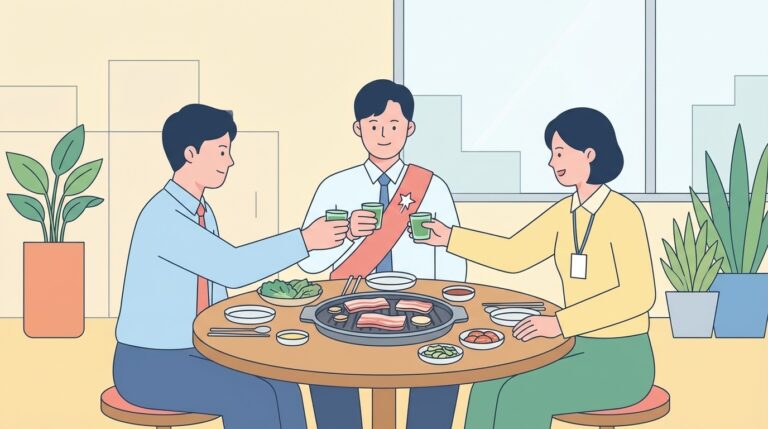
Picture this: You are watching a classic K-Drama like Misaeng or Business Proposal. The office chatroom suddenly explodes with messages. Someone just got promoted. Cut to the next scene—the whole team is sitting around a round metal table at a samgyeopsal (pork belly) restaurant, clinking green soju glasses, and shouting ‘Geonbae!’ (Cheers!).
But wait… how did they get from the office to the restaurant? Who decided the date? And more importantly, who is paying for all that meat?
In Korean workplace culture, a promotion isn’t just an individual victory; it is a team event. Organizing a 회식 (Hoesik – company dinner) to celebrate is almost a rite of passage. If you are an expat working in Korea or working closely with Korean colleagues, knowing how to naturally congratulate someone and schedule a celebration dinner will instantly upgrade you from ‘foreign coworker’ to ‘trusted team insider.’
Don’t worry! I’ve been living in Seoul for over a decade, and I’ve survived (and planned) countless office dinners. Today, I’ll share the exact phrases real Korean office workers use—far beyond the stiff textbook dialogues.
Phase 2: Core Expression Deep Dive
Let’s master the three essential expressions you need for a promotion celebration.
1. 승진 축하드립니다!
- Pronunciation: [seung-jin chu-ka-deu-rim-ni-da!] ‘seung’ sounds like ‘sung’, and ‘eu’ sounds like the disgusted sound you make when stepping in gum.
- Meaning: Congratulations on your promotion! (Literal: I give you promotion congratulations)
- K-Culture Moment: The moment the HR email goes out, younger staff members will pop over to the promoted person’s desk, bowing slightly and saying this phrase with a bright smile.
- Editor’s Insight: The verb ‘드리다’ (to give – humble form) makes this incredibly polite. It shows deep respect. If you use this, you can never go wrong in the office.
- Situation Spectrum:
- Close friend (Casual): 🚫 (Too stiff! Use ‘승진 축하해!’)
- Coworker (Semi-formal): ✅
- Boss/Elder (Formal): ✅
- 🤔 Think About It: Why does Korean have a special humble verb (드리다) just for giving something to someone of higher status? How does your native language express respect when offering something?
2. 제가 한턱쏠게요!
- Pronunciation: [je-ga han-teok-ssol-ge-yo!] ‘ssol’ sounds like ‘soul’ but with a sharp, tense ‘s’ at the beginning.
- Meaning: I’ll treat! / The drinks are on me! (Literal: I will shoot one jaw/feast!)
- K-Culture Moment: At the end of the first round of drinks, the promoted person will likely stand up, take out their corporate or personal credit card, and proudly declare this. It is the ultimate boss move.
- Editor’s Insight: ‘쏘다’ literally means ‘to shoot’ (like a gun or arrow). In modern slang, ‘shooting’ means paying for the meal. It is a very dynamic and generous expression.
- Situation Spectrum:
- Close friend (Casual): ✅ (제가 -> 내가 한턱쏠게!)
- Coworker (Semi-formal): ✅
- Boss/Elder (Formal): ⚠️ (A junior rarely treats a senior, but if promoted, it’s okay!)
- 🤔 Think About It: In Korea, the person celebrating a milestone often pays for the group, rather than the group paying for them. Why do you think this culture of ‘sharing the luck’ exists?
3. 회식 언제로 잡을까요?
- Pronunciation: [hoe-sik eon-je-ro ja-beul-kka-yo?]
- Meaning: When should we schedule the team dinner? (Literal: When shall we catch the hoesik?)
- K-Culture Moment: The youngest team member (the maknae) usually asks this question in the team chat or directly to the senior members, acting as the unofficial event coordinator.
- Editor’s Insight: Notice the verb ‘잡다’ (to catch/grab). Koreans don’t just ‘decide’ on a schedule; they ‘catch’ a date. It implies securing a time in everyone’s busy lives.
- Situation Spectrum:
- Close friend (Casual): 🚫 (Friends don’t have ‘hoesik’, they have ‘moim’ (gatherings))
- Coworker (Semi-formal): ✅
- Boss/Elder (Formal): ✅
- 🤔 Think About It: Why is scheduling a team dinner considered ‘work’ in Korea, often coordinated carefully around the boss’s schedule?
Phase 3: Textbook vs. Real Korean
[Congratulating a Colleague]
* 📖 Textbook Korean: 진급을 축하합니다. (jin-geu-beul chu-ka-ham-ni-da.)
* 🗣️ Real Korean: 대리님, 승진 축하드려요! 오늘 한턱쏘시는 거예요? ㅋㅋ (dae-ri-nim, seung-jin chu-ka-deu-ryeo-yo! o-neul han-teok-sso-si-neun geo-ye-yo?)
* 💡 Why the difference?: Real Korean adds the person’s title (대리님 – Assistant Manager) and playfully pressures them to buy food, building rapport and closeness.
[Suggesting a Date for Dinner]
* 📖 Textbook Korean: 회식 날짜를 정합시다. (hoe-sik nal-jja-reul jeong-hap-si-da.)
* 🗣️ Real Korean: 이번 주 금요일 저녁 어떠세요? (i-beon ju geu-myo-il jeo-nyeok eo-tteo-se-yo?)
* 💡 Why the difference?: ‘정합시다’ sounds like a military order. Asking ‘어떠세요?’ (How about…?) shows nunchi (consideration) for the other person’s schedule.
Bottom Note: At a B1 level, you want to sound polite but approachable. Avoid overly stiff textbook endings like ‘~ㅂ시다’ when suggesting things to colleagues.
Phase 4: Cultural Context — K-Culture Deep Dive
4-1. Non-Verbal Communication: The Art of ‘Nunchi’
When scheduling a hoesik, 눈치 (Nunchi – the ability to read the room) is everything.
* Don’t force Fridays: Historically, Fridays were popular for hoesik. Today, younger Koreans value their weekend starting early. Suggesting a Thursday (목요일) is considered a high-nunchi move.
* The Two-Handed Pour: When the dinner happens, if you are pouring a drink for a senior, always support your pouring arm with your other hand. It is a sign of respect.
4-2. The K-Drama Connection: The ‘Samgyeopsal’ Hierarchy
You have definitely seen this in K-dramas. The team goes to a BBQ joint. Have you noticed who holds the tongs? It is rarely the boss. Usually, the junior members take the initiative to grill the meat. However, if the dinner is to celebrate a junior’s promotion, a cool senior might say, ‘오늘 고기는 내가 굽는다’ (I’m grilling the meat today) as a special treat for the promoted employee.
Critical View: While K-dramas often romanticize the heavy-drinking hoesik culture, modern Korean companies are shifting away from it. Many teams now celebrate promotions with fancy lunches or coffee rather than late-night drinking sessions.
Phase 5: Practical Roleplay Scenario
Scenario A: The Office Breakroom
- Setting: Tuesday afternoon, 2 PM. The office breakroom smells of cheap instant coffee. The promotion announcements just went out.
- Characters:
- YOU: An expat working in Seoul, trying to navigate team dynamics.
- Min-su (32): Your friendly Korean colleague who just got promoted to Daeri (Assistant Manager).
YOU: 민수 대리님! 소식 들었어요. 승진 축하드립니다! 🎉
(min-su dae-ri-nim! so-sik deu-reo-sseo-yo. seung-jin chu-ka-deu-rim-ni-da!)
[Assistant Manager Min-su! I heard the news. Congratulations on your promotion!]
(🎭 Stage Direction: You offer Min-su an iced Americano)
Min-su: 아유, 감사합니다! 다 팀원들 덕분이죠.
(a-yu, gam-sa-ham-ni-da! da ti-mwon-deul deok-bu-ni-jyo.)
[Oh, thank you! It’s all thanks to the team members.]
YOU: 오늘 회식하는 건가요? 🍻
(o-neul hoe-si-ka-neun geon-ga-yo?)
[Are we having a team dinner today?]
Min-su: 당연하죠! 제가 오늘 한턱쏘겠습니다!
(dang-yeon-ha-jyo! je-ga o-neul han-teok-sso-get-seum-ni-da!)
[Of course! I’ll treat today!]
YOU: 오~ 메뉴는 뭔가요?
(o~ me-nyu-neun mwon-ga-yo?)
[Oh~ what’s the menu?]
Min-su: 소고기 어때요? 제가 좋은 곳 알아요.
(so-go-gi eo-ttae-yo? je-ga jo-eun got a-ra-yo.)
[How about beef? I know a good place.]
YOU: 대박! 진짜 기대되네요.
(dae-bak! jin-jja gi-dae-doe-ne-yo.)
[Awesome! I’m really looking forward to it.]
Min-su: 근데 다들 오늘 시간 괜찮으시려나? 회식 언제로 잡을까요?
(geun-de da-deul o-neul si-gan gwaen-cha-neu-si-ryeo-na? hoe-sik eon-je-ro ja-beul-kka-yo?)
[But I wonder if everyone is free today? When should we schedule the dinner?]
🔀 Your Turn! How should you respond?
– A) ‘당장 오늘 하시죠!’ (Let’s do it today right now!)
– B) ‘부장님께 먼저 여쭤볼까요?’ (Should we ask the department head first?)
– C) ‘제가 식당 예약할게요!’ (I’ll reserve the restaurant!)✅ Best Choice: B — Reason: In Korean corporate culture, the schedule of the highest-ranking person (the department head / Bujang-nim) dictates the team’s schedule. Showing this consideration is a massive nunchi flex.
⚠️ Choice A Analysis: A bit too aggressive and ignores the schedules of other colleagues.
⚠️ Choice C Analysis: Helpful, but you shouldn’t book until the date is confirmed by the boss.
YOU: (Choosing B) 부장님께 먼저 여쭤볼까요?
(bu-jang-nim-kke meon-jeo yeo-jjwo-bol-kka-yo?)
[Should we ask the department head first?]
Min-su: 아, 그게 좋겠네요. 제가 확인해 볼게요!
(a, geu-ge jo-ken-ne-yo. je-ga hwa-gin-hae bol-ge-yo!)
[Ah, that would be good. I’ll check!]
Scenario B: K-Culture Bonus (At the Restaurant)
- Setting: The beef restaurant. The meat is sizzling.
- Min-su: 자, 다들 잔 채우세요! 건배합시다!
(ja, da-deul jan chae-u-se-yo! geon-bae-hap-si-da!) [Okay, everyone fill your glasses! Let’s toast!] - YOU: 민수 대리님의 승진을 / 위하여!
(min-su dae-ri-ni-me seung-ji-neul / wi-ha-yeo!) [To Assistant Manager Min-su’s promotion!] - All: 위하여! (wi-ha-yeo!) [Cheers!]
Phase 6: 10-Second Shadowing Drill
Practice speaking like a true Seoulite. Pay attention to the pauses (/) and the emotion tags!
- 😊 Brightly: 대리님! / 승진 / 정~말 축하드려요!
(dae-ri-nim! / seung-jin / jeong~mal chu-ka-deu-ryeo-yo!) - 😎 Confident: 오늘 고기는 / 제가 쏘겠습니다!
(o-neul go-gi-neun / je-ga sso-get-seum-ni-da!) - 🤔 Thoughtful: 회식 날짜는 / 언제로 잡을까요?
(hoe-sik nal-jja-neun / eon-je-ro ja-beul-kka-yo?)
Phase 7: K-Culture Mini Dictionary
| Korean | Romanization | English | Cultural Context |
|---|---|---|---|
| 눈치 | nunchi | Social awareness / tact | The essential Korean skill of reading the room and anticipating needs. |
| 회식 | hoesik | Company dinner | A team-building dinner often involving alcohol. Slowly evolving in modern times. |
| 한턱쏘다 | hanteok ssoda | To treat / pay for everyone | Usually done by someone who achieved something great (promotion, new job). |
| 2차 | i-cha | Round 2 (after-party) | Moving to a second venue (like a pub or karaoke) after the main meal. |
| 건배사 | geonbaesa | Toast / Cheers speech | A short speech given before clinking glasses. Often rhyming or witty. |
Phase 8: Traveler’s Survival Kit
Even if you aren’t working in Korea, you might find yourself dragged to a celebratory dinner with local friends! Here is how to survive the aftermath of a hoesik.
🆘 Survival Expression #1
– 🇰🇷 ‘제가 계산할게요.’ (je-ga gye-san-hal-ge-yo.)
– 🗣️ Meaning: I will pay the bill.
– 📍 Where to use: At the counter of any restaurant or cafe.
– 💡 Pro Tip: In Korea, people often ‘fight’ over the bill to show generosity. It’s polite to offer to pay, even if the promoted person insists on treating!🆘 Survival Expression #2
– 🇰🇷 ‘영수증 버려주세요.’ (yeong-su-jeung beo-ryeo-ju-se-yo.)
– 🗣️ Meaning: Please throw away the receipt.
– 📍 Where to use: After paying. Most Koreans don’t keep paper receipts.📌 Editor’s Travel Note
– Getting Home: After a late hoesik, the subway might be closed. Download Kakao T (카카오T) to hail a taxi easily.
– Paying for Cabs: You can hand your physical credit card directly to the driver at the end of the ride. No cash needed!
– Tipping: Remember, there is NO tipping culture in Korea. If you try to leave cash on the table, the waiter might chase you down the street thinking you forgot your money!
Phase 9: Critical Thinking Corner — ‘A Step Deeper’
Language & Power: The Hierarchy of Treating
In many Western cultures, if it is your birthday or you get a promotion, your friends or colleagues will buy you a drink to celebrate. In Korea, the opposite often happens—the person celebrating the good news is expected to ‘shoot’ (한턱쏘다) and buy food for everyone. This stems from a deep-rooted collectivist mindset: your success is not just yours; it was made possible by the support of the community around you. By paying for the meal, you are giving back to the group and reinforcing harmony within the hierarchy.
🧠 Think Deeper: Does the Korean way of treating feel generous or burdensome to you?
💬 Your Turn: How is a promotion celebrated in your native culture? Who usually pays the bill? Share in the comments!
Phase 10: FAQ & Avoiding Misunderstandings
Q: Do I have to attend the team dinner?
Yes and no. In the past, hoesik was practically mandatory. Nowadays, it is more flexible, especially for expats. However, attending a ‘promotion’ hoesik is highly recommended as it shows respect and team solidarity.
Q: Can I use ‘수고하셨습니다’ (You worked hard) to a boss who got promoted?
No! This is a very common trap.
❌ Common Mistake #1: Saying ‘수고하셨습니다’ to someone higher ranking than you. It implies you are evaluating their work.
✅ Do this instead: Stick to ‘승진 축하드립니다!’ (Congratulations on your promotion!)❌ Common Mistake #2: Calling someone by their name without their title. Don’t say ‘Minsu, congratulations.’
✅ Do this instead: Always attach the title: ‘민수 대리님, 축하드립니다.’ (Assistant Manager Minsu, congratulations.)
Phase 11: Summary & Action Items
- One-Liner Summary: To celebrate a promotion in Korea, politely congratulate them, anticipate the hoesik, and use your nunchi to suggest a convenient date!
Action Mission 3 Steps:
* 🥉 Bronze (Solo): Stand in front of a mirror and say ‘승진 축하드립니다!’ three times with a bright smile.
* 🥈 Silver (Online): Go to a Korean learning forum and write a post pretending you got promoted, using ‘제가 한턱쏠게요!’
* 🥇 Gold (Real Life): Next time a Korean friend or colleague achieves something great, offer to schedule a celebratory meal using ‘언제로 잡을까요?’
K-Culture Mission:
Watch one episode of a Korean office drama (like Misaeng or Start-Up). Spot the team dinner scene and observe who pours the drinks, who grills the meat, and who pays the bill at the counter!
Phase 12: Quiz — Interactive Challenge
1. Situational Judgment: Your boss, Department Head Lee (이 부장님), just got promoted to Director. What is the BEST thing to say?
– A) 이 부장, 축하해! (Lee Bujang, chukahae!)
– B) 이 부장님, 수고하셨습니다! (Lee Bujang-nim, su-go-ha-syeot-seum-ni-da!)
– C) 이 부장님, 승진 축하드립니다! (Lee Bujang-nim, seung-jin chu-ka-deu-rim-ni-da!)
2. Fill in the Blank:
You want to treat your team to lunch. ‘제가 오늘 ______쏠게요!’
– A) 두턱 (du-teok)
– B) 한턱 (han-teok)
– C) 입턱 (ip-teok)
3. True or False — K-Culture Edition:
If a colleague gets promoted, the rest of the team must pool their money to buy them a very expensive dinner. (T/F)
4. Roleplay Application:
In our Phase 5 roleplay, you asked Min-su, ‘회식 언제로 잡을까요?’ (When should we schedule the dinner?). If Min-su is a smart junior employee, whose schedule will he check FIRST before answering you?
– A) The restaurant owner’s schedule
– B) The highest-ranking boss’s schedule
– C) His own girlfriend’s schedule
(Answers: 1. C (A is rude, B evaluates the boss). 2. B. 3. False (Usually the promoted person treats, or the company pays). 4. B (Nunchi dictates checking the boss’s schedule first!))
Frequently Asked Questions (FAQ)
Q: What does "승진 축하드립니다!" mean in Korean and how do you pronounce it?
A: In Korean, "승진 축하드립니다!" is pronounced [seung-jin chu-ka-deu-rim-ni-da!] and means: Congratulations on your promotion! (Literal: I give you promotion congratulations)
Q: What does "제가 한턱쏠게요!" mean in Korean and how do you pronounce it?
A: In Korean, "제가 한턱쏠게요!" is pronounced [je-ga han-teok-ssol-ge-yo!] and means: I'll treat! / The drinks are on me! (Literal: I will shoot one jaw/feast!)
Q: What does "회식 언제로 잡을까요?" mean in Korean and how do you pronounce it?
A: In Korean, "회식 언제로 잡을까요?" is pronounced [hoe-sik eon-je-ro ja-beul-kka-yo?] and means: When should we schedule the team dinner? (Literal: When shall we catch the hoesik?)







