

Phase 1: Empathy (The Cold Open)
Hello! This is your Daily Hangul Editor.
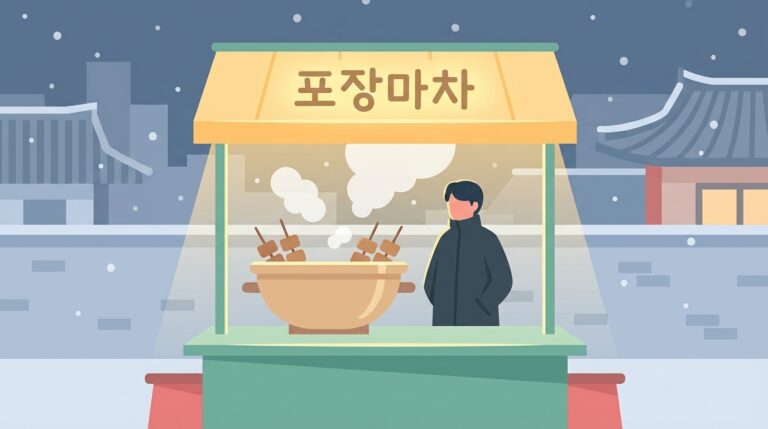
Picture this: It’s mid-January in Seoul. The temperature has dropped below freezing, the wind is howling, and your hands are practically icicles. Suddenly, you spot it—a bright orange tent (Pojangmacha) emitting thick, glorious clouds of steam. You step inside, grab an Eomuk (fish cake) skewer, and take a sip of that magical, savory broth from a small paper cup. Instantly, your soul thaws.
But wait… your cup is empty.
You look at the steaming pot. You look at the vendor. In K-Dramas, the main characters just confidently scoop it up themselves or flash a charming smile and get a refill. But what about you? Do you have to pay for more? Can you just grab the ladle? How do you ask without sounding demanding?
If you’ve ever stood at a Korean street stall clutching an empty paper cup, overthinking your next move, this guide is exactly for you. Today, we’re diving deep into the art of the Eomuk Gungmul (fish cake broth) refill. This isn’t just about learning a sentence; it’s about mastering the Insim (warm-hearted generosity) of Korean street food culture!
Phase 2: Deep Dive into Core Expressions
Let’s look at the most natural ways to get that second (or third!) cup of liquid gold.
1. 사장님, 국물 좀 더 주시겠어요?
- Pronunciation: [Sajangnim, gungmul jom deo jusigesseoyo?]
- Meaning: Boss, could you give me a little more broth?
- K-Culture Moment: You’ll hear this polite, gentle request all the time. Sajangnim literally means ‘CEO’ or ‘Boss’, but in Korea, it’s the universal, respectful way to address a store or stall owner.
- Editor’s Insight: The magic word here is 좀 (a little). It acts as a conversational cushion. Asking for “more broth” sounds like a command, but “a little more broth” sounds like a modest favor. It shows you respect their hard work.
- Situation Spectrum:
- Casual (Friends): 🚫 (Too formal for friends)
- Stall Owner/Elder: ✅ (Perfect, respectful)
- 🤔 Think About It: Why do Koreans use ‘사장님’ (CEO) for even the smallest street stall owners? How does elevating the other person’s status reflect traditional Korean values of respect?
2. 국물은 셀프인가요?
- Pronunciation: [Gungmureun selpeu-ingayo?]
- Meaning: Is the broth self-serve?
- K-Culture Moment: In many modern snack shops (Bunsik-jip) or busy stalls, you don’t even need to ask for a refill—you just do it yourself. But taking the ladle without asking can be rude if it’s not self-serve. This question is your ultimate safety net.
- Editor’s Insight: ‘셀프’ (Self) is one of the most important Konglish words you will learn in Korea. Water is self, side dishes are self, and very often, broth is self!
- Situation Spectrum:
- Any restaurant/stall where you aren’t sure: ✅
- 🤔 Think About It: Why are so many things “Self” in Korean dining? (Hint: Speed and efficiency, or Palli-palli culture, plays a huge role!)
3. (크으~) 국물 진짜 시원하다!
- Pronunciation: [(Kkeu-eu~) Gungmul jinjja siwonhada!]
- Meaning: (Literal) Ah, the broth is really cool/cold! / (Real nuance) Ah, this hot broth hits the spot / is so refreshing!
- K-Culture Moment: Wait, why are we calling boiling hot soup “cool”? If you use this expression at a street stall, the owner will look at you with deep respect. It’s the sound Korean grandfathers make when drinking hot stew or stepping into a hot bath.
- Editor’s Insight: As a B2 learner, this is your secret weapon. ‘시원하다’ doesn’t just mean physical temperature; it means a cathartic release of tension.
- Situation Spectrum:
- Muttering to yourself or to friends: ✅
- Saying it out loud so the vendor hears your appreciation: ✅
Phase 3: Textbook vs. Real Korean
[When asking for a refill]
* 📖 Textbook Korean: 어묵 국물을 다시 채워 주시겠습니까? (Would you please replenish the fish cake broth?)
* 🗣️ Real Korean: 사장님, 여기 국물 좀 더 먹어도 돼요? (Boss, can I drink a little more broth here?)
* 💡 Why the difference?: Textbooks teach direct translations of “refill” or “replenish,” but real Korean relies on asking for permission (“May I eat/drink a little more?”) to soften the request.
[When asking about the price of the refill]
* 📖 Textbook Korean: 국물 추가 요금이 얼마입니까? (How much is the additional fee for the broth?)
* 🗣️ Real Korean: (Just drinks it) / 국물 더 먹어도 되죠? (I can have more broth, right?)
* 💡 Why the difference?: Eomuk gungmul is universally FREE in Korea. Asking how much it costs will just confuse the vendor. It’s part of the Korean Jeong (warmth/sharing) culture.
Bottom Note: At a B2 level, focus on the tone. You don’t need complex grammar; you need the right amount of politeness and the ‘cushion’ words like 좀.
Phase 4: Cultural Context — K-Culture Deep Dive
4-1. Non-Verbal Cues & “Nunchi” at the Pocha
Asking for a refill isn’t just about words; it’s about Nunchi (눈치)—reading the room.
* The Shared Ladle: Often, there is only one long-handled ladle resting in the broth. If the vendor is busy flipping hotteok or cooking tteokbokki, use your nunchi. Wait for them to finish, or if you see other customers serving themselves, politely grab the ladle.
* The Two-Handed Rule: If the vendor is pouring the hot broth into your paper cup from their own kettle or ladle, hold your little paper cup with both hands. It’s a fundamental sign of respect!
4-2. The K-Drama Trope: The Healing Power of Eomuk
If you’ve watched K-Dramas like Goblin or Weightlifting Fairy Kim Bok-joo, you’ve seen the characters eating Eomuk. It is the ultimate equalizer in Korean society. Whether you are a broke college student, a heartbroken CEO, or a Grim Reaper, you stand shoulder-to-shoulder at the street stall. The broth isn’t just food; it’s emotional comfort. Sharing a cup of hot broth with someone on a freezing night is a subtle way of showing you care.
Phase 5: Real-life Roleplay Scenario
Setting: It’s 8 PM on a snowy Friday night in Hongdae. You and your Korean colleague, Minsu, just got out of a long, exhausting meeting. You’re shivering. You both spot a street stall and rush over, ordering spicy Tteokbokki and Eomuk.
Characters:
– YOU: B2 Korean learner, craving warmth.
– Minsu (32): Your friendly, energetic colleague.
– Sajangnim: The busy but kind stall owner.
Dialogue:
Minsu: 아, 진짜 춥다! 사장님, 어묵 두 개 먼저 주세요! 🍢
(A, jinjja chupda! Sajangnim, eomuk du gae meonjeo juseyo!)
[Ah, it’s so cold! Boss, two fish cakes first, please!]
(🎭 Stage Direction: Minsu hands you a paper cup filled with hot broth. You drink it in one gulp.)
YOU: 와… 살 것 같아요. 이거 진짜 맛있네요.
(Wa… sal geot gatayo. Igeo jinjja masinneyo.)
[Wow… I feel alive again. This is really delicious.]
Minsu: 그쵸? 한국 겨울엔 역시 어묵 국물이죠.
(Geuchyo? Hanguk gyeouren yeoksi eomuk gungmurijyo.)
[Right? For Korean winters, eomuk broth is the best.]
YOU: 근데 저 국물 다 마셨는데…
(Geunde jeo gungmul da masyeonneunde…)
[But I drank all my broth…]
🔀 Your Turn! How do you ask for a refill?
– A) “사장님, 국물 리필해 주세요!” (Boss, refill the broth!)
– B) “사장님, 여기 국물 좀 더 주시겠어요?”
– C) (Silently reaching across the tteokbokki pan to grab the ladle yourself)✅ Best Choice: B — It’s polite, uses the cushion word ‘좀’, and respects the vendor.
⚠️ Choice A Analysis: Using the English word “refill” (리필) sounds a bit transactional at a traditional street stall, though acceptable in a cafe.
🚫 Choice C Analysis: Without checking if it’s “self-serve,” reaching across hot food is dangerous and lacks nunchi!
(Assuming you chose B)
Sajangnim: 네~ 이리 컵 줘봐요. 뜨거우니까 조심하고요.
(Ne~ iri keop jwobwayo. Tteugeounikka josimhagoyo.)
[Yes~ give me the cup here. It’s hot, so be careful.]
YOU: 감사합니다! (Sips) 크으~ 시원하다!
(Gamsahamnida! … Keu-eu~ siwonhada!)
[Thank you! … Ah~ so refreshing!]
Minsu: 오? ‘시원하다’도 알아요? 한국 사람 다 됐네요! 🤣
[Oh? You even know ‘siwonhada’? You’re practically Korean now!]
Phase 6: 10-Second Shadowing Drill
Let’s practice the melodic, gentle tone of asking for a favor.
- 😊 Politely & Warmly:
사.장.님~ / 국물 / 쪼오끔만 더 / 주시겠어요?
(Sa-jang-nim~ / gung-mul / jjo-kkeum-man deo / ju-si-ge-sseo-yo?)
💡 Tip: Stretch the “쪼~” (jjo) a little bit. It makes you sound friendly and emphasizes that you only want a little bit!
Phase 7: K-Culture Mini Dictionary
| Korean | Romanization | English | Context |
|---|---|---|---|
| 눈치 | nunchi | Social sense/tact | The ability to read the room. Crucial for knowing when to ask the busy vendor for more broth. |
| 포장마차 | pojangmacha | Street tent / stall | The iconic orange/red tents selling street food. A staple of Korean nightlife. |
| 인심 | insim | Generosity / Warmheartedness | The concept of giving generously. Free broth refills are a perfect example of Korean insim. |
| 시원하다 | siwonhada | Refreshing / Cool | Used for actual cold things, but metaphorically used when hot soup relieves physical or mental fatigue. |
Phase 8: Traveler Survival Kit
If you’re exploring the streets of Myeongdong, Gwangjang Market, or Haeundae Beach, here are the absolute survival phrases you need for street food stalls.
🆘 Survival Phrases: Street Food Edition
– 🇰🇷 “이거 많이 매워요?” (Igeo mani maewoyo?)
– 🗣️ Meaning: Is this very spicy?
– 📍 When to use: Before ordering that terrifyingly red Tteokbokki.
– 🇰🇷 “계좌이체 되나요?” (Gyejwa-iche doenayo?)
– 🗣️ Meaning: Can I do a bank transfer?
– 📍 When to use: If you don’t have cash. (Most stalls accept local bank transfers, but as a tourist, always carry some 1,000 KRW bills!)
– 🇰🇷 “다 먹은 꼬치는 어디에 버려요?” (Da meogeun kkochineun eodie beoryeoyo?)
– 🗣️ Meaning: Where do I throw away the finished skewers?
– 📍 When to use: Never throw wooden skewers in regular street trash; vendors usually have a specific bucket for them.📌 Editor’s Travel Note
Street stalls (Pojangmacha) rarely accept credit cards. Always carry small cash! Also, you stand while you eat and pay at the very end by counting how many wooden skewers you have in your hand.
Phase 9: Critical Thinking — “One Step Deeper”
Food & Identity: Why is the Broth Free?
In many Western cultures, every item you consume at a restaurant or stall has a price tag attached to it. So, why is the savory, labor-intensive Eomuk broth completely free in Korea—with unlimited refills?
This goes back to the deeply rooted culture of Jeong (정) and communal dining. In Korea, soup (Guk/Tang) is the core of a meal. It represents warmth and care. Giving someone soup is akin to saying, “Eat well and stay warm.” By offering free broth, the street vendor isn’t just selling a product; they are offering a temporary sanctuary from the cold. The shared ladle and the steam rising into the winter night are beautiful symbols of a society that historically survived harsh winters by sharing what little they had.
💬 Your Turn: Does your culture have a specific food or drink that is traditionally given for free as a sign of hospitality? Share it in the comments!
Phase 10: FAQ & Avoiding Misunderstandings
- Q: Can I use “이모님 (Auntie)” instead of “사장님 (Boss)”?
- A: Yes! Imo-nim is very friendly and commonly used for middle-aged female vendors. However, if the vendor is male, use Sajang-nim. If the female vendor looks relatively young, stick to Sajang-nim to be safe!
- Q: Can I just scoop the broth myself without asking?
- A: If you see paper cups stacked next to a ladle on the counter, it usually means it’s self-serve. But if the vendor is standing directly over the pot managing the skewers, it’s polite to ask first.
❌ Common Mistake #1: Treating the refill like a paid service.
Saying “국물 하나 더 주세요” (Give me one more broth) sounds like you are ordering an item off a menu. Because it’s a free favor, always use “좀 더” (a little more) to sound appreciative, not demanding.
Phase 11: Summary & Action Items
- One-Liner Summary: To get a warm refill of Eomuk broth, politely ask the vendor: “사장님, 국물 좀 더 주시겠어요?” and enjoy the free warmth of Korean Jeong!
Action Mission:
– 🥉 Bronze: Stand in front of your mirror and practice saying, “크으~ 시원하다!” like a Korean grandfather enjoying hot soup.
– 🥈 Silver: Next time you watch a K-Drama set in winter, pause when they are at a street stall. Can you spot the paper cups and the shared ladle?
– 🥇 Gold (Real Life): Visit a Korean grocery store (H-Mart, etc.), buy frozen Eomuk, make the broth at home, and serve it to your friends using the phrase “국물 좀 더 줄까?” (Want a little more broth?).
K-Culture Mission: Go on Google Street View, drop your pin somewhere in Myeongdong or Jongno in Seoul. Look for the red/orange tents. Imagine yourself walking up to it—what’s the first thing you’re ordering?
Phase 12: Quiz — Interactive Challenge
1. Situational Judgment:
You are at a street stall. The vendor is furiously cooking Tteokbokki and looks very busy. Your broth cup is empty. What should you do?
* A) Tap them on the shoulder and ask for broth.
* B) Look around for a stack of paper cups and a customer-facing ladle. If it’s there, serve yourself carefully.
* C) Shout “리필!!!” (Refill!!!)
(Answer: B. Use your Nunchi! If it looks like a self-serve setup, save the busy vendor some trouble.)
2. True or False — K-Culture Edition:
* “If you drink more than one cup of Eomuk broth, you must pay extra.”
(Answer: False. It is part of the generous ‘Insim’ culture. But try not to drink 10 cups if you only bought one skewer!)
3. Fill in the Blank:
To sound extremely native and satisfied after drinking hot broth, you can say: “크으~ 진짜 _______!”
(Answer: 시원하다!)
Stay warm out there, learners! Until next time, this is your Daily Hangul Editor signing off. 🧣❄️
Frequently Asked Questions (FAQ)
Q: What does "사장님, 국물 좀 더 주시겠어요?" mean in Korean and how do you pronounce it?
A: In Korean, "사장님, 국물 좀 더 주시겠어요?" is pronounced [Sajangnim, gungmul jom deo jusigesseoyo?] and means: Boss, could you give me a little more broth?
Q: What does "국물은 셀프인가요?" mean in Korean and how do you pronounce it?
A: In Korean, "국물은 셀프인가요?" is pronounced [Gungmureun selpeu-ingayo?] and means: Is the broth self-serve?
Q: What does "(크으~) 국물 진짜 시원하다!" mean in Korean and how do you pronounce it?
A: In Korean, "(크으~) 국물 진짜 시원하다!" is pronounced [Kkeu-eu~] and means: (Literal) Ah, the broth is really cool/cold! / (Real nuance) Ah, this hot broth hits the spot / is so refreshing!







