

Phase 1: Empathy (Immersive Open)
Hello! I’m the Lead Editor at Daily Hangul, your veteran tutor and local Seoul guide.
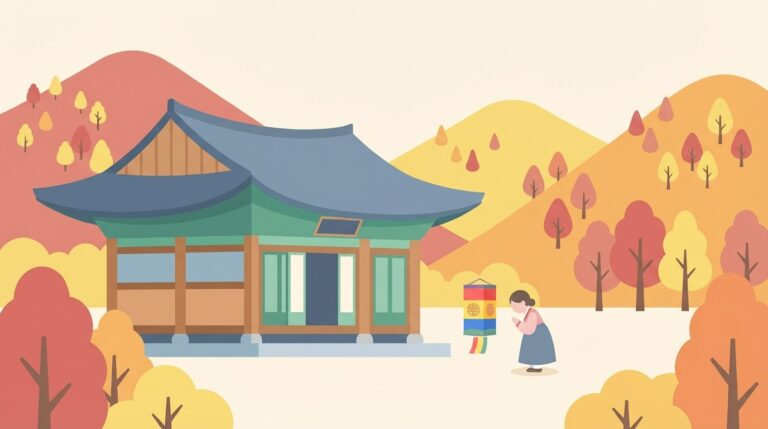
You’ve seen it in K-Dramas, haven’t you? The main character is going through a heartbreaking breakup or a stressful office crisis. Suddenly, the scene cuts to a peaceful mountain. You hear the deep, resonant sound of a bronze bell—doooong—and see them taking a slow breath under colorful paper lanterns.
Visiting a Buddhist temple (절, jeol) in Korea isn’t just a religious activity; it’s a deep dive into traditional K-Culture, finding peace, and maybe trying some amazing vegan temple food (사찰음식).
But wait… when you actually visit a famous spot like Bongeunsa Temple in Gangnam, do you know what to say? How do you ask to make a wish without looking like a lost tourist? What does the monk mean when they point at your shoes?
Don’t worry. This guide is based on real experiences from my students who successfully navigated Korean temples, finding their Zen without any awkward cultural faux pas. Let’s step into the tranquil world of Korean temples!
Phase 2: Core Expressions Deep Dive
1. 절에 가요 (I’m going to a temple)
- Pronunciation: [jeore gayo] + Sounds like: juh-reh gah-yo (‘eo’ sounds like ‘uh’ in ‘uh-oh’)
- Meaning: Literal: I go to a temple. / Real nuance: I’m heading to a Buddhist temple (often implies seeking peace or doing a templestay).
- K-Culture Moment: When your Korean coworkers ask about your weekend plans, answering with “절에 가요” will instantly make them look at you with respect. It shows you’re exploring deep Korean culture, not just shopping in Myeongdong.
- Editor’s Insight: The word ‘절’ means temple. Because of the location particle ‘에’ (to/at), the ‘ㄹ’ sound carries over, making it sound like ‘저레’ (jeo-re).
- Situation Spectrum:
- Casual (Friends): ✅ (You can drop the ‘요’ and say “절에 가”)
- Semi-formal (Coworkers): ✅
- Formal (Boss/Elders): ✅
- 🤔 Think About It: Why do Koreans, even non-Buddhists, frequently visit temples on weekends? How does the concept of ‘healing’ (힐링) in Korean society connect to nature and tradition?
2. 소원을 빌어요 (I make a wish)
- Pronunciation: [sowoneul bireoyo] + Sounds like: so-won-eul bee-ruh-yo
- Meaning: Literal: I beg a wish. / Real nuance: I’m making a wish.
- K-Culture Moment: You’ll see this in almost every historical K-Drama (사극). The characters write their wishes on a roof tile (기와) or light a lotus lantern (연등) while clasping their hands together.
- Editor’s Insight: ‘소원’ means wish, and ‘빌다’ means to pray or wish for. In Korea, making a wish isn’t just for birthdays; it’s an active practice of writing it down, paying a small donation, and placing it in a sacred spot.
- Situation Spectrum:
- Casual (Friends): ✅
- Semi-formal (Coworkers): ✅
- Formal (Boss/Elders): ✅
- 🤔 Think About It: In many Western cultures, wishes are kept secret (like blowing out birthday candles). In Korea, wishes are written clearly on colorful lanterns for everyone to see. What does this public display of hope say about the culture?
3. 신발을 벗으세요 (Please take off your shoes)
- Pronunciation: [sinbareul beoseuseyo] + Sounds like: shin-bal-eul buh-seu-seh-yo
- Meaning: Literal: Please take off your shoes. / Real nuance: Shoes are strictly forbidden beyond this point; please remove them to show respect.
- K-Culture Moment: You step onto the wooden porch of the main temple hall (대웅전). Suddenly, a kind volunteer rushes over waving their hands, saying this phrase. It’s the ultimate rule of Korean indoor spaces!
- Editor’s Insight: ‘신발’ (shoes) + ‘벗다’ (to take off). The ‘-으세요’ ending makes it a polite command. Memorize this sound, because you will hear it at temples, traditional restaurants, and Korean homes!
- Situation Spectrum:
- Casual (Friends): 🚫 (Too formal for friends, use “신발 벗어”)
- Semi-formal (Coworkers): ⚠️ (Only if you are guiding them)
- Formal (General Public/Signs): ✅ (Standard polite request)
- 🤔 Think About It: Taking off shoes separates the ‘clean’ inside from the ‘dirty’ outside. How does this physical boundary reflect the mental boundary of entering a spiritual space in Korea?
Phase 3: Textbook vs Real Korean
Let’s see how textbook Korean differs from what you’ll actually hear at the temple.
[Expressing your weekend plans]
* 📖 Textbook: 저는 이번 주말에 불교 사찰에 방문할 예정입니다. (I plan to visit a Buddhist temple this weekend. – Too stiff, sounds like a news report!)
* 🗣️ Real Korean: 이번 주말에 절에 가요. (I’m going to a temple this weekend.)
* 💡 Why different?: Koreans prefer efficiency in daily conversation. The native Korean word ‘절’ is used much more often than the Sino-Korean word ‘사찰’ (temple) in casual speech.
[Asking someone to be quiet]
* 📖 Textbook: 이곳에서는 정숙해 주시기를 바랍니다. (We hope you maintain silence in this area.)
* 🗣️ Real Korean: 쉿, 조용히 해 주세요. (Shh, please be quiet.)
* 💡 Why different?: Written signs at temples will use formal words like ‘정숙’ (silence), but spoken requests rely on the simple verb ‘조용히 하다’ (to be quiet).
(Bottom Note: For A2 learners, sticking to the present polite form (-아요/어요) is the perfect balance of respectful and natural!)
Phase 4: Cultural Context — K-Culture Deep Dive
4-1. Non-Verbal Communication & Nunchi
At a temple, Nunchi (눈치)—the Korean art of reading the room—is your best friend.
When you enter the temple grounds, you might not see explicit “Be Quiet” signs everywhere. However, using your Nunchi, you’ll notice people speaking in hushed tones, avoiding loud laughter, and walking softly.
Also, never point your toes towards the Buddha statue when sitting inside the hall. Always sit cross-legged or with your feet tucked under/behind you.
4-2. K-Drama & K-Travel Connection
Have you noticed that temples in K-Dramas are often located right in the middle of a busy city? That’s not just TV magic! While many temples are in deep mountains, places like Jogyesa (조계사) or Bongeunsa (봉은사) are located right next to skyscrapers in Seoul.
If you do a Templestay (템플스테이), you’ll experience a famous drama trope: 108 Bows (108배). It’s a physical and spiritual exercise where you bow down to the floor 108 times to let go of worldly desires. It’s a fantastic workout, but expect your legs to shake the next day!
Phase 5: Real-Life Roleplay Scenario
Scenario A: Making a Wish at Jogyesa Temple
- Setting: Saturday afternoon. Jogyesa Temple in central Seoul. Colorful lotus lanterns cover the sky above the courtyard. The smell of incense is in the air.
- Characters:
- YOU: An A2 Korean learner, visiting a temple for the first time.
- Min-su (32): Your friendly Korean coworker who offered to show you around.
Min-su: 절 분위기 어때요? 좋죠?
(jeol bunwigi eottaeyo? chojyo?)
[How’s the temple atmosphere? Nice, right?]
YOU: 네, 정말 평화로워요. 그런데 저 사람들은 뭐 해요?
(ne, jeongmal pyeonghwarowoyo. geureonde jeo saramdeureun mwo haeyo?)
[Yes, it’s really peaceful. But what are those people doing?]
Min-su: 아, 기와에 소원을 적고 있어요. 우리도 해 볼까요?
(a, giwa-e sowoneul jeokgo isseoyo. urido hae bolkkayo?)
[Ah, they are writing wishes on roof tiles. Shall we try it too?]
(🎭 Stage Direction: Min-su points to a booth where people are painting letters on black clay tiles)
YOU: 좋아요! 얼마예요?
(joayo! eolmayeyo?)
[Sounds good! How much is it?]
Min-su: 만 원이에요. 저기 대웅전 안에 들어가서 절도 할래요?
(man wonieyo. jeogi daeungjeon ane deureogaseo jeoldo hallaeyo?)
[It’s 10,000 won. Do you want to go inside the main hall over there and bow too?]
🔀 Your Turn! You step up to the main hall’s wooden floor. What do you do?
* A) Walk straight in with your cool sneakers on.
* B) Ask: “신발 벗어요?” (sinbal beoseoyo? – Do I take off my shoes?)
* C) Say: “조용히 해 주세요!” (joyonghi hae juseyo! – Please be quiet!)✅ Best Choice: B — Korean temples strictly require you to remove your shoes before entering any prayer hall. Asking “신발 벗어요?” shows great cultural awareness!
⚠️ Choice A & C Analysis: Choice A is a major cultural offense. Choice C means telling others to be quiet, which might make you look like a grumpy security guard!
YOU: 신발 벗어요?
(sinbal beoseoyo?)
[Do I take off my shoes?]
Min-su: 네, 맞아요. 신발은 벗고 들어가야 해요.
(ne, majayo. sinbareun beotgo deureogaya haeyo.)
[Yes, that’s right. You have to take off your shoes to go in.]
YOU: 알겠어요. 조금 떨려요.
(algesseoyo. jogeum tteollyeoyo.)
[Understood. I’m a little nervous.]
Min-su: 괜찮아요. 제가 하는 거 보고 따라 하세요.
(gwaenchanayo. jega haneun geo bogo ttara haseyo.)
[It’s okay. Just watch what I do and follow along.]
Scenario B: Buying a Wish Bracelet (Bonus)
- Setting: The temple gift shop (불교 용품점).
Staff: 어서 오세요. 찾으시는 거 있으세요?
(eoseo oseyo. chajeusineun geo isseuseyo?)
[Welcome. Are you looking for anything in particular?]
YOU: 네, 소원 팔찌 있어요?
(ne, sowon paljji isseoyo?)
[Yes, do you have wish bracelets?]
Staff: 네, 이쪽에 있어요. 색깔마다 의미가 달라요.
(ne, ijjoge isseoyo. saekkkalmada uimiga dallayo.)
[Yes, they are over here. Each color has a different meaning.]
Phase 6: 10-Second Shadowing Drill
Read this out loud. Pay attention to the pauses (/) and the mood tags!
😊 Brightly: 저는 / 주말에 / 절에 가요!
(jeo-neun / ju-ma-re / jeo-re ga-yo!)
[I’m going to a temple on the weekend!]🥺 Earnestly: 여기서 / 소원을 / 빌어요.
(yeo-gi-seo / so-wo-neul / bi-reo-yo.)
[I make a wish here.]🤫 Whispering: 쉿, / 조용히 해 / 주세요.
(swit, / jo-yong-hi hae / ju-se-yo.)
[Shh, please be quiet.]
Phase 7: K-Culture Mini Dictionary
| 한국어 | Romanization | English | Cultural Context |
|---|---|---|---|
| 템플스테이 | tempeulseutei | Templestay | A program where visitors live like monks for a few days. Highly popular among foreigners! |
| 연등 | yeondeung | Lotus Lantern | Colorful paper lanterns hung during Buddha’s Birthday. People attach wish tags to them. |
| 합장 | hapjang | Clasping Hands | The Buddhist greeting of putting hands together at the chest and slightly bowing. |
| 눈치 | nunchi | Social Awareness | Reading the atmosphere. Essential at a temple to know when to be quiet without being told. |
| 소원 팔찌 | sowon paljji | Wish Bracelet | Buddhist prayer beads worn as bracelets. A very popular souvenir. |
Phase 8: Traveler Survival Kit
If you’re visiting a Korean temple, keep these survival phrases handy!
🆘 Survival Phrase #1: Can I take pictures?
* 🇰🇷 “사진 찍어도 돼요?” (sajin jjigeodo dwaeyo?)
* 📍 Where to use: Before taking photos of monks, inside buildings, or during ceremonies.
* 💡 Pro Tip: Taking photos of the outside of buildings is usually fine, but photos inside the main hall containing the Buddha statue are often prohibited. Always ask!🆘 Survival Phrase #2: How much is this? (For donations/gifts)
* 🇰🇷 “이거 얼마예요?” (igeo eolmayeyo?)
* 📍 Where to use: At the gift shop or when buying a roof tile (기와) or rice (공양미) for offering.🆘 Survival Phrase #3: Where is the restroom?
* 🇰🇷 “화장실이 어디예요?” (hwajangsiri eodiyeyo?)
* 📍 Where to use: When you get lost in the large temple complexes.📌 Editor’s Travel Note
* Socks are mandatory: Bare feet are considered disrespectful on temple floors. Bring clean socks!
* Card vs Cash: While Korea is a cashless society, having a 10,000 KRW bill is useful if you want to leave a small donation in the offering box (불전함).
* Navigation Apps: Use KakaoMap or Naver Map. Google Maps does not provide accurate walking directions in Korea.
Phase 9: Critical Thinking — “One Step Deeper”
Media vs Reality: The K-Drama Temple vs The Real Temple
🧠 Think Deeper:
In K-Dramas, temples are often portrayed as magical, isolated spots where characters go to hide from the world or undergo dramatic healing. While temples are peaceful, they are also highly active community centers. On weekends, they are bustling with elderly locals praying for their children’s exams, volunteers cooking large meals, and tourists taking photos. The reality of a Korean temple is a beautiful, slightly chaotic blend of ancient spirituality and modern, busy Korean life.💬 Your Turn: Do religious or spiritual places in your culture act more like quiet retreats or bustling community centers? Share in the comments!
Phase 10: FAQ & Avoiding Misunderstandings
Q: “Can I wear shorts and a tank top to a temple?”
* Editor says: NO. Korean temples require modest dress. Sleeveless shirts, mini-skirts, and short shorts are considered disrespectful. If you accidentally wear them, some large temples might lend you “elephant pants” (냉장고 바지), but it’s best to come prepared!
Q: “Do I have to bow if I’m not Buddhist?”
* Editor says: NO. You don’t have to participate in the religious bowing (절하기) if you don’t want to. Standing quietly or giving a slight nod of the head is perfectly respectful.
Q: “Can I use ‘조용히 해 주세요’ to an older person?”
* Editor says: NO. Even with ‘주세요’ (please), asking an elder to be quiet can sound rude. It’s better to just use your Nunchi or ask a temple volunteer for help.
❌ Common Mistake: Walking through the absolute center door of a temple hall.
✅ Do This Instead: The central door is reserved for monks and the Buddha. Visitors should always use the side doors to enter and exit. Also, avoid stepping on the wooden door threshold (문지방)!
Phase 11: Summary & Action Items
- One-Liner Summary: Remember to say “절에 가요” (I go to the temple), take off your shoes (신발 벗기), and make a beautiful wish (소원 빌기)!
🎬 Action Mission:
* 🥉 Bronze (Solo): Read the 3 core expressions out loud in front of a mirror, practicing the polite ‘-요’ ending.
* 🥈 Silver (Online): Comment below: “저는 [Your City]에서 소원을 빌어요!” (I make a wish in [City]!)
* 🥇 Gold (Real Life): When you visit Korea, successfully buy a wish bracelet (소원 팔찌) at a temple using “이거 얼마예요?”.
🌸 K-Culture Mission:
Open Google Street View (or KakaoMap Road View) and search for Jogyesa Temple (조계사) in Seoul. Look around the courtyard. Can you spot where you would write your wish or take off your shoes?
Phase 12: Quiz — Interactive Challenge
1. Situational Judgment: You are about to step into the main hall of the temple to see the beautiful golden statues. Your Korean friend looks down at your feet. What should you ask?
* A) “사진 찍어도 돼요?” (Can I take photos?)
* B) “신발 벗어요?” (Do I take off my shoes?)
* C) “얼마예요?” (How much is it?)
2. Fill in the Blank:
“이번 주말에 평화로운 ______에 가요. 가서 ______을 빌어요.”
(This weekend, I’m going to a peaceful ______. I will make a ______ there.)
* A) 절 / 소원
* B) 카페 / 커피
* C) 식당 / 기와
3. True or False — K-Culture Edition:
“If you enter a temple hall in Korea, you must walk through the middle door to show confidence.”
* True or False?
(Answers: 1. B – Always check if you need to remove shoes! 2. A – jeol (temple) / sowon (wish). 3. False – Always use the side doors, as the middle door is reserved!)
Frequently Asked Questions (FAQ)
Q: What does "절에 가요 (I'm going to a temple)" mean in Korean and how do you pronounce it?
A: In Korean, "절에 가요 (I'm going to a temple)" is pronounced [jeore gayo] and means: Literal: I go to a temple. / Real nuance: I'm heading to a Buddhist temple (often implies seeking peace or doing a templestay).
Q: What does "소원을 빌어요 (I make a wish)" mean in Korean and how do you pronounce it?
A: In Korean, "소원을 빌어요 (I make a wish)" is pronounced [sowoneul bireoyo] and means: Literal: I beg a wish. / Real nuance: I'm making a wish.
Q: What does "신발을 벗으세요 (Please take off your shoes)" mean in Korean and how do you pronounce it?
A: In Korean, "신발을 벗으세요 (Please take off your shoes)" is pronounced [sinbareul beoseuseyo] and means: Literal: Please take off your shoes. / Real nuance: Shoes are strictly forbidden beyond this point; please remove them to show respect.







