

Unlocking Korean Convenience Stores: Mastering 1+1 & 2+1 Promos Like a Local
Phase 1: Empathy (The Convenience Store Standoff)
Hello! Daily Hangul Editor here.
Picture this: It’s 11 PM in Seoul. You’ve just finished watching a K-Drama where the main characters bond over a late-night snack outside a convenience store (편의점 – pyeonuijeom). Inspired, you head to the local CU or GS25. You grab one bag of potato chips and head to the counter. The cashier scans it, pauses, looks at you, and points rapidly at the shelf while saying something like, “투플원이라 하나 더…” You freeze. You just wanted chips! Why are they sending you back?
If you’ve ever felt this panic, you’re not alone! Knowing how to navigate Korea’s ubiquitous 1+1 (“one-plus-one”) and 2+1 (“two-plus-one”) deals will not only save you money, but it will also earn you that sweet “insider” nod from the cashier.
This guide is based on real SOS messages from my students who ended up paying full price because they didn’t know how to claim their free items!
Phase 2: Deep Dive into Core Expressions
1. 이거 1+1 행사 상품인가요?
- Pronunciation: igeo won-peul-leo-seu-won haeng-sa sang-pum-in-ga-yo? (Sound analogy: ‘won’ like the currency, ‘peul-leo-seu’ said rapidly like a single blur, ‘haeng’ like hang + sah).
- Meaning: Literal: “Is this a 1+1 event product?” / Real Nuance: “Is this buy-one-get-one-free?”
- K-Culture Moment: You see a pink tag under your favorite banana milk, but it’s slightly shifted. You ask this to make sure you’re getting the deal before scanning.
- Editor’s Insight: Koreans pronounce “1+1” as the English words “One-Plus-One,” but with a Korean accent. You don’t read the numbers in native Korean!
- Situation Spectrum:
- Casual with friends: ✅ (“야, 이거 원플원이야?”)
- Semi-formal (Cashiers): ✅
- Formal: 🚫 (Not typically used in corporate boardroom settings)
- 🤔 Think About It: Why do Koreans use the word “행사” (event/ceremony) for a simple discount? It shows how retail promotions are treated as special, time-limited campaigns rather than just everyday price drops.
2. 교차 증정 되나요?
- Pronunciation: gyo-cha jeung-jeong doe-na-yo? (Sound analogy: ‘gyo’ sounds like yo with a soft g, ‘jeung’ sounds like jung in jungle).
- Meaning: Literal: “Is cross-presentation possible?” / Real Nuance: “Can I mix and match flavors?”
- K-Culture Moment: You’re buying a 2+1 deal on triangle kimbap (삼각김밥). You want two Tuna Mayo and one Jeonju Bibimbap flavor. You ask this to confirm the deal applies across different flavors of the same brand.
- Editor’s Insight: “증정” is a formal word meaning “presentation” or “gifting.” It sounds very corporate, but it’s the absolute standard term used in retail customer service.
- Situation Spectrum:
- Casual: ⚠️ (Too formal for friends. Just say “다른 맛 섞어도 돼?”)
- Semi-formal (Cashiers): ✅
- Formal: ✅
- 🤔 Think About It: Have you noticed how formal Korean retail language can be? Cashiers often use highly polite vocabulary for objects. Does your native language have a specific “customer service” register?
3. 나머지 하나는 앱에 보관할게요.
- Pronunciation: na-meo-ji ha-na-neun aeb-e bo-gwan-hal-ge-yo.
- Meaning: Literal: “I will store the remaining one in the app.” / Real Nuance: “I’ll save the free item in my app for later.”
- K-Culture Moment: You buy a 2+1 milk deal, but carrying three milks is too heavy. You whip out the convenience store app and scan it to pick up the third milk at any branch another day.
- Editor’s Insight: This highlights the ultimate “Ppalli-Ppalli” (hurry up) and hyper-convenience culture of Korea. It’s practical magic!
- Situation Spectrum:
- Casual: 🚫
- Semi-formal (Cashiers): ✅
- Formal: ⚠️
- 🤔 Think About It: Storing physical goods in a digital space to pick up later at a different location—how does this reflect Korea’s IT infrastructure and dense city living?
Phase 3: Textbook vs. Real Korean
[Asking about the promotion]
* 📖 Textbook Korean: 이것은 하나 사면 하나를 무료로 주는 물건입니까? (Is this an item where if I buy one, you give one free?)
* 🗣️ Real Korean: 이거 원플원(1+1) 맞아요? (igeo won-peul-won ma-ja-yo?)
* 💡 Why the difference?: Koreans love efficiency. “One-plus-one” gets shortened even further to the slang “원플원” (won-peul-won) and 2+1 becomes “투플원” (tu-peul-won).
[When the cashier tells you to grab another]
* 📖 Textbook Korean: 손님, 한 개를 더 가져오셔야 합니다. (Customer, you must bring one more.)
* 🗣️ Real Korean: 손님, 이거 투플원이라 하나 더 가져오시면 돼요. (son-nim, igeo tu-peul-won-i-ra ha-na deo ga-jyeo-o-si-myeon dwae-yo.)
* 💡 Why the difference?: The grammar “~(으)면 되다” (it would be fine if you…) softens the command, making the customer service sound much more polite and less demanding.
Bottom Note: For B2 learners, using “원플원” shows you really know your stuff, but sticking to “원플러스원” is perfectly natural and safe!
Phase 4: Cultural Context — K-Culture Deep Dive
4-1. Non-Verbal Cues: The “Barcode Nunchi”
In Korea, “Nunchi” (눈치) is the subtle art of reading the room. At the convenience store, Nunchi is required at the checkout. If you bring two items of a 2+1 deal, the cashier will scan them and pause. They won’t always speak immediately. If they look at the screen, then look at you, that’s your Nunchi cue to say, “아, 하나 더 가져올까요?” (Ah, should I go grab one more?).
4-2. K-Food Connection: The Late-Night Ramen Run
If you watch K-Dramas like Hospital Playlist or Reply 1988, you’ve seen characters eating instant ramen at the convenience store tables. These tables are social hubs. Often, teenagers or coworkers will buy 2+1 sausages or drinks to split. The 2+1 promotion is essentially designed for Korea’s group-oriented dining culture (Jeong – 정). It encourages you to share!
Phase 5: Real-Life Roleplay Scenario
Setting: 11:30 PM. A CU convenience store near your hotel in Myeongdong. You’re exhausted from shopping and just want some spicy ramen and a drink.
Characters:
– YOU: A tired but hungry traveler on day 3 of your trip.
– Cashier (알바생 – Alba-saeng): A 20-something university student working the night shift, wearing a CU vest.
Dialogue:
Cashier: 어서 오세요. 봉투 필요하세요? 🛍️
(eoseo oseyo. bongtu piryohaseyo?)
[Translation] Welcome. Do you need a bag?
YOU: 아니요, 괜찮아요. 가방에 넣을게요.
(aniyo, gwaenchanayo. gabaenge noeulgeyo.)
[Translation] No, it’s okay. I’ll put it in my bag.
Cashier: 네, 알겠습니다.
(ne, algetseumnida.)
[Translation] Yes, understood.
(🎭 Stage Direction: Scans your ramen, then scans your two peach waters. ‘Beep beep’.)
Cashier: 손님, 이 음료수 투플원(2+1) 행사 중인데 하나 더 가져오시겠어요?
(sonnim, i eumnyosu tu-peul-won haengsa junginde hana deo gajyeoosigesseoyo?)
[Translation] Customer, these drinks are on a 2+1 promotion, would you like to bring one more?
YOU: 아, 정말요? 교차 증정도 되나요?
(a, jeongmalyo? gyocha jeungjeongdo doenayo?)
[Translation] Oh, really? Can I mix and match flavors?
Cashier: 네, 같은 브랜드면 다 돼요. 레몬 맛이나 청포도 맛으로 가져오시면 됩니다.
(ne, gateun beuraendeumyeon da dwaeyo. remon masina cheongpodo maseuro gajyeoosimyeon deomnida.)
[Translation] Yes, any from the same brand is fine. You can bring lemon or white grape flavor.
YOU: 그럼 잠시만요!
(geureom jamsimanyo!)
[Translation] Just a moment then!
(🎭 Stage Direction: You run to the fridge, grab a lemon water, and run back to the counter.)
YOU: 여기 있습니다. 이거 1+1 행사하는 소시지도 하나 추가할게요.
(yeogi itseumnida. igeo won-peul-won haengsahaneun sosijido hana chugahalgeyo.)
[Translation] Here it is. I’ll also add this sausage that’s on a 1+1 promotion.
Cashier: 아, 손님. 이 소시지는 원플원(1+1)이라서 하나 더 가져오셔야 하는데요.
(a, sonnim. i sosijineun won-peul-woniraseo hana deo gajyeoosyeoya haneundeyo.)
[Translation] Ah, customer. This sausage is 1+1, so you need to bring one more.
🔀 Your Turn! Decision Point:
You’re tired of running back and forth. What do you say?
– A) “그냥 하나만 결제해 주세요.” (Just ring up one, please.)
– B) “나머지 하나는 앱에 보관할게요.” (I’ll store the other one in the app.)
– C) “진짜요? 대박! 또 다녀올게요.” (Really? Awesome! I’ll be right back.)✅ Best Choice: B — If you have the store’s app, this is the ultimate pro move! You get the deal without the heavy lifting.
⚠️ Choice A Analysis: You can say this, but you are literally paying the exact same price for one sausage as you would for two. The cashier might look at you like you’re missing out on free food!
YOU (Choosing B): 아, 소시지 나머지 하나는 앱에 보관할게요. 바코드 여기 있어요. 📱
(a, sosiji nameoji hananeun aebe bogwanhalgeyo. bakodeu yeogi isseoyo.)
[Translation] Ah, I’ll store the remaining sausage in the app. Here’s the barcode.
Cashier: 네, 앱에 보관해 드렸습니다. 포인트 적립하시나요?
(ne, aebe bogwanhae deuryeotseumnida. pointeu jeongnipasinayo?)
[Translation] Yes, I’ve stored it in the app. Would you like to earn points?
YOU: 아니요, 카드로 계산할게요.
(aniyo, kadeuro gyesanhalgeyo.)
[Translation] No, I’ll pay by card.
(🎭 Stage Direction: Transaction completes successfully! You walk out a true convenience store master.)
Scenario B: K-Culture Bonus — The “Nunchi” Game with a Friend
Setting: You and your Korean coworker, Minsu, just bought a 2+1 coffee deal after a heavy lunch. You have 3 coffees for 2 people.
Minsu: 앗, 커피가 세 개네요. 누가 두 개 마실래요?
(at, keopiga se gaeneyo. nuga du gae masillaeyo?)
[Translation] Oops, there are three coffees. Who wants to drink two?
YOU: 제가 오늘 너무 피곤해서… 제가 하나 더 마셔도 될까요?
(jega oneul neomu pigonhaeseo… jega hana deo masyeodo doelkkayo?)
[Translation] I’m so tired today… could I drink one more?
Minsu: 그럼요! 다 드세요. 수고하세요!
(geureomyo! da deuseyo. sugohaseyo!)
[Translation] Of course! Drink up. Keep up the good work!
Phase 6: 10-Second Shadowing Drill
Listen to the rhythm and practice out loud! Pay attention to the pauses.
😊 아, / 이거 / 교차 증정 / 되나요?
(Ah, / igeo / gyo-cha jeung-jeong / doe-na-yo?)
Speak with a bright, slightly curious tone, raising the pitch at the very end.
Phase 7: K-Culture Mini Dictionary
| Korean | Romanization | English | Context |
|---|---|---|---|
| 알바생 | alba-saeng | Part-time worker | Derived from the German “Arbeit”. The backbone of Korea’s retail industry. |
| 원플원 | won-peul-won | 1+1 (BOGO) | Slang for One-Plus-One. Essential for bargain hunters. |
| 투플원 | tu-peul-won | 2+1 | Buy two, get one free. The most common promotion type in Korea. |
| 교차 증정 | gyo-cha jeung-jeong | Mix and match | Being able to choose different flavors for your free promotional item. |
| 나만의 냉장고 | na-man-ui naeng-jang-go | My Fridge | A feature in the GS25 app allowing you to digitally store free items. |
Phase 8: Traveler Survival Kit
🆘 Survival Phrase #1
– 🇰🇷 “봉투 필요하세요?” (bong-tu pi-ryo-ha-se-yo?)
– 🗣️ English: Do you need a bag?
– 📍 Where: Every convenience store, supermarket, and bakery.
– 💡 Pro Tip: In Korea, plastic bags cost about 20 to 50 won by law. Just say “네 (Yes)” or “아니요, 괜찮아요 (No, it’s okay)”.📌 Editor’s Travel Note
– App to Download: If you are staying in Korea for a while, download the “Pocket CU” or “GS25 (우리동네GS)” apps to store your +1 items.
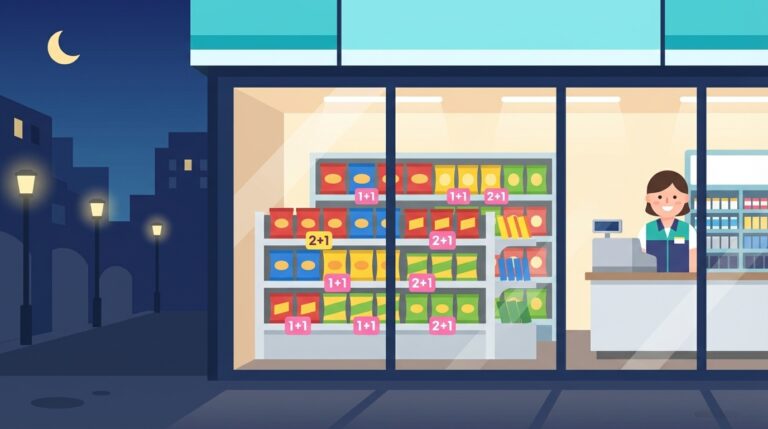
– Price Tags: Look at the price tags on the shelves. 1+1 tags are usually bright pink, and 2+1 are yellow or blue. If there’s no tag, it’s full price!
– Self-Checkout: Many stores now have self-checkout kiosks. The machine will literally announce “행사 상품입니다!” (It’s a promo item!) if you forget to scan your free item. Don’t panic, just go grab it!
Phase 9: Critical Thinking Corner — “A Step Deeper”
Food & Identity: The “We” Culture in Promotions
🧠 Think Deeper:
Have you ever wondered why 2+1 is more common than a simple 33% off discount in Korea? Korean food culture is deeply rooted in communal sharing (Jeong – 정). Buying two items to get a third free naturally encourages you to share the extras with friends, classmates, or coworkers. It transforms a solitary, purely transactional purchase into a communal experience.💬 Your Turn: Does your country prefer direct percentage discounts, or “Buy X Get Y” deals? Share your thoughts in the comments!
Phase 10: FAQ & Avoiding Misunderstandings
- Q: Can I use 1+1 deals across completely different brands?
- No. You can only mix and match (교차 증정) within the same brand and same price point. For example, you can mix a Binggrae Banana Milk with a Binggrae Strawberry Milk, but not with a Seoul Milk.
- Q: If I only want one item of a 1+1 deal, do I pay half price?
- No. You pay the full price of one item. The second item is strictly a free bonus.
❌ Common Mistake #1: Thinking 2+1 means you get two items total.
✅ Do this instead: 2+1 means you pay for two, and you get a THIRD one free. Always bring three items to the counter! If you only bring two, the cashier will tell you to go get one more.
Phase 11: Summary & Action Items
- One-Liner Summary: Don’t miss out on free snacks—look for the colorful tags and confidently ask “교차 증정 되나요?” to mix your flavors!
-
Action Mission 3 Steps:
- 🥉 Bronze (Solo): Say “이거 원플원 맞아요?” out loud 3 times in front of the mirror.
- 🥈 Silver (Online): Check a Korean YouTuber’s convenience store ‘Mukbang’ and try to spot the 2+1 tags on the shelves in the background.
- 🥇 Gold (Real Life): Go to a Korean convenience store, find a 2+1 deal, mix the flavors, and buy it flawlessly!
- K-Culture Mission: Watch an episode of a K-Drama set in a convenience store (like Backstreet Rookie or Convenience Store Fling). See how many times the characters say “알바생” or interact with the cash register deals!
Engagement: What’s your absolute favorite Korean convenience store snack? Let me know in the comments below!
Phase 12: Quiz — Interactive Challenge
1. Situational Judgment:
You bring two 1,500 won juices to the counter. The cashier says it’s a 2+1 deal. How many juices should you walk out of the store with, and how much do you pay in total?
A) 2 juices, 1,500 won.
B) 3 juices, 3,000 won.
C) 3 juices, 4,500 won.
👀 Click for Answer
Correct Answer: B! You pay for two (1,500 x 2 = 3,000) and get the third one completely free.
2. Fill in the Blank:
You want to choose a different flavor for your free 2+1 item. What do you ask?
“이거 [ ________ ] 되나요?”
👀 Click for Answer
Answer: 교차 증정 (gyo-cha jeung-jeong). Mix and match!
3. True or False – K-Culture Edition:
“If an item is 1+1, the cashier will always go fetch the free item for you if you forget it.”
👀 Click for Answer
False! The cashier (알바생) is usually tied to the register. It is the customer’s responsibility to go grab the extra item. They will just politely wait for you to run and get it!
4. Roleplay Application:
In Phase 5, if you chose Option C (“진짜요? 대박! 또 다녀올게요.”) instead of using the app, how would the Alba-saeng likely react?
A) They will be deeply offended by your casual tone.
B) They will patiently wait, though “대박” is a bit casual for strangers.
C) They will cancel the transaction and ask you to leave.
👀 Click for Answer
Answer: B! “대박” (Daebak/Awesome) is casual slang, but convenience store workers are used to friendly travelers being excited. However, it’s always safer to use semi-formal language with strangers!
Frequently Asked Questions (FAQ)
Q: What does "이거 1+1 행사 상품인가요?" mean in Korean and how do you pronounce it?
A: In Korean, "이거 1+1 행사 상품인가요?" is pronounced [igeo won-peul-leo-seu-won haeng-sa sang-pum-in-ga-yo? (Sound analogy: 'won' like the currency, 'peul-leo-seu' said rapidly like a single blur, 'haeng' like hang + sah] and means: Literal: "Is this a 1+1 event product?" / Real Nuance: "Is this buy-one-get-one-free?"
Q: What does "교차 증정 되나요?" mean in Korean and how do you pronounce it?
A: In Korean, "교차 증정 되나요?" is pronounced [gyo-cha jeung-jeong doe-na-yo? (Sound analogy: 'gyo' sounds like yo with a soft g, 'jeung' sounds like jung in jungle] and means: Literal: "Is cross-presentation possible?" / Real Nuance: "Can I mix and match flavors?"
Q: What does "나머지 하나는 앱에 보관할게요." mean in Korean and how do you pronounce it?
A: In Korean, "나머지 하나는 앱에 보관할게요." is pronounced [na-meo-ji ha-na-neun aeb-e bo-gwan-hal-ge-yo.] and means: Literal: "I will store the remaining one in the app." / Real Nuance: "I'll save the free item in my app for later."







