

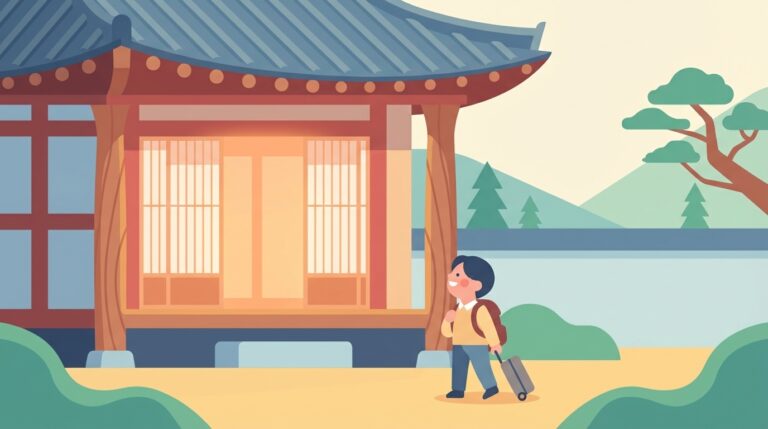
Step Into a K-Drama! How to Book a Traditional Hanok Stay Like a Pro
Phase 1: Empathy & K-Culture Cold Open
Hello, language explorers! It’s your Daily Hangul Editor here.
Imagine this: You’re watching a historical K-Drama like Mr. Queen or Love in the Moonlight. The main character slides open a beautiful wooden door lined with delicate paper, stepping out onto a sunlit wooden porch (마루, maru). The wind chimes ring, and you think, “I want to wake up there!”
Well, you can! A Hanok (한옥) stay is a must-do experience when traveling to Korea. But here’s the catch—when you try to book one, you realize it’s not like booking a standard hotel. Suddenly, you need to know about heated floors, traditional mattresses, and whether you have to share a bathroom!
If you don’t know the right questions to ask, you might end up shivering on a thin blanket or awkwardly walking across a shared courtyard in your pajamas. Don’t worry! As someone who has navigated countless Hanok alleys in Seoul and Jeonju, I’ve gathered the essential B1-level phrases you need to book your dream stay. Let’s make your K-Drama moment a reality!
(Note: This guide is based on real questions from travelers who wanted to experience traditional Korean architecture without the stress!)
Phase 2: Core Expressions Deep Dive
Here are the three most important phrases you’ll need when booking or inquiring about a Hanok stay.
1. 온돌방으로 예약할 수 있나요? (Can I book an Ondol room?)
- Pronunciation: [ondolbang-euro yeyakal su innayo?] + [on-dol-bang-eu-ro ye-yak-al soo in-na-yo?]
- Meaning: Can I reserve an Ondol (traditional Korean heated floor) room?
- K-Culture Moment: Winter in Korea is freezing! But step inside an Ondol room, and the floor is so warm that Koreans naturally sit, eat, and sleep on the ground. In dramas, you’ll often see families peeling tangerines while sitting on a warm Ondol floor.
- Editor’s Insight: Most Hanoks do not have western beds. Instead, you sleep on a thick traditional blanket called a ‘요’ (yo). If you have a bad back, you might want to ask if they have rooms with beds (침대방), but trying the Ondol is the authentic way!
- Situation Spectrum:
- Close Friends (Casual): 온돌방으로 예약할까? ✅
- Hotel Staff (Semi-formal/Formal): 온돌방으로 예약할 수 있나요? ✅
- Boss/Elder: 🚫 (Not typically used unless making a booking on their behalf)
- 🤔 Think About It: Why did Koreans develop a floor-heating system rather than air heating? How does sitting on the floor change the way people interact with each other in a room?
2. 화장실은 방 안에 있나요? (Is the bathroom inside the room?)
- Pronunciation: [hwajangsireun bang ane innayo?] + [hwa-jang-shil-eun bang ahn-eh in-na-yo?]
- Meaning: Is the bathroom inside the room? (Is it a private en-suite?)
- K-Culture Moment: Traditional Hanoks originally had bathrooms outside the main house. While modernized for tourists, some older or budget Hanok guesthouses still use shared external bathrooms. Imagine running outside in the winter night just to use the restroom!
- Editor’s Insight: This is the #1 question my foreign friends forget to ask. Always confirm this unless you love midnight courtyard adventures.
- Situation Spectrum:
- Casual: 화장실 방 안에 있어? ✅
- Staff (Semi-formal/Formal): 화장실은 방 안에 있나요? / 공용인가요? (Is it shared?) ✅
- 🤔 Think About It: Many older Korean homes separated the living space from the restroom for hygiene. How does this compare to traditional architecture in your country?
3. 조식이 포함되어 있나요? (Is breakfast included?)
- Pronunciation: [josigi pohamdoeeo innayo?] + [jo-shig-ee po-ham-dwe-uh in-na-yo?]
- Meaning: Is breakfast included?
- K-Culture Moment: Some premium Hanok stays offer a stunning traditional Korean breakfast—rice, soup, and various side dishes (반찬, banchan) served on a small, beautifully crafted wooden table (소반, soban) brought right to your room.
- Editor’s Insight: Even if it’s just toast and coffee in the communal kitchen, knowing your morning fuel situation is key for a busy travel day.
- Situation Spectrum:
- Casual: 조식 포함이야? ✅
- Staff (Semi-formal/Formal): 조식이 포함되어 있나요? ✅
- 🤔 Think About It: The word ‘조식’ (Breakfast) is derived from Chinese characters. Koreans use different words for meals depending on the setting (e.g., 아침밥 at home vs. 조식 at a hotel). Do you have formal vs. informal words for meals in your language?
Phase 3: Textbook vs. Real Korean
Let’s upgrade your textbook Korean to what real travelers and locals use!
[Asking About Room Availability]
* 📖 Textbook Korean: 예약을 하고 싶습니다. 빈 방이 있습니까? (I want to make a reservation. Is there an empty room?)
* 🗣️ Real Korean: 빈방 있어요? (Got any empty rooms?) or 예약 되나요? (Is booking available?)
* 💡 Why the difference?: Koreans value efficiency (빨리빨리 culture). In casual booking situations, getting straight to the point using the friendly “~아요/어요” form is much more natural than the stiff “~습니다”.
[Checking Times]
* 📖 Textbook Korean: 입실과 퇴실 시간은 언제입니까? (When are the admission and departure times?)
* 🗣️ Real Korean: 체크인/체크아웃 몇 시예요? (What time is check-in/out?)
* 💡 Why the difference?: Global travel terms! While ‘입실’ (enter room) and ‘퇴실’ (leave room) are written on official signs, everyone just says “check-in” and “check-out” in spoken Korean.
Phase 4: Cultural Context — K-Culture Deep Dive
4-1. Non-Verbal Hanok Etiquette
- Shoes Off, Always! When you step onto the wooden porch (마루) or into a room, your shoes must come off. Leaving them on is the ultimate Hanok faux pas.
- Handle with Care: The beautiful sliding doors (창호지문) are made of traditional mulberry paper. They tear easily! Slide them gently, and never poke them (even if you’re tempted).
- Lower Your Volume: Hanoks are made of wood and paper. Sound travels very easily. This isn’t the place for a loud late-night party; it’s a place for quiet ‘눈치’ (Nunchi – reading the room and being considerate of other guests).
4-2. K-Drama Connection: The Aesthetic vs. Reality
Have you noticed in historical K-Dramas how kings and queens sit elegantly in massive, airy rooms? Real Hanok stays in places like Bukchon Hanok Village are often much cozier and more compact. Modern owners have ingeniously hidden air conditioners behind wooden panels and installed modern toilets behind traditional doors. It’s the perfect blend of Joseon Dynasty aesthetics and 21st-century comfort!
Phase 5: Real-Life Roleplay Scenario
Setting: It’s 3 PM. You are planning a weekend trip to Jeonju Hanok Village. You found a beautiful listing online, but you want to call the host to check a few details before paying.
Characters:
– YOU: A B1-level Korean learner excited for your first Hanok experience.
– 사장님 (Owner): A friendly, welcoming Hanok owner in her 50s.
(Phone rings…)
사장님: 네, ‘달빛 한옥’입니다.
(Ne, ‘Dalbit Hanok’imnida.)
[Yes, this is ‘Moonlight Hanok’.]
YOU: 안녕하세요, 이번 주 토요일에 방 예약하려고요.
(Annyeonghaseyo, ibeon ju toyoire bang yeyakaryeogoyo.)
[Hello, I’m calling to book a room for this Saturday.]
사장님: 아, 네! 2명 맞으시죠? 침대방이랑 온돌방 중에 어떤 방으로 하시겠어요?
(Ah, ne! Dumyeong majeushijyo? Chimdaebang-irang ondolbang jung-e eotteon bang-euro hashigesseoyo?)
[Ah, yes! For 2 people, right? Would you like a bed room or an Ondol room?]
YOU: 음… 한국 전통을 느끼고 싶어서요. 온돌방으로 예약할 수 있나요?
(Eum… Hanguk jeontong-eul neukkigo shipeoseoyo. Ondolbang-euro yeyakal su innayo?)
[Um… I want to feel Korean tradition. Can I book an Ondol room?]
사장님: 그럼요! 바닥이 아주 따뜻할 거예요.
(Geureomyo! Badagi aju ttatteutal geo-yeyo.)
[Of course! The floor will be very warm.]
YOU: 그런데, 혹시 화장실은 방 안에 있나요?
(Geureonde, hokshi hwajangsireun bang ane innayo?)
[By the way, is the bathroom inside the room?]
사장님: 네, 방마다 개인 화장실이 다 있어요. 걱정 마세요.
(Ne, bangmada gaein hwajangsiri da isseoyo. Geokjeong maseyo.)
[Yes, every room has a private bathroom. Don’t worry.]
YOU: 다행이네요. 아, 조식이 포함되어 있나요?
(Dahaeng-ineyo. Ah, josigi pohamdoeeo innayo?)
[That’s a relief. Ah, is breakfast included?]
사장님: 네, 아침 8시에 떡국을 드려요.
(Ne, achim yeodeolshie tteokgugeul deuryeoyo.)
[Yes, we serve Tteokguk (rice cake soup) at 8 AM.]
🔀 Your Turn! How should you respond?
– A) “아, 싫어요. 빵 주세요.” (Ah, I hate it. Give me bread.)
– B) “우와, 떡국이요? 감사합니다! 잘 먹겠습니다.” (Wow, Tteokguk? Thank you! I will enjoy it.)
– C) “얼마예요? 깎아주세요!” (How much is it? Give me a discount!)✅ Best Choice: B — Showing enthusiasm for traditional food is a great way to bond with a Hanok host!
⚠️ Choice C Analysis: Asking for a discount over the phone at an established guesthouse is considered slightly rude. Save your haggling skills for the traditional markets!
Phase 6: 10-Second Shadowing Drill
Practice speaking like a local! Pay attention to the pauses (/) and the intonation.
😊 온돌방으로 / 예약할 수 / 있나요?
(on-dol-bang-eu-ro / ye-yak-al su / in-na-yo?)
Make your voice go slightly up at the end to sound polite and inquiring.
🤔 화장실은 / 방 안에 / 있나요?
(hwa-jang-shil-eun / bang ahn-eh / in-na-yo?)
Emphasize ‘방 안에’ (inside the room) so the host knows exactly what you’re asking.
Phase 7: K-Culture Mini Dictionary
| 한국어 | Romanization | English | Context/Meaning |
|---|---|---|---|
| 한옥 | Hanok | Traditional Korean House | Built using natural materials like wood, earth, and stone. |
| 온돌 | Ondol | Underfloor Heating | The heart of Korean winter culture. Heat comes from below! |
| 요 / 이불 | Yo / Ibul | Mattress / Blanket | The thick sleeping pad (요) and blanket (이불) used on the floor. |
| 마루 | Maru | Wooden Porch | The connecting wooden floor outside the rooms. Perfect for relaxing. |
| 눈치 | Nunchi | Social Awareness | Reading the atmosphere. Essential in quiet Hanok stays. |
Phase 8: Traveler Survival Kit
Even if you book online, you’ll need these phrases when you actually arrive at the Hanok!
🆘 Survival Phrases for Your Stay
– 🇰🇷 “체크인/아웃 몇 시예요?” (chekeuin/aut myeot shiyeyo?)
– Meaning: What time is check-in/out?
– 🇰🇷 “짐 좀 맡겨도 될까요?” (jim jom matgyeodo doelkkayo?)
– Meaning: Can I leave my luggage (before check-in / after check-out)?
– 🇰🇷 “방이 너무 추워요/더워요.” (bang-i neomu chuwoyo/deowoyo.)
– Meaning: The room is too cold/hot.
– 📍 Pro Tip: Ondol takes time to heat up or cool down. Tell the host early!📌 Editor’s Travel Note
– Navigating Alleys: Hanok villages (like Bukchon or Jeonju) have narrow, winding alleys. Google Maps doesn’t work well in Korea. Download Naver Map or KakaoMap for accurate walking directions!
– Wheeled Luggage: Dragging heavy luggage over cobblestones and dirt paths can be rough. Pack light if you’re staying in a Hanok!
Phase 9: Critical Thinking — “One Step Deeper”
Media vs Reality: The Evolution of Tradition
🧠 Think Deeper:
When foreigners see Hanoks in K-Dramas, they often romanticize the past. But modern Hanok stays represent a fascinating compromise between preserving history and embracing global tourism. Owners must maintain the protected exterior architecture while heavily modifying the interior to include modern plumbing, Wi-Fi, and air conditioning. It begs the question: Is a Hanok with an indoor toilet and an electric Ondol still a “traditional” experience? Or is tradition something that evolves with the people living inside it?💬 Your Turn: Does your country have historical buildings that have been modernized for tourists? Do you think modernizing ruins the authenticity, or keeps the culture alive? Share your thoughts below!
Phase 10: FAQ & Avoiding Misunderstandings
Q: Is it rude to ask if the bathroom is shared?
A: Not at all! It’s a very standard question for guesthouses. Just use polite language (요 form).
Q: Do I have to sleep on the floor?
A: Mostly yes, if you book an Ondol room. However, modern Hanoks provide surprisingly thick ‘Yo’ (mattresses). If you absolutely cannot sleep on the floor due to physical issues, search specifically for “한옥 침대방” (Hanok bed room).
❌ Common Mistake #1: Wearing your outdoor shoes on the ‘Maru’ (wooden porch) or inside the room.
✅ How to fix it: The moment your foot touches wood, the shoes should be off! Many Hanoks provide rubber slippers (고무신) or slip-ons for walking around the courtyard.❌ Common Mistake #2: Assuming breakfast is always included.
✅ How to fix it: Hanok stays range from luxury boutique hotels to simple homestays. Always ask “조식이 포함되어 있나요?” to avoid morning hunger.
Phase 11: Summary & Action Items
One-Liner Summary: Mastering words like Ondol and politely asking about bathrooms and breakfast will guarantee a comfortable and culturally rich Hanok experience!
Action Mission 3 Steps:
– 🥉 Bronze (Solo): Stand in your room and practice saying “온돌방으로 예약할 수 있나요?” three times out loud.
– 🥈 Silver (Online): Go to an accommodation site like Airbnb or Agoda, search for a Hanok in Seoul, and look at the room descriptions. Can you spot the words 온돌 or 공용 화장실?
– 🥇 Gold (Real Life): When you book your Hanok in Korea, send a message to the host in Korean asking if breakfast is included!
K-Culture Mission:
Watch one episode of a historical K-Drama (like Under the Queen’s Umbrella or Alchemy of Souls). Look closely at how the characters sit on the floor and open the doors. Notice the architecture!
Phase 12: Interactive Quiz
Test your Hanok survival skills!
1. Situational Judgment:
You just arrived at your Hanok stay. The host opens your room door. You see a beautiful wooden floor and traditional blankets. What is your first move?
– A) Walk right in with your sneakers to put your bags down.
– B) Take off your shoes before stepping onto the wooden floor.
– C) Ask where the bed is.
2. Fill in the Blank:
You want to know if you have to share a bathroom.
“사장님, ________은 방 안에 있나요?”
– A) 온돌 (Ondol)
– B) 조식 (Breakfast)
– C) 화장실 (Bathroom)
3. True or False — K-Culture Edition:
“Because Hanoks are traditional, it is acceptable to speak loudly and play music, just like in a modern hotel.”
– True or False?
🚨 Click here for the answers!
1. B – Shoes off! Always!
2. C – 화장실 (Bathroom). Asking if it’s inside the room is crucial.
3. False – Hanoks have thin walls made of paper and wood. ‘Nunchi’ (being considerate of noise) is very important!
Frequently Asked Questions (FAQ)
Q: What does "온돌방으로 예약할 수 있나요? (Can I book an Ondol room?)" mean in Korean and how do you pronounce it?
A: In Korean, "온돌방으로 예약할 수 있나요? (Can I book an Ondol room?)" is pronounced [ondolbang-euro yeyakal su innayo?] and means: Can I reserve an Ondol (traditional Korean heated floor) room?
Q: What does "화장실은 방 안에 있나요? (Is the bathroom inside the room?)" mean in Korean and how do you pronounce it?
A: In Korean, "화장실은 방 안에 있나요? (Is the bathroom inside the room?)" is pronounced [hwajangsireun bang ane innayo?] and means: Is the bathroom inside the room? (Is it a private en-suite?)
Q: What does "조식이 포함되어 있나요? (Is breakfast included?)" mean in Korean and how do you pronounce it?
A: In Korean, "조식이 포함되어 있나요? (Is breakfast included?)" is pronounced [josigi pohamdoeeo innayo?] and means: Is breakfast included?







