

Phase 1: Empathy
Hello! I’m the Lead Editor at Daily Hangul.
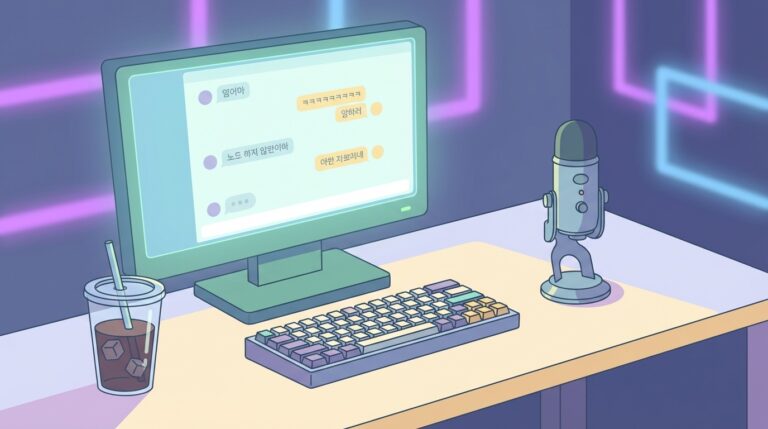
Picture this: It’s 11 PM on a Friday. You’re watching your favorite Korean gaming streamer on Chzzk, AfreecaTV, or YouTube. Suddenly, the streamer makes a slight mistake in the game, and the chat scrolls so fast it looks like a waterfall. You see words like “나락”, “어그로”, and “떡상” flooding the screen. The auto-translate is hopelessly confused, translating things as “abyss” or “aggro,” and you’re left wondering: What is going on here?
Welcome to the C1-level Korean that textbooks are too afraid to teach you. Today, we are diving deep into the multi-million dollar world of Korean Gaming Streamers and the MCN (Multi-Channel Network) business.
This isn’t just about playing games; it’s about digital marketing, fandom culture, and the highly specialized slang that drives the Korean internet. If you want to understand what Gen Z, gamers, and digital marketers are really saying in Seoul today, you need this vocabulary. (Disclaimer: This lesson is based on real interactions from foreign MCN managers and e-sports fans in Korea!)
Phase 2: Core Expressions Deep Dive
1. 어그로(를) 끌다
- Pronunciation: [eogeuro(reul) kkeulda] + ‘Eogeuro’ sounds like ‘uh-goo-row’ with a soft, rolling ‘r’. ‘Kkeulda’ sounds like the sharp ‘k’ you make when clearing your throat.
- Meaning: Literal: To draw aggro (from MMORPGs). Real nuance: To clickbait, to troll, or to intentionally provoke to get attention.
- K-Culture Moment: You are in an MCN marketing meeting. The thumbnail designer says, “썸네일 어그로 좀 끌어볼까요?” (Shall we make the thumbnail a bit clickbaity/provocative?). It’s not necessarily negative; in the content business, it means grabbing the audience’s eyeballs.
- Editor’s Insight: This word perfectly shows how gamer slang conquered mainstream Korean. It started in World of Warcraft (drawing a monster’s attention) and now even serious news anchors use it to describe politicians “drawing aggro.”
- Situation Spectrum:
- Casual with friends: ✅
- Coworkers (MCN/Marketing): ✅
- Traditional Corporate Boss: 🚫
- 🤔 Think About It: Why do you think a concept from a video game became the defining word for internet marketing in Korea? Does your language have a gaming term that became mainstream?
2. 떡상하다 / 나락가다
- Pronunciation: [tteoksanghada / narakgada] + ‘Tteok’ is sharp like a clicking tongue. ‘Narak’ sounds like ‘nah-rock’.
- Meaning: Literal: To soar like a rice cake / To go to the abyss. Real nuance: To go incredibly viral or succeed (떡상) vs. To get canceled or fail spectacularly (나락).
- K-Culture Moment: A streamer’s clip goes viral on YouTube Shorts. The chat screams “알고리즘 탔다! 완전 떡상!” (Rode the algorithm! Total explosion in views!). But if that same streamer gets into a scandal? The chat will just be spammed with “나락” (Cancel him/Abyss).
- Editor’s Insight: These two words are the absolute poles of Korean internet life. They originated from cryptocurrency and stock trading communities but are now the standard way to describe a streamer’s career trajectory.
- Situation Spectrum:
- Casual with friends/Twitch chat: ✅
- Coworkers (Semi-formal): ⚠️ (Use jokingly)
- Formal/Business Email: 🚫
- 🤔 Think About It: “Narak” is originally a Buddhist term for hell. Isn’t it fascinating how modern Korean internet culture repurposes ancient religious concepts to describe cancel culture?
3. 합방(을) 하다
- Pronunciation: [hapbang(eul) hada] + ‘Hap’ sounds like hopping, ‘bang’ like a door slamming.
- Meaning: Literal: Joint room. Real nuance: A collaboration stream (short for 합동 방송 – joint broadcast).
- K-Culture Moment: You manage a foreign streamer. You message a Korean MCN: “저희 크리에이터랑 합방 어떠세요?” (How about a collab stream with our creator?). This is the magic word that opens doors in the Korean YouTube/Twitch scene.
- Editor’s Insight: It implies sharing viewers and chemistry. A successful ‘합방’ can lead to ‘떡상’.
- Situation Spectrum:
- Casual with friends: ✅
- Coworkers (Semi-formal): ✅
- Formal (MCN Business Pitch): ✅
- 🤔 Think About It: Koreans love shortening words (합동 + 방송 = 합방). What does this hyper-efficiency in language tell us about Korea’s “Pali-Pali” (hurry-hurry) culture?
Phase 3: Textbook vs. Real Korean
[Pitching a Collaboration]
* 📖 Textbook Korean: 저희 채널과 협업하시겠습니까? (Would you like to collaborate with our channel?)
* 🗣️ Real Korean: 저희 쪽이랑 합방 한 번 가시죠! (Let’s go for a collab stream with our side!)
* 💡 Why the difference?: “협업” (Collaboration) sounds like a stiff B2B corporate email. In the MCN world, “합방” is the industry-standard slang that makes you sound like an insider.
[Asking for Likes and Subscribes]
* 📖 Textbook Korean: 채널 구독과 좋아요를 부탁드립니다. (Please subscribe and like the channel.)
* 🗣️ Real Korean: 구독, 좋아요, 알람 설정까지 가보자고! (Subs, likes, and notifications, let’s gooo!)
* 💡 Why the difference?: “가보자고” (Let’s go) is a trending Gen Z meme phrase that adds energetic, gamer-like hype rather than a polite, robotic request.
Bottom Note: At a C1 level, your goal isn’t just to be polite; it’s to adapt your register. Using MCN slang in an MCN meeting shows high cultural competence, but keep it out of a traditional bank or law firm!
Phase 4: Cultural Context — K-Culture Deep Dive
4-1. Non-verbal Context: The “Nunchi” of the Chat Room
In Korean streaming culture, Nunchi (눈치) is everything. Chat rooms have strict, often unspoken rules. If a viewer crosses the line with an inappropriate joke, the chat will aggressively say “선 넘네” (You’re crossing the line) or “뇌절 그만” (Stop beating a dead horse). As a foreign viewer or collaborator, reading the ‘Nunchi’ of a streamer’s specific fandom is more important than speaking perfect grammar.
4-2. K-Culture Connection: The “Gamer-Corporate” Blur
Korea is the birthplace of modern e-sports. Because gaming is so ingrained in the culture (think of PC Bangs on every corner), the line between “Gamer Slang” and “Corporate Jargon” in the IT/MCN sector is completely blurred.
If you watch a K-Drama about a tech startup (like Start-Up or Search: WWW), you’ll notice young CEOs using words like ‘어그로’ or ‘버프’ (Buff – gaining a stat boost) in serious boardroom meetings. It shows how the digital generation has claimed economic power in Korea.
Phase 5: Real-Life Roleplay Scenario
Setting: A bustling networking party at G-Star (Korea’s largest gaming exhibition) in Busan. Electronic music is booming, neon lights are everywhere. You are representing a foreign gaming talent agency, trying to network with a major Korean MCN manager.
Characters:
– YOU: A savvy talent manager looking for a Korean partner.
– Min-su (34): A fast-talking, trendy Content Director at a top Korean MCN.
Dialogue:
Min-su: 아, 만나서 반갑습니다! 이번에 데리고 오신 스트리머 분, 방송 봤어요. 완전 떡상각이던데요?
(Ah, mannaseo bangapseumnida! Ibeone derigo osin seuteurimeo bun, bangsong bwasseoyo. Wanjeon tteoksanggagideondeyo?)
[Ah, nice to meet you! I saw the stream of the creator you brought this time. It looks like they are totally going to skyrocket!]
(🎭 Stage Direction: Min-su hands you his sleek black business card with a smile)
YOU: 좋게 봐주셔서 감사합니다. 민수 님네 크리에이터들도 요즘 폼 미쳤던데요.
(Joke bwajusyeoseo gamsahamnida. Minsu nimne keurieiteodeuldo yojeum pom micheotdeondeyo.)
[Thanks for the kind words. Your creators’ form is crazy good lately too.]
Min-su: 에이, 저희는 요즘 알고리즘을 못 타서 죽겠어요. 그나저나, 우리 쪽 게임 스트리머랑 날 잡아서 합방 한 번 어때요?
(Ei, jeohuineun yojeum algorijeumeul mot taseo jukgesseoyo. Geunajeona, uri jjok geim seuteurimeorang nal jabaseo hapbang han beon eottaeyo?)
[Ah, we’re dying lately because we can’t ride the algorithm. Anyway, how about we set a date for a collab stream with our gaming streamer?]
🔀 Your Turn! How do you respond?
– A) “네, 협업 일정에 대해 이메일로 논의하시죠.” (Yes, let’s discuss the collaboration schedule via email.)
– B) “오, 완전 좋죠! 저희가 어그로 한 번 제대로 끌어보겠습니다!” (Oh, that sounds awesome! We’ll make sure to draw some serious aggro/hype!)
– C) “합방이요? 저희 채널 나락 가면 책임지실 건가요? ㅋㅋㅋ” (A collab? Are you going to take responsibility if our channel goes to the abyss? lol)✅ Best Choice: B — Reason: It perfectly matches the energetic, insider vibe of the MCN industry. You used “어그로” appropriately to mean “generating hype/views.”
⚠️ Choice A Analysis: Too robotic and stiff for a networking party in the gaming industry.
⚠️ Choice C Analysis: A bit too aggressive/sarcastic for a first meeting, even if intended as a joke.
Phase 6: 10-Second Shadowing Drill
Read this out loud to sound like a Korean MCN Executive:
😲 와, / 이 스트리머 / 텐션 미쳤다. / 오늘 / 어그로 / 제대로 끌겠는데요?
(Wa, / i seuteurimeo / tyensyeon micheotda. / oneul / eogeuro / jedaero kkeulgenneundeyo?)
[Wow, this streamer’s energy is insane. They are going to draw some serious hype today!]
(Focus on pausing at the slashes. Emphasize ‘미쳤다’ (crazy good) and ‘제대로’ (properly).)
Phase 7: K-Culture Mini Dictionary (MCN/Streamer Edition)
| 한국어 | Romanization | English | Cultural Context |
|---|---|---|---|
| 도네 (도네이션) | done (doneisyeon) | Donation | Often comes with funny voice messages (TTS) that interrupt the streamer. A core part of “reaction” culture. |
| 킹받네 | king-bat-ne | So annoying/frustrating (but funny) | ‘King’ + ‘열받네’ (angry). Used when a streamer playfully trolls the viewers. Very common Gen Z slang. |
| 뇌절 | noe-jeol | Beating a dead horse | Originally a Naruto anime move. Now means taking a joke way too far until it’s unfunny. |
| 방종 | bang-jong | Ending the stream | Short for 방송 종료 (Broadcast end). Viewers usually type “ㅂㅈ” or “방종” when it’s time to sleep. |
Phase 8: Traveler Survival Kit (Gaming Edition)
If you are a gaming fan traveling to Korea, visiting a high-end PC Bang (Internet Cafe) or attending an e-sports event (like LoL Park or G-Star) is a must.
🆘 Survival Phrases #1: The PC Bang
– 🇰🇷 “여기 비회원도 카드 결제 되나요?” (yeogi bihoewondo kadeu gyeolje doenayo?)
– 🗣️ Meaning: Can non-members pay with a credit card here?
– 📍 Where to use: At the payment kiosk in a PC Bang.
– 💡 Pro Tip: Korean PC Bangs use automated kiosks. If you don’t have a Korean ID to make an account, ask the counter staff to log you in as a ‘비회원’ (Non-member).📌 Editor’s Travel Note
– Food in PC Bangs: Do not miss the food! You can order Michelin-level ramen, hotdogs, and iced coffee directly from your computer screen. Just click ‘상품 주문’ (Order Items) on the desktop.
– Cheering at e-Sports: When watching matches live, fans don’t just scream randomly. There are organized fan chants (팬챈트), much like K-Pop! Listen to the crowd and follow the rhythm.
Phase 9: Critical Thinking — “One Step Deeper”
Language & Power: The Mainstreaming of Subculture
In the past, the Korean language was strictly dictated by news anchors and literature. Slang was considered a “destruction of the language.” However, in the global digital era, the power dynamics have shifted. The vocabulary created by teenagers in PC Bangs and streamers on Twitch has become the new standard for digital marketing. Major corporations now actively hire MCN experts who understand words like “어그로” and “떡상” because speaking this subcultural language is the only way to tap into the purchasing power of Gen Z and Millennials.
🧠 Think Deeper:
The line between “unprofessional slang” and “essential marketing terminology” is disappearing in Korea.💬 Your Turn: How is internet or gaming slang treated in your native language? Is it used in corporate marketing, or is it still looked down upon? Share your thoughts in the comments!
Phase 10: FAQ & Avoiding Mistakes
Q: Can I use “~님 (Nim)” for a streamer in the chat?
Yes! In fact, you MUST. Never call a streamer “너” (you) or just their username unless they explicitly allow informal speech (반말). Always attach ~님 (e.g., “페이커님”).
Q: Can I use “어그로” or “나락” at a traditional Korean company?
No. If you work at a bank or a traditional conglomerate (Chaebol), these words sound incredibly unprofessional. Reserve them for IT startups, marketing teams, or MCN businesses.
❌ Common Mistake #1: Translating “You are so funny” as “너 진짜 웃기다” in a streamer’s chat.
✅ Do this instead: Use “폼 미쳤다” (Your form is crazy) or “진짜 킹받네 ㅋㅋㅋ” (You’re so playfully annoying lol). Direct “너” sounds rude to a streamer you don’t know personally.
Phase 11: Summary & Action Items
- One-Liner Summary: Master “어그로” (hype/clickbait), “떡상” (viral success), and “합방” (collab) to sound like a true Korean MCN insider!
Action Mission 3 Steps:
– 🥉 Bronze (Solo): Read the 10-second shadowing drill aloud 3 times, focusing on the gamer hype energy.
– 🥈 Silver (Online): Go to a Korean streamer’s YouTube or Chzzk VOD and leave a comment saying: “알고리즘 타고 떡상 가보자고!” (Let’s ride the algorithm and skyrocket!).
– 🥇 Gold (Real Life): If you meet a Korean friend who plays video games, ask them: “요즘 어떤 스트리머 방송이 제일 떡상 중이야?” (Which streamer’s broadcast is skyrocketing the most these days?)
🎮 K-Culture Mission:
Log into Twitch or Chzzk today. Watch a Korean stream for 10 minutes and try to spot the words “도네”, “어그로”, or “ㅋㅋㅋㅋ” in the live chat!
Phase 12: Quiz — Interactive Challenge
1. Situational Judgment: Your agency’s YouTuber just hit 1 million subscribers overnight after a viral video. What is the most natural message to send your Korean MCN partner?
– A) 저희 채널이 나락을 갔습니다. (Our channel went to the abyss.)
– B) 알고리즘 타고 완전 떡상했네요! (We rode the algorithm and completely skyrocketed!)
– C) 저희가 어그로를 끌어서 죄송합니다. (We apologize for drawing aggro.)
2. Fill in the Blank:
To grow our channels, how about we do a ( ________ ) next week?
– “다음 주에 같이 ( ________ ) 한 번 하실래요?”
3. True or False – K-Culture Edition:
In a Korean PC Bang, you must leave the building to buy food and bring it back inside. (T/F)
👀 Click here for answers!
1. B – It’s a massive success, so ‘떡상’ is perfect. A is for failure. C is apologizing for bad clickbait.
2. 합방 (Collab stream)
3. False! Korean PC Bangs have built-in restaurants. You order right from your computer and they bring it to your desk!
Frequently Asked Questions (FAQ)
Q: What does "어그로(를) 끌다" mean in Korean and how do you pronounce it?
A: In Korean, "어그로(를) 끌다" is pronounced [eogeuro(reul] and means: Literal: To draw aggro (from MMORPGs). Real nuance: To clickbait, to troll, or to intentionally provoke to get attention.
Q: What does "떡상하다 / 나락가다" mean in Korean and how do you pronounce it?
A: In Korean, "떡상하다 / 나락가다" is pronounced [tteoksanghada / narakgada] and means: Literal: To soar like a rice cake / To go to the abyss. Real nuance: To go incredibly viral or succeed (떡상) vs. To get canceled or fail spectacularly (나락).
Q: What does "합방(을) 하다" mean in Korean and how do you pronounce it?
A: In Korean, "합방(을) 하다" is pronounced [hapbang(eul] and means: Literal: Joint room. Real nuance: A collaboration stream (short for 합동 방송 - joint broadcast).







