
Skip to content
Daily Hangul

Decoding the Matrix: How to Speak K-Pop Lore Like a Native Fan
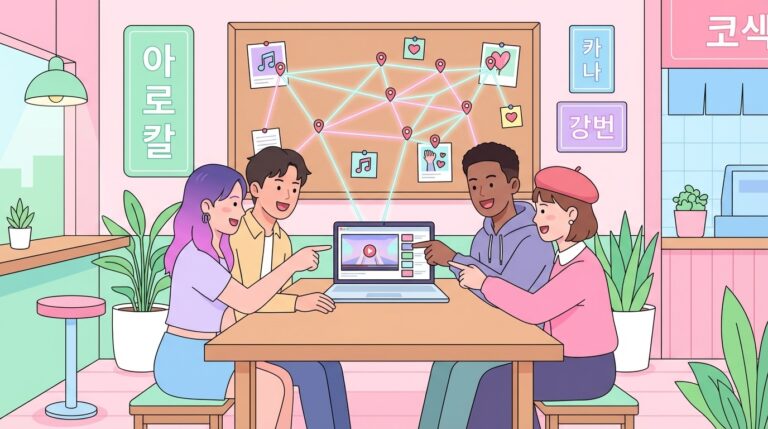
Decoding the Matrix: How to Speak K-Pop Lore Like a Native Fan - Daily Hangul

Phase 1: The Midnight MV Drop\n\nHello! I’m your Daily Hangul Editor.\n\nIt’s midnight in Seoul. You’ve been refreshing YouTube for the last 10 minutes. Finally, your favorite group’s new music video drops. You watch it, completely mesmerized. But wait… the screen goes black, and a mysterious date flashes. A butterfly flies across the screen.\n\nYou open Twitter, and your Korean mutuals (moots) are losing their minds. \”미쳤다, 드디어 떡밥 회수함!\” (Crazy, they finally retrieved the rice cake?!) Wait, what does rice cake have to do with this?\n\nWelcome to the intense, brain-twisting world of the K-Pop Idol Universe (아이돌 세계관). Knowing how to say \”I love this song\” is great, but if you want to truly connect with Korean fans, join the late-night theory spaces, and sound like a true insider, you need to speak the language of ‘Lore’.\n\nThis guide is based on real questions from B2-level learners who wanted to survive the fan-theories without getting lost in translation. Let’s decode the matrix together!\n\n—\n\n### Phase 2: Core Expressions for Lore Decoding\n\nHere are the top 3 expressions you absolutely need to know to survive a K-Pop comeback season.\n\n> ### 1. 세계관 (The Universe / Lore)\n>\n> – Pronunciation: segyegwan [Sounds like: seh-gyeh-gwahn]\n> – Meaning: Literal: Worldview / Real nuance: The fictional universe, backstory, or lore of an idol group.\n> – K-Culture Moment: You’re at a fan cafe, and someone pulls out an iPad to explain how aespa’s ‘Kwangya’ connects to EXO’s superpowers. They are explaining the ‘세계관’.\n> – Editor’s Insight: This word originally meant someone’s philosophical view of the world. Now, thanks to K-Pop and Marvel movies, it’s exclusively used to describe intricate fictional universes. \n> – Situation Spectrum:\n> – Casual with K-Pop friends: ✅\n> – Semi-formal (discussing media/art): ✅\n> – Formal (business meetings not related to media): 🚫\n> – 🤔 Think About It: Why do K-Pop agencies invest so much in fictional lore? How does having a shared ‘secret language’ affect the bond between fans?\n\n> ### 2. 떡밥을 회수하다 (Retrieving the Bait)\n>\n> – Pronunciation: tteokbabeul hoesu-hada [Sounds like: dduck-bahb-eul hweh-soo-ha-da] (Pro tip: ‘떡’ sounds like the tight ‘dd’ in ‘duck’)\n> – Meaning: Literal: To retrieve the rice cake bait / Real nuance: To resolve a foreshadowed clue or mystery.\n> – K-Culture Moment: The music video shows a broken clock. Fans realize it’s the exact time from a debut photo from 3 years ago! The agency planned it all along. That’s when you scream, \”떡밥 회수 미쳤다!\”\n> – Editor’s Insight: \”떡밥\” is literally a ball of rice cake used as fish bait. In slang, it means a ‘teaser’ or ‘clue’ thrown out to hook the audience. When the creator finally explains the clue, they are \”reeling in the bait.\”\n> – Situation Spectrum:\n> – Casual fan spaces: ✅\n> – Co-workers (discussing a drama/movie): ✅\n> – Formal boss/Elders: 🚫\n> – 🤔 Think About It: Korean slang often uses very physical, sensory metaphors (like fishing bait for story clues). Do you have similar metaphors in your native language?\n\n> ### 3. 궁예하다 (To Blindly Theorize)\n>\n> – Pronunciation: gung-ye-hada [Sounds like: goong-yeah-ha-da]\n> – Meaning: Literal: To act like Gung-ye / Real nuance: To guess, speculate, or over-analyze without solid proof.\n> – K-Culture Moment: A member changes their hair color to blue. A fan writes a 10-page essay on how this proves they are the villain of the universe. Other fans might say, \”이건 너무 궁예 아니야?\” (Isn’t this too much of a stretch?)\n> – Editor’s Insight: Gung-ye was a real historical king, famously portrayed in a 2000s K-Drama wearing an eyepatch, claiming he could \”read people’s minds.\” Now, his name is a verb for anyone trying to ‘read minds’ or make wild guesses!\n> – Situation Spectrum:\n> – Casual internet friends: ✅\n> – Semi-formal: ⚠️ (Only if they know internet slang)\n> – Formal: 🚫\n> – 🤔 Think About It: Isn’t it fascinating how a historical drama character from 20 years ago became a staple K-Pop slang word today?\n\n—\n\n### Phase 3: Textbook vs. Real Korean\n\nLet’s see how textbooks teach these concepts versus how fans actually talk on X (Twitter) or in fan chats.\n\n[Discussing a new clue in the Music Video]\n* 📖 Textbook Korean: 이 비디오에는 숨겨진 의미가 있습니다. (There is a hidden meaning in this video.)\n* 🗣️ Real Korean: 헐 이번 뮤비 떡밥 대박이야. (Omg the bait in this MV is insane.)\n* 💡 Why the difference?: Fandom culture thrives on high energy and exaggerated reactions. ‘대박’ and ‘떡밥’ convey that emotional thrill instantly.\n\n[Trying to figure out the storyline]\n* 📖 Textbook Korean: 우리는 다음 이야기를 추측해야 합니다. (We must guess the next story.)\n* 🗣️ Real Korean: 다들 모여봐, 궁예 파티 시작하자! (Gather ‘round everyone, let’s start the theory party!)\n* 💡 Why the difference?: Theorizing isn’t just a task; it’s a social event. Calling it a \”파티\” (party) shows how communal fandom culture is.\n\n[Realizing the company planned it all]\n* 📖 Textbook Korean: 기획사가 예전 단서를 해결했습니다. (The agency resolved the past clue.)\n* 🗣️ Real Korean: 와, 3년 전 떡밥 회수 실화냐? 소름 돋아. (Wow, retrieving a 3-year-old bait, is this real life? I have goosebumps.)\n* 💡 Why the difference?: Using \”실화냐?\” (Is this real life?) and \”소름 돋아\” (goosebumps) emphasizes the physical shock of a plot twist.\n\n> Bottom Note: At a B2 level, you want to use slang like ‘떡밥’ and ‘궁예’, but keep your sentence endings polite (요) if you are talking to older fans or strangers at a fan meeting!\n\n—\n\n### Phase 4: Cultural Context — K-Culture Deep Dive\n\n#### 4-1. Non-Verbal Cues: The Art of the \”Mind Blown\” reaction\nWhen discussing ‘세계관’ in person, Koreans often cover their mouths with both hands to show shock, or aggressively tap the table when someone makes a good point. Eye contact is intense because you’re connecting dots together. If you’re typing, you’ll use a lot of \”ㄷㄷㄷ\” (shivering/goosebumps) or \”미쳤다\” to show excitement.\n\n#### 4-2. The K-Pop Connection: Fandom as a Detective Game\nK-Pop isn’t just about music anymore; it’s a multi-season interactive thriller. Agencies drop ‘떡밥’ (bait) in concept photos, album covers, and even the members’ clothes. Fans use their ‘궁예’ skills to piece it together. \n\nThis creates a unique Nunchi (눈치) challenge. If you join a fandom late, you have to read the room and quickly catch up on the lore so you don’t ask obvious questions. The beauty of this culture? If you respectfully ask, \”저 늦게 입덕했는데, 이 세계관 설명해주실 분?\” (I joined late, can anyone explain this universe?), veteran fans will eagerly bring out their PowerPoint presentations!\n\n—\n\n### Phase 5: Interactive Roleplay Scenario\n\nSetting: It’s Friday night, 8 PM. You are at a trendy idol-themed cafe in Hongdae. The walls are covered in your favorite group’s posters. You’re sitting with two Korean fans you just met through Twitter. The group’s concept trailer dropped 10 minutes ago.\n\nCharacters:\n- YOU: A foreign fan who understands Korean well (B2) but is a bit shy about using slang.\n- Ji-a (24): A hardcore theorist. Her brain works at 200 mph.\n- Min-su (26): A chill fan who loves the music but gets easily confused by the lore.\n\nDialogue:\n\nJi-a: 봤어요?! 마지막에 그 파란 나비 나오는 거 봤냐고요! 🦋\n(Bwasseoyo?! Majimage geu paran nabi naoneun geo bwannyagoyo!)\n[Did you see it?! Did you see the blue butterfly at the end!]\n(🎭 Stage Direction: Ji-a aggressively taps the table, eyes wide.)\n\nMin-su: 아… 나비? 나비가 왜요? 예쁘던데.\n(A… nabi? Nabiga waeyo? Yeppeudeonde.)\n[Ah… butterfly? What about it? It was pretty.]\n\nJi-a: 오빠!! 데뷔곡 뮤비 1분 23초에 파란 나비 나오잖아요! 이거 완전 떡밥 회수라니까요?\n(Oppa!! Daebwigok myubi ilbun isipsamchoe paran nabi naojannayo! Igeo wanjeon tteokbap hoesuranikkayo?)\n[Oppa!! The blue butterfly appears at 1:23 in their debut MV! I’m telling you, this is a total bait retrieval!]\n\nYOU: 헐, 진짜요? 저도 몰랐어요.\n(Heol, jinjjayo? Jeodo mollasseoyo.)\n[Omg, really? I didn’t know either.]\n\nMin-su: 와, 기획사 진짜 독하다. 근데 이번 흑막(villain)은 누구일 것 같아요?\n(Wa, gihoeksa jinjja dokhada. Geunde ibeon heungmageun nuguil geot gatayo?)\n[Wow, the agency is truly ruthless. But who do you think the villain is this time?]\n\nJi-a: 제 생각에는 리더가 흑막 같아요. 거울 볼 때 그림자가 없었거든요.\n(Je saenggageneun rideoga heungmak gatayo. Geoul bol ttae geurimjaga eopseotgeodeunyo.)\n[I think the leader is the villain. When they looked in the mirror, there was no shadow.]\n\nMin-su: 에이, 그건 너무 궁예 아니에요? 빛 반사 때문일 수도 있잖아요.\n(Ei, geugeon neomu gung-ye anieyo? Bit bansa ttaemunil sudo itjannayo.)\n[Hey, isn’t that too much of a stretch (blind guess)? It could just be light reflection.]\n\n> 🔀 Your Turn! How do you respond to back up Ji-a?\n> – A) \”리더가 나쁜 사람입니다.\” (Too textbook and serious.)\n> – B) \”아니에요! 지아 씨 말이 맞아요. 완전 소름 돋았어요!\” (Natural, shows emotional agreement.)\n> – C) \”민수 오빠 눈치 없네요.\” (Too aggressive for someone you just met!)\n>\n> ✅ Best Choice: B — In fandom culture, validating someone’s theory with emotional reactions like \”소름 돋다\” (goosebumps) is the perfect way to build camaraderie.\n\nJi-a: 거봐요! OO님도 동의하시잖아요! 제 뇌피셜(headcanon)이 맞다니까요.\n(Geobwayo! OO-nimdo dong-uihasijannayo! Je noepisyeori matdanikkayo.)\n[See! OO agrees with me! My headcanon is right.]\n\nMin-su: 알았어요, 알았어. 오늘 밤 다들 잠 다 잤네.\n(Arasseoyo, arasseo. Oneul bam dadeul jam da janne.)\n[Alright, alright. I guess none of us are sleeping tonight.]\n\nYOU: 오늘 밤새서 세계관 복습해야겠어요!\n(Oneul bamsaeseo segyegwan bokseuphaeyagesseoyo!)\n[I’ll have to stay up all night reviewing the lore!]\n\n—\n\n### Phase 6: 10-Second Shadowing Drill\n\nPractice your \”Lore Shocked\” reaction. Follow the slashes for pauses and match the emotion!\n\n😱 와, / 이번 뮤비 / 떡밥 회수 / 미쳤어! / 완전 / 소름 돋아!\n(wa, / ibeon myubi / tteokbap hoesu / micheosseo! / wanjeon / soreum doda!)\n[Wow, / this MV’s / bait retrieval / is crazy! / Total / goosebumps!]\n\n—\n\n### Phase 7: K-Culture Mini Dictionary (Fandom Edition)\n\n| Korean | Romanization | English | Context |\n|—|—|—|—|\n| 세계관 | segyegwan | Universe/Lore | The overarching fictional storyline of a group. |\n| 떡밥 | tteokbap | Clue/Bait | Foreshadowing details left by the agency. |\n| 궁예질 | gung-ye-jil | Theorizing | Making guesses about the plot (often wild ones). |\n| 뇌피셜 | noepisyeol | Headcanon | Brain + Official = Something you believe is true in your head, though not confirmed. |\n| 과몰입 | gwamorip | Over-immersion | Being too deeply emotionally invested in the lore or idols. |\n\n—\n\n### Phase 8: Traveler Survival Kit (Pop-up Store Edition)\n\nIf you’re visiting Korea as a K-Pop fan, you’ll likely visit an Idol Pop-Up Store or Exhibition focused on their 세계관. Here’s how to survive.\n\n> 🆘 Survival Expressions\n> – 🇰🇷 \”이거 품절인가요?\” (igeo pumjeoringayo?) -> \”Is this sold out?\”\n> – 🇰🇷 \”포카 교환하실 분?\” (poka gyohwanhasil bun?) -> \”Anyone want to trade photocards?\”\n> – 🇰🇷 \”입장 마감됐나요?\” (ipjang magamdoennayo?) -> \”Is entry closed?\”\n>\n> 📌 Editor’s Travel Note:\n> – Pop-up Reservations: Most idol pop-ups in Seoul require pre-booking via CatchTable or Naver. You can’t just walk in!\n> – Trading Culture: After buying merchandise, fans stand outside the venue holding up their ‘포카’ (photocards) to trade. Don’t be shy—just hold yours up!\n\n—\n\n### Phase 9: Critical Thinking — \”Going Deeper\”\n\nGlobal Era: Shared Jargon, Shared Identity\nWhy do Korean fandoms use such complex, coded language like 떡밥 and 궁예? In sociology, specialized jargon creates an ‘in-group’ identity. By using these words, fans aren’t just communicating; they are proving they belong to the same ‘tribe’. Furthermore, as K-Pop goes global, words like bias, moot, and lore mix with 막내 (maknae), 애교 (aegyo), and 세계관, creating a brand new, borderless internet dialect. \n\n> 🧠 Think Deeper: K-Pop companies intentionally create complex lore to make fans work together to solve puzzles, strengthening their loyalty and community bond.\n>\n> 💬 Your Turn: Do Western artists (like Taylor Swift) have their own version of ‘떡밥’? How do fans in your country talk about hidden clues? Share in the comments!\n\n—\n\n### Phase 10: FAQ & Avoiding Mistakes\n\nQ: Can I use \”떡밥\” at work?\nA: No! 🚫 Unless you work in the entertainment or marketing industry discussing audience engagement, using \”떡밥\” in a serious business meeting sounds unprofessional. Stick to \”단서\” (clue) or \”힌트\” (hint).\n\nQ: Can I talk about Marvel’s ‘세계관’?\nA: Yes! ✅ Marvel is actually the reason the word \”세계관\” became so popular in Korea. Saying \”마블 세계관\” (Marvel Cinematic Universe) is perfectly natural.\n\n> ❌ Common Mistake #1: Translating \”My theory is…\” to \”나의 이론은…\”\n> ✅ Do this instead: Fandoms don’t use the academic word \”이론\” (theory). Use \”제 궁예로는…\” (My guess is…) or \”제 뇌피셜로는…\” (In my headcanon…).\n\n—\n\n### Phase 11: Summary & Action Items\n\nOne-Liner Summary: To navigate a K-Pop Idol Universe, you must master the art of catching the bait (떡밥) and theorizing (궁예) about the lore (세계관)!\n\nAction Mission:\n- 🥉 Bronze: Watch a K-Pop MV and say \”떡밥 회수 미쳤어!\” out loud.\n- 🥈 Silver: Go to a Korean YouTube video about your favorite group’s lore and read the comments to find the words 세계관 or 궁예.\n- 🥇 Gold: Reply to a Korean fan’s theory on X (Twitter) using the phrase, \”완전 소름 돋아요! (Goosebumps!)\”\n\nK-Culture Mission: Search for \”[Your Favorite Group Name] 세계관 정리\” (Universe Summary) on YouTube. Even if you don’t understand everything, notice how deeply Korean fans analyze the videos!\n\n—\n\n### Phase 12: Interactive Challenge Quiz\n\n1. Fill in the Blank:\nThe agency finally explained the mysterious key from their debut MV! \n\”드디어 ____ 회수 대박이다!\”\nA) 세계관\nB) 떡밥\nC) 눈치\n\n2. Situational Judgment:\nYour friend is making a wild guess that an idol is a vampire just because they wore red. What is the most natural, witty response?\nA) 그것은 사실이 아닙니다. (That is not true.)\nB) 너 너무 궁예 심한 거 아니야? (Aren’t you theorizing a bit too much?)\nC) 떡밥이 맛있어요. (The bait is delicious.)\n\n3. True or False – K-Culture Edition:\nIf you want to say \”MCU (Marvel Cinematic Universe)\” in Korean, you say \”마블 세계관\”. (T/F)\n\n(Answers: 1: B, 2: B, 3: True)\n\n—\nDid you enjoy decoding the K-Pop matrix with Daily Hangul? Leave a comment below with your favorite group’s wildest ‘떡밥’!

Prefer to study this lesson in Japanese? 日本語版で読む →
Share Lesson
X / Twitter

コメントを残す

メールアドレスが公開されることはありません。 ※ が付いている欄は必須項目です

SHIBA

Most Read Lessons

Popular · Top 3




