

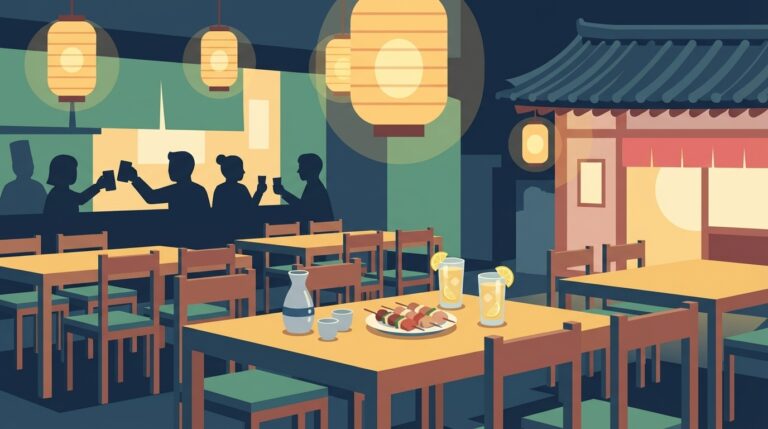
Navigating Izakayas in Korea Like a Local: Sake, Highballs, and Hidden Rules
Phase 1: Empathy & K-Culture Cold Open
Greeting: Hello! I’m your Daily Hangul Editor.
Imagine this: You’re watching a K-Drama. The protagonist has just had a crushing day at the office. But instead of the usual green Soju bottle under a street tent (포장마차), they slide open the wooden door of a dimly lit, cozy Izakaya (이자카야). They sit at the bar, order a steaming skewer, and sip a bubbling, golden drink from a glass filled with ice, or perhaps they pour a warm, clear liquid from a tiny ceramic carafe.
Welcome to Korea’s modern drinking scene. While Soju and Makgeolli are the traditional titans, Japanese liquor culture—specifically Sake (사케) and Highballs (하이볼)—has seamlessly woven itself into the fabric of Korean nightlife, especially for Millennials and Gen Z.
If you’re at a C1 level, you already know how to order a beer. But do you know how to ask the bartender to make your highball less sweet because Korean highballs default to using tonic water? Or how to ask a high-end Korean beef (한우) restaurant if you can bring your own bottle of premium Sake? Let’s dive into the sophisticated, hybrid world of Japanese liquor in Korea. (This guide is built from the actual panicked texts I get from my advanced students living in Seoul!)
Phase 2: Core Expressions Deep Dive
Let’s master the three essential expressions you’ll need when navigating this cultural crossover.
1. 따뜻한 사케 한 도쿠리 주시겠어요?
- Pronunciation: ttatteuthan sake han dokuri jusigesseoyo? [Tta-tteu-tan sa-ke han do-ku-ri ju-shi-ge-sseo-yo?]
- Meaning: (Literal) Would you give me one tokkuri of warm sake? / (Real Nuance) Could I get a small carafe of hot sake?
- K-Culture Moment: Winter in Seoul is freezing. When you duck into an Izakaya to escape the biting wind, ordering ‘아츠칸’ (Atsukan – hot sake) is the ultimate comfort move. In Korea, sake is often sold by the ‘도쿠리’ (tokkuri – small ceramic flask) rather than just the bottle or glass.
- Editor’s Insight: This sentence immediately signals you know what you’re doing. Instead of awkwardly pointing at the menu, specifying ‘따뜻한’ (warm) and ‘도쿠리’ (carafe) makes you sound like a seasoned Seoulite.
- Situation Spectrum:
- Casual with friends: ✅ (Just drop the 요: 따뜻한 사케 한 도쿠리 주라!)
- Semi-formal (colleagues): ✅
- Formal (boss): ✅
- 🤔 Think About It: Why did the Japanese word ‘tokkuri’ become a standard counting unit for sake in Korean Izakayas, even though Korea has its own words for flasks (병, 호리병)? It shows how deeply imported dining cultures retain their original vocabulary in Korea to maintain an ‘authentic’ vibe.
2. 하이볼은 토닉워터 말고 탄산수로 타주세요.
- Pronunciation: haiboreun tonigweoteo malgo tansansuro tajuseyo. [Hai-bol-eun to-nik-weo-teo mal-go tan-san-su-ro ta-ju-se-yo.]
- Meaning: (Literal) For the highball, please mix it with carbonated water, not tonic water. / (Real Nuance) Please make my highball dry (with club soda), not sweet.
- K-Culture Moment: Korea is currently in the middle of a massive ‘Highball Boom’. However, unlike in Japan where highballs are traditionally dry (whisky + plain soda), Korean Izakayas often use sweet tonic water or ginger ale by default.
- Editor’s Insight: If you prefer the classic, dry taste, you must specify ‘탄산수’ (carbonated water/club soda). Otherwise, you might end up with a very sweet drink! The verb ‘타다’ (to mix a drink) is crucial here.
- Situation Spectrum:
- Casual: ✅
- Semi-formal: ✅
- Formal: ✅
- 🤔 Think About It: Koreans love modifying recipes to fit local palates—adding syrup, Earl Grey tea, or fruit flavors to highballs. Does your home country also heavily modify imported drinks to suit local tastes?
3. 혹시 사케 콜키지 되나요? 병당 차지가 어떻게 돼요?
- Pronunciation: hoksi sake kolkiji doenayo? byeongdang chajiga eotteoke dwaeyo? [Hok-shi sa-ke kol-ki-ji doe-na-yo? byeong-dang cha-ji-ga eo-tteo-ke dwae-yo?]
- Meaning: (Literal) By any chance, is sake corkage possible? How is the charge per bottle? / (Real Nuance) Can I bring my own sake, and what’s the corkage fee per bottle?
- K-Culture Moment: You brought a beautiful bottle of Junmai Daiginjo from a recent trip to Japan. You want to drink it at a premium Korean BBQ (한우) or Sushi Omakase restaurant. ‘콜키지 프리’ (Corkage Free) is a huge trend in Seoul right now, but always call ahead to ask!
- Editor’s Insight: Using Konglish terms like ‘콜키지’ (Corkage) and ‘차지’ (Charge) makes you sound highly fluent in modern Korean dining culture.
- Situation Spectrum:
- Used strictly with restaurant staff over the phone or at the counter: ✅
- 🤔 Think About It: The BYOB culture was historically rare in Korea, where alcohol sales drive restaurant profits. The rise of ‘Corkage’ reflects a shift towards premium, customized dining experiences.
Phase 3: Textbook vs. Real Korean
How do actual Koreans speak when the sake is flowing?
[Asking for a recommendation at a Liquor Store/Bottle Shop]
* 📖 Textbook Korean: 추천할 만한 일본 술이 있습니까? (Do you have any Japanese liquor to recommend?)
* 🗣️ Real Korean: 입문용으로 괜찮은 사케 하나 추천해 주시겠어요? (Could you recommend a good sake for a beginner?)
* 💡 Why the difference?: ‘입문용’ (for beginners/entry-level) is a trendy and humble way to ask for advice in hobbyist cultures like wine, whiskey, or sake.
[Ordering a single glass]
* 📖 Textbook Korean: 사케 한 잔 주세요. (Please give me one glass of sake.)
* 🗣️ Real Korean: 여기 잔술도 파나요? (Do you sell drinks by the glass here?)
* 💡 Why the difference?: ‘잔술’ (glass-liquor) is the exact term used when you don’t want a whole bottle. It’s efficient and sounds completely native.
Phase 4: Cultural Context — K-Culture Deep Dive
4-1. The Unbreakable Rule of ‘Nunchi’ (눈치) in Pouring
Here is a critical cultural secret: Even if you are drinking Japanese Sake in a Japanese-style Izakaya in Seoul, Korean drinking etiquette strictly applies.
If your older colleague or boss pours sake for you from a tokkuri, you must:
1. Hold your small cup (오초코) with two hands.
2. When drinking, slightly turn your head away from the senior to show respect.
3. Never pour your own drink (자첨 – Jacheom). Wait for someone to pour for you, and keep an eye on their cup to refill it when it’s empty!
4-2. The Evolution of the ‘Hoesik’ (Company Dinner)
In the past, K-Dramas depicted hoesik (회식) as endless rounds of Soju and beer (소맥) at a noisy BBQ joint. Today, modern companies—especially tech and design firms in Pangyo or Gangnam—often opt for chic Izakayas. They order high-end sashimi, yakitori, and highballs. It’s considered a more ‘refined’ and less pressuring environment. Knowing how to order a customized highball or discuss sake flavors gives you a massive advantage in these modern networking situations.
Phase 5: Real-Life Roleplay Scenario
Setting: Friday, 8:00 PM. A trendy Izakaya in Yeonnam-dong. You are having an informal hoesik with your Korean team. The vibe is relaxed, but the Department Head (부장님) is present.
Characters:
– YOU: A foreign professional working in Seoul. You want to impress the team but also want a drink you actually enjoy.
– Min-su: Your friendly 32-year-old colleague.
– Department Head (부장님): Generous, a bit traditional, loves sake.
Dialogue:
Min-su: 우리 오늘은 각자 마시고 싶은 거 시킬까요? 전 얼그레이 하이볼이요.
(uri oneureun gakja masigo sipeun geo sikilkkayo? jeon eolgeurei haiboriyo.)
[Shall we each order what we want to drink today? I’ll have an Earl Grey Highball.]
(🎭 Stage Direction: Min-su looks at the menu and turns to you)
YOU: 음… 저도 하이볼 마실게요. 근데 덜 달게 마시고 싶어요.
(eum… jeodo haibol masilgeyo. geunde deol dalge masigo sipeoyo.)
[Hmm… I’ll have a highball too. But I want to drink it less sweet.]
Min-su: 아, 그럼 주문할 때 탄산수로 변경해 달라고 할게요. 부장님은요?
(a, geureom jumunhal ttae tansansuro byeongyeonghae dallago halgeyo. bujangnimeunyo?)
[Ah, then I’ll ask them to change it to carbonated water when ordering. How about you, Boss?]
부장님: 난 날씨도 추운데, 따뜻한 사케나 한 도쿠리 마시지 뭐.
(nan nalssido chuunde, ttatteuthan sakena han dokuri masiji mwo.)
[The weather is cold, I guess I’ll just have a carafe of warm sake.]
(🎭 Stage Direction: The drinks arrive. The Boss picks up his steaming tokkuri and gestures toward you with a smile)
부장님: OO씨, 하이볼 마시기 전에 사케도 한 잔 받을래?
(OO-ssi, haibol masigi jeone sakedo han jan badeullae?)
[OO, before you drink your highball, want to receive a glass of sake?]
🔀 Your Turn! How do you respond?
– A) “아니요, 저는 하이볼만 마실게요.” (No, I’ll only drink the highball.)
– B) “네, 감사합니다!” (Hold out your cup with one hand)
– C) “아, 감사합니다! 한 잔 받겠습니다.” (Hold your cup with both hands)✅ Best Choice: C — In a Korean business setting, it’s polite to accept the first drink offered by a boss, even if you ordered something else. Holding the cup with two hands is non-negotiable!
⚠️ Choice A & B Analysis: Choice A might come off as slightly abrupt to a traditional boss (though acceptable in very modern startups). Choice B is a major etiquette faux pas due to the one-handed gesture.
Phase 6: 10-Second Shadowing Drill
Practice this until it flows completely naturally. Pay attention to the pauses (/)!
😊 사장님, / 여기 산토리 하이볼 한 잔 / 탄산수로 타서 / 주시겠어요?
(sajangnim, / yeogi santori haibol han jan / tansansuro taseo / jusigesseoyo?)
Vibe: Friendly but clear, ordering with confidence at a busy bar.
Phase 7: K-Culture Mini Dictionary
| 한국어 | Romanization | English | Cultural Context |
|---|---|---|---|
| 이자카야 | ijakaya | Izakaya | Japanese-style pub, deeply embedded in Korean nightlife. |
| 꼬치 / 야키토리 | kkochi / yakitori | Skewers | The go-to pairing for sake and highballs in Korea. |
| 오마카세 | omakase | Omakase | Chef’s choice dining. In Korea, “Hanwoo (Beef) Omakase” is wildly popular and a prime spot for sake corkage. |
| 콜키지 프리 | kolkiji peuri | Corkage Free | Restaurants that allow you to bring your own alcohol without a fee. |
| 잔술 | jansul | Drink by the glass | A single glass order, common for premium sake or whiskey. |
Phase 8: Traveler Survival Kit
Even if you’re just visiting Seoul for a week, you’ll likely end up in an Izakaya or a trendy liquor store (Bottle Shop).
🆘 Survival Phrases for Bottle Shops & Izakayas
– 🇰🇷 “이거 제일 작은 병인가요?” (igeo jeil jageun byeongingayo?)
– 🗣️ Guide: [ee-geo je-il ja-geun byung-in-ga-yo?]
– 📍 Use case: Asking if this is the smallest bottle (Sake bottles can be massive!).
– 🇰🇷 “너무 달지 않은 하이볼 추천해 주세요.” (neomu dalji aneun haibol chucheonhae juseyo.)
– 📍 Use case: Asking the bartender for a highball that isn’t overly sweet.
– 🇰🇷 “얼음 좀 더 주실 수 있나요?” (eoreum jom deo jusil su innayo?)
– 📍 Use case: Asking for more ice for your drink.📌 Editor’s Travel Note
– Highball Base: If you order a “짐빔 하이볼” (Jim Beam Highball) in Korea without specifying, it will likely be made with sweet lemon syrup and tonic. Always say “달지 않게” (Not sweet) if you want the original taste.
– ID Checks: Korea is notoriously strict about ID checks, even if you look 40! Always carry your physical Passport or ARC (Alien Registration Card) when visiting bars or Izakayas.
Phase 9: Critical Thinking — “A Step Deeper”
Korean in the Global Era: The Linguistic Hybridity of Liquor
🧠 Think Deeper:
The way Koreans talk about Japanese liquor perfectly illustrates the dynamic, hybrid nature of modern Korean. We take an English word like ‘Highball’, filter it through Japanese drinking culture, and then apply native Korean verbs to it: “하이볼을 타다” (to mix a highball, using the same verb used for mixing instant coffee). We adopt ‘Tokkuri’ from Japan, but apply strict Neo-Confucian Korean pouring etiquette when serving it. This shows that the Korean language doesn’t just borrow foreign words; it fully domesticates them, wrapping them in Korean syntax and social rules.💬 Your Turn: Does your culture adopt foreign food or drink terms and completely change how they are used? Share your examples in the comments!
Phase 10: FAQ & Common Mistakes
Q: “Can I yell ‘건배’ (Geonbae – Cheers) with Sake?”
Absolutely! While ‘짠’ (Jjan) is more casual, ‘건배’ works perfectly. Just remember to clink your glass lower than your senior’s glass as a sign of respect.
Q: “Is it okay to ask for refills on side dishes at an Izakaya?”
Yes! Unlike in Japan where the ‘Oto-shi’ (appetizer) is often charged, Korean Izakayas usually follow the Korean ‘service’ culture. Boiled edamame or pickled cabbage can usually be refilled for free by asking: “기본 안주 좀 더 주시겠어요?” (Could we get more of the basic snacks?).
❌ Common Mistake #1: Doing a “원샷” (One-shot) with warm Sake.
✅ Do this instead: While Koreans love shouting “원샷!” with Soju, hot sake (Atsukan) is meant to be sipped. Take your time.❌ Common Mistake #2: Pouring for yourself (자첨).
✅ Do this instead: In Korean culture, it’s considered bad luck (or just bad manners) to pour your own alcohol. Pour for your friends, and let them pour for you!
Phase 11: Summary & Action Items
One-Liner Summary: To enjoy Japanese liquor in Korea like a local, remember to customize your highball (탄산수!), order sake by the tokkuri (도쿠리), and always follow Korean pouring etiquette.
Action Mission 3 Steps:
– 🥉 Bronze (Solo): Stand in front of a mirror and practice asking for a less sweet highball: “하이볼 탄산수로 타주세요!”
– 🥈 Silver (Online): Find a Korean menu from an Izakaya on Google Maps/Naver Maps and locate the word ‘도쿠리’ or ‘하이볼’.
– 🥇 Gold (Real-world): Next time you are in Korea or at a Korean bar abroad, ask if they have ‘잔술’ (glass liquor) or order a customized highball in Korean!
K-Culture Mission:
Watch a recent Korean office drama (like Misaeng, My Mister, or Work Later, Drink Now). Notice the scenes where they drink. Can you spot the difference in body language when they drink with friends versus when they drink with their boss?
Drop a comment below: Have you ever tried a Korean-style Highball? What flavor was it?
Phase 12: Quiz — Interactive Challenge
1. Situational Judgment: You are at a high-end sushi restaurant in Gangnam. You brought a bottle of Sake you bought at the airport. What is the most natural thing to say to the staff?
– A) “이거 여기서 마셔도 됩니까?”
– B) “혹시 콜키지 되나요? 차지 얼만가요?”
– C) “술병 하나 주세요.”
2. Fill in the Blank:
To make sure your Earl Grey Highball isn’t overly sweet, you say:
“토닉워터 말고 ________(으)로 타주세요.”
3. True or False – K-Culture Edition:
“Even when drinking Japanese Sake in a Japanese restaurant in Korea, you must use two hands when pouring for someone older than you.”
(Highlight below to see answers)
Click for Answers
1. B (Using ‘콜키지’ sounds highly fluent and understands the premium dining culture. A is too direct, C is unnatural).
2. 탄산수 (Tansansu – carbonated water/club soda).
3. True! Korean etiquette overrides the origin of the alcohol or the restaurant theme.
Frequently Asked Questions (FAQ)
Q: What does "따뜻한 사케 한 도쿠리 주시겠어요?" mean in Korean and how do you pronounce it?
A: In Korean, "따뜻한 사케 한 도쿠리 주시겠어요?" is pronounced [ttatteuthan sake han dokuri jusigesseoyo? [Tta-tteu-tan sa-ke han do-ku-ri ju-shi-ge-sseo-yo?] and means: (Literal) Would you give me one tokkuri of warm sake? / (Real Nuance) Could I get a small carafe of hot sake?
Q: What does "하이볼은 토닉워터 말고 탄산수로 타주세요." mean in Korean and how do you pronounce it?
A: In Korean, "하이볼은 토닉워터 말고 탄산수로 타주세요." is pronounced [haiboreun tonigweoteo malgo tansansuro tajuseyo. [Hai-bol-eun to-nik-weo-teo mal-go tan-san-su-ro ta-ju-se-yo.] and means: (Literal) For the highball, please mix it with carbonated water, not tonic water. / (Real Nuance) Please make my highball dry (with club soda), not sweet.
Q: What does "혹시 사케 콜키지 되나요? 병당 차지가 어떻게 돼요?" mean in Korean and how do you pronounce it?
A: In Korean, "혹시 사케 콜키지 되나요? 병당 차지가 어떻게 돼요?" is pronounced [hoksi sake kolkiji doenayo? byeongdang chajiga eotteoke dwaeyo? [Hok-shi sa-ke kol-ki-ji doe-na-yo? byeong-dang cha-ji-ga eo-tteo-ke dwae-yo?] and means: (Literal) By any chance, is sake corkage possible? How is the charge per bottle? / (Real Nuance) Can I bring my own sake, and what's the corkage fee per bottle?







