

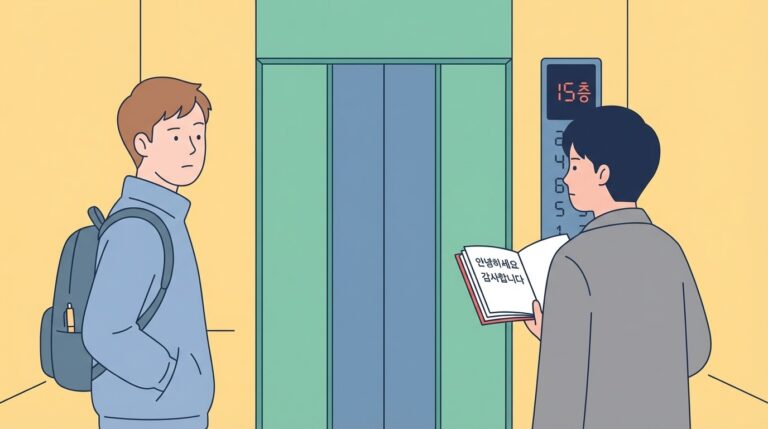
Korean Apartment Culture: How to Survive the Awkward Elevator Ride with Neighbors
Hello! It’s your Daily Hangul Editor. Imagine this: You step into an elevator in your newly rented Seoul apartment. The doors are about to close when suddenly, a neighbor rushes in. You make eye contact. In your home country, this might be the perfect time to ask, ‘How’s the weather?’ or ‘Did you have a good day?’ But in Korea? Total, absolute silence. You both stare at the digital floor numbers changing as if it’s the most gripping thriller movie ever made.
Why is that? Is the neighbor being rude? Did you do something wrong? In Korean K-Dramas like Strangers from Hell or romantic comedies where the leads live next door, the elevator is a place of extreme tension, secret romance, or hilarious awkwardness. But in real life, Korean elevator etiquette has its own unspoken rules.
Today, we are going to learn exactly how to navigate this uniquely awkward Korean apartment culture. By the end of this guide, you won’t just survive the elevator ride—you’ll ride it like a true local.
Phase 2: Core Expressions — Breaking (or Keeping) the Ice
Here are the top phrases you need when meeting neighbors in Korea.
1. 안녕하세요 (The Elevator Mumble)
- Pronunciation: annyeonghaseyo + [Sounds like a quick, slightly faded ‘an-nyung-ha-se-yo’ while dipping your head]
- Meaning: Literal: Are you in peace? / Real nuance: I acknowledge your presence, but I will not disturb you.
- K-Culture Moment: You’ll notice Koreans rarely do a full 90-degree bow in the elevator. Instead, they do a Mongnye (목례), which is a slight nod of the head with a brief, quiet greeting.
- Editor’s Insight: The key here is volume. Do not shout ‘ANNYEONGHASEYO!’ like you’re in a military camp. It should be soft, almost like a sigh.
- Situation Spectrum:
- Casual/Neighbors: ✅
- Delivery drivers: ✅
- Your Boss (if you work together): ⚠️ (Needs to be a bit louder and more formal)
- 🤔 Think About It: Why do Koreans prefer quiet greetings in enclosed spaces? Could it be related to the value of personal space in a densely populated city like Seoul?
2. 몇 층 가세요?
- Pronunciation: myeot cheung gaseyo? + [myut choong ga-se-yo?]
- Meaning: Literal: Which floor are you going to? / Real nuance: I am standing near the buttons, let me press it for you.
- K-Culture Moment: If a neighbor walks in carrying three heavy bags of groceries or a massive box of Kimchi sent from their mother, you become the ‘button master.’ Asking this makes you an instant neighborhood angel.
- Editor’s Insight: You don’t need to say a long sentence like ‘Can I press the button for you?’ Just asking ‘What floor?’ implies you will do the job.
- Situation Spectrum:
- To anyone whose hands are full: ✅
- To a child: ✅ (Use ‘몇 층 가?’ for kids)
- 🤔 Think About It: In many cultures, independence is highly valued (doing it yourself). In Korea, helping someone with a small task like this shows Jeong (정, community affection).
3. 먼저 내리세요
- Pronunciation: meonjeo naeriseyo + [mun-juh nae-ri-se-yo]
- Meaning: Literal: Please get down first. / Real nuance: After you.
- K-Culture Moment: When the elevator reaches the ground floor and the doors open, there is sometimes a 1-second ‘who goes first’ dance. A simple hand gesture with this phrase smoothly resolves the traffic jam.
- Editor’s Insight: Koreans are famous for the ‘Ppalli Ppalli’ (hurry hurry) culture. But at the elevator door, there’s often a sudden display of polite yielding.
- Situation Spectrum:
- Elders: ✅
- Neighbors: ✅
- 🤔 Think About It: Have you noticed who usually gets off the elevator first in your country? Is it based on age, gender, or just whoever is closest to the door?
Phase 3: Textbook vs Real Korean
Let’s see how the textbooks compare to the real everyday Korean you’ll hear in an apartment building.
[Greeting a neighbor you see every day]
* 📖 Textbook Korean: 안녕하십니까. 좋은 아침입니다. (Hello. It is a good morning.)
* 🗣️ Real Korean: (Slight head nod) 안녕하세요…
* 💡 Why the difference?: Koreans rarely say ‘Good morning’ as a literal translation. A quiet, humble nod acknowledges the person without forcing unwanted small talk.
[When you want the door to close quickly]
* 📖 Textbook Korean: 엘리베이터 문을 닫아주시겠습니까? (Would you please close the elevator door?)
* 🗣️ Real Korean: (Silence) + Rapidly tapping the 닫힘 (Close) button.
* 💡 Why the difference?: The most frequently broken or faded button in a Korean elevator is the ‘Close’ button. Action speaks louder than words in the ‘hurry hurry’ culture!
Phase 4: Cultural Context — K-Culture Deep Dive
4-1. Non-Verbal Communication: The Art of ‘Mongnye’ and ‘Nunchi’
Language is only 10% of elevator etiquette. The rest is Nunchi (눈치)—the Korean art of reading the room. If a neighbor is staring at their phone or the floor numbers, your Nunchi should tell you: ‘Do not ask them about their day.’ The most polite physical gesture here is the Mongnye (목례), an ‘eye bow’ or slight tilt of the head. It says, ‘I respect you, but I will give you peace.’
4-2. The K-Drama Trope: The Elevator Encounter
If you’ve watched K-Dramas, you know the elevator is a sacred space for plot twists. It’s where the male lead secretly holds the door for the heroine, or where characters accidentally overhear a huge secret.
* Critical View: While dramas show characters having deep, dramatic conversations or romantic confessions in the elevator, trying to strike up a long conversation with a Korean stranger in an elevator will likely result in a very panicked, uncomfortable neighbor. Save the drama for the TV!
Phase 5: Real-Life Roleplay Scenario
Setting: It’s Tuesday at 6:30 PM in a Seoul apartment complex. The elevator stops on the 7th floor. An Ahjumma (middle-aged lady) steps in. She is holding a large, heavy-looking box of sweet potatoes, struggling to reach the buttons. You are standing right next to the control panel.
Characters:
– YOU: A foreign resident who just moved in, eager to be polite.
– Ahjumma (Mrs. Kim): A busy but warm neighbor.
Dialogue:
(Ahjumma walks in, looking at the buttons but her hands are full.)
YOU: 안녕하세요.
(Annyeonghaseyo.)
[Hello.]
(🎭 Stage Direction: You give a slight bow.)
Ahjumma: 네, 안녕하세요.
(Ne, annyeonghaseyo.)
[Yes, hello.]
(🎭 Stage Direction: She struggles to lift her arm to press a button.)
🔀 Your Turn! How do you react?
– A) Stand still and look at your phone. (Not your problem!)
– B) ‘몇 층 가세요?’ (What floor are you going to?)
– C) ‘제가 도와드릴까요? 무거워 보이시네요.’ (Shall I help you? It looks heavy.)✅ Best Choice: B — It is quick, practical, and standard. You become the helpful neighbor without making it a huge deal.
⚠️ Choice C Analysis: While very polite, it might feel a bit too intimate or conversational for a quick elevator ride. Keep it brief!
YOU (Choosing B): 몇 층 가세요?
(Myeot cheung gaseyo?)
[What floor are you going to?]
Ahjumma: 아유, 14층이요. 고마워요.
(Ayu, sipsacheung-iyo. Gomawoyo.)
[Oh, 14th floor. Thank you.]
YOU: (Presses 14) 네.
(Ne.)
[Yes.]
(🎭 Stage Direction: The elevator reaches the 14th floor. The doors open.)
YOU: 먼저 내리세요.
(Meonjeo naeriseyo.)
[Please get off first.]
Ahjumma: 감사합니다. 수고하세요!
(Gamsahamnida. Sugohaseyo!)
[Thank you. Have a good day (keep up the good work)!]
Phase 6: 10-Second Shadowing Drill
Practice speaking like a local! Pay attention to the pauses (/) and the emotion tags.
- 😊 Friendly but brief: 안녕하세요. / 몇 층 / 가세요?
(an-nyeong-ha-se-yo. / myeot cheung / ga-se-yo?) - 😌 Polite yielding: 천천히 / 먼저 / 내리세요.
(cheon-cheon-hi / meon-jeo / nae-ri-se-yo) -> Please take your time and get off first.
Phase 7: K-Culture Mini Dictionary
| Korean | Romanization | English | Cultural Context |
|---|---|---|---|
| 눈치 | nunchi | Social sense / tact | The ability to read the room. Crucial for knowing when to stay silent in an elevator. |
| 목례 | mongnye | Eye bow / slight nod | A minimal bow used in tight spaces where a full bow is impossible. |
| 닫힘 버튼 | dat-him beoteun | Close button | The most used button in Korea. Often worn out due to the ‘Ppalli Ppalli’ culture. |
| 아파트 | apateu | Apartment complex | In Korea, these are often massive high-rise complexes, meaning you share elevators with hundreds of people. |
Phase 8: Traveler Survival Kit
Even if you don’t live in an apartment, you will use elevators in Korean hotels, subway stations, or department stores.
🆘 Survival Expressions
– 🇰🇷 ‘잠시만요!’ (Jam-si-man-yo!)
– 🗣️ English: Excuse me / Just a moment!
– 📍 Where to use: When you need to squeeze out of a crowded elevator, or when you are running and want someone to hold the door.
– 💡 Pro Tip: In a crowded subway elevator, just saying ‘잠시만요’ will part the sea of people like magic.📌 Editor’s Travel Note
– Button Etiquette: If you are standing closest to the control panel in a hotel or restaurant elevator, you are the unofficial ‘Elevator Captain.’ It is polite to hold the ‘Open’ (열림) button until everyone gets in or out.
– The B1/B2/B3 buttons: Don’t be confused! ‘B’ stands for Basement (지하). B1 is Basement level 1.
Phase 9: Critical Thinking — ‘Think Deeper’
Language & Space: Why the Silence?
In Western cultures, small talk in an elevator (‘Low-context culture’) is a way to acknowledge someone’s humanity and prevent awkwardness. But Korea is a ‘High-context culture’ with a very high population density. When millions of people share small spaces every day, silence is actually considered a form of respect. By not talking to you, Koreans are giving you the gift of ‘mental space’ and privacy. It’s not coldness; it’s an invisible boundary of politeness.
💬 Your Turn: How do people behave in elevators in your home country? Is it a place for chatting or a place for staring at the ceiling? Share in the comments!
Phase 10: FAQ & Avoiding Misunderstandings
- Q: Can I ask ‘How are you?’ in the elevator?
- A: Maybe, but mostly NO. Unless you are already close friends with the neighbor, asking ‘How are you?’ (잘 지내셨어요?) to a mere acquaintance in an elevator will make them panic to find an answer before their floor arrives. Keep it to ‘안녕하세요’.
- Q: If someone is running for the elevator, should I hold the door?
- A: YES! Press and hold the 열림 (Open) button. They will usually rush in and say ‘감사합니다’ (Thank you).
❌ Common Mistake #1: Trying to make eye contact the entire ride.
✅ Do this instead: Say hello once, then look at the floor indicator, your shoes, or your phone.
Phase 11: Summary & Action Items
One-Liner Summary: In a Korean elevator, a slight nod (‘안녕하세요’) and offering to press the button (‘몇 층 가세요?’) are the ultimate signs of a polite neighbor.
Action Mission:
* 🥉 Bronze (Solo): Stand in front of a mirror, do a slight head nod (목례), and practice saying ‘안녕하세요’ quietly 3 times.
* 🥈 Silver (Online): Leave a comment below telling us what floor you live on in Korean! (e.g., 저는 5층에 살아요!)
* 🥇 Gold (Real Life): The next time you are in an elevator in Korea (or at a Korean establishment), stand by the buttons and ask someone ‘몇 층 가세요?’
🎬 K-Culture Mission: Watch any Korean Drama episode today. Spot an elevator scene. Notice if they use the ‘Mongnye’ (slight nod) or if someone is frantically pressing the ‘Close’ button!
Phase 12: Interactive Quiz
1. You are standing by the buttons. A neighbor walks in with heavy bags. What is the most natural thing to say?
– A) 좋은 아침입니다! (Good morning!)
– B) 몇 층 가세요? (What floor are you going to?)
– C) 도와주세요! (Help me!)
2. True or False: In Korea, it is considered rude to stay completely silent after the initial ‘안녕하세요’ in an elevator.
– A) True
– B) False
3. Fill in the blank: When it’s time to get off, you can politely tell the older neighbor to go first by saying, “______ 내리세요.”
– A) 같이 (Together)
– B) 먼저 (First)
– C) 빨리 (Quickly)
(Answers: 1: B, 2: False – Silence is golden and polite!, 3: B)
Frequently Asked Questions (FAQ)
Q: What does "안녕하세요 (The Elevator Mumble)" mean in Korean and how do you pronounce it?
A: In Korean, "안녕하세요 (The Elevator Mumble)" is pronounced [annyeonghaseyo + [Sounds like a quick, slightly faded 'an-nyung-ha-se-yo' while dipping your head] and means: Literal: Are you in peace? / Real nuance: I acknowledge your presence, but I will not disturb you.
Q: What does "몇 층 가세요?" mean in Korean and how do you pronounce it?
A: In Korean, "몇 층 가세요?" is pronounced [myeot cheung gaseyo? + [myut choong ga-se-yo?] and means: Literal: Which floor are you going to? / Real nuance: I am standing near the buttons, let me press it for you.
Q: What does "먼저 내리세요" mean in Korean and how do you pronounce it?
A: In Korean, "먼저 내리세요" is pronounced [meonjeo naeriseyo + [mun-juh nae-ri-se-yo] and means: Literal: Please get down first. / Real nuance: After you.







