

Hello! I’m the Senior Editor at Daily Hangul, your personal K-Culture navigator and veteran Korean tutor.
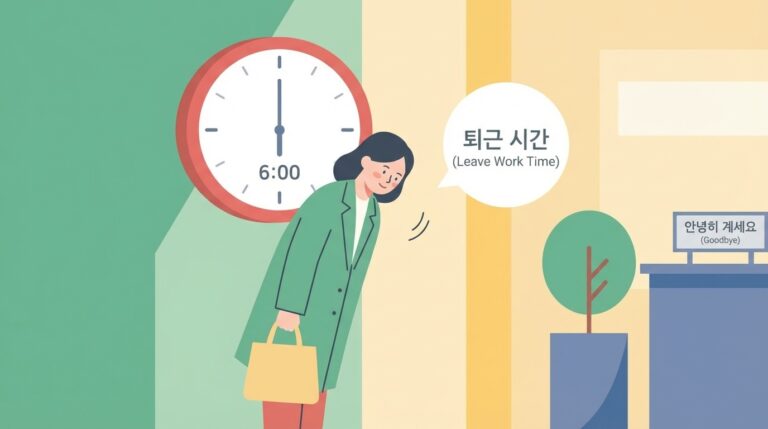
Have you ever watched a Korean office drama like Business Proposal or Misaeng? The clock strikes 6:00 PM. But nobody moves. Finally, the main character stands up, gives a polite bow to the team, and says a specific phrase. The subtitles just say, “Goodbye” or “See you tomorrow.”
But wait… was it really just a simple “Goodbye”?
If you use the textbook “Goodbye” (안녕히 계세요 – Annyeonghi gyeseyo) in a Korean office, your colleagues might stare at you in confusion! Leaving work in Korea isn’t just about walking out the door; it’s a social ritual of acknowledging everyone’s hard work.
Today, I’m going to share the exact phrases you need to survive 6:00 PM in a Korean office. This guide is based on real questions from beginners who felt super awkward leaving their Korean workplace for the first time!
Phase 2: Core Expressions Deep Dive
Here are the absolute must-know survival phrases for clocking out.
1. 먼저 가보겠습니다
- Pronunciation: Meonjeo gabogetseumnida [sounds like: mun-juh gah-bo-get-seum-nee-dah]
- Meaning:
- Literal: I will try going first.
- Real nuance: I am leaving for the day (before you).
- K-Culture Moment: Picture a quiet office. You slowly pack your bag, stand up, make eye contact with your boss, and say this. It’s the ultimate “I’m clocking out” announcement.
- Editor’s Insight: Think of it less as “goodbye” and more as politely asking for permission/informing them you are exiting. It shows respect to those who are still working.
- Situation Spectrum:
- Close Friends (Casual): 🚫 (Too stiff!)
- Coworkers (Semi-formal): ✅
- Boss/Elders (Formal): ✅
- 🤔 Think About It: Why do Koreans emphasize “going first” (먼저)? How does this reflect the group-oriented culture of a Korean workplace?
2. 수고하셨습니다
- Pronunciation: Sugohasyeotseumnida [sounds like: soo-go-ha-shut-seum-nee-dah]
- Meaning:
- Literal: You have put in hard effort/work.
- Real nuance: Great job today / Thank you for your hard work.
- K-Culture Moment: At a team dinner (Hoesik), when everyone is finally leaving the BBQ restaurant, you hear a chorus of “Sugohasyeotseumnida!” echoing in the street.
- Editor’s Insight: This is the magic social glue of Korea! It acknowledges that everyone suffered/worked hard together. You say it to coworkers when leaving, or when a meeting ends.
- Situation Spectrum:
- Close Friends (Casual): ⚠️ (Friends use a shorter version: 수고했어!)
- Coworkers (Semi-formal): ✅
- Boss/Elders (Formal): ✅ (Safe to use for past effort at the end of the day)
- 🤔 Think About It: Does your native language have a specific phrase to thank someone for their daily labor, or do you just say “Bye”?
3. 내일 뵙겠습니다
- Pronunciation: Naeil boepgetseumnida [sounds like: nae-eel bep-get-seum-nee-dah]
- Meaning:
- Literal / Real nuance: See you tomorrow. (Very polite)
- K-Culture Moment: You usually combine this with expression #1. “먼저 가보겠습니다. 내일 뵙겠습니다!” It’s the perfect, safest combo to end the day.
- Situation Spectrum:
- Close Friends (Casual): 🚫 (Use “내일 봐!” instead)
- Coworkers/Boss (Formal): ✅
Phase 3: Textbook vs. Real Korean
Let’s see why textbook Korean might make you sound like a robot in the office.
[Leaving the Office]
* 📖 Textbook Korean: 안녕히 계세요. (Annyeonghi gyeseyo – Stay in peace / Goodbye)
* 🗣️ Real Korean: 먼저 가보겠습니다. 내일 뵙겠습니다! (I’ll leave first. See you tomorrow!)
* 💡 Why the difference?: The workplace is a formal environment. “안녕히 계세요” sounds like you are leaving a friend’s house or a store, not a professional setting.
[Greeting a Coworker in the Elevator at 6 PM]
* 📖 Textbook Korean: 좋은 저녁 되세요. (Joeun jeonyeok dweseyo – Have a good evening.)
* 🗣️ Real Korean: 수고하셨습니다~ 조심히 들어가세요! (You worked hard~ Go home safely!)
* 💡 Why the difference?: Koreans rarely translate “have a good evening.” Instead, they focus on “You worked hard” and “Get home safe” (조심히 들어가세요).
Bottom Note: For A1 beginners, don’t worry about memorizing every grammar rule here. Just memorize these phrases as single “vocabulary” words. They are lifesavers!
Phase 4: Cultural Context — K-Culture Deep Dive
4-1. Non-Verbal Elements: Nunchi at 6 PM
Leaving work requires serious Nunchi (눈치)—the Korean art of reading the room. If your boss is typing furiously and looking stressed, you don’t just yell “BYE!” and run out.
– The Body Language: Stand up, grab your bag, walk slightly towards the center of the room, give a 30-to-45-degree bow, and say “먼저 가보겠습니다.”
– Eye Contact: Make gentle eye contact, but don’t stare them down.
4-2. K-Drama Connection: The Dreaded Hoesik
If you watch K-Dramas, you’ve seen this trope: It’s 5:58 PM. The hero is ready for a date. Suddenly, the boss stands up and claps. “오늘 회식합시다!” (Let’s have a team dinner today!)
In the past, refusing a Hoesik (회식 – team dinner) was considered taboo. Today, modern Korean companies respect personal time much more. However, the dramatic tension of “Will I be able to go home on time?” is still a relatable pain point for every Korean worker!
Phase 5: Real-Life Roleplay Scenario
Setting: Friday, 6:00 PM. A marketing office in Gangnam. Your bags are packed. You want to start your weekend.
Characters:
– YOU: A foreign intern who just finished their first week.
– Manager Kim (45): Your boss. He is still staring at his computer screen.
Dialogue:
YOU: (Stands up carefully, holding your bag)
과장님… (Gwajangnim… / Manager…)
Manager Kim: 네, OO 씨. 다 끝났어요?
(Ne, OO ssi. Da kkeutnasseoyo?)
[Yes, OO. Are you all finished?]
YOU: 네, 다 했습니다.
(Ne, da haetseumnida.)
[Yes, I’m all done.]
🔀 Your Turn! How should you say goodbye?
– A) 안녕히 계세요! (Annyeonghi gyeseyo! – Goodbye!)
– B) 먼저 가보겠습니다. 수고하셨습니다! (Meonjeo gabogetseumnida. Sugohasyeotseumnida! – I’ll leave first. You worked hard!)
– C) 저 집에 갈게요! (Jeo jibe galgeyo! – I will go home!)✅ Best Choice: B — This is the perfect, polite, and culturally accurate way to leave. Manager Kim will be incredibly impressed!
⚠️ Choice A & C Analysis: ‘A’ is for a store, not an office. ‘C’ sounds like a 5-year-old telling their mom they are going home!
Manager Kim: 아, 네! 주말 푹 쉬어요. 수고했어요!
(A, ne! Jumal puk swieoyo. Sugohaesseoyo!)
[Ah, yes! Rest well this weekend. Good job!]
YOU: 감사합니다. 주말 잘 보내세요!
(Gamsahamnida. Jumal jal bonaeseyo!)
[Thank you. Have a good weekend!]
Phase 6: 10-Second Shadowing Drill
Let’s practice the rhythm! Read these out loud, pausing at the slash (/).
- 🙇♂️ Polite & Professional:
먼저 / 가보겠습니다.
(Meonjeo / gabogetseumnida.) - 😊 Warm & Appreciative:
오늘 하루도 / 수고하셨습니다!
(Oneul harudo / sugohasyeotseumnida!) - 👋 Respectful farewell:
내일 / 뵙겠습니다.
(Naeil / boepgetseumnida.)
Phase 7: K-Culture Mini Dictionary
| Korean | Romanization | English | Context |
|---|---|---|---|
| 퇴근 | toegeun | Leaving work | The act of clocking out and going home. The best time of day! |
| 칼퇴 | kaltoe | Leaving exactly on time | “Kal” means knife. It means cutting work exactly at 6:00 PM and leaving. |
| 야근 | yageun | Overtime / Night work | The opposite of Kaltoe. Working late into the night. |
| 회식 | hoesik | Company dinner | After-work gathering with colleagues, usually involving BBQ and Soju. |
| 눈치 | nunchi | Social awareness | The ability to read the room (e.g., checking if it’s okay to leave). |
Phase 8: Traveler Survival Kit (The Rush Hour Edition)
Even if you don’t work in Korea, you will experience “퇴근 시간” (Toegun time) as a traveler. Between 6:00 PM and 7:30 PM, Seoul turns into a battlefield!
🆘 Survival Phrases for 6 PM
– 🇰🇷 “가장 가까운 지하철역이 어디예요?” (Gajang gakkaun jihacheollyeogi eodiyeyo?)
– 🗣️ Pronunciation: [Gajang gak-ka-woon ji-ha-chul-yuck-ee uh-di-ye-yo?]
– 📍 Meaning: Where is the nearest subway station?
– 💡 Pro Tip: At 6 PM, avoiding taxis and finding the subway is the fastest way to travel.📌 Editor’s Travel Note
– The Hell Subway (지옥철): Line 2 and Line 9 in Seoul at 6:30 PM are called Jiok-cheol (Hell Subway) because they are so packed. If you are a tourist, try to have an early dinner and avoid taking the train with your big luggage between 6-7 PM!
– Taxi Apps: Catching a taxi on the street at 6 PM is nearly impossible. Make sure you have downloaded Kakao T (Kakao Taxi) to call a ride.
Phase 9: Critical Thinking — “One Step Deeper”
Language & Power: The Collectivist Workplace
In many Western cultures, work is just an individual transaction. You do your job, you say “Bye,” and you leave. But in Korea, the workplace is viewed as a collective community. When you say “수고하셨습니다” (You worked hard), you are acknowledging the shared struggle and effort of the team. Even if you worked on completely different projects, recognizing each other’s labor builds harmony. This is why sneaking out without saying anything is considered highly disrespectful in Korean corporate culture.
💬 Your Turn:
Do you have a culture of “clocking out” phrases in your country? Or do people just quietly slip out the back door? Share in the comments!
Phase 10: FAQ & Avoiding Mistakes
Q: Can I use “수고하셨습니다” to my boss?
Yes, at the end of the day, it is generally acceptable to say this to acknowledge their hard work for that day.
❌ HUGE Mistake Alert: “수고하세요!”
Beginners often say “수고하세요” (Sugohaseyo) instead of “수고하셨습니다” (Sugohasyeotseumnida).
– 수고하셨습니다 (Past tense): “You worked hard.” (Polite, good for boss/coworkers).
– 수고하세요 (Present/Imperative tense): “Keep working hard!”
If you say “수고하세요” to your boss as you leave, it sounds like: “I’m leaving to have fun! You stay here and keep suffering!” Never say this to an older person or boss. Only use it to service workers (like taxi drivers or convenience store clerks) when you leave.
Phase 11: Summary & Action Items
- One-Liner Summary: When leaving a Korean office, skip the textbook “Goodbye” and say “먼저 가보겠습니다” (I’ll leave first) to sound like a true local!
Your Action Missions:
* 🥉 Bronze (Solo): Stand in front of your mirror with your bag, bow slightly, and say “먼저 가보겠습니다” out loud.
* 🥈 Silver (Online): Comment “수고하셨습니다!” on your favorite Korean creator’s latest YouTube video to thank them for their hard work.
* 🥇 Gold (Real World): If you are visiting Korea, when you exit a taxi or a small restaurant, confidently tell the driver/owner: “수고하세요!” (Keep up the good work!).
K-Culture Mission:
Next time you watch a Korean drama set in an office (Start-Up, King the Land), pause when it’s time to leave work. Listen carefully—I guarantee you will hear “먼저 가보겠습니다” or “수고하셨습니다”!
Phase 12: Quiz — Interactive Challenge
1. Situational Judgment:
It’s 6:00 PM. You are an intern. Your manager is still at his desk. You need to go home. What is the BEST thing to say?
– A) 안녕히 계세요. (Annyeonghi gyeseyo.)
– B) 수고하세요! (Sugohaseyo!)
– C) 먼저 가보겠습니다. (Meonjeo gabogetseumnida.)
2. True or False — K-Culture Edition:
“It is highly recommended to take the subway with large suitcases at 6:30 PM in Seoul to experience true Korean culture.”
– True (T) / False (F)
(Answers: 1. C – A is for stores, B is insulting to a boss. 2. False! Avoid the ‘Hell Subway’ with luggage at rush hour at all costs!)
Frequently Asked Questions (FAQ)
Q: What does "먼저 가보겠습니다" mean in Korean and how do you pronounce it?
A: In Korean, "먼저 가보겠습니다" is pronounced [Meonjeo gabogetseumnida [sounds like: mun-juh gah-bo-get-seum-nee-dah] and means: Literal: I will try going first.
Q: What does "수고하셨습니다" mean in Korean and how do you pronounce it?
A: In Korean, "수고하셨습니다" is pronounced [Sugohasyeotseumnida [sounds like: soo-go-ha-shut-seum-nee-dah] and means: Literal: You have put in hard effort/work.
Q: What does "내일 뵙겠습니다" mean in Korean and how do you pronounce it?
A: In Korean, "내일 뵙겠습니다" is pronounced [Naeil boepgetseumnida [sounds like: nae-eel bep-get-seum-nee-dah] and means: Literal / Real nuance: See you tomorrow. (Very polite)






