

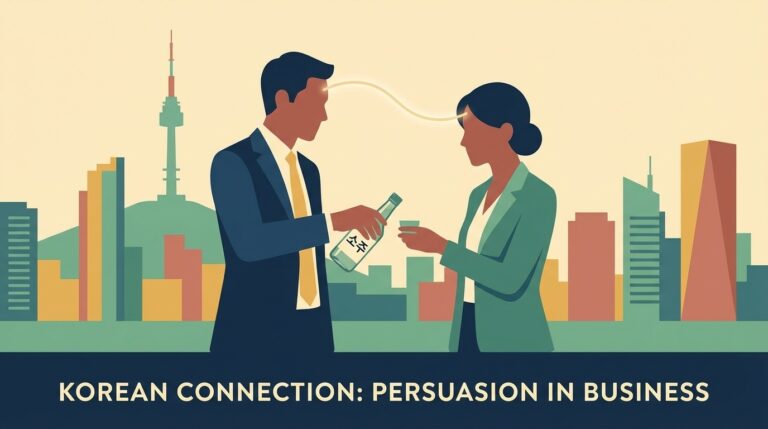
Phase 1: Empathy (The K-Culture Cold Open)
Hello! I’m your Daily Hangul Editor.
Picture this: You are watching a tense K-Drama like Misaeng or Crash Landing on You. Two CEOs are sitting in a private room of a high-end Hanwoo (Korean beef) restaurant. They are pouring each other premium Soju, smiling warmly, and exchanging pleasantries. The subtitles simply read, “I will do my best for you.” But the atmosphere is thick with tension. Was that really just a polite promise?
If you’ve reached the C2 level, you already know how to ask for a discount or make a basic proposal. But real negotiation in Korea is a psychological chess match. It operates deeply on the principles of Robert Cialdini’s Psychology of Persuasion—specifically Reciprocity (상호성), Scarcity (희귀성), and the intricate concept of Liking/Social Debt (정 and 체면).
In my 10+ years of living in Seoul and guiding foreign professionals, I’ve seen countless brilliant expats fail deals simply because they were ‘too direct.’ In Korea, you don’t just put numbers on the table; you build a web of mutual obligation. Today, we are going to decode the subtle, high-level Korean expressions that will give you the ultimate upper hand in any negotiation.
(Note: This guide is crafted from real-world B2B negotiations and high-stakes social interactions experienced by our advanced learners.)
Phase 2: Core Expressions Deep Dive
Let’s unpack the psychological triggers hidden in advanced Korean negotiation phrases.
1. 저희가 이 부분은 무리해서라도 맞춰드릴 테니…
- Pronunciation: jeo-hui-ga i bu-bun-eun mu-ri-hae-seo-ra-do mat-chwo-deu-ril te-ni… (The ‘mu-ri’ sounds like ‘moo-ree’ but with a quick, light tap of the ‘r’)
- Meaning: (Literal) We will stretch ourselves to accommodate this part for you, so… / (Real nuance) I am making a significant sacrifice for you, so I expect a concession in return.
- K-Culture Moment: This is the ultimate application of Reciprocity (상호성). You hear this often over business dinners. By explicitly stating that you are going out of your way (무리하다), you are gently forcing the other party to feel socially indebted to you.
- Editor’s Insight: The magic is in the trailing dots (…). You don’t immediately state your demand. You let the weight of your ‘sacrifice’ sink in.
- Situation Spectrum:
- Casual friends: ⚠️ (A bit too formal, but can be used jokingly)
- Colleagues/B2B (Semi-formal): ✅
- High-level Executives (Formal): ✅
- 🤔 Think About It: Why do Koreans prefer to leave the sentence unfinished with “~테니…” (since I will do X…) instead of directly saying “I did X, so you do Y”? How does this reflect the high-context nature of Korean communication?
2. 대표님께만 특별히 제안 드리는 조건입니다.
- Pronunciation: dae-pyo-nim-kke-man teuk-byeol-hi je-an deu-ri-neun jo-geon-im-ni-da.
- Meaning: (Literal) This is a condition I am specially proposing only to you, CEO. / (Real nuance) This is an exclusive, highly restricted offer. Take it now.
- K-Culture Moment: A textbook use of Scarcity (희귀성) and Exclusivity. Whether you are in a VIP room at a Gangnam plastic surgery clinic or closing a massive tech deal, framing the offer as an exclusive privilege triggers the psychological fear of missing out (FOMO) while stroking the listener’s ego.
- Editor’s Insight: Notice the use of “~께만” (only to you). It instantly isolates the listener from the general public, making them feel like an insider.
- Situation Spectrum:
- Casual friends: 🚫
- Colleagues/B2B (Semi-formal): ✅
- High-level Executives (Formal): ✅
- 🤔 Think About It: Korean VIP culture is massive. How does making someone feel ‘exclusive’ serve as a stronger persuasion tool than simply offering the lowest price?
3. 이번 한 번만 제 체면을 세워주십시오.
- Pronunciation: i-beon han beon-man je che-myeon-eul se-wo-ju-sip-si-o.
- Meaning: (Literal) Please raise my face just this once. / (Real nuance) Please do me this favor to save my professional reputation.
- K-Culture Moment: This invokes Liking and Social Debt. ‘Che-myeon’ (체면) means ‘face’ or ‘reputation.’ By asking someone to save your face, you are placing immense trust in them, creating an emotional bond that is very hard for a Korean partner to reject.
- Editor’s Insight: This is your “break glass in case of emergency” phrase. It is powerful but should be used sparingly. If a Korean partner accepts this, you are now practically blood brothers—and you will owe them one.
- Situation Spectrum:
- Casual friends: 🚫 (Too heavy)
- Colleagues/B2B (Semi-formal): ⚠️ (Only if you have built strong rapport)
- High-level Executives (Formal): ✅
- 🤔 Think About It: Does your culture have a concept similar to ‘saving face’? How does weaponizing your own vulnerability help in a high-stakes negotiation?
Phase 3: Textbook vs Real Korean
Let’s look at how textbooks teach negotiation versus how it actually sounds in a Seoul boardroom.
[Situation 1: Offering a Concession (Reciprocity)]
* 📖 Textbook Korean: 제가 양보하겠습니다. (I will yield.)
* 🗣️ Real Korean: 이번엔 저희가 좀 무리해서라도 맞춰보겠습니다. (We’ll try to accommodate it even if it’s a bit of a stretch for us this time.)
* 💡 Why it’s different: “양보하다” sounds like you are casually giving up a seat on a bus. “무리하다” (overdo/stretch) highlights the cost of your concession, amplifying the Reciprocity effect.
[Situation 2: Pushing for a Quick Decision (Scarcity)]
* 📖 Textbook Korean: 시간이 없습니다. 빨리 결정해 주세요. (There is no time. Please decide quickly.)
* 🗣️ Real Korean: 이 조건은 오늘까지 확답 주셔야 홀딩 가능합니다. (We can only hold these terms if you give us a firm answer by today.)
* 💡 Why it’s different: “홀딩” (Holding from English) and “확답” (firm answer) are staple Korean corporate jargon. It creates professional urgency without sounding desperate.
[Situation 3: Appealing to Authority/Trust]
* 📖 Textbook Korean: 저를 믿으세요. (Believe me.)
* 🗣️ Real Korean: 대표님, 저 한 번만 믿고 가시죠. 제가 책임지겠습니다. (CEO, trust me just this once and let’s go with it. I will take responsibility.)
* 💡 Why it’s different: “책임지다” (taking responsibility) is the ultimate trigger word for authority and trust in Korea’s risk-averse corporate culture.
Phase 4: Cultural Context — K-Culture Deep Dive
4-1. Non-verbal Negotiation Tactics
In Korean negotiations, Silence (침묵) is a calculated psychological weapon. When presented with an offer, a seasoned Korean negotiator might simply cross their arms, inhale deeply (creating a ‘hissing’ sound through their teeth), and say nothing for 10 seconds. This is designed to make you nervous and offer a lower price. Don’t break the silence. Match their Nunchi (눈치).
4-2. The “Dining Room” Diplomacy (K-Food Connection)
Why do so many K-Drama business deals happen over food? In Korea, eating together breaks down the rigid corporate hierarchy. Pouring a drink for your counterpart is a physical manifestation of Reciprocity. If you want to persuade a Korean partner, don’t do it in the boardroom under fluorescent lights. Do it after you’ve poured them their second glass of Soju. The psychological guard drops, and the Jeong (정 – emotional connection) takes over.
Phase 5: Real-Life Roleplay Scenario
Scenario A: The High-Stakes Hanwoo Dinner
- Setting: 7:30 PM on a Thursday. A private room at a premium Hanwoo restaurant in Gangnam. The marbled beef is sizzling on the grill.
- Characters:
- YOU: A foreign director trying to close a vital supply chain contract.
- Mr. Park: (50s, Korean Partner) A shrewd but warm executive who loves a good negotiation.
Mr. Park: 디렉터 님, 고기 맛이 어때요? 한국 소고기가 최고죠? 😊
(Direkteo-nim, gogi masi eottaeyo? Hanguk sogogiga choegojo?)
[How’s the meat, Director? Korean beef is the best, right?]
(🎭 Stage Direction: Mr. Park pours you a glass of premium Soju, signaling the start of the real talk.)
YOU: 네, 입에서 살살 녹네요. 오늘 초대해 주셔서 정말 감사합니다.
(Ne, ibeseo salsal nongneyo. Oneul chodaehae jusyeoseo jeongmal gamsahamnida.)
[Yes, it melts in my mouth. Thank you so much for inviting me today.]
Mr. Park: 에이, 뭘요. 그나저나… 아까 회의실에서 주신 단가표 말입니다. 조금만 더 빼주시죠. 우리 사이에.
(Ei, mwollyo. Geunajeona… akka hoeuisireseo jusin dangapyo marimnida. Jogeumman deo ppaejusijo. Uri saie.)
[Oh, don’t mention it. By the way… about that unit price sheet you gave me in the meeting room earlier. Please shave off a little more. Between us.]
🔀 Your Turn! How do you respond to apply psychological leverage?
– A) “안 됩니다. 그게 최저가입니다.” (No. That is the lowest price.)
– B) “하아… 전무님. 저희가 단가는 무리해서라도 맞춰드릴 테니, 대신 계약 기간을 1년 연장해 주시는 건 어떨까요?”
– C) “알겠습니다. 그럼 5% 깎아드릴게요.”✅ Best Choice: B — Reason: This perfectly utilizes Reciprocity. You show hesitation (“하아…”), acknowledge their request, frame your concession as a sacrifice (“무리해서라도”), and immediately ask for a counter-concession (contract extension).
⚠️ Choice A & C Analysis: ‘A’ is too rigid and breaks the ‘Jeong’ being built. ‘C’ gives away your leverage too easily, violating the rule of reciprocity.
Scenario B: The Scarcity Tactic at a High-End Boutique
- Setting: A luxury boutique in Cheongdam-dong. You are trying to get a rare item.
- Clerk: 고객님, 이 모델은 전국에 재고가 딱 하나 남았습니다.
(Gogaengnim, i modereun jeonguge jaegoga ttak hana namatseumnida.)
[Customer, there is exactly one unit of this model left nationwide.] - YOU: 아, 그래요? 그럼 제가 지금 바로 결제할 테니, 디스플레이 상품 말고 새 상품으로 구해주실 수 있나요?
(Ah, geuraeyo? Geureom jega jigeum baro gyeoljehal teni, diseupeullei sangpum malgo sae sangpumeuro guhaeju-sil su innayo?)
[Ah, really? Then I will pay right now, so could you get me a new one instead of the display item?]
(Applying reciprocity: “I will buy it immediately IF you do this for me.”)
Phase 6: 10-Second Shadowing Drill
Let’s practice the rhythm and intonation. Pay attention to the pauses (/)!
😤 (With professional determination)
저희가 / 이 부분은 / 무리해서라도 / 맞춰드릴 테니…
(jeo-hui-ga / i bu-bun-eun / mu-ri-hae-seo-ra-do / mat-chwo-deu-ril te-ni…)
🤫 (Leaning in, speaking softly like a secret)
대표님께만 / 특별히 제안 드리는 / 조건입니다.
(dae-pyo-nim-kke-man / teuk-byeol-hi je-an deu-ri-neun / jo-geon-im-ni-da.)
Phase 7: K-Culture Mini Dictionary
| 한국어 | Romanization | English | Cultural Context |
|---|---|---|---|
| 눈치 | nunchi | Social intelligence | The ability to read the room. Crucial for knowing when to push or pull in a negotiation. |
| 밀당 | mil-dang | Push and pull | Originally a dating term, but heavily used in business negotiations to describe the tug-of-war of offers. |
| 체면 | che-myeon | Face/Reputation | A core Korean value. Damaging a partner’s ‘che-myeon’ during a negotiation will kill the deal instantly. |
| 갑을관계 | gap-eul gwang-ye | Power dynamic | ‘Gap’ is the one with power (client), ‘Eul’ is the one seeking the deal (contractor). Understanding who is Gap and Eul dictates the language used. |
Phase 8: Traveler Survival Kit (High-End Edition)
Even if you aren’t doing corporate deals, these psychological triggers work wonders when traveling or staying at premium hotels.
🆘 Survival Phrases for Upgrades & Perks
– 🇰🇷 “기념일이라서 그러는데, 혹시 룸 업그레이드 가능할까요?” (ginyeomiraseo geureoneunde, hoksi rum eopgeureideu ganeunghalkkayo?)
– 🗣️ Meaning: “It’s our anniversary, so is a room upgrade possible by any chance?”
– 📍 Where to use: Hotel front desk.
– 💡 Pro Tip: Koreans value special milestones (Anniversaries, birthdays). By giving them a “reason” (psychology of ‘Because’), front desk staff are culturally more inclined to offer a scarce perk.📌 Editor’s Travel Note
– Bargaining: Bargaining is dead in modern Korean malls and department stores. However, in wholesale markets like Dongdaemun, if you buy in bulk (Reciprocity), you can confidently ask: “사장님, 두 개 살 테니까 조금만 빼주세요!” (I’m buying two, so please give me a discount!)
– The Power of Cash: In markets, cash is king. Flashing a 50,000 won bill while negotiating triggers immediate visual compliance.
Phase 9: Critical Thinking Corner — “A Step Deeper”
🧠 Think Deeper: Language and Power (언어와 권력)
Have you noticed that the Korean honorific system is inherently a negotiation tool? By intentionally using extremely polite language (높임말) and humbling verbs (like 드리다 instead of 주다), you are psychologically lowering yourself to elevate the counterpart. In the West, negotiators often try to assert dominance and appear alpha. In Korea, adopting a posture of extreme respect and humility disarms the opponent, creating a psychological obligation for them to treat you fairly in return. True power in Korean communication often lies in knowing how to gracefully lower your posture to get exactly what you want.
💬 Your Turn:
Does your culture have a way to negotiate by acting humble, or is dominance the only respected tactic? Share your thoughts in the comments!
Phase 10: FAQ & Common Mistakes
Q: “Can I use these expressions with someone I just met?”
– Maybe. Phrases like “특별히 제안 드립니다” (Special offer) work immediately in B2B. However, invoking “체면” (saving face) with a stranger is too intimate and will cause awkwardness.
Q: “How do I politely reject a concession they offer me?”
– Say: “마음만 감사히 받겠습니다.” (I will gratefully accept just your warm intentions.) It perfectly declines the offer while honoring the Reciprocity effect.
❌ Common Mistake #1: Saying “No” directly (아니요, 안 됩니다) in a formal negotiation.
✅ Do this instead: Use the ‘Yes, but…’ framework. “말씀은 이해했습니다만…” (I understand what you’re saying, however…)❌ Common Mistake #2: Accepting a favor or discount without expressing profound gratitude.
✅ Do this instead: In Korea, if they stretch (무리하다) for you, you must vocally acknowledge it: “신경 써주셔서 정말 감사합니다.” (Thank you so much for paying special attention to this.)
Phase 11: Summary & Action Items
- One-Liner Summary: Mastering advanced Korean negotiation means moving beyond numbers and utilizing Reciprocity, Scarcity, and Face-saving tactics to build psychological leverage.
-
Action Mission 3 Steps:
- 🥉 Bronze (Solo): Practice the shadowing drill (Phase 6) in front of a mirror until you sound naturally persuasive.
- 🥈 Silver (Online): Write a mock email paragraph to a Korean partner using “무리해서라도 맞춰드릴 테니” and post it in our learning community for feedback.
- 🥇 Gold (Real World): Next time you are at a Korean market or booking a hotel, try using a ‘reason’ or offering a small concession to get a perk!
- K-Culture Mission: Watch an episode of a corporate K-Drama like Misaeng or Itaewon Class. Count how many times the characters use food, drinks, or silence as a negotiation tactic before they actually state their demands!
Phase 12: Quiz — Interactive Challenge
1. Situational Judgment:
You are negotiating a contract and the Korean CEO says, “이 조건은 대표님께만 특별히 제안 드리는 겁니다.” (This is a special condition only for you.) What is the underlying psychological trigger, and what is your best response?
– A) Say “That’s illegal” because you suspect foul play.
– B) Say “Thank you, let me take 3 weeks to think about it.”
– C) Recognize it as a Scarcity/Exclusivity tactic, express gratitude, and use the momentum to finalize a favorable term.
(Answer: C. Recognizing the tactic allows you to play the game without being completely swept away. B ruins the momentum.)
2. Fill in the Blank:
If you want to say, “We will stretch ourselves to accommodate this for you,” you say:
“저희가 이 부분은 [ ________ ]라도 맞춰드릴 테니…”
(Answer: 무리해서)
3. True or False — K-Culture Edition:
In a Korean business negotiation, if the other party goes silent after your proposal, you should immediately offer a lower price to break the awkwardness.
(Answer: False. Silence is often a deliberate tactic to test your confidence. Hold your ground and wait.)
Frequently Asked Questions (FAQ)
Q: What does "저희가 이 부분은 무리해서라도 맞춰드릴 테니..." mean in Korean and how do you pronounce it?
A: In Korean, "저희가 이 부분은 무리해서라도 맞춰드릴 테니..." is pronounced [jeo-hui-ga i bu-bun-eun mu-ri-hae-seo-ra-do mat-chwo-deu-ril te-ni... (The 'mu-ri' sounds like 'moo-ree' but with a quick, light tap of the 'r'] and means: (Literal) We will stretch ourselves to accommodate this part for you, so... / (Real nuance) I am making a significant sacrifice for you, so I expect a concession in return.
Q: What does "대표님께만 특별히 제안 드리는 조건입니다." mean in Korean and how do you pronounce it?
A: In Korean, "대표님께만 특별히 제안 드리는 조건입니다." is pronounced [dae-pyo-nim-kke-man teuk-byeol-hi je-an deu-ri-neun jo-geon-im-ni-da.] and means: (Literal) This is a condition I am specially proposing only to you, CEO. / (Real nuance) This is an exclusive, highly restricted offer. Take it now.
Q: What does "이번 한 번만 제 체면을 세워주십시오." mean in Korean and how do you pronounce it?
A: In Korean, "이번 한 번만 제 체면을 세워주십시오." is pronounced [i-beon han beon-man je che-myeon-eul se-wo-ju-sip-si-o.] and means: (Literal) Please raise my face just this once. / (Real nuance) Please do me this favor to save my professional reputation.







