

Phase 1: Empathy — The “No-Data” Panic Mode
Hello! I’m your Daily Hangul Editor.
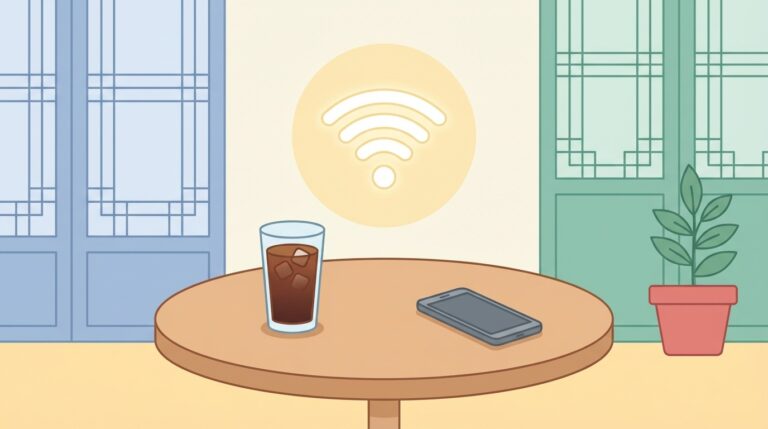
Imagine this: You just walked into a stunning, Instagram-worthy cafe in Seongsu-dong, Seoul. You ordered your perfect Iced Americano, found a cozy window seat, and pulled out your laptop to map out your next destination. But wait… you’re out of roaming data. You look around. The baristas are moving at the speed of light making lattes. The cafe is buzzing. You need the internet, but you freeze.
“How do I ask for the Wi-Fi without sounding awkward? Do I just yell ‘Wi-Fi please?!'”
Don’t worry, we’ve all been there! Korea is famously the land of lightning-fast internet. You can find Wi-Fi almost everywhere—cafes, restaurants, subway stations, and even on buses. But knowing exactly how to ask for it smoothly will save you from awkward hand gestures and make you look like a seasoned traveler.
This guide is built from the real “panic moments” of our beginner students. Let’s get you connected!
Phase 2: Core Expressions Deep Dive
Here are the top phrases you need to survive the Korean digital jungle.
1. 와이파이 비밀번호가 뭐예요? (What is the Wi-Fi password?)
- Pronunciation: wa-i-pa-i bi-mil-beon-ho-ga mwo-ye-yo? (mwo sounds like ‘mwuh’ — say it with a slight tone of curiosity!)
- Meaning: Literal: “What is the Wi-Fi secret number?” / Real: “What’s the Wi-Fi password?”
- K-Culture Moment: This is the standard, golden phrase. You’ll use this at the cafe counter when you’ve scoured the walls and can’t find the password written anywhere.
- Editor’s Insight: It feels polite but direct. “비밀번호” (bi-mil-beon-ho) is a super useful word. It literally means “secret number,” and Koreans use it for everything—Wi-Fi, digital door locks, bank PINs, and computer passwords.
- Situation Spectrum:
- Casual with friends: ✅ (Just drop the “yo”: 와이파이 비밀번호가 뭐야?)
- Cafe Staff/Strangers (Semi-formal): ✅
- Boss/Elders (Formal): ✅
- 🤔 Think About It: Why do you think Koreans use the term “secret number” (비밀번호) instead of “password” (암호) for everyday digital access? How does it relate to the digital keypad culture in Korea?
2. 여기 와이파이 돼요? (Do you have Wi-Fi here?)
- Pronunciation: yeo-gi wa-i-pa-i dwae-yo? (dwae sounds like ‘dway’ in ‘hallway’)
- Meaning: Literal: “Does Wi-Fi become here?” / Real: “Is Wi-Fi available here?” or “Do you have Wi-Fi?”
- K-Culture Moment: You walk into a tiny, old-school mom-and-pop restaurant (식당) for some authentic Kimchi Jjigae. You’re not sure if they even have a router. You ask the kind elderly owner this question.
- Editor’s Insight: The verb “돼요?” (dwae-yo) is absolute magic. It means “does it work?”, “is it available?”, or “can I?”. If you point at your phone and say “돼요?”, 90% of Koreans will understand you’re asking about the internet or charging.
- Situation Spectrum:
- Casual with friends: ✅
- Cafe Staff/Strangers (Semi-formal): ✅
- Boss/Elders (Formal): ⚠️ (A bit too casual for strict formal settings)
- 🤔 Think About It: The verb 되다 (to become/function) focuses on whether the situation works, rather than who owns it. Does your language ask “Do you have Wi-Fi?” or “Does the Wi-Fi work?”
3. 와이파이 비번 알려주세요. (Please tell me the Wi-Fi password.)
- Pronunciation: wa-i-pa-i bi-beon al-lyeo-ju-se-yo. (al-lyeo sounds like a quick ‘al-lyuh’)
- Meaning: Literal: “Please inform the Wi-Fi secret number.” / Real: “Password, please.”
- K-Culture Moment: You are studying with a Korean friend at a study cafe (스터디카페). They quickly ask the staff for the password using this shortened phrase.
- Editor’s Insight: “비번” (bi-beon) is the popular slang abbreviation for 비밀번호. Koreans love shortening words to save time (빨리빨리 culture!). It’s casual, efficient, and makes you sound like a local.
- Situation Spectrum:
- Casual with friends: ✅
- Cafe Staff/Strangers (Semi-formal): ⚠️ (Okay for young staff, but #1 is safer)
- Boss/Elders (Formal): 🚫 (Too informal)
- 🤔 Think About It: How does the Korean habit of shortening words (like 비번) reflect the modern, fast-paced digital lifestyle of Seoul?
Phase 3: Textbook vs. Real Korean
Let’s see how real life differs from your grammar books.
[Situation 1: Asking the Barista for the Password]
* 📖 Textbook Korean: 실례하지만, 무선 인터넷 비밀번호를 가르쳐 주시겠습니까? (Excuse me, would you mind teaching me the wireless internet password?)
* 🗣️ Real Korean: 저기요, 와이파이 비번이 뭐예요? (Excuse me, what’s the Wi-Fi pw?)
* 💡 Why the difference?: No one says “무선 인터넷” (wireless internet) in real life. It sounds like a 1990s tech manual. “와이파이” (Wi-Fi) is the universal standard!
[Situation 2: Asking a Friend to Share Their Data]
* 📖 Textbook Korean: 내 핸드폰이 인터넷이 안 돼요. 핫스팟을 켜 줄 수 있나요? (My phone’s internet isn’t working. Can you turn on your hotspot?)
* 🗣️ Real Korean: 야, 나 데이터 다 썼어. 핫스팟 좀 켜줘. (Hey, I’m out of data. Turn on your hotspot.)
* 💡 Why the difference?: Among friends, Koreans use very direct language. Dropping formal endings (요) and being straightforward shows you are close!
Bottom Note: For A2 beginners, stick to “와이파이 비밀번호가 뭐예요?” It is the safest, most natural, and perfectly polite phrase for any public place.
Phase 4: Cultural Context — K-Culture Deep Dive
4-1. Non-verbal Context: The “Nunchi” Scan
Before you march up to the counter and ask for the Wi-Fi, you must use your 눈치 (Nunchi – social awareness). In Korea, asking for the password right away is a rookie mistake! Why? Because 95% of the time, the password is already visible. Look for a small sign next to the cash register that says “Wi-Fi.” If it’s not there, it is almost certainly printed at the very bottom of your 영수증 (receipt). Always check your receipt before asking!
4-2. K-Culture Link: Cafe Study Culture (카공)
In K-Dramas, you often see the main characters sitting in cafes with their laptops, right? This is called 카공 (Ka-gong), short for 카페 공부 (cafe studying). Because so many people work and study in cafes, providing fast, free Wi-Fi is considered a basic duty for cafe owners. It’s not a luxury; it’s a necessity! Therefore, cafe staff will never be annoyed if you ask for the Wi-Fi password—they expect it. Just remember to buy a drink first!
Phase 5: Real-world Roleplay Scenario
Setting: Saturday afternoon, 2 PM. A trendy, minimalist cafe in Hongdae. You just ordered an Iced Americano. The barista hands you the vibrating pager and your receipt.
Characters:
– YOU: A traveler trying to connect to the internet to upload an Instagram Story of your gorgeous coffee.
– Barista (Jiwon): A 20-something college student working part-time. Friendly but busy.
Dialogue:
YOU: 아이스 아메리카노 한 잔 주세요. 🧊☕
(a-i-seu a-me-ri-ka-no han jan ju-se-yo.)
[Iced Americano, please.]
Jiwon: 네, 4,500원입니다. 영수증 드릴까요? 🧾
(ne, sa-cheon-o-baek-won-im-ni-da. yeong-su-jeung deu-ril-kka-yo?)
[Yes, that’s 4,500 won. Would you like the receipt?]
YOU: 네, 주세요.
(ne, ju-se-yo.)
[Yes, please.]
(🎭 Stage Direction: You take the receipt, but you don’t see any Wi-Fi signs around the counter.)
🔀 Your Turn! How do you ask for the Wi-Fi?
– A) “저기요, 와이파이 줘요!” (Excuse me, give me Wi-Fi!)
– B) “저기요, 와이파이 비밀번호가 뭐예요?”
– C) “인터넷 어떻게 해요?” (How do I do internet?)✅ Best Choice: B — It is the perfect balance of polite and natural.
⚠️ Choice A Analysis: “줘요” (give me) sounds demanding. You can’t physically “give” Wi-Fi, so it sounds very unnatural in Korean.
Jiwon: 아, 와이파이 비밀번호요? 영수증 밑에 있어요! 😊
(a, wa-i-pa-i bi-mil-beon-ho-yo? yeong-su-jeung mi-te i-sseo-yo!)
[Ah, the Wi-Fi password? It’s at the bottom of the receipt!]
YOU: 아, 네! 감사합니다!
(a, ne! gam-sa-ham-ni-da!)
[Ah, yes! Thank you!]
🌟 Bonus Scenario: The Dead Battery Panic
You have the Wi-Fi, but your phone is at 2%! You need to charge it.
YOU: 저기요, 혹시 충전 돼요?
(jeo-gi-yo, hok-si chung-jeon dwae-yo?)
[Excuse me, by any chance, is charging available?]
Jiwon: 네, 저쪽 창가 자리에 콘센트 있어요.
(ne, jeo-jjok chang-ga ja-ri-e kon-sen-teu i-sseo-yo.)
[Yes, there are outlets at the window seats over there.]
Phase 6: 10-Second Shadowing Drill
Let’s practice the flow. Pay attention to the pauses!
😊 저기요, / 와이파이 비밀번호가 / 뭐예요?
(jeo-gi-yo, / wa-i-pa-i bi-mil-beon-ho-ga / mwo-ye-yo?)
Emotion: Friendly and inquisitive.
🥺 핸드폰 / 충전 / 돼요?
(haen-deu-pon / chung-jeon / dwae-yo?)
Emotion: Slightly desperate, pointing at your dying phone!
Phase 7: K-Culture Mini Dictionary
| Korean | Romanization | English | Context |
|---|---|---|---|
| 와이파이 | wa-i-pa-i | Wi-Fi | Written exactly how it sounds in Konglish. |
| 비밀번호 | bi-mil-beon-ho | Password | Lit: “Secret number.” Used for Wi-Fi, doors, and bank accounts. |
| 비번 | bi-beon | Password (Slang) | The shortened, casual form of 비밀번호. |
| 영수증 | yeong-su-jeung | Receipt | Where the Wi-Fi password usually hides in cafes! |
| 데이터 | de-i-teo | Mobile Data | If you don’t have Wi-Fi, you use your “data.” |
| 충전 | chung-jeon | Charging | Essential word for surviving a full day of traveling. |
Phase 8: Traveler’s Survival Kit
Because finding Wi-Fi is a core survival skill for any traveler in Korea!
🆘 Survival Expression #1: “영수증 버려주세요.”
– 🇰🇷 yeong-su-jeung beo-ryeo-ju-se-yo.
– 🗣️ Meaning: “Please throw away the receipt.”
– 📍 Context: Cashiers will ALWAYS ask “영수증 드릴까요?” (Shall I give you the receipt?). If you already know the Wi-Fi password or don’t need it, say this to save paper!🆘 Survival Expression #2: “영수증 밑에 있어요.”
– 🇰🇷 yeong-su-jeung mi-te i-sseo-yo.
– 🗣️ Meaning: “It’s at the bottom of the receipt.”
– 📍 Context: This is the answer you will hear 80% of the time when you ask for the Wi-Fi password. Train your ears for this!📌 Editor’s Travel Note
– Public Wi-Fi: Seoul has amazing public Wi-Fi (look for ‘Public WiFi Free’). But it can be slow. Cafe Wi-Fi is always faster.
– The “a” in Passwords: Often, Korean Wi-Fi passwords include the cafe’s phone number or name, followed by an English letter. If they say “12345678에이(a)”, it means type the numbers, then the lowercase letter ‘a’.
Phase 9: Critical Thinking Corner — “한 발 더 깊이”
🧠 Think Deeper: Korean in the Global Era (Konglish)
Have you noticed how many tech words in Korean sound like English? 와이파이 (Wi-Fi), 데이터 (Data), 인터넷 (Internet), 핫스팟 (Hotspot). Because Korea adopted modern internet technology rapidly from the West, they didn’t invent new Korean words for these concepts; they just adapted the English sounds into Hangul. This is called “Konglish” (Korean-English). While some language purists worry that Korean is losing its traditional roots, others argue that adapting global words makes communication faster and more practical.💬 Your Turn: Does your native language create completely new words for tech terms (like ‘computer’ or ‘Wi-Fi’), or do you just use the English pronunciation with your local accent? Share in the comments!
Phase 10: FAQ & Avoiding Misunderstandings
- “Can I just say ‘와이파이 주세요’ (Give me Wi-Fi)?”
- No. You can say “Coffee 주세요” because coffee is a physical object. Wi-Fi is a signal. It sounds very awkward to native ears. Stick to “비밀번호가 뭐예요?”
- “Do I have to buy something to use the Wi-Fi?”
- Yes. In Korea, the cafe space and Wi-Fi are considered part of the service you pay for when you buy a drink. Going in just to use the Wi-Fi without ordering is considered bad manners (눈치 없는 행동).
❌ Common Mistake #1: Throwing away the receipt immediately, then going back to the counter to ask for the Wi-Fi password.
✅ How to fix it: Always keep the receipt until you are fully connected!
Phase 11: Summary & Action Items
- One-Liner Summary: To get connected in Korea, check your receipt first, and if it’s not there, politely ask: “와이파이 비밀번호가 뭐예요?”
-
Action Mission:
- 🥉 Bronze: Say “와이파이 비밀번호가 뭐예요?” out loud 3 times while imagining you are in a Seoul cafe.
- 🥈 Silver: Next time you go to your local cafe in your home country, pretend the barista is Korean and mutter the phrase under your breath.
- 🥇 Gold (For those in Korea): Go to a cafe today, order a drink, get the receipt, and successfully connect to the Wi-Fi using only Korean!
- K-Culture Mission: Watch an episode of a modern K-Drama today. Whenever they are in a cafe scene, look closely at the counter. Can you spot the little Wi-Fi password sign?
Engagement: Have you ever had a funny or embarrassing moment trying to connect to the internet in a foreign country? Tell us your story in the comments below! 👇
Phase 12: Quiz — Interactive Challenge
1. You are at a cafe and you can’t find the Wi-Fi password on the wall. What is the most natural thing to say to the staff?
A) 와이파이 주세요. (Give me Wi-Fi)
B) 인터넷 원해요. (I want internet)
C) 와이파이 비밀번호가 뭐예요? (What is the Wi-Fi password?)
2. Fill in the blank: The Korean slang word for password is [ ______ ].
3. True or False: In Korean cafes, it is perfectly fine to walk in, not buy a drink, and ask for the Wi-Fi password.
4. You ask the barista for the password, and she says “영수증 밑에 있어요.” Where should you look?
A) Under the table
B) At the bottom of the receipt
C) On the cafe door
👀 Click here for Answers!
1. C (A and B are grammatically awkward because you can’t “give” or “want” an internet signal like a physical object.)
2. 비번 (bi-beon) – Short for 비밀번호.
3. False – You should always order a drink first as part of cafe etiquette.
4. B – 영수증 means receipt, and 밑에 means at the bottom!
Frequently Asked Questions (FAQ)
Q: What does "와이파이 비밀번호가 뭐예요? (What is the Wi-Fi password?)" mean in Korean and how do you pronounce it?
A: In Korean, "와이파이 비밀번호가 뭐예요? (What is the Wi-Fi password?)" is pronounced [wa-i-pa-i bi-mil-beon-ho-ga mwo-ye-yo? (mwo sounds like 'mwuh' — say it with a slight tone of curiosity!] and means: Literal: "What is the Wi-Fi secret number?" / Real: "What's the Wi-Fi password?"
Q: What does "여기 와이파이 돼요? (Do you have Wi-Fi here?)" mean in Korean and how do you pronounce it?
A: In Korean, "여기 와이파이 돼요? (Do you have Wi-Fi here?)" is pronounced [yeo-gi wa-i-pa-i dwae-yo? (dwae sounds like 'dway' in 'hallway'] and means: Literal: "Does Wi-Fi become here?" / Real: "Is Wi-Fi available here?" or "Do you have Wi-Fi?"
Q: What does "와이파이 비번 알려주세요. (Please tell me the Wi-Fi password.)" mean in Korean and how do you pronounce it?
A: In Korean, "와이파이 비번 알려주세요. (Please tell me the Wi-Fi password.)" is pronounced [wa-i-pa-i bi-beon al-lyeo-ju-se-yo. (al-lyeo sounds like a quick 'al-lyuh'] and means: Literal: "Please inform the Wi-Fi secret number." / Real: "Password, please."







