

Phase 1: Empathy & K-Culture Cold Open
Hello! It’s your Daily Hangul Editor.
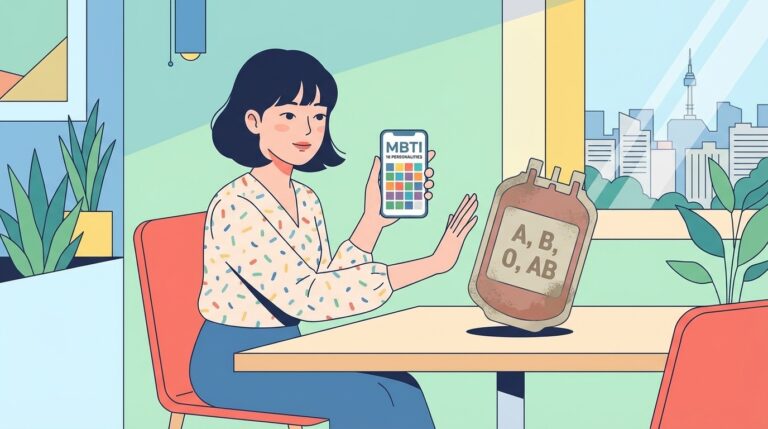
Picture this: You are watching a trendy Korean drama. The main characters meet for a Sogaeting (blind date) at a cozy cafe in Yeonnam-dong. In the past, the guy might have asked, “What’s your blood type?” to guess if she was a timid ‘Type A’ or a stubborn ‘Type B’. But today? That would make him look like he time-traveled from 2008.
Instead, he leans in, smiles, and asks, “What’s your MBTI?”
If you go to Korea right now, you will be asked this question. A lot. It has completely replaced the old blood type personality theory. From making friends at a language exchange to K-Pop idols introducing themselves on variety shows, MBTI is the ultimate icebreaker. If you don’t know yours, or don’t know how to talk about it in Korean, you might feel a bit left out.
Don’t worry! This guide is based on real questions from my students who were suddenly bombarded with four-letter acronyms in Seoul. Let’s dive into Korea’s biggest social trend!
Phase 2: Deep Dive into Core Expressions
1. MBTI가 어떻게 되세요?
- Pronunciation: [M-B-T-I-ga eotteoke doeseyo?]
- Meaning: (Literal) How does your MBTI become? -> (Real) What is your MBTI?
- K-Culture Moment: This is the modern Korean handshake. Whether you’re on a blind date, meeting new university classmates, or even doing a casual job interview, this is the go-to question to break the ice.
- Editor’s Insight: Notice we use ‘어떻게 되세요?’ instead of ‘뭐예요?’ (What is it?). It sounds much softer and more polite. It’s like asking, “May I know your MBTI?”
- Situation Spectrum:
- Casual with friends: ✅ (Though friends usually just ask “너 MBTI 뭐야?”)
- Co-workers (Semi-formal): ✅
- Boss/Elders (Formal): ⚠️ (Only if the atmosphere is very casual)
- 🤔 Think About It: Koreans love knowing where they stand with someone to ensure social harmony. How does knowing a personality type help people avoid making mistakes with new friends? Do people in your country use similar shortcuts?
2. 완전 T시구나! / 너 T야?
- Pronunciation: [Wanjeon ti-siguna!] / [Neo ti-ya?]
- Meaning: (Literal) You are completely a T! / Are you a T?
- K-Culture Moment: If you watch Korean YouTube or comedy shows, you’ve heard this. When someone gives a cold, overly logical response instead of emotional comfort, Koreans joke, “Are you a T?” (Thinking type). It has become a massive meme!
- Editor’s Insight: It’s usually said with a playful, slightly disappointed tone. If you tell a Korean friend you’re sick and they say, “Did you take medicine?” instead of “Oh no, are you okay?”, you can hit them with “너 T야?”
- Situation Spectrum:
- Casual with friends: ✅
- Co-workers (Semi-formal): ⚠️ (Only if you are close)
- Boss/Elders (Formal): 🚫
- 🤔 Think About It: Why is being ‘too logical’ (a T) seen as a funny flaw in Korean culture, which highly values Jeong (정, emotional connection and empathy)?
3. 혈액형은 옛날 거잖아요.
- Pronunciation: [Hyeoraek-hyeong-eun yennal geojannayo.]
- Meaning: (Literal) Blood types are old things, you know. -> (Real) Blood type personality theory is so old school.
- K-Culture Moment: If an older relative or a clueless friend asks, “Are you blood type O? You seem outgoing,” young Koreans will playfully roll their eyes and say this.
- Editor’s Insight: The ending ‘~잖아요’ means “you know that” or “as we both know.” It’s a great way to gently correct someone while keeping the mood light.
- Situation Spectrum:
- Casual with friends: ✅
- Co-workers (Semi-formal): ✅
- Boss/Elders (Formal): ⚠️ (Might sound slightly sassy to a strict boss)
- 🤔 Think About It: Trends change fast in Korea. Why do you think MBTI (16 types) replaced Blood Types (4 types) so quickly? Do we prefer more detailed labels today?
Phase 3: Textbook vs. Real Korean
[Asking about someone’s personality]
* 📖 Textbook Korean: 성격이 어때요? (What is your personality like?)
* 🗣️ Real Korean: MBTI가 뭐예요? (What’s your MBTI?)
* 💡 Why the difference?: “성격이 어때요?” feels like a serious job interview question. MBTI is a fun, pop-culture-friendly way to ask the exact same thing.
[Saying someone lacks empathy]
* 📖 Textbook Korean: 너무 이성적이네요. (You are very rational/logical.)
* 🗣️ Real Korean: 헐, 완전 T. (Whoa, total T.)
* 💡 Why the difference?: Internet culture loves abbreviations and inside jokes. Calling someone a ‘T’ is a trendy, slightly teasing way to say they are being too practical.
[Describing someone as spontaneous]
* 📖 Textbook Korean: 계획을 잘 안 세워요. (I don’t make plans well.)
* 🗣️ Real Korean: 저 완전 P라서요. (Because I’m a total P.)
* 💡 Why the difference?: MBTI letters have become adjectives. ‘P’ (Perceiving) is now the universal Korean slang for being spontaneous or disorganized.
Bottom Note: For B1 learners, using MBTI letters as adjectives (like “I am so J today” – meaning “I planned perfectly today”) will make you sound incredibly fluent and culturally tuned in!
Phase 4: Cultural Context — K-Culture Deep Dive
4-1. Non-verbal Communication: The ‘MBTI Nods’
When you reveal your MBTI in Korea, don’t just stand there! The expected reaction is a loud “Ahhh!” followed by vigorous nodding. It shows Nunchi (눈치). By nodding, they are signaling, “I have analyzed your personality and now know exactly how to treat you.” If someone says they are an ‘I’ (Introvert), it’s a non-verbal cue that the group shouldn’t pressure them to sing at karaoke.
4-2. K-Pop Connection: Idol Personas
In the 2nd generation of K-Pop (like Girls’ Generation or BIGBANG), idols’ profiles always listed their blood types. Fans would write fanfiction based on “Type A” traits.
Today? It’s all about MBTI. Idols take the test on YouTube, and fans use it to understand their dynamics. If a fan meets an idol at a fan signing (팬사인회), a very common interaction is:
Fan: “Oppa, did your MBTI change?”
Idol: “No, still INFP!”
Knowing this vocabulary is essential for modern K-Pop Deokjil (덕질, fangirling/fanboying).
Phase 5: Real-life Roleplay Scenario
Setting: Friday night, 8 PM. A trendy rooftop cafe in Itaewon. You are meeting Ji-hoon, a friend of a friend, for a casual hangout (basically a blind date). He is energetic, very friendly, and clearly an extrovert.
Characters:
– YOU: A foreign professional working in Seoul, navigating the dating scene.
– Ji-hoon (28): Friendly, talkative, total ENFP.
Dialogue:
Ji-hoon: 안녕하세요! 오시느라 고생했어요. 커피 괜찮으세요? ☕
(Annyeonghaseyo! Osineura gosaenghaesseoyo. Keopi gwaenchaneuseyo?)
[Hello! Thanks for coming all this way. Is coffee okay?]
(🎭 Stage Direction: Ji-hoon pulls out a chair for you with a bright smile)
YOU: 네, 좋아요! 분위기가 너무 좋네요.
(Ne, joayo! Bunwigiga neomu jonneyo.)
[Yes, I’d love some! The atmosphere here is great.]
Ji-hoon: 다행이다! 저 근데 진짜 궁금한 거 있었어요.
(Dahaengida! Jeo geunde jinjja gunggeumhan geo isseosseoyo.)
[I’m glad! But actually, there was something I was really curious about.]
Ji-hoon: 엠비티아이(MBTI)가 어떻게 되세요? 저는 ENFP거든요!
(M-B-T-I-ga eotteoke doeseyo? Jeoneun E-N-F-P-geodeunyo!)
[What’s your MBTI? I’m an ENFP!]
🔀 Your Turn! How will you respond?
– A) “저는 O형이에요.” (I am blood type O.)
– B) “저도 잘 몰라요. 성격은 조용한 편이에요.” (I don’t really know. I’m on the quiet side.)
– C) “아! 저는 INFP예요. 완전 반대네요?”✅ Best Choice: C — “Ah! I’m an INFP. We are total opposites?”
Why? Matching his energy and providing your MBTI immediately creates a bond. Koreans love discussing the chemistry between different MBTIs.
⚠️ Choice A Analysis: Saying your blood type will make him laugh. It’s a funny “boomer” joke, but not the answer he’s looking for!
Phase 6: 10-Second Shadowing Drill
Let’s practice the trendiest phrase. Pay attention to the pauses!
😲 아! / 그래서 / 완전 P시구나! (Ah! / geuraeseo / wanjeon P-siguna!)
Emotion: With sudden realization, nodding your head.
(Ah! / That’s why / you are such a ‘P’!)
Phase 7: K-Culture Mini Dictionary
| 한국어 | Romanization | English | Context |
|---|---|---|---|
| 엠비티아이 | em-bi-ti-ai | MBTI | Said as the English letters, but fast. The ultimate modern icebreaker. |
| 너 T야? | neo ti-ya | Are you a T? | A meme used when someone lacks empathy or is too blunt. |
| 팩폭 | paek-pok | Fact-bombing | Telling the harsh truth. Usually associated with ‘T’ personality types. |
| 소개팅 | so-gae-ting | Blind date | Where you will 100% be asked your MBTI within the first 5 minutes. |
| 혈액형 | hyeo-raek-hyeong | Blood type | The ghost of Korea’s past personality trend. |
Phase 8: Traveler’s Survival Kit
Even if you are just traveling, knowing about MBTI can lead to fun interactions with cafe owners, hostel roommates, or tour guides!
🆘 Survival Phrases #1
– 🇰🇷 “저는 대문자 I 예요.” (Jeoneun daemunja I-yeyo.)
– 🗣️ Sound-alike: [Jeo-neun dae-mun-ja eye-yeh-yo.]
– 📍 Meaning: “I am a capital I” (Meaning: I am extremely introverted).
– 💡 Pro Tip: Use this at a hostel or a party when you want to politely excuse yourself because your social battery is dead. Koreans will immediately understand and respect it!📌 Editor’s Travel Note
– Pop-up Stores: In areas like Seongsu or Hongdae, you will see MBTI-themed cafes, pop-up stores, and even merchandise (like perfumes based on your type!).
– Don’t take it personally: If a Korean friend says “You’re such an F,” they aren’t insulting you. They are just trying to understand you better!
Phase 9: Critical Thinking Corner — “Going Deeper”
🧠 Think Deeper: Language & Power / Categorizing for Harmony
Why are Koreans so obsessed with blood types in the past, and MBTI today? Historically, the Korean language and society are deeply rooted in hierarchy and social roles (age, job titles, honorifics). Knowing where someone fits into a system helps Koreans know exactly how to speak and act around them to maintain harmony. MBTI is the modern, peer-to-peer version of this. It’s not about putting people in boxes to restrict them; it’s a social “cheat sheet” to avoid hurting someone’s feelings and to build Jeong (정) faster.
💬 Your Turn: Do people in your culture use personality tests to understand each other, or do you prefer to get to know someone naturally over time? Share your thoughts in the comments!
Phase 10: FAQ & Avoiding Misunderstandings
Q: Can I ask my boss about their MBTI?
A: Maybe. If the company culture is young and you are having a team dinner (회식), it’s a great topic. But don’t ask a strict, older CEO during a serious meeting.
Q: Do older people still talk about blood types?
A: Yes! People in their 40s and older might still ask about your blood type. Just smile, tell them, and maybe jokingly ask, “MBTI는 모르세요?” (You don’t know MBTI?).
Q: I really don’t know my MBTI. What should I say?
A: Say “한 번도 안 해봤어요” (I’ve never tried it). But be prepared—they will probably pull out their phone and make you take the test right there!
❌ Common Mistake #1: Taking the “Are you a T?” joke too seriously and getting offended.
✅ Do this instead: Laugh and agree! Say, “맞아요, 저 완전 T예요.” (That’s right, I’m a total T.) Self-awareness is highly valued in Korea.
Phase 11: Summary & Action Items
One-Liner Summary: In modern Korea, MBTI has replaced blood types as the ultimate social icebreaker, so knowing yours is a cultural necessity!
Action Mission 3 Steps:
– 🥉 Bronze (Solo): Look up your MBTI type in Korean and practice saying “저는 [MBTI]예요.” in the mirror.
– 🥈 Silver (Online): Leave a comment below with your MBTI and one Korean adjective that describes you!
– 🥇 Gold (Real-world): Next time you meet a Korean speaker, confidently ask: “MBTI가 어떻게 되세요?”
🌟 K-Culture Mission:
Go to YouTube, search for “[Your favorite Idol’s Name] MBTI”, and watch a clip. Notice how the other members react to their results. Did they nod? Did they agree?
Phase 12: Quiz — Interactive Challenge
1. Situational Judgment:
A Korean friend tells you their pet is sick. You reply, “What time is the vet open?” Your friend looks at you and says, “너 완전 ____구나!”
What letter goes in the blank?
A) J
B) I
C) T
D) P
2. True or False — K-Culture Edition:
“If you are a blood type A, young Koreans will immediately assume you are an Introvert (I).”
(True/False)
3. Fill in the Blank:
A: MBTI가 _____ 되세요?
B: 저는 ENFJ예요!
A) 뭐에
B) 어떻게
C) 언제
👀 Click here for answers!
1. C (T). You offered a logical solution instead of emotional comfort! Typical ‘T’ behavior.
2. False. Most young Koreans don’t care about blood types anymore. They just care about your MBTI letters!
3. B (어떻게). “어떻게 되세요?” is the natural and polite way to ask for information like MBTI, age, or name.
Frequently Asked Questions (FAQ)
Q: What does "MBTI가 어떻게 되세요?" mean in Korean and how do you pronounce it?
A: In Korean, "MBTI가 어떻게 되세요?" is pronounced [M-B-T-I-ga eotteoke doeseyo?] and means: (Literal) How does your MBTI become? -> (Real) What is your MBTI?
Q: What does "완전 T시구나! / 너 T야?" mean in Korean and how do you pronounce it?
A: In Korean, "완전 T시구나! / 너 T야?" is pronounced [Wanjeon ti-siguna!] and means: (Literal) You are completely a T! / Are you a T?
Q: What does "혈액형은 옛날 거잖아요." mean in Korean and how do you pronounce it?
A: In Korean, "혈액형은 옛날 거잖아요." is pronounced [Hyeoraek-hyeong-eun yennal geojannayo.] and means: (Literal) Blood types are old things, you know. -> (Real) Blood type personality theory is so old school.







