

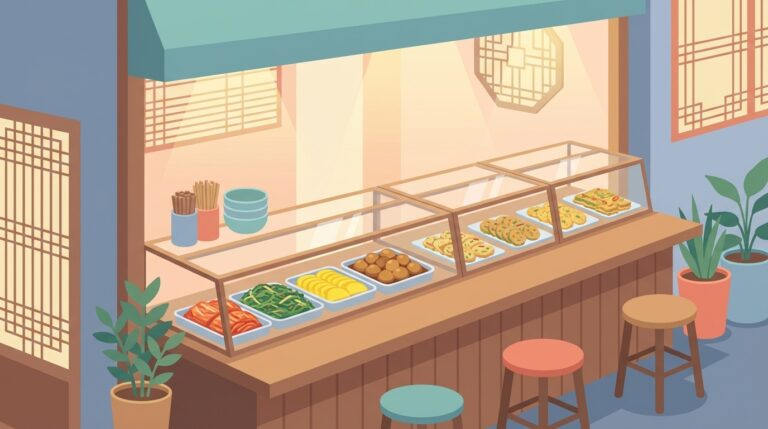
Phase 1: Immersion & Empathy
Hello there! It’s your Daily Hangul Editor.
If you’ve watched K-Dramas like Reply 1988, you’ve probably seen those heartwarming scenes where neighbors exchange endless Tupperware containers filled with Banchan (Korean side dishes). You might be thinking, “Wow, do Koreans really cook five different side dishes every single day?”
Here’s a little local secret: We buy them.
Welcome to the magic of the Banchan-gage (반찬가게, Banchan shop)! While K-BBQ and Chimaek (chicken and beer) get all the global spotlight, Banchan is the true, quiet backbone of the Korean dining table. As a B2 learner living in or visiting Korea, stepping into a local Banchan shop is the ultimate “insider” move. It means you’re no longer just a tourist eating out—you’re living, eating, and thriving like a true local.
But here’s the catch: Banchan shops in traditional markets or local neighborhoods can be intimidating. There are no English menus, the ahjummas (ladies) are moving at lightning speed, and you need to communicate your preferences quickly.
Don’t worry! I’ve gathered the exact phrases you need to navigate a Banchan shop like a 10-year Seoulite. Let’s dive in!
Phase 2: Core Expressions Deep Dive
Here are the top three expressions you absolutely need when picking out your side dishes.
1. 이거 세 팩에 만 원 맞죠?
- Pronunciation: igeo se paege man won matjo? (ee-geo seh paek-eh man won maht-joh?)
- Meaning: Literal: “These are 10,000 won for three packs, right?” / Real Nuance: “I’m choosing three from the 3-for-10k section, just confirming!”
- K-Culture Moment: Most Banchan shops have a dedicated section of small, pre-packaged side dishes (like quail eggs, stir-fried anchovies, or spinach) that are bundled for a discount. You’ll see locals aggressively mixing and matching three containers to hand to the cashier.
- Editor’s Insight: The grammar
-에(for/per) and-지/죠(seeking confirmation) shows you know your way around Korean pricing structures. It sounds much more natural than just asking “How much is this?” - Situation Spectrum:
- Local Market Vendor (Casual/Semi-formal): ✅
- Supermarket Staff (Semi-formal): ✅
- High-end Department Store Banchan Section: ⚠️ (Usually priced by weight, not bundled)
- 🤔 Think About It: Why does Korea have such a strong “bundle pricing” (묶음 할인) culture at local markets? It’s heavily tied to the concept of Jeong (정, affection/generosity)—giving a little extra to make the customer feel valued!
2. 이거 냉장고에 며칠 정도 두고 먹어도 돼요?
- Pronunciation: igeo naengjanggoe myeochil jeongdo dugo meogeodo dwaeyo?
- Meaning: Literal: “Can I leave this in the fridge for a few days and eat it?” / Real Nuance: “How long is this good for in the fridge?”
- K-Culture Moment: You bought a massive pack of seasoned crabs (Yangnyeom Gejang). It’s delicious, but you live alone. Asking the shop owner this question is a survival skill for 1-person households (1인 가구) in Korea to prevent food waste!
- Editor’s Insight: Notice the use of the B2 grammar
-아/어 두다(to do an action and keep it in that state) combined with-아/어 먹다. It paints a vivid picture of “storing and gradually consuming.” This makes you sound incredibly fluent. - Situation Spectrum:
- Any Banchan Shop Owner: ✅
- Friend who gave you leftovers: ✅
- Formal Business Dinner: 🚫 (Out of context)
- 🤔 Think About It: Fermentation is key in Korean food. While spinach might go bad in two days, fermented squid (Ojingeo Jeotgal) lasts months. How does climate shape a country’s food preservation methods?
3. 이거 많이 매워요? 애들도 먹을 수 있어요?
- Pronunciation: igeo mani maewoyo? aedeuldo meogeul su isseoyo?
- Meaning: Literal: “Is this very spicy? Can kids eat it too?” / Real Nuance: “Please give me an honest assessment of the spice level, I can’t handle nuclear fire.”
- K-Culture Moment: In Korea, the color red is deceiving. Some red side dishes (like dried shredded squid – Jinmichae) are sweet and chewy, while others will make you cry. Asking if “kids can eat it” is the ultimate, universally understood code for “I need the lowest spice level possible.”
- Editor’s Insight: Koreans have a very high tolerance for spice. If an ahjumma says “It’s deliciously spicy” (맛있게 매워요), beware! Asking if kids can eat it gives you a much more objective answer.
- Situation Spectrum:
- Banchan Shop: ✅
- Any Local Restaurant: ✅
Phase 3: Textbook vs. Real Korean
Let’s look at how textbook phrases compare to what you’ll actually hear in the bustling alleys of Mangwon Market.
[Asking About Expiration Dates]
* 📖 Textbook Korean: 이 반찬은 유통기한이 언제까지입니까? (Until when is the expiration date of this side dish?)
* 🗣️ Real Korean: 사장님, 이거 언제까지 먹어야 돼요? (Boss, until when do I have to eat this?)
* 💡 Why it’s different: “유통기한” (expiration date) is a formal term used for manufactured goods with barcodes. For fresh, homemade market food, Koreans prefer the active, practical verb “먹다” (to eat).
[Asking for a Smaller Portion]
* 📖 Textbook Korean: 조금만 주십시오. (Please give me only a little.)
* 🗣️ Real Korean: 양이 너무 많은데, 반만 덜어주실 수 있어요? (The portion is too big, could you scoop out just half for me?)
* 💡 Why it’s different: Sometimes Banchan is sold in massive mounds. Using the verb “덜다” (to scoop out / transfer a portion) is the precise vocabulary used for side dishes and soups in Korea.
Bottom Note: At a B2 level, moving away from generic verbs like “주다” (to give) and using highly specific verbs like “덜다” (to portion out) or “담다” (to put into a container) will instantly elevate your Korean!
Phase 4: Cultural Context — K-Culture Deep Dive
4-1. Non-Verbal Cues: The Nunchi of the Market
When picking out your 3-for-10k packs, do not open the lids to smell them! Use your Nunchi (눈치). If there is a glass display case, point from the outside. If the food is piled high in open basins (often in traditional markets), the owner will use special tongs to pack it for you. Do not point your finger directly over the open food, as it’s considered unhygienic.
4-2. The Evolution of Banchan (K-Food Connection)
Why do Banchan shops even exist if Korean moms are supposedly cooking masters?
The reality of modern Korea is the rise of the 1인 가구 (1-person household). Making Banchan from scratch requires buying large amounts of ingredients, peeling garlic for hours, and balancing complex flavors. It’s simply not cost-effective or time-efficient for busy office workers in Seoul. Thus, the local Banchan shop has become the outsourced “Mom’s Kitchen.” Even older generations now prefer buying complex dishes like Japchae or Gejang instead of slaving over a hot stove!
Phase 5: Real-Life Roleplay Scenario
Scenario A: The Mangwon Market Mission
– Setting: A bustling Saturday afternoon at Mangwon Market. The smell of sesame oil fills the air. You are standing in front of a colorful display of at least 30 different side dishes.
– Characters:
– YOU: A hungry B2 Korean learner trying to stock up your fridge for the week.
– Ahjumma (사장님): A friendly but fast-paced Banchan shop owner wielding metal tongs.
Dialogue:
사장님: 아이고, 어서 와요! 맛있는 거 많으니까 천천히 골라봐요. 세 팩에 만 원!
(aigo, eoseo wayo! masinneun geo maneunikka cheoncheonhi golrabwayo. se paege man won!)
[Welcome! We have lots of delicious things, take your time picking. 3 packs for 10,000 won!]
YOU: 사장님, 이거 진미채 많이 매운가요?
(sajangnim, igeo jinmichae mani maeungayo?)
[Boss, is this shredded squid very spicy?]
사장님: 하나도 안 매워! 달달해서 애들도 잘 먹어. 하나 담아줄까?
(hanado an maewo! daldalhaeseo aedeuldo jal meogeo. hana damajulkka?)
[Not spicy at all! It’s sweet, so kids eat it well too. Should I pack one for you?]
YOU: 네, 그럼 진미채 하나랑… 아, 이 멸치볶음은 냉장고에 며칠 두고 먹어도 돼요?
(ne, geureom jinmichae hanarang… a, i myeolchibokkeumeun naengjanggoe myeochil dugo meogeodo dwaeyo?)
[Yes, then one squid, and… ah, how many days can I keep this stir-fried anchovy in the fridge?]
사장님: 멸치는 한 달 둬도 끄떡없어! 자, 그럼 두 개 골랐고. 하나 더 골라봐요.
(myeolchineun han dal dwodo kkeutteogeopseo! ja, geureom du gae golratgo. hana deo golrabwayo.)
[Anchovies are fine even if you keep them for a month! Okay, you picked two. Pick one more.]
YOU: 음… 그럼 깻잎무침으로 할게요. 이렇게 세 팩에 만 원 맞죠?
(eum… geureom kkaennipmuchimeuro halgeyo. ireoke se paege man won matjo?)
[Hmm… then I’ll go with the marinated perilla leaves. These 3 packs are 10,000 won, right?]
(🎭 Stage Direction: The Ahjumma packs the 3 boxes, then suddenly throws in a small pack of bean sprouts (콩나물).)
사장님: 아이고, 외국인 청년이 한국말도 잘하네! 이거 콩나물은 내가 주는 서비스야!
(aigo, oegugin cheongnyeoni hangukmaldo jalhane! igeo kongnamureun naega juneun seobiseuya!)
[Oh my, this young foreigner speaks Korean so well! This bean sprout is a service (on the house) from me!]
🔀 Your Turn! How do you respond to this free “Service”?
– A) “아닙니다. 제가 돈을 더 내겠습니다.” (No, I will pay more money.)
– B) “우와, 진짜요? 사장님 최고! 잘 먹겠습니다!” (Wow, really? You’re the best! I will eat it well!)
– C) “왜 주시는 거예요?” (Why are you giving this to me?)✅ Best Choice: B — This embraces the Jeong (affection) of the market. Expressing bright, genuine gratitude (“사장님 최고!”) will make you her favorite customer!
⚠️ Choice A & C Analysis: Rejecting market “service” (A) can actually offend the vendor, as it rejects their hospitality. Asking “why” (C) sounds suspicious and kills the warm mood.
Phase 6: 10-Second Shadowing Drill
Practice this sentence until it flows like water. Pay attention to the pauses (/) and the intonation!
😊 사장님, / 이거 진미채 / 애들이 먹기엔 / 많이 매운가요?
(sajangnim, / igeo jinmichae / aedeuri meoggien / mani maeungayo?)
Tone: Polite, slightly curious, with a soft rising intonation at the end.
Phase 7: K-Culture Mini Dictionary
| 한국어 (Korean) | Romanization | English | Context |
|---|---|---|---|
| 밑반찬 | mitbanchan | Basic side dishes | Dry or fermented side dishes that can be stored for a long time (e.g., anchovies, pickled radishes). |
| 서비스 / 덤 | seobiseu / deom | Freebie / Extra | Extra food given by a vendor out of generosity (Jeong). Very common in traditional markets! |
| 단골 | dangol | Regular customer | If you visit the same Banchan shop often, you become a ‘dangol’ and get more ‘deom’! |
| 1인 가구 | irin gagu | 1-person household | A major demographic shift in Korea driving the explosive growth of Banchan shops and delivery apps. |
Phase 8: Traveler Survival Kit
Whether you are living in a Seoul Airbnb or visiting a local market, you need these quick phrases:
🆘 Survival Phrases for the Market
– 🇰🇷 “이거 한 팩에 얼마예요?” (igeo han paege eolmayeyo? – How much for one pack?)
– 🇰🇷 “조금만 덜어주실 수 있어요?” (jogeumman deoreojusil su isseoyo? – Can you scoop out just a little?)
– 🇰🇷 “현금 영수증 해주세요.” (hyeongeum yeongsujeung haejuseyo. – Please issue a cash receipt.)
– 📍 Where to use: Mangwon Market, Gwangjang Market, neighborhood Banchan shops.
📌 Editor’s Travel Note
– Card vs. Cash: While Korea is a “card paradise,” traditional market vendors still highly appreciate cash or direct bank transfers (계좌이체) for small purchases under 10,000 won.
– Apps: If you don’t want to go out, apps like Baemin (배달의민족) or Market Kurly (마켓컬리) have dedicated Banchan delivery sections!
Phase 9: Critical Thinking — “One Step Deeper”
Food & Identity: Why so many side dishes?
Have you ever wondered why Korean cuisine requires a main dish, soup, and at least 3 to 5 side dishes, while many Western meals consist of a single plate?
Historically, Korea was an agrarian society where plain white rice (밥) was the core energy source. Banchan evolved primarily to add flavor and nutrition to the large bowls of rice. More importantly, Banchan are placed in the center of the table to be shared by everyone. This act of everyone’s chopsticks crossing paths to reach for the same spinach or kimchi is a physical manifestation of Korea’s communal identity (우리 – “We”). Buying Banchan today might be outsourced, but the cultural desire to have a “proper table” filled with various shared flavors remains deeply embedded in the Korean psyche.
💬 Your Turn: Does your culture have a concept similar to Banchan, where multiple small dishes are meant to be shared? Let me know in the comments!
Phase 10: FAQ & Avoiding Mistakes
Q: Can I taste the Banchan before buying it?
In traditional markets, sometimes! If you look curious, a friendly vendor might offer you a piece on a toothpick. However, never use your own fingers or ask to taste it unless they offer first.
Q: Do I tip the Banchan shop owner if they give me extra food?
Absolutely not! There is no tipping culture in Korea. Tipping them would cause severe confusion. Just give them a big smile and a loud “감사합니다!” (Thank you!).
❌ Common Mistake #1: Leaving “Mit-banchan” (dry side dishes) out on the counter.
✅ How to fix it: Even though they are preserved, Korean homes keep all side dishes in the refrigerator. Only take them out right before you eat, and put them back immediately after!❌ Common Mistake #2: Double-dipping your chopsticks into the communal Banchan container.
✅ How to fix it: If you bought a tub of Banchan, don’t eat directly from it. Use a clean spoon or chopsticks to transfer a small portion onto your own plate, then put the tub back in the fridge. This prevents food from spoiling!
Phase 11: Summary & Action Items
One-Liner Summary: Mastering the Banchan shop is all about navigating bundle prices, asking about spice levels tactfully, and embracing the warm Jeong of the market!
Your Action Missions:
– 🥉 Bronze (Solo): Say “이거 세 팩에 만 원 맞죠?” out loud 3 times while looking in the mirror.
– 🥈 Silver (Online): Look up a “Mangwon Market Vlog” on YouTube and try to spot a Banchan shop in the video.
– 🥇 Gold (Real Life): Visit a local Banchan shop or the Banchan aisle of a Korean supermarket (like H-Mart) and buy your favorite side dish using today’s phrases!
Phase 12: Interactive Quiz
Test your new B2 knowledge!
1. You want to know if the seasoned crab will survive in your fridge until next weekend. What should you ask?
A) 언제 죽어요? (When does it die?)
B) 이거 냉장고에 며칠 두고 먹어도 돼요?
C) 진미채 많이 매운가요?
2. Fill in the blank (B2 Grammar):
“이 고추장아찌, ______ 많이 매워요?” (Is this pickled chili too spicy for kids to eat?)
A) 애들이 먹기에
B) 애들이 먹어서
C) 애들이 먹지만
3. True or False: K-Culture Edition
If a market vendor gives you an extra pack of Banchan for free, you should insist on paying for it to be polite.
(Answers: 1: B, 2: A, 3: False – Accept it graciously as ‘Jeong’ and say thank you!)
Ready to conquer the Banchan shop? Let me know which Korean side dish is your absolute favorite in the comments below! See you in the next lesson.
Frequently Asked Questions (FAQ)
Q: What does "이거 세 팩에 만 원 맞죠?" mean in Korean and how do you pronounce it?
A: In Korean, "이거 세 팩에 만 원 맞죠?" is pronounced [igeo se paege man won matjo? (ee-geo seh paek-eh man won maht-joh?] and means: Literal: "These are 10,000 won for three packs, right?" / Real Nuance: "I'm choosing three from the 3-for-10k section, just confirming!"
Q: What does "이거 냉장고에 며칠 정도 두고 먹어도 돼요?" mean in Korean and how do you pronounce it?
A: In Korean, "이거 냉장고에 며칠 정도 두고 먹어도 돼요?" is pronounced [igeo naengjanggoe myeochil jeongdo dugo meogeodo dwaeyo?] and means: Literal: "Can I leave this in the fridge for a few days and eat it?" / Real Nuance: "How long is this good for in the fridge?"
Q: What does "이거 많이 매워요? 애들도 먹을 수 있어요?" mean in Korean and how do you pronounce it?
A: In Korean, "이거 많이 매워요? 애들도 먹을 수 있어요?" is pronounced [igeo mani maewoyo? aedeuldo meogeul su isseoyo?] and means: Literal: "Is this very spicy? Can kids eat it too?" / Real Nuance: "Please give me an honest assessment of the spice level, I can't handle nuclear fire."







