

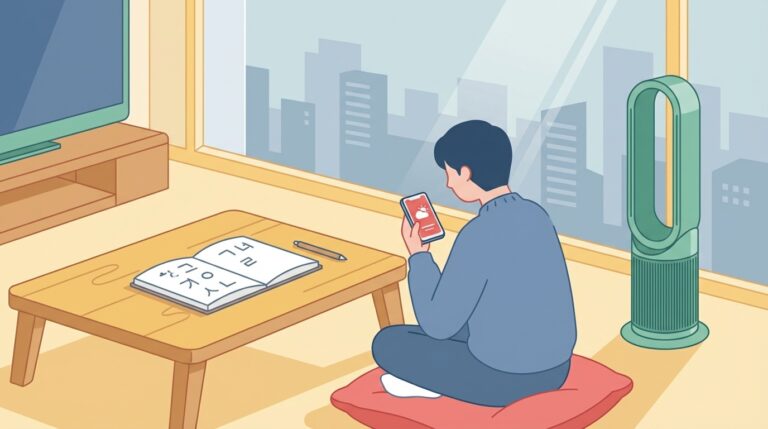
Phase 1: Empathy (Welcome to the Hazy Days)
Hello! I am your Daily Hangul Editor.
Picture this: You are watching a K-Drama. The main character’s apartment is incredibly clean, and right next to the designer sofa is a tall, sleek white machine glowing with a soft blue light. Or maybe you’ve watched K-Pop idols at an airport, looking effortlessly cool while wearing masks that cover half their faces.
Behind these scenes lies a very real part of daily life in Korea: 미세먼지 (Mise-meonji, Fine Dust).
If you visit Korea during spring or winter, you might wake up, look out the window, and think, “Wow, it’s so foggy today!” But your Korean friend will immediately check their phone, gasp, and rush to close the windows. It’s not fog; it’s fine dust.
Knowing how to talk about the air quality and asking to turn on the 공기청정기 (Air Purifier) is an absolute survival skill in Korea. It’s a topic of daily small talk, just like the weather! In this lesson, we will learn the easiest, most natural ways to handle fine dust situations, specially tailored for A1 beginners.
Phase 2: Core Expressions Deep Dive
1. 공기청정기 켜주세요. (Please turn on the air purifier.)
- Pronunciation: Gonggi-cheongjeong-gi kyeo-juseyo.
- Sound guide: (Gong-ghee / chung-jung / ghee) + (kyuh – sounds like ‘kyo’ in Tokyo / ju-se-yo)
- Meaning: Please turn on the air purifier.
- K-Culture Moment: You walk into a Korean cafe, and the air feels a bit stuffy. The app on your phone says the air quality is “Very Bad.” You can politely ask the cafe staff this phrase. You’ll instantly sound like a local who knows how things work!
- Editor’s Insight: Yes, “공기청정기” is a long word! Think of it as three blocks: Gonggi (Air) + Cheongjeong (Clean/Pure) + Gi (Machine). If it’s too hard to say, you can just point to the machine and say, “이거 켜주세요” (Igeo kyeojuseyo – Please turn this on).
- Situation Spectrum:
- Casual with friends: ✅ (Say: 공기청정기 켜 줘 – kyeo-jwo)
- Cafe staff/Host (Semi-formal): ✅
- Boss/Elders (Formal): ⚠️ (Better to say: 공기청정기 좀 켜도 될까요? – May I turn it on?)
- 🤔 Think About It: Koreans love the word “~주세요” (Please do it for me). It shows a culture of reliance and community service. Do you use “please” this often in your native language for small tasks?
2. 오늘 미세먼지 나빠요. (The fine dust is bad today.)
- Pronunciation: Oneul mise-meonji nappayo.
- Sound guide: (Oh-neul) + (Mee-seh / mun-jee) + (Nah-ppa-yo – ‘ppa’ sounds like the ‘pa’ in Papa but sharper).
- Meaning: Today’s fine dust is bad. (Literal: Today fine dust bad).
- K-Culture Moment: This is the ultimate ice-breaker. In an elevator with a Korean neighbor? Look at your phone, sigh, and say this. They will vigorously nod and agree with you.
- Editor’s Insight: In Korean, we don’t always need to say “The air is bad.” Just saying the dust is “bad” (나빠요) or “severe” (심해요) perfectly delivers the point.
- Situation Spectrum:
- Casual with friends: ✅ (Say: 미세먼지 나빠 – nappa)
- Co-workers (Semi-formal): ✅
- Boss/Elders (Formal): ✅ (Safe to use!)
- 🤔 Think About It: Why do Koreans talk about fine dust instead of just “the weather”? Because it dictates whether you can have a picnic at the Han River or if you must stay indoors!
Phase 3: Textbook vs. Real Korean
[Situation 1: Asking to turn on the machine]
* 📖 Textbook Korean: 공기청정기를 켜 주시겠습니까? (Would you kindly turn on the air purifier?)
* 🗣️ Real Korean: 저기… 공기청정기 좀 켜주세요. (Excuse me… please turn on the air purifier.)
* 💡 Why the difference?: Adding “좀” (jom – a little bit) makes the request sound softer and much more polite in daily life than rigid textbook grammar.
[Situation 2: Warning a friend about the air]
* 📖 Textbook Korean: 대기 오염이 심각합니다. (The air pollution is serious.)
* 🗣️ Real Korean: 야, 오늘 미세먼지 장난 아니야. (Hey, the fine dust is no joke today.)
* 💡 Why the difference?: “장난 아니야” (literally: it’s not a joke) is a universally loved expression to emphasize that something is extreme!
Bottom Note: For A1 beginners, sticking to “나빠요” (It’s bad) is perfectly fine and safe for all situations!
Phase 4: Cultural Context — K-Culture Deep Dive
4-1. Non-Verbal Elements: The App and the Mask
When a Korean says “오늘 미세먼지 나빠요,” they rarely just say it out of nowhere. They will usually hold up their smartphone to show you a weather app. In Korea, apps like ‘Mise-mise’ (미세미세) are essential. Instead of numbers, these apps use angry red or black face emojis to warn you. When talking about the dust, subtly showing your phone screen is a great non-verbal cue!
4-2. K-Drama PPL (Product Placement)
Have you ever noticed that in K-Dramas, no matter how poor the main character is, they always have a state-of-the-art, glowing air purifier in their tiny rooftop room? This is a classic K-Drama PPL (Product Placement). Because air purifiers have become a “must-have” appliance like a fridge or TV, home appliance brands heavily sponsor dramas. So next time you watch a drama, play a game of Spot the Gonggi-cheongjeong-gi!
Phase 5: Interactive Roleplay Scenario
Setting: It’s a Saturday morning in April. You are staying at an Airbnb in Seoul. The host, Ji-hoon, comes over to bring you some fresh towels. You look out the window at the N Seoul Tower, but you can barely see it because the sky is grayish-yellow.
Characters:
* YOU: A traveler exploring Seoul, tired of coughing.
* Ji-hoon (28, Airbnb Host): Friendly, wants to make sure you have a great stay.
Dialogue:
Ji-hoon: 안녕하세요! 수건 가져왔어요. 여행은 어때요?
(Annyeong-haseyo! Sugeon gajyeowasseoyo. Yeohaeng-eun eottaeyo?)
[Hello! I brought the towels. How is your trip?]
(🎭 Stage Direction: Ji-hoon smiles and hands you the towels.)
YOU: 좋아요! 그런데 오늘 밖이 좀 뿌옇네요.
(Joayo! Geureonde oneul bakki jom ppuyeonneyo.)
[It’s good! But it looks a bit hazy outside today.]
Ji-hoon: 아… 네. 봄이라서 그래요.
(Ah… ne. Bomiraseo geuraeyo.)
[Ah… yes. It’s because it’s spring.]
🔀 Your Turn! How should you respond and ask for the air purifier?
* A) “미세먼지 나빠요? 공기청정기 켜주세요.”
* B) “안개입니까? 불 켜주세요.”
* C) “날씨가 좋아요. 창문 열어주세요.”
✅ Best Choice: A — “Is the fine dust bad? Please turn on the air purifier.” This is the most natural and accurate response.
⚠️ Choice B & C Analysis: B means “Is it fog? Turn on the lights.” C means “The weather is nice. Open the window” (which is the worst thing you can do on a fine dust day!).
Ji-hoon: 네! 오늘 미세먼지 정말 나빠요. 바로 켜 드릴게요!
(Ne! Oneul mise-meonji jeongmal nappayo. Baro kyeo deurilgeyo!)
[Yes! The fine dust is really bad today. I will turn it on right away!]
(🎭 Stage Direction: Ji-hoon turns on the machine. A blue light appears. You can finally breathe!)
Phase 6: 10-Second Shadowing Drill
Let’s practice speaking! Repeat these sentences out loud. Pay attention to the pauses (/) and emotions.
- 🥺 Polite & Needy: 저기요, / 공기청정기 좀 / 켜주세요.
(Jeogiyo, / gonggi-cheongjeong-gi jom / kyeo-juseyo.) - 😤 Frustrated by the dust: 오늘 / 미세먼지가 / 너~~무 나빠요!
(Oneul / mise-meonji-ga / neo~~mu nappayo!) - 😊 Relieved: 아, / 공기 좋다!
(Ah, / gonggi jota! – Ah, the air is good!)
Phase 7: K-Culture Mini Dictionary
| 한국어 (Korean) | Romanization | English | Context |
|---|---|---|---|
| 미세먼지 | mise-meonji | Fine Dust | The micro-particles in the air. A daily concern in Korea. |
| 공기청정기 | gonggi-cheongjeong-gi | Air Purifier | Found in homes, cafes, and even subway stations! |
| 마스크 | maseukeu | Mask | Koreans wore KF94 masks for fine dust long before 2020. |
| 황사 | hwangsa | Yellow Dust | Sandstorms blowing in during spring. Worse than fine dust! |
Phase 8: Traveler Survival Kit 🎒
Since fine dust is everywhere, you will need these survival phrases when visiting a Korean convenience store (편의점) or cafe!
🆘 Survival Phrases TOP 3
1. 🇰🇷 “마스크 어디 있어요?” (Maseukeu eodi isseoyo?)
* 🗣️ English: Where are the masks?
* 📍 Where to use: Convenience stores, Pharmacies.
2. 🇰🇷 “이거 좀 켜주세요.” (Igeo jom kyeojuseyo.)
* 🗣️ English: Please turn this on (pointing at the purifier).
* 📍 Where to use: Cafes, Airbnbs.
3. 🇰🇷 “창문 닫아주세요.” (Changmun dada-juseyo.)
* 🗣️ English: Please close the window.
* 📍 Where to use: Taxis, Restaurants (if dust is blowing in).📌 Editor’s Travel Note
* Must-Download App: Download an air quality app like MiseMise or check Naver. If it’s a “Red” or “Black” mask day, do not plan outdoor hiking!
* Pork Belly Myth: Many Koreans believe that eating 삼겹살 (Samgyeopsal – Pork Belly) washes the fine dust out of your throat with its grease. Scientifically proven? No. A great excuse to eat Korean BBQ? Absolutely!
Phase 9: Critical Thinking — “One Step Deeper”
Media vs. Reality (K-Drama Skies vs. Real Seoul)
If you only watch K-Pop music videos or K-Dramas, you might think Seoul is a city of perpetual sunshine and crystal-clear blue skies. However, the reality of spring and winter in Korea involves a daily battle with air quality. This gap between the glossy media representation and the everyday reality shows how media often filters out the “inconveniences” of a country. But adapting to this reality—checking the air app, wearing a mask, and huddling around an air purifier in a cozy cafe—is what actually makes you experience the real modern Korean lifestyle.
💬 Your Turn: Does your country have a specific weather or environmental issue that foreigners don’t know about until they visit? Share it in the comments!
Phase 10: FAQ & Avoiding Mistakes
Q: Can I tell my boss “공기청정기 켜주세요”?
Maybe, but be careful. Even with “주세요” (please), it is a direct command. To a boss, it’s better to ask: “공기청정기 좀 켜도 될까요?” (May I turn on the air purifier?).
Q: Do I need to wear a mask inside?
Usually, no! Most indoor spaces in Korea (subways, malls, cafes) have massive, industrial-grade air purifiers running 24/7. It’s often cleaner inside than outside!
❌ Common Mistake #1: Confusing Fog (안개) with Fine Dust (미세먼지).
✅ Do this instead: If it’s hazy in the morning, always check your weather app before taking a deep breath of “fresh morning air”!
Phase 11: Summary & Action Items
One-Liner Summary: When the sky turns grey, protect your lungs by pointing at the machine and saying: “공기청정기 켜주세요” (Please turn on the air purifier)!
Action Mission:
* 🥉 Bronze (Solo): Say “Gonggi-cheongjeong-gi kyeojuseyo” out loud 3 times without stumbling!
* 🥈 Silver (Online): Look up the current air quality in Seoul online and write down if the “mise-meonji” is good or bad today.
* 🥇 Gold (Real Life): Next time you are at a Korean cafe or restaurant, try to spot the air purifier. Point it out to your friend!
K-Culture Mission: Open YouTube, search for a “Seoul Walking Tour,” and count how many people you see wearing masks. It’s part of the culture!
Phase 12: Quiz — Interactive Challenge
1. Situational Judgment: You are in a Korean taxi. The fine dust level is very high, but the driver has the window wide open. What is the most natural thing to say?
* A) 택시 멈춰주세요. (Stop the taxi.)
* B) 공기청정기 켜주세요. (Turn on the air purifier.)
* C) 창문 좀 닫아주세요. (Please close the window.)
(Answer: C. Taxis rarely have air purifiers, so closing the window is your best bet!)
2. Fill in the Blank:
오늘 _________ 나빠요. 마스크 쓰세요!
(Today’s ________ is bad. Wear a mask!)
(Answer: 미세먼지 – mise-meonji)
3. True or False – K-Culture Edition:
* Koreans only started wearing masks because of recent global events. (True / False)
(Answer: False. Koreans have been wearing masks for years due to yellow dust from deserts and fine dust!)
Frequently Asked Questions (FAQ)
Q: What does "공기청정기 켜주세요. (Please turn on the air purifier.)" mean in Korean and how do you pronounce it?
A: In Korean, "공기청정기 켜주세요. (Please turn on the air purifier.)" is pronounced [Gonggi-cheongjeong-gi kyeo-juseyo.] and means: a key conversational Korean expression covered in this lesson.
Q: What does "오늘 미세먼지 나빠요. (The fine dust is bad today.)" mean in Korean and how do you pronounce it?
A: In Korean, "오늘 미세먼지 나빠요. (The fine dust is bad today.)" is pronounced [Oneul mise-meonji nappayo.] and means: a key conversational Korean expression covered in this lesson.







