

Hello there! I’m the Lead Editor at Daily Hangul, your premium Korean tutoring brand.
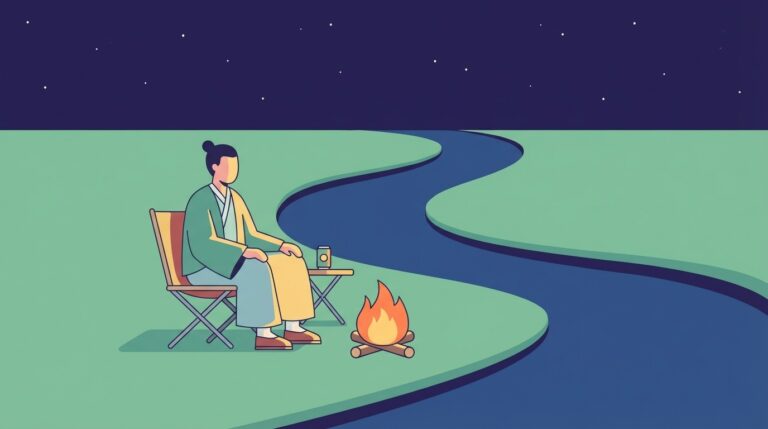
Imagine this scene from a K-Drama: After a brutal, soul-crushing week at a Seoul corporate office, the protagonist doesn’t go to a wild club or a fancy restaurant. Instead, they drive out to the Han River, pitch a tiny tent, crack open a can of beer, and just… stare out at the water. No words are spoken. The subtitles might say something like, “I’m resting,” but any Korean watching that scene feels a deep, philosophical resonance.
Welcome to the profound irony of modern Korea. In a society infamous for its hyper-competitive, hyper-speed Ppalli-ppalli (빨리빨리) culture, how do locals actually rest? The answer lies in an ancient Eastern philosophy: 무위자연 (Muwi-jayeon), or the concept of Wu-wei (non-action/letting nature take its course).
But if you walk around Hongdae or Gangnam, nobody is quoting ancient Taoist texts. Instead, they’ve evolved this profound philosophy into ultra-modern, uniquely Korean survival slang. Let’s dive deep into how C2-level speakers express the philosophy of “doing nothing” in a country that never stops.
Phase 2: Deep Dive into Core Expressions
1. 멍때리다
- Pronunciation: [meong ttaerida]
- Sound Guide: ‘Meong’ sounds like the muffled ‘mong’ in mongrel. ‘Ttaerida’ has a sharp, tense double consonant ‘tt’—like the sharp ‘t’ when you say stop!
- Meaning: (Literal) To hit a bruise/blankness. / (Real Nuance) To space out, to zone out completely.
- K-Culture Moment: This is the ultimate modern manifestation of Muwi-jayeon. Every year, Seoul even hosts the Space-out Competition (멍때리기 대회) where citizens sit in a park, and the person with the most stable heart rate while doing absolutely nothing wins.
- Editor’s Insight: This expression feels almost paradoxical. Ttaerida means “to strike” or “to hit.” So in Korean, doing nothing isn’t passive; it’s an active pursuit. You are actively striking into the void.
- Situation Spectrum:
- Friends (Casual): ✅
- Co-workers (Semi-formal): ⚠️ (Okay with close peers)
- Boss/Elders (Formal): 🚫
- 🤔 Think About It: Why did Koreans combine a violent verb like “hit” (때리다) with “blankness” (멍) to describe resting? Could it be that in a society where “doing nothing” is often stigmatized as laziness, you need an aggressive verb to justify your rest?
2. 불멍 / 물멍
- Pronunciation: [bul-meong / mul-meong]
- Sound Guide: ‘Bul’ sounds like bull, and ‘Mul’ sounds like the mull in mulligan.
- Meaning: (Literal) Fire blank / Water blank. / (Real Nuance) Zoning out while looking at a campfire / staring at water.
- K-Culture Moment: If you watch K-Dramas like Hospital Playlist or camping reality shows, you’ll constantly hear celebrities say, “아, 불멍하고 싶다” (Ah, I want to do bul-meong). It’s the act of letting your thoughts burn away with the fire or wash away with the water.
- Editor’s Insight: This is highly trendy, C2-level vocabulary. It shows you understand not just the language, but the specific aesthetic of Korean relaxation.
- Situation Spectrum:
- Friends (Casual): ✅
- Co-workers (Semi-formal): ✅
- Boss/Elders (Formal): ⚠️ (They might not know the slang if they are very old!)
- 🤔 Think About It: Does your native culture have specific words for “staring at a fire” or “staring at the water” as a form of mental health care?
3. 여백의 미
- Pronunciation: [yeo-bae-ge mi]
- Sound Guide: ‘Yeo’ like yuh, ‘baek’ like back, ‘ui’ (pronounced ‘e’ here) like eh, ‘mi’ like me.
- Meaning: (Literal) The beauty of empty space. / (Real Nuance) Finding aesthetic or philosophical value in what is left undone or empty.
- K-Culture Moment: Originally an art history term used for traditional Korean ink paintings (where the unpainted white paper is as important as the ink). Today, advanced speakers use it metaphorically. If someone leaves an awkward silence, or if a schedule has a free afternoon, a witty Korean might say, “이게 바로 여백의 미죠” (This is the beauty of empty space).
- Editor’s Insight: Using this phrase makes you sound incredibly educated and poetically witty.
- Situation Spectrum:
- Friends (Casual): ✅ (Playfully)
- Co-workers (Semi-formal): ✅
- Boss/Elders (Formal): ✅ (They will be highly impressed)
- 🤔 Think About It: Western art often seeks to fill the canvas. Traditional Eastern art intentionally leaves it blank. How does this “appreciation of the void” translate to how you manage your daily calendar?
Phase 3: Textbook vs. Real Korean
[Expressing the desire to do absolutely nothing]
* 📖 Textbook Korean: 저는 주말에 아무것도 안 하고 쉴 거예요. (I will do nothing and rest this weekend.)
* 🗣️ Real Korean: 주말에 격렬하게 아무것도 안 하고 싶다. (I want to intensely do absolutely nothing this weekend.)
* 💡 Why the difference?: Originating from a famous commercial, “격렬하게” (intensely/fiercely) paired with “doing nothing” perfectly captures the exhausted modern Korean’s desperate cry for a break.
[Letting things flow naturally / Muwi-jayeon]
* 📖 Textbook Korean: 순리대로 살겠습니다. (I will live according to reason/nature.)
* 🗣️ Real Korean: 그냥 물 흐르듯이 두자. (Let’s just let it be like flowing water.)
* 💡 Why the difference?: Direct philosophical terms sound like a monk; “flowing water” is the poetic yet common daily metaphor for letting go of control.
Bottom Note: For C2 learners, sounding natural isn’t about using the most complex Hanja (Sino-Korean) words. It’s about knowing when to use a philosophical concept (like Muwi-jayeon) playfully, and when to use highly evocative slang (like Bul-meong).
Phase 4: Cultural Context — K-Culture Deep Dive
4-1. Non-verbal Cue: The “Healing Sigh” (한숨)
In many Western cultures, letting out a deep sigh while looking at the sunset might imply depression or sadness. In Korea, this heavy exhalation is often a physical manifestation of letting go. It is the body practicing Muwi-jayeon. When doing 물멍 (staring at the Han River), letting out a long “하아…” (Haaa…) followed by “좋다…” (Good…) means you are perfectly at peace, not sad.
4-2. K-Drama & The “Exhaustion Trope”
If you watched My Liberation Notes (나의 해방일지), you saw the ultimate exploration of this theme. The characters are completely depleted by society. Their romance isn’t fiery; it’s about mutual “worshipping” (추앙) by simply sitting together in silence.
Critical Point: Notice how in these dramas, characters rarely say “I need a vacation.” Instead, they seek microscopic moments of isolation—a quiet late-night walk, or sitting on a dark porch. In a culture built on intense collective Nunchi (reading the room), true rest (Muwi-jayeon) is only achieved when you are completely unobserved.
Phase 5: Real-life Roleplay Scenario
Setting: Friday night, 9:00 PM. A trendy “Glamping” (glamorous camping) BBQ restaurant on the outskirts of Seoul. You just wrapped up a 6-month, soul-draining mega-project with your Korean team. You are sitting around a crackling fire pit with your closest Korean colleague, Min-su.
Characters:
– YOU: A foreign professional working in Seoul. Exhausted but relieved.
– Min-su (32): Your witty, slightly burnt-out Korean co-worker.
Dialogue:
민수: 와, 드디어 끝났네요. 진짜 이번 프로젝트 때문에 수명이 3년은 줄어든 것 같아요. 📉
(Wa, deudieo kkeutnanneyo. Jinjja ibeon peurojekteu ttaemune sumyeongi samnyeoneun jureodeun geot gatayo.)
[Wow, it’s finally over. I seriously think my lifespan shortened by 3 years because of this project.]
(🎭 Stage Direction: Min-su takes a sip of his beer and deeply sighs)
YOU: 제 말이요. 우리 당분간은 진짜 아무것도 하지 맙시다.
(Je mariyo. Uri dangbunganeun jinjja amugeotdo haji mapsida.)
[Tell me about it. Let’s really not do anything for a while.]
민수: 맞아요. 아, 장작 타는 소리 너무 좋네요. 🔥
(Majayo. Ah, jangjak taneun sori neomu jonneyo.)
[Right. Ah, the sound of the firewood burning is so good.]
🔀 Your Turn! How do you reply?
– A) “네, 우리 조용히 명상합시다.” (Yes, let’s quietly meditate.)
– B) “진짜 격렬하게 아무것도 안 하고 싶네요. 우리 그냥 조용히 불멍이나 때리죠.”
– C) “무위자연의 경지에 도달해 봅시다!” (Let us reach the state of Muwi-jayeon!)✅ Best Choice: B.
Why? It perfectly blends the C2-level slang “격렬하게 아무것도 안 하다” with the trendy activity “불멍 때리다”. It shows deep cultural empathy.
⚠️ Choice C Analysis: It’s hilarious and witty, but might break the calm, relaxing mood by sounding like a dramatic theater actor.
(Continuing with B)
YOU: 진짜 격렬하게 아무것도 안 하고 싶네요. 우리 그냥 조용히 불멍이나 때리죠.
(Jinjja gyeongnyeolhage amugeotdo an hago simneyo. Uri geunyang joyonghi bulmeongina ttaerijo.)
[I really want to intensely do nothing. Let’s just quietly space out looking at the fire.]
민수: (Laughs softly) 하하, OOO씨 한국인 다 됐네요. 네, 오늘은 그냥 물 흐르듯이 둡시다.
(Haha, OOO-ssi hangugin da dwaenneyo. Ne, oneureun geunyang mul heureudeusi dupsida.)
[Haha, you’ve become totally Korean. Yeah, today let’s just let things flow like water.]
Phase 6: 10-Second Shadowing Drill
Take a deep breath. Imagine you are staring at a campfire. Say this slowly, with a sense of total relief.
😌 이번 / 주말에는 / 폰 끄고 / 격렬하게 / 아무것도 안 하면서 / 불멍이나 / 때리려고요.
(ibeon / jumareneun / pon kkeugo / gyeongnyeolhage / amugeotdo an hamyeonseo / bulmeongina / ttaeriryeogoyo.)
Tip: Drop your pitch slightly at the end of “때리려고요” to convey ultimate relaxation.
Phase 7: K-Culture Mini Dictionary
| Korean | Romanization | English | Context |
|---|---|---|---|
| 멍때리기 | meong-ttaerigi | Spacing out | The modern, colloquial verb for emptying one’s mind. |
| 불멍 | bulmeong | Fire-gazing | Looking blankly at a fire (campsite/cafe trend). |
| 소확행 | sohwakhaeng | Small but certain happiness | Finding joy in tiny, effortless things (e.g., a good cup of coffee) rather than massive success. |
| 번아웃 | beon-aut | Burnout | Frequently used in modern Korea due to the intense work culture. |
| 힐링 | hilling | Healing | Used wildly in Korea to describe any relaxing activity (Healing cafe, healing trip). |
Phase 8: Traveler Survival Kit (The “Healing Trip” Edition)
Are you planning a “Healing Trip” (힐링 여행) to the Korean countryside or a Han River cafe to practice some Muwi-jayeon? Here are C2-level expressions you’ll actually need.
🆘 Survival Expression #1: For Glamping/Cafes
– 🇰🇷 “장작 좀 더 추가할 수 있을까요?” (jangjak jom deo chugahal su isseulkkayo?)
– 🗣️ Meaning: “Could we add some more firewood?”
– 📍 Where to use: Glamping sites, outdoor fire-pit cafes.
– 💡 Pro Tip: Koreans love Bul-meong so much that many indoor cafes actually play a 4K video of a fireplace on a giant screen.🆘 Survival Expression #2: Seeking Solitude
– 🇰🇷 “여기서 제일 조용한 자리가 어디예요?” (yeogiseo jeil joyonghan jariga eodiyeyo?)
– 🗣️ Meaning: “Where is the quietest seat here?”
– 📍 Where to use: Hipster cafes, Han River parks.📌 Editor’s Travel Note
– App to use: When searching for quiet nature spots on Naver Map, type in “뷰 맛집” (View restaurant/hotspot) or “불멍 카페” (Fire-gazing cafe).
– The Irony of Nature: In Korea, the most “natural” and “empty” looking cafes (with massive yeobaek) are usually the most aggressively designed and heavily crowded on weekends. True Muwi-jayeon requires strategic timing (go on a Tuesday morning)!
Phase 9: Critical Thinking — “한 발 더 깊이”
🧠 Think Deeper: Media vs. Reality — The Paradox of Scheduled Rest
In Eastern philosophy, Muwi-jayeon means letting nature take its course effortlessly. Yet, modern Koreans schedule their rest with intense precision. To experience “doing nothing,” a Seoulite might battle through cutthroat online ticketing to reserve a 300,000 KRW premium glamping site, drive two hours through brutal traffic, just to sit in front of a fire for an hour and say, “Ah, this is healing.”
Does the extreme hyper-capitalism of Korea mean that even Muwi-jayeon has become a luxury commodity? Is it true rest if you have to fight for it? This paradox is deeply embedded in the Korean psyche; because everyday life demands 110% effort, true relaxation feels like something that must be aggressively conquered and procured.
💬 Your Turn: How does your culture view “doing nothing”? Is it seen as lazy, or is it a luxury you have to pay for? Let us know in the comments!
Phase 10: FAQ & Avoiding Mistakes
Q: Can I use “멍때리다” (spacing out) with my boss?
A: NO. While it’s highly popular, it carries a slightly casual, slacker vibe. If your boss asks what you did over the weekend, say “그냥 푹 쉬었습니다” (I just rested well). Don’t say “집에서 멍때렸어요” (I spaced out at home) unless your boss is very young and progressive.
Q: Why do Koreans use the English word “Healing” (힐링) instead of a Korean word?
A: In Korea, “힐링” has transcended its medical English origin. It’s a cultural buzzword meaning “emotional restoration.” A spicy bowl of tteokbokki can be “힐링,” a K-Pop concert is “힐링.”
❌ Common Mistake: Saying “심심해요” (I’m bored) when you are peacefully resting.
✅ Do this instead: “심심하다” implies you want something to do but can’t find it (negative). If you are enjoying the emptiness, say “여유롭고 좋네요” (It’s relaxed and nice) or “평화롭네요” (It’s peaceful).
Phase 11: Summary & Action Items
🎯 One-Liner Summary: True Korean fluency at the C2 level isn’t just about fast talk; it’s about mastering the philosophical slang of doing nothing—from “멍때리다” to “여백의 미”.
🚀 Action Mission:
– 🥉 Bronze: Say “격렬하게 아무것도 안 하고 싶다” out loud with a heavy sigh next time you finish work.
– 🥈 Silver: Leave a comment below sharing your favorite way to “멍때리다” (Bul-meong? Mul-meong?).
– 🥇 Gold: Search “불멍 카페” on Naver Maps, visit one, and order a coffee while practicing the beauty of empty space.
📺 K-Culture Mission:
Go to YouTube and search “한강 멍때리기 대회” (Han River Space-out Competition). Watch the participants. Notice their eyes. That is the face of a society mastering modern Muwi-jayeon.
Phase 12: Interactive Quiz
1. Situational Judgment: You are sitting with a Korean friend by the Han River. They let out a deep, long sigh. What is the most culturally intelligent response?
– A) “왜 그래? 우울해?” (What’s wrong? Are you depressed?)
– B) “물멍 때리기 딱 좋은 날씨지?” (Perfect weather for water-spacing-out, right?)
– C) “우리 빨리 집에 가자.” (Let’s go home quickly.)
(Answer: B. In this context, the sigh is likely a release of tension, not sadness. Acknowledging the peaceful ‘mul-meong’ shows profound cultural Nunchi.)
2. Fill in the Blank:
“이번 주말에는 아무 약속도 안 잡고, 집에서 _______ 아무것도 안 할 거야.”
(Hint: Intensely/Fiercely)
(Answer: 격렬하게)
3. True or False – K-Culture Edition:
“In Korean traditional art, ‘여백의 미’ means painting the canvas entirely white to show purity.”
(Answer: False. It means appreciating the unpainted, empty spaces left naturally on the canvas.)
What’s your favorite way to rest? Let Daily Hangul know in the comments below!
Frequently Asked Questions (FAQ)
Q: What does "멍때리다" mean in Korean and how do you pronounce it?
A: In Korean, "멍때리다" is pronounced [meong ttaerida] and means: a key conversational Korean expression covered in this lesson.
Q: What does "불멍 / 물멍" mean in Korean and how do you pronounce it?
A: In Korean, "불멍 / 물멍" is pronounced [bul-meong / mul-meong] and means: a key conversational Korean expression covered in this lesson.
Q: What does "여백의 미" mean in Korean and how do you pronounce it?
A: In Korean, "여백의 미" is pronounced [yeo-bae-ge mi] and means: a key conversational Korean expression covered in this lesson.







