

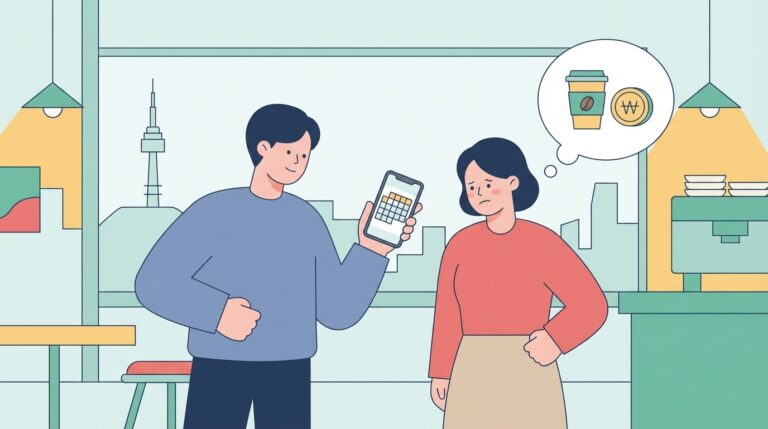
Phase 1: Sympathy & The ‘Why’
Hello! I’m the Lead Editor of Daily Hangul.
Imagine this: You’re watching a K-Drama. The main character gets an urgent text and has to suddenly cancel a date. They type out a message, and the subtitle simply reads, “I’m sorry.” But if you listen closely, they didn’t just say “Mianhae” (Sorry). They usually add a magical phrase at the end: “Da-eum-e nae-ga ssal-ge!”
Have you ever had to change or cancel an appointment with a Korean friend, language exchange partner, or coworker? If you just say “I’m sorry, I can’t go,” it can sound a bit cold or blunt to Korean ears. In Korean culture, canceling plans creates a small social ‘debt.’ How do you fix it? By promising to buy them food or coffee next time!
This post is based on real struggles my beginner students face when trying to navigate Korean social etiquette. Let’s learn how to soften the blow of a canceled appointment and keep your relationships strong like a true local!
Phase 2: Deep Dive into Core Expressions
Here are the top 3 expressions you need when changing plans and offering a raincheck.
1. 다음에 제가 살게요. (Next time, I’ll buy.)
- Pronunciation: daeum-eneun je-ga salgeyo. [‘살’ sounds like the ‘sal’ in salary, and ‘게’ sounds like the ‘ge’ in get.]
- Meaning: Literal: “Next time I will buy.” / Real nuance: “I feel bad for changing our plans, so let me treat you next time to make up for it.”
- K-Culture Moment: You use this when you have to reschedule a coffee date or dinner. It instantly shows the other person that you value them and definitely want to see them again.
- Editor’s Insight: The verb 사다 (sada) usually means “to buy,” but in a social context, it means “to treat” someone. This is the most polite and standard way to say it.
- Situation Spectrum:
- Friends (Casual): ✅ (Say: 다음에 내가 살게)
- Coworkers (Semi-formal): ✅
- Boss/Elders (Formal): ⚠️ (Use with caution; elders usually prefer to pay for younger people, but offering a coffee is okay.)
- 🤔 Think About It: Why do Koreans apologize by offering to spend money on the other person? Does your culture have a similar way of “making up” for canceled plans?
2. 밥 한 번 살게요. (I’ll buy you a meal.)
- Pronunciation: bap han beon salgeyo. [‘밥/bap’ sounds like ‘bop’, but close your lips tightly at the end.]
- Meaning: Literal: “I will buy a meal one time.” / Real nuance: “Let’s definitely grab food next time, my treat!”
- K-Culture Moment: This is the ultimate Korean polite phrase. Even if you don’t have a specific date set for the rescheduled appointment, saying this keeps the connection alive.
- Editor’s Insight: In Korea, “bap” (rice/meal) is everything. Promising a meal is promising that the relationship will continue.
- Situation Spectrum:
- Friends (Casual): ✅
- Coworkers (Semi-formal): ✅
- Boss/Elders (Formal): ⚠️
- 🤔 Think About It: Koreans use the word “bap” (rice) to mean a whole meal. How important is the concept of a shared meal in your culture?
3. 다음엔 제가 쏠게요! (Next time, I’ll treat!)
- Pronunciation: daeum-en je-ga ssolgeyo! [Make a tight, hissing ‘ss’ sound for ‘쏠’.]
- Meaning: Literal: “Next time I will shoot!” / Real nuance: “It’s completely on me next time!”
- K-Culture Moment: Imagine a group of friends chatting on KakaoTalk. You have to back out of a Friday night chicken-and-beer (Chimaek) plan. You type this to soften their disappointment.
- Editor’s Insight: 쏘다 (ssoda) literally means to shoot an arrow or a gun. But in slang, it means to treat someone enthusiastically. It’s fun, lively, and very native!
- Situation Spectrum:
- Friends (Casual): ✅
- Coworkers (Semi-formal): ✅ (If you are close)
- Boss/Elders (Formal): 🚫 (Too informal!)
- 🤔 Think About It: Why would the word for “shooting” turn into meaning “paying for food”? Perhaps because treating your friends feels like a confident, bold action!
Phase 3: Textbook vs. Real Korean
When canceling or changing plans, textbooks sound a bit like a robot. Let’s make you sound human.
[Canceling plans due to work]
* 📖 Textbook Korean: 약속을 취소해서 죄송합니다. 다음 번에 제가 계산하겠습니다. (I am sorry for canceling the appointment. I will calculate the bill next time.)
* 🗣️ Real Korean: 진짜 미안해요! 다음엔 제가 쏠게요! (I’m really sorry! I’ll treat next time!)
* 💡 Why the difference?: Textbooks use vocabulary fit for business contracts. Real life requires emotion and friendly slang like “쏠게요” to maintain social harmony.
[When the other person says “It’s fine, don’t worry!”]
* 📖 Textbook Korean: 아닙니다. 제가 돈을 내고 싶습니다. (No. I want to pay the money.)
* 🗣️ Real Korean: 에이~ 미안해서 그래요. 제가 살게요! (Hey~ It’s because I feel bad. Let me buy!)
* 💡 Why the difference?: Directly talking about “money” (돈) can feel transactional. Korean communication relies on expressing your feelings (미안해서 그래요 – because I feel sorry) to justify buying the meal.
Bottom Note: For A2 learners, sticking to “제가 살게요” is perfectly safe and highly appreciated. Reserve “제가 쏠게요” for friends of the same age!
Phase 4: Cultural Context — K-Culture Deep Dive
4-1. Non-Verbal Nuances
When you say “I’ll buy next time” to apologize for changing an appointment, your tone matters. Don’t say it proudly! Use a slightly pleading, apologetic tone. Also, Koreans love Nunchi (reading the room). If your friend seems genuinely disappointed about the canceled date, follow up quickly with a concrete suggestion: “Are you free next Friday instead?”
4-2. The “Bap” (Rice) Promise in K-Dramas
Have you noticed in K-Dramas that when two characters have a misunderstanding or a broken promise, someone always says, “Let’s eat together next time”? In Korea, eating together isn’t just about nutrition; it’s about Jeong (정 – deep emotional connection). Canceling an appointment breaks that connection momentarily. Promising to buy food next time is the cultural glue that puts the connection right back together.
Phase 5: Real-Life Roleplay Scenario
Setting: Friday, 4:30 PM. You are texting your Korean friend, Minji. You were supposed to meet for Samgyeopsal (Korean BBQ) at 6 PM, but your boss just handed you a massive pile of work.
Characters:
– YOU: An A2 Korean learner, stressed at work but eager to maintain your friendship.
– Minji (28): Your friendly Korean language exchange partner.
Dialogue:
YOU: 민지 씨, 정말 미안해요. 😭
(Minji ssi, jeongmal mianhaeyo.)
[Minji, I’m so sorry.]
Minji: 무슨 일 있어요?
(Museun il isseoyo?)
[Is something wrong?]
YOU: 갑자기 야근해야 해요. 오늘 약속을 미뤄야 할 것 같아요.
(Gapjagi yageun-haeya haeyo. Oneul yaksog-eul mirwoya hal geot gatayo.)
[I suddenly have to work late. I think we need to postpone our plans today.]
Minji: 헉, 야근이요? 괜찮아요! 일 끝내고 푹 쉬세요.
(Heok, yageun-iyo? Gwaenchayo! Il kkeutnaego puk swiseyo.)
[Gasp, overtime? It’s okay! Finish your work and get some good rest.]
YOU: 너무 아쉬워요.
(Neomu aswiwoyo.)
[I’m so bummed/sad about it.]
Minji: 다음 주에 삼겹살 먹으러 가요!
(Daeum ju-e samgyeopsal meogeureo gayo!)
[Let’s go eat BBQ next week!]
🔀 Your Turn! How do you reply to seal the deal?
– A) 네, 알겠습니다. (Yes, I understand.)
– B) 네! 다음 주 삼겹살은 제가 쏠게요! (Yes! Next week’s BBQ is my treat!)
– C) 돈이 없어요. (I have no money.)✅ Best Choice: B — By offering to “shoot” (treat) next time, you completely erase any disappointment Minji might have felt. It shows you are generous and genuinely sorry for canceling.
⚠️ Choice A Analysis: This sounds like you are talking to your boss in the military. It’s too stiff for a friend!
Phase 6: 10-Second Shadowing Drill
Practice this sentence so it rolls off your tongue the next time you need to reschedule!
🥺 정말 미안해요. / 다음엔 / 제가 쏠게요!
(jeong-mal mi-an-hae-yo. / da-eum-en / je-ga ssol-ge-yo!)
[Emotion: Look genuinely apologetic at the start, then smile warmly at the end!]
Phase 7: K-Culture Mini Dictionary
| Korean | Romanization | English | Context |
|---|---|---|---|
| 정 | jeong | Affection/Bond | The deep emotional connection Koreans value in relationships. |
| 눈치 | nunchi | Social awareness | The ability to “read the room” and know when a friend is disappointed. |
| 쏘다 | ssoda | To treat (slang) | Literally “to shoot,” used among friends when paying for a meal. |
| 야근 | yageun | Overtime work | The #1 reason appointments get canceled in Korea! |
| 밥약 | bapyak | Meal appointment | Short for 밥 약속 (bap yaksok). College students use this often! |
Phase 8: Traveler’s Survival Kit
Even if you aren’t canceling a formal meeting, you might need to offer to buy something for a local who helped you with directions, or a new friend you made at a guesthouse!
🆘 Survival Expressions for Treating Someone
– 🇰🇷 “커피 한 잔 사 드릴게요.” (keopi han jan sa deurilgeyo.)
– 🗣️ Meaning: “Let me buy you a cup of coffee.”
– 📍 Where to use: When a local helps you find your hotel.
– 💡 Pro Tip: Koreans almost never say “no” to an iced Americano (아아 – Ah-Ah)!📌 Editor’s Travel Note
– Splitting the bill: In the past, one person paid for everything. Nowadays, young people often split the bill (더치페이 – Dutch pay). But if someone canceled on you previously, they will insist on paying the whole bill!
– No Tipping: Remember, if you say “I’ll pay,” you just pay the exact amount on the receipt. There is no tipping culture in Korea!
Phase 9: Critical Thinking — A Step Deeper
Food & Identity: Why Food equals Apology
In many Western cultures, a sincere “I’m sorry” and a brief explanation of why you had to cancel is enough. However, in Korea, food is deeply tied to identity and community. Historically, Korea went through times of scarcity, so making sure someone is fed became the highest form of care. By saying “I’ll buy you a meal next time” (다음에 밥 살게요), you are essentially saying, “I still care about your well-being, and our bond is intact despite this cancellation.”
💬 Your Turn: In your culture, what is the best way to make up for a canceled plan? Do you offer food, drinks, or just reschedule? Share in the comments!
Phase 10: FAQ & Avoiding Common Mistakes
Q: Can I say “제가 쏠게요” to my manager at work?
No! 쏘다 is informal slang. If you must offer to buy a coffee for your manager to apologize for missing a meeting, use standard polite Korean: “제가 커피 한 잔 사겠습니다” (I will buy a cup of coffee).
Q: What if they insist on paying anyway?
Koreans love the “wallet dance” (arguing over who pays). If you canceled the appointment last time, stand your ground! Say, “아니에요, 제가 저번에 약속 미뤄서 죄송해서 그래요” (No, it’s because I feel sorry for postponing last time).
❌ Common Mistake #1: Translating “I’ll pay” directly from English as “제가 지불할게요” (je-ga jibul-halgeyo).
✅ Do this instead: “지불하다” is a highly formal word used in banking. Always use “제가 살게요” (I will buy/treat) in daily conversation.
Phase 11: Summary & Action Items
One-Liner Summary: When changing plans in Korea, always pair your “Sorry” with “I’ll treat you next time” (다음엔 제가 살게요) to keep the relationship strong.
Action Mission 3 Steps:
– 🥉 Bronze (Solo): Stand in front of a mirror, look slightly apologetic, and say “미안해요. 다음에 제가 살게요” three times.
– 🥈 Silver (Online): Go to your language exchange app (like HelloTalk) and leave a post: “If I cancel a plan, I will say: 다음에 밥 한 번 살게요!”
– 🥇 Gold (Real Life): The next time you have to reschedule with your Korean friend or tutor, use today’s phrase in your text message!
K-Culture Mission:
Watch one episode of a K-Drama this week. Pay attention to how characters say goodbye or apologize. I guarantee you will hear “밥 먹자” (Let’s eat) or “내가 살게” (I’ll buy) at least once!
Phase 12: Interactive Quiz
Let’s test what you’ve learned!
1. You have to cancel a study session with your college friend. Which is the most natural message?
a) 약속을 취소합니다. (I cancel the appointment.)
b) 진짜 미안! 다음엔 내가 쏠게! (So sorry! I’ll treat next time!)
c) 제가 돈을 지불하겠습니다. (I will pay the money.)
2. True or False: In Korea, “밥 한번 살게요” (I’ll buy you a meal) is only used when you literally want to buy a bowl of plain white rice.
3. Fill in the blank:
“정말 미안해요. 다음에는 ______ 살게요!”
(I’m so sorry. Next time I will buy!)
(Answers: 1. b – it’s friendly and natural! 2. False – ‘Bap’ represents any meal or social gathering. 3. 제가 – jega!)
Frequently Asked Questions (FAQ)
Q: What does "다음에 제가 살게요. (Next time, I'll buy.)" mean in Korean and how do you pronounce it?
A: In Korean, "다음에 제가 살게요. (Next time, I'll buy.)" is pronounced [daeum-eneun je-ga salgeyo. ['살' sounds like the 'sal' in salary, and '게' sounds like the 'ge' in get.] and means: Literal: "Next time I will buy." / Real nuance: "I feel bad for changing our plans, so let me treat you next time to make up for it."
Q: What does "밥 한 번 살게요. (I'll buy you a meal.)" mean in Korean and how do you pronounce it?
A: In Korean, "밥 한 번 살게요. (I'll buy you a meal.)" is pronounced [bap han beon salgeyo. ['밥/bap' sounds like 'bop', but close your lips tightly at the end.] and means: Literal: "I will buy a meal one time." / Real nuance: "Let's definitely grab food next time, my treat!"
Q: What does "다음엔 제가 쏠게요! (Next time, I'll treat!)" mean in Korean and how do you pronounce it?
A: In Korean, "다음엔 제가 쏠게요! (Next time, I'll treat!)" is pronounced [daeum-en je-ga ssolgeyo! [Make a tight, hissing 'ss' sound for '쏠'.] and means: Literal: "Next time I will shoot!" / Real nuance: "It's completely on me next time!"







