

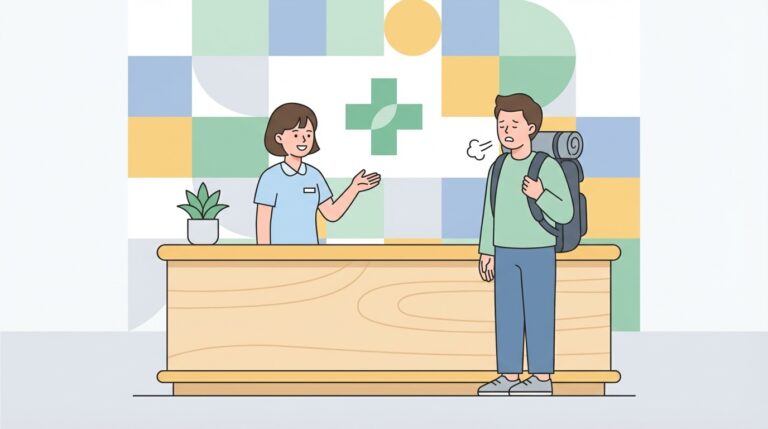
Phase 1: Empathy — Welcome to the Real Korean Clinic
Hello! I’m the Lead Editor at Daily Hangul.
Picture this: You are watching a K-Drama, and the main character faints from overwork, only to wake up in a luxurious VIP hospital room with a dramatic IV drip. Fast forward to real life: You’re traveling in Seoul, you cheered a little too hard at a K-Pop concert last night, and now your throat is completely gone. You don’t need a VIP room; you just need a doctor!
Walking into a Korean clinic (병원) can feel scarier than a horror movie if you don’t know the words. Your map app says you have arrived, but you’re standing in front of a building with 10 different signs. What if the receptionist asks you a complicated question?
Don’t panic. I’ve taught hundreds of expats and travelers, and today, I’ll give you the exact “survival phrases” you need to book an appointment and navigate a Korean clinic like a confident local. Let’s get you feeling better!
Phase 2: Deep Dive into Core Expressions
Here are the absolute most important phrases you need at the clinic reception desk.
1. 진료 예약하고 싶어요.
- Pronunciation: jillyo yeyak-hago sipeoyo. (Sounds like: jil-lyo ye-yak-ha-go shee-po-yo)
- Meaning: Literal: “I want to make a medical treatment reservation.” / Real nuance: “I’d like to see a doctor.”
- K-Culture Moment: In K-Dramas, wealthy characters always demand to see “the chief of surgery right now!” But in real life, you walk up to the friendly nurse at the desk and politely use this phrase.
- Editor’s Insight: The word 진료 (jillyo) means “medical treatment/consultation.” While you can just say “예약하고 싶어요” (I want to make a reservation), adding 진료 makes you sound incredibly natural and specific!
- Situation Spectrum:
- Casual with friends: 🚫 (You wouldn’t say this to a friend)
- Semi-formal (Clinic staff): ✅
- Formal (Seniors/Boss): ⚠️
- 🤔 Think About It: In English, we say “see a doctor.” In Korean, we focus on the action of getting the treatment (진료). How does your language express going to the hospital?
2. 처음 왔어요.
- Pronunciation: cheoeum wasseoyo. (Sounds like: chuh-eum wa-sso-yo)
- Meaning: Literal: “I came for the first time.” / Real nuance: “It’s my first time here (I am a new patient).”
- K-Culture Moment: Korean clinics often keep meticulous digital records of returning patients. When you say this, the staff will immediately know to hand you a new patient form and ask for your ID!
- Editor’s Insight: This is a magical phrase. You can use it anywhere! First time at a famous K-BBQ restaurant? “처음 왔어요.” First time at a hair salon? “처음 왔어요.”
- Situation Spectrum:
- Casual with friends: ✅ (e.g., “I’ve never been here before”)
- Semi-formal (Clinic staff/Shop owners): ✅
- Formal: ✅
- 🤔 Think About It: Admitting it’s your first time immediately shifts the dynamic. Koreans love being helpful to newcomers. Have you ever been afraid to admit you’re new at something?
3. 여기 아파요.
- Pronunciation: yeogi apayo. (Sounds like: yuh-gee ah-pa-yo)
- Meaning: Literal/Real nuance: “It hurts here.”
- K-Culture Moment: K-Pop idols often have to sit out of concerts because they are “아파요” (sick/hurt). When you don’t know the exact medical term for your body part, just point and say this!
- Editor’s Insight: “아파요” (It hurts) is the ultimate A1 survival word. Headache? 머리(Head) 아파요. Stomachache? 배(Stomach) 아파요. Just point to the spot!
- Situation Spectrum:
- Casual with friends: ✅
- Semi-formal (Doctor/Nurse): ✅
- Formal: ✅
- 🤔 Think About It: Pointing is generally considered impolite in Korea, but when describing pain to a doctor, pointing to your own body is perfectly fine and helpful!
Phase 3: Textbook vs. Real Korean
Let’s look at how real Koreans speak compared to language textbooks.
[Saying why you are at the clinic]
* 📖 Textbook Korean: 의사 선생님을 뵙고 싶습니다. (I would like to meet the doctor.)
* 🗣️ Real Korean: 진료 보러 왔어요. (I came to get medical treatment.)
* 💡 Why the difference?: Textbooks focus on the person (the doctor), but real Korean focuses on the purpose of the visit (the treatment).
[Describing your pain]
* 📖 Textbook Korean: 저는 목이 매우 아픕니다. (My throat is very painful.)
* 🗣️ Real Korean: 목 아파요. (Throat hurts.)
* 💡 Why the difference?: Koreans drop the subject (“I” / 저는) all the time! We value speed and efficiency, especially when we don’t feel well.
Phase 4: Cultural Context — K-Culture Deep Dive
4-1. Non-Verbal Communication: The ID Handover
When you say it’s your first time, the receptionist will ask for your ID card (신분증 – passport or Alien Registration Card). Always hand it over using both hands! Even if you feel sick, using two hands shows basic respect. Also, Korean waiting rooms are usually very quiet. This is Nunchi (눈치) in action—reading the room and keeping your voice low out of respect for other sick patients.
4-2. K-Drama Connection: The Magical “IV Drip” (링거)
Have you noticed in K-Dramas that whenever someone is mildly stressed or has a cold, they end up in a hospital bed with an IV drip? In Korea, getting an IV drip (called 링거 or 수액) packed with vitamins and fluids is a very common, quick remedy for fatigue or a bad cold. If you tell the doctor you are exhausted, they might actually ask, “수액 맞으실래요?” (Would you like an IV drip?).
4-3. K-Food Connection: Comfort Food (죽)
After your clinic visit, you must eat Juk (죽 – Korean rice porridge). Just like chicken noodle soup in the West, Juk is the ultimate Korean “sick food.” Brands like Bonjuk (본죽) are everywhere. Try the Abalone Porridge (전복죽) or Vegetable Porridge (야채죽) to soothe your throat!
Phase 5: Real-Life Roleplay Scenario
Setting: Monday morning, 9:30 AM. A small ENT (Ear, Nose, Throat – 이비인후과) clinic on the 3rd floor of a building in Hongdae. You have a terrible sore throat after going to a karaoke (노래방) and cheering at a K-Pop concert over the weekend.
Characters:
– YOU: A foreign traveler or expat with a raspy voice.
– Nurse Kim (간호사): Friendly, efficient, but speaking a little fast.
Dialogue:
Nurse Kim: 안녕하세요! 어떻게 오셨어요?
(annyeonghaseyo! eotteoke osyeosseoyo?)
[Hello! What brings you here?]
YOU: 안녕하세요. 진료 예약하고 싶어요.
(annyeonghaseyo. jillyo yeyak-hago sipeoyo.)
[Hello. I want to make an appointment to see a doctor.]
Nurse Kim: 네, 혹시 예약하셨어요?
(ne, hoksi yeyakhasyeosseoyo?)
[Yes, did you make a reservation by any chance?]
YOU: 아니요, 처음 왔어요.
(aniyo, cheoeum wasseoyo.)
[No, it’s my first time here.]
Nurse Kim: 아, 네. 신분증 부탁드립니다.
(a, ne. sinbunjeung butakdeurimnida.)
[Ah, I see. Your ID, please.]
YOU: 네, 여기 있어요.
(ne, yeogi isseoyo.)
[Yes, here it is.]
(🎭 Stage Direction: You hand your passport over with both hands.)
Nurse Kim: 네, 감사합니다. 어디가 아프세요?
(ne, gamsahamnida. eodiga apeuseyo?)
[Yes, thank you. Where does it hurt?]
🔀 Your Turn! How do you answer?
– A) “저는 병에 걸렸습니다.” (I have caught a disease.)
– B) “여기 아파요.” (It hurts here. Points to throat)
– C) “목이 너무너무 아파 죽겠어요!” (My throat hurts to death!)✅ Best Choice: B — It’s simple, accurate, and completely natural for a beginner! Just point to your throat.
⚠️ Choice A & C Analysis: ‘A’ sounds like a robot from a 1980s textbook. ‘C’ is very native-like and dramatic, but maybe too casual for an A1 learner speaking to a nurse for the first time.
Nurse Kim: 아, 목이 아프시군요. 저기 앉아서 잠시만 기다려주세요.
(a, mogi apeusigunyo. jeogi anjaseo jamsiman gidaryeojuseyo.)
[Ah, your throat hurts. Please sit over there and wait a moment.]
YOU: 네, 감사합니다.
(ne, gamsahamnida.)
[Yes, thank you.]
Phase 6: 10-Second Shadowing Drill
Let’s practice! Follow the intonation lines (/) and match the emotion.
😊 (Polite & Clear) 저기요, / 진료 예약 / 하고 싶어요.
(jeogiyo, / jillyo yeyak / hago sipeoyo.)
[Excuse me, I’d like to make an appointment.]
😢 (Looking slightly distressed) 저... / 처음 왔는데요, / 여기 아파요.
(jeo… / cheoeum wanneundeyo, / yeogi apayo.)
[Um… it’s my first time here, and it hurts here.]
Phase 7: K-Culture Mini Dictionary
| Korean | Romanization | English | Context |
|---|---|---|---|
| 내과 | naegwa | Internal Medicine | The go-to clinic for stomachaches, colds, or general illness. |
| 이비인후과 | ibiinhugwa | ENT Clinic | Ear, Nose, and Throat. Go here for a bad cough, sore throat, or earache! |
| 약국 | yakguk | Pharmacy | Where you get your medicine. Look for the “약” (Yak) sign on the street! |
| 처방전 | cheobangjeon | Prescription | The doctor gives you this piece of paper. Take it to the pharmacy. |
| 눈치 | nunchi | Nunchi | The social sense of reading the room. E.g., keeping your voice down in a clinic. |
Phase 8: Traveler’s Survival Kit 🆘
Even if you aren’t an expat living in Korea, getting sick while traveling happens. Here is your essential kit:
🆘 Survival Phrases for Travelers
– 🇰🇷 “약국이 어디예요?” (yakgugi eodiyeyo?)
– 🗣️ Sounds like: yak-goo-gi eo-di-ye-yo?
– 📍 Use when: You need over-the-counter medicine but can’t find the pharmacy.
- 🇰🇷 “영수증 주세요.” (yeongsujeung juseyo.)
- 🗣️ Sounds like: yeong-soo-jeung joo-se-yo.
- 📍 Use when: You need the receipt for your travel insurance!
📌 Editor’s Travel Note
– Translation Apps: Use Papago. If you can’t speak Korean well, just type your symptoms into Papago and show your phone screen to the doctor. They are very used to this!
– Insurance & ID: Always bring your passport. Korea’s medical system is relatively cheap even for tourists without Korean national insurance, but they still need to register your identity.
Phase 9: Think Deeper — Language & Power
🧠 Think Deeper: Language & Power in the Clinic
Notice how the nurse asks, “어디가 아프세요?” (eodiga apeuseyo?). That “세요 (seyo)” is a special honorific marker showing deep respect to you, the patient. In Korea, patients and customers are treated with high linguistic respect. However, as a patient, you reply with standard polite Korean (“아파요“). You should never use casual language (반말, banmal) to the medical staff, even if they are younger than you. The language structure beautifully maintains a polite, professional distance.💬 Your Turn: In your culture, do doctors and patients use formal or casual language with each other? Share in the comments!
Phase 10: FAQ & Mistake Prevention
Q: Do I always need to book an appointment days in advance?
Yes and No! For small neighborhood clinics (의원), Koreans usually just walk in without an appointment! You only make an appointment for larger university hospitals or busy dentists.
Q: Should I tip the doctor or nurse?
No! There is absolutely zero tipping culture in Korea. Tipping will cause deep confusion.
❌ Common Mistake #1: Going directly to the pharmacy (약국) for strong antibiotics.
✅ Do this instead: In Korea, pharmacies cannot give you strong medicines (like antibiotics) without a doctor’s prescription (처방전). Always go to the clinic (병원/의원) first, pay the cheap consultation fee, get the paper, and then walk over to the pharmacy!
Phase 11: Summary & Action Items
- One-Liner Summary: Walk confidently into the clinic, say “진료 예약하고 싶어요” (I’d like to make an appointment) and “처음 왔어요” (It’s my first time), and hand over your ID!
Action Mission:
– 🥉 Bronze: Stand in front of your mirror and practice saying “여기 아파요” while pointing to your stomach, head, and throat.
– 🥈 Silver: Write “진료 예약하고 싶어요” in your travel notes app right now so you don’t forget it.
– 🥇 Gold: Next time you pass by a Korean clinic or pharmacy, look at the signs and try to read them!
K-Culture Mission 🏥:
Open Google Maps or KakaoMap and explore a Korean street view (like Gangnam or Hongdae). Try to spot a sign that says 약국 (Pharmacy) or 의원 (Clinic). They are usually covered in green or blue crosses. How many can you find on one street?
Did you ever get sick while traveling? How did you handle it? Let us know in the comments below! 👇
Phase 12: Interactive Challenge Quiz
1. Situational Judgment: You walk into a tiny clinic for a sore throat. You’ve never been there. What is the BEST first thing to say to the receptionist?
– A) 의사 선생님을 뵙고 싶습니다. (I would like to meet the doctor.)
– B) 처음 왔어요. 진료 예약하고 싶어요. (It’s my first time. I’d like to make an appointment.)
– C) 약 주세요. (Give me medicine.)
2. True or False — K-Culture Edition:
In Korea, you must leave a 15% tip for the nurse if they are very kind. (T/F)
3. Fill in the Blank:
My stomach hurts. -> 배가 ________.
(Answers: 1: B – A is too textbook, C is rude and wrong because clinics don’t sell medicine directly. / 2: False – No tipping in Korea! / 3: 아파요)
Frequently Asked Questions (FAQ)
Q: What does "진료 예약하고 싶어요." mean in Korean and how do you pronounce it?
A: In Korean, "진료 예약하고 싶어요." is pronounced [jillyo yeyak-hago sipeoyo. (Sounds like: jil-lyo ye-yak-ha-go shee-po-yo] and means: Literal: "I want to make a medical treatment reservation." / Real nuance: "I'd like to see a doctor."
Q: What does "처음 왔어요." mean in Korean and how do you pronounce it?
A: In Korean, "처음 왔어요." is pronounced [cheoeum wasseoyo. (Sounds like: chuh-eum wa-sso-yo] and means: Literal: "I came for the first time." / Real nuance: "It's my first time here (I am a new patient)."
Q: What does "여기 아파요." mean in Korean and how do you pronounce it?
A: In Korean, "여기 아파요." is pronounced [yeogi apayo. (Sounds like: yuh-gee ah-pa-yo] and means: Literal/Real nuance: "It hurts here."







